
Timeshare Collections Guide
Can a Timeshare Send You to Collections? What Happens Next
Yes. Unpaid timeshare obligations can move into collections—but the stage of collection, the type of balance, and what happens to the underlying ownership are separate questions.
The decision: Identify what is being collected, who controls the balance now, what could happen next, and what paying, settling, disputing, or resolving the debt would actually change about the ownership.
TTCA separates the past-due balance from the broader ownership consequences that may follow. This guide explains internal and third-party collection stages, what to verify before paying or settling, how delinquency may affect ownership options, and why resolving a debt is not always the same as resolving the timeshare.
On This Page
- Quick answer
- How collections develop
- What kind of debt is being collected?
- What to verify from a notice
- How collections affect ownership options
- What paying or settling may resolve
- What a settlement agreement should say
- What happens if you ignore collections?
- How collections may affect credit
- How to confirm resolution
- My Take
- FAQ
- TTCA Decision

A collection notice may involve loan payments, maintenance fees, assessments, or other timeshare charges. The first step is identifying what is owed and who is handling the account.
Quick Answer
Can a Timeshare Send You to Collections?
Yes. Unpaid timeshare loan payments, maintenance fees, club dues, special assessments, and other required charges may be pursued internally by the lender, developer, resort, association, or servicer and later placed with a third-party collection agency or law office.
Being in collections does not automatically mean foreclosure, a lawsuit, or credit reporting has already occurred. What happens next depends on the type of obligation, who is handling the balance, how long the account has been delinquent, and what the governing documents and account status allow.
What does “timeshare collections” mean?
Timeshare collections are efforts to recover an unpaid timeshare-related balance. An account may be handled internally before being placed with an outside collector.
Paying or settling the balance may resolve the debt being pursued without ending the timeshare ownership, stopping future fees, or resolving a separate purchase loan.
Collection Stages
How Does a Timeshare Account Move Into Collections?
A timeshare account does not need to be with an outside collection agency before collection activity begins. Many accounts move through several stages.
- Missed payment A loan payment, maintenance fee, special assessment, club due, or another required charge becomes past due.
- Internal collections The lender, developer, resort, association, or servicer may send notices, make calls, add late charges, restrict the account, or request payment while it still controls the balance.
- Third-party collections If the delinquency remains unresolved, the balance may be assigned, transferred, or placed with an outside collection agency or law office.
- Possible escalation Depending on the obligation and governing documents, later consequences may include additional fees, credit reporting, foreclosure, litigation, termination, or another enforcement process.
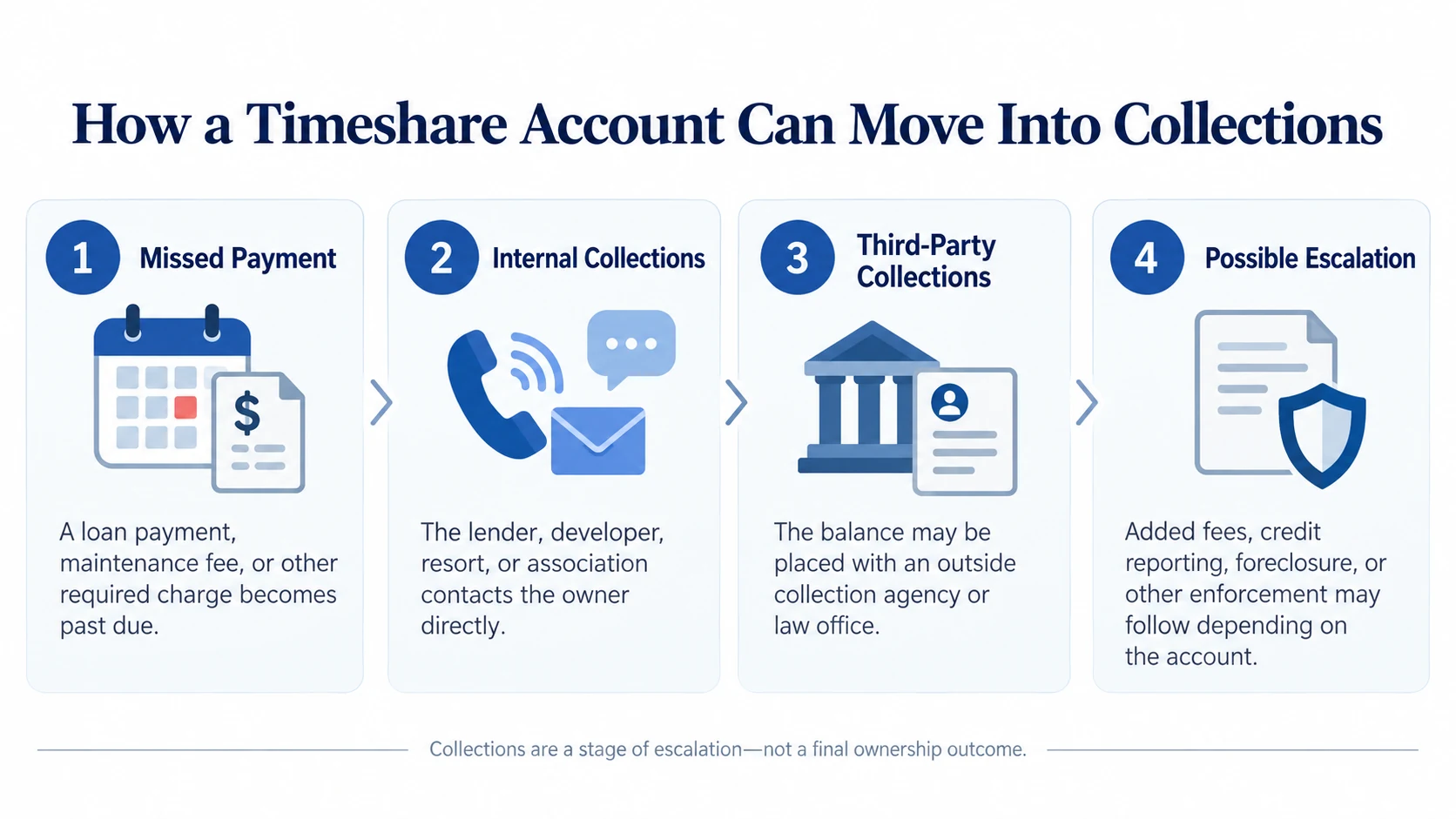
A delinquent account may progress from a missed payment to internal collections and then to an outside collector. Later escalation varies by debt type, account status, and governing documents.
What Is Being Collected?
What Kind of Timeshare Debt Is Being Collected?
The type of obligation matters because different balances may involve different parties, different reporting practices, and different ownership consequences.
- Purchase loan Financing used to buy the timeshare may involve a separate lender, balance, contract, and reporting process. If financing is still outstanding, see How to Get Out of a Timeshare With a Loan.
- Maintenance fees or club dues Recurring charges may continue while the ownership or membership remains active. For the broader cost structure, see Timeshare Maintenance Fees. If annual fees are already in collections, see What Happens When Timeshare Maintenance Fees Go to Collections?.
- Special assessments One-time or irregular charges may be pursued separately from ordinary annual fees.
- Late fees, interest, and collection costs Additional amounts may be added after the account becomes delinquent.
- Other account charges Taxes, administrative fees, or other contractual amounts may also appear depending on the ownership structure.
Before You Respond
What Should You Verify From a Timeshare Collection Notice?
Start with the account facts before deciding whether to pay, dispute, settle, ignore, or pursue another ownership-resolution path.
- Who sent the notice? Identify the legal name of the lender, developer, association, servicer, collector, or law office.
- What balance is being pursued? Determine whether the debt involves a loan, maintenance fees, dues, an assessment, or another charge.
- How was the amount calculated? Review the original balance, billing period, payments or credits, interest, late charges, collection costs, and current total.
- Who currently controls the account? Confirm whether the original party still owns or services the balance or whether it has been assigned or transferred.
- Is the ownership still active? A collection file and the ownership record may be controlled by different parties.
- What happens if the account stays unresolved? Ask what additional charges, restrictions, reporting, or enforcement steps may follow.

TTCA Ownership PathFinder™
Keep, rent, sell or exit?
Being in collections does not automatically determine what you should do with the ownership.
Answer five quick questions to compare Keep, Rent, Sell, and Exit based on the value you still receive, what the ownership costs, your financing, and what you want next.
Complimentary for TTCA visitors • About 2 minutes
You decide what happens next. We help you understand the paths.
Ownership Consequences
How Can Collections Change Your Ownership Options?
Delinquency can affect more than the balance currently due. Some deed-back, surrender, transfer, resale, or owner-assistance programs require the account to be current or financing to be resolved before a request will be considered.
- Developer surrender or deed-back Eligibility may require the loan to be paid off and maintenance fees or assessments to be current. See What Is a Timeshare Deed-Back Program?.
- Resale or transfer A buyer, recipient, closing company, developer, or association may require current account status before transfer approval. If you are evaluating resale, see Why Are Timeshares So Hard to Sell?.
- Financing Paying maintenance-fee debt does not automatically resolve a separate purchase loan, and paying the loan does not automatically end ownership.
- Account standing Collection activity, restrictions, or unresolved charges can narrow the practical choices available before foreclosure or another formal enforcement step.
If the account facts are already clear but you need qualified outside help understanding resale, brokerage, transfer, or another ownership-resolution route, you can learn about a consultation with Timeshare Specialists.
Which ownership path are you trying to protect or change?
- Keep →
- Decide whether the ownership still delivers enough value to justify keeping it after the account issue is addressed.
- Rent →
- Review whether eligible unused usage can still be rented or transferred to guests under the program rules.
- Sell →
- Understand resale demand, transfer barriers, and why account standing can affect whether a sale can actually close.
- Exit →
- Compare direct surrender, deed-back, transfer, resale, and qualified outside-help paths when the goal is to end the obligation.

Before agreeing to pay or settle a timeshare collection balance, confirm what the agreement resolves, what remains outstanding, and whether future ownership obligations can continue.
Before You Pay or Settle
Would Paying or Settling the Collection Balance Actually Resolve the Timeshare?
Paying or settling a timeshare collection balance may satisfy the amount currently being pursued. It does not automatically transfer the deed, terminate a points contract, close a membership, eliminate future maintenance fees, or resolve a separate purchase loan.
That distinction matters because a collector may have authority over one past-due balance but no authority to approve a deed-back, terminate a membership, waive future charges, or update ownership records.
- Debt outcome Does the payment satisfy the full balance, part of it, or only the amount assigned to the collector?
- Loan outcome Does a separate purchase loan remain active?
- Ownership outcome Will the deed, points interest, membership, or resort account remain in your name?
- Future charges Can maintenance fees, dues, assessments, or other recurring obligations continue?
- Reporting outcome How will the account be described after payment, and which party is furnishing the information?
- Completion proof What written documentation will confirm the final debt and ownership status?
Settlement Terms
What Should a Timeshare Settlement Agreement Actually Say?
A proposed payment or settlement should be reviewed for more than the dollar amount. The written terms should make clear what is being resolved and what remains after payment.
- Balance covered Does the agreement resolve the full balance or only one assigned collection amount?
- Remaining amounts Will unpaid loan principal, resort charges, interest, fees, or another balance remain?
- Account reporting Will the account be described as paid, settled, current, closed, or something else?
- Ownership status Does the agreement address the deed, points contract, membership, or resort account?
- Future fees Are future maintenance fees, dues, or assessments released—or can they continue?
- Record updates Who is responsible for updating the ownership and account records?
- Final confirmation What written proof will be provided after the agreement is completed?
Once you know what the debt or settlement will—and will not—resolve, you may still need to evaluate resale, brokerage, transfer, or another ownership-resolution route. Timeshare Specialists is one outside option TTCA has partnered with for that stage.
Request a ConsultationIf the Balance Remains Unresolved
What Can Happen If You Ignore Timeshare Collections?
Not every delinquent account follows the same path, but unresolved balances can continue to escalate. Depending on the debt and governing documents, that may involve added fees, interest, account restrictions, credit reporting, foreclosure, litigation, termination, or other enforcement.
The absence of immediate foreclosure or credit reporting does not mean the account is harmless. Delinquency can also narrow surrender, transfer, resale, or other ownership-resolution options before more formal enforcement begins.
If you are still deciding whether nonpayment is a path you are willing to take, review Should You Stop Paying Your Timeshare?. If the account has progressed to foreclosure risk, see Can a Timeshare Be Foreclosed On?. For questions about liens and other claims, see Can a Timeshare Put a Lien on Your House?.
Credit Reporting
Do Timeshare Collections Always Affect Your Credit?
Not always. Credit impact can depend on the type of debt, the organization handling the account, whether information is furnished to a credit bureau, and how the account is later updated.
A financed timeshare loan may create different reporting exposure from unpaid maintenance fees, club dues, or assessments. A third-party collection account and the underlying loan may also be handled differently.
For a deeper look at the credit side of the decision, see Can You Exit a Timeshare Without Ruining Your Credit?.
A paid or closed collection account is not enough by itself. Confirm the final status of the debt, ownership record, and future obligations in writing.
Proof of Resolution
How Do You Know the Debt and Ownership Are Actually Resolved?
The end point should be documented separately for each obligation that matters. A payment receipt proves payment; it does not necessarily prove ownership release.
- Collection balance Confirm whether the amount was paid, settled, released, or remains outstanding.
- Purchase loan Confirm whether financing was paid, settled, released, or remains active.
- Ownership record Confirm who is now recognized as the owner or whether the ownership was formally surrendered, transferred, foreclosed, or terminated.
- Future fees Confirm whether maintenance fees, dues, assessments, or membership obligations can continue.
- Account reporting Keep written information about how the creditor, servicer, or collector expects to update the account.
- Final documentation Retain the agreement, itemized balance, payment receipt, ownership documents, correspondence, and final confirmation.
My Take
I Would Not Pay a Collection Account Until I Understood What the Payment Actually Resolves
If I received a timeshare collection notice, I would first identify exactly who is collecting, what debt they are pursuing, how the amount was calculated, and whether the collector controls only the balance or has any authority over the ownership.
I would not assume that paying, settling, or closing the collection file automatically ends the timeshare. I would want written answers about the loan, deed or membership, future maintenance fees, and account status after the payment is complete.
If the ownership itself still needed to be resolved, I would treat that as a separate decision and compare the legitimate paths still available before paying an outside provider.
Get clearer timeshare guidance.
Independent TTCA guidance on collections, nonpayment, surrender, transfer, resale, financing, and broader ownership decisions.
Frequently Asked Questions
Timeshare Collections FAQ
Can a timeshare send you to collections?
Yes. Unpaid loan payments, maintenance fees, club dues, special assessments, and other required charges may be pursued internally or placed with an outside collection agency or law office.
What is the difference between internal and third-party collections?
Internal collections means the lender, developer, resort, association, or servicer is still handling the delinquency. Third-party collections means the balance has been assigned, transferred, or placed with an outside collector or law office.
Does paying a timeshare collection account end the ownership?
Not automatically. Payment may satisfy the amount being pursued without transferring the deed, terminating a points contract, closing a membership, or releasing future maintenance-fee obligations.
Can a collector settle the debt but leave the timeshare active?
Yes. A collector may have authority to resolve a specific balance without having authority to cancel, surrender, transfer, or otherwise end the underlying ownership.
Can future maintenance fees continue after a collection settlement?
They may continue if the ownership remains active. The settlement terms should be reviewed separately from the ownership status and future-fee responsibility.
Do timeshare collections always affect your credit?
No. Reporting can vary depending on the debt, the organization handling it, and whether information is furnished to a credit bureau. Ownership consequences can also exist even when no collection entry appears on a credit report.
Is a timeshare collection account the same as foreclosure?
No. Collections involve efforts to recover an unpaid balance. Foreclosure is a separate enforcement process that may occur later in some situations depending on the ownership, debt, governing documents, and applicable procedures.
What records should you keep after paying or settling?
Keep the written agreement, itemized balance, correspondence, payment receipt, account statements, and any final confirmation describing both the debt status and ownership status.
TTCA Decision
Treat the Debt Outcome and the Ownership Outcome as Separate Questions
A timeshare collection notice means an obligation is unresolved and may be moving through a more formal recovery process. It does not, by itself, tell you whether foreclosure has occurred, whether the ownership has ended, or whether future fees will stop.
Before paying or settling, verify what debt is being resolved and what written documentation will show the final status of the loan, ownership, existing balances, and future obligations.
Continue From Here
Follow the Stage Your Account Has Reached

Should You Stop Paying Your Timeshare?
Use this if you are still deciding whether nonpayment is a path you are willing to take.
Can a Timeshare Be Foreclosed On?
Review what can happen when an unresolved delinquency progresses beyond ordinary collection activity.
Timeshare Deed-Back Program
See why direct surrender programs often depend on financing and account standing.

Free Timeshare Self-Review
Take a clearer look at the ownership behind the collection problem.
The Timeshare Self-Review helps you look beyond the current balance and review how the ownership is actually working for you.
- Your current ownership costs
- How often you use it
- Your booking experience
- The benefits you actually use
- Fit with your travel habits
- Ownership factors worth reviewing