
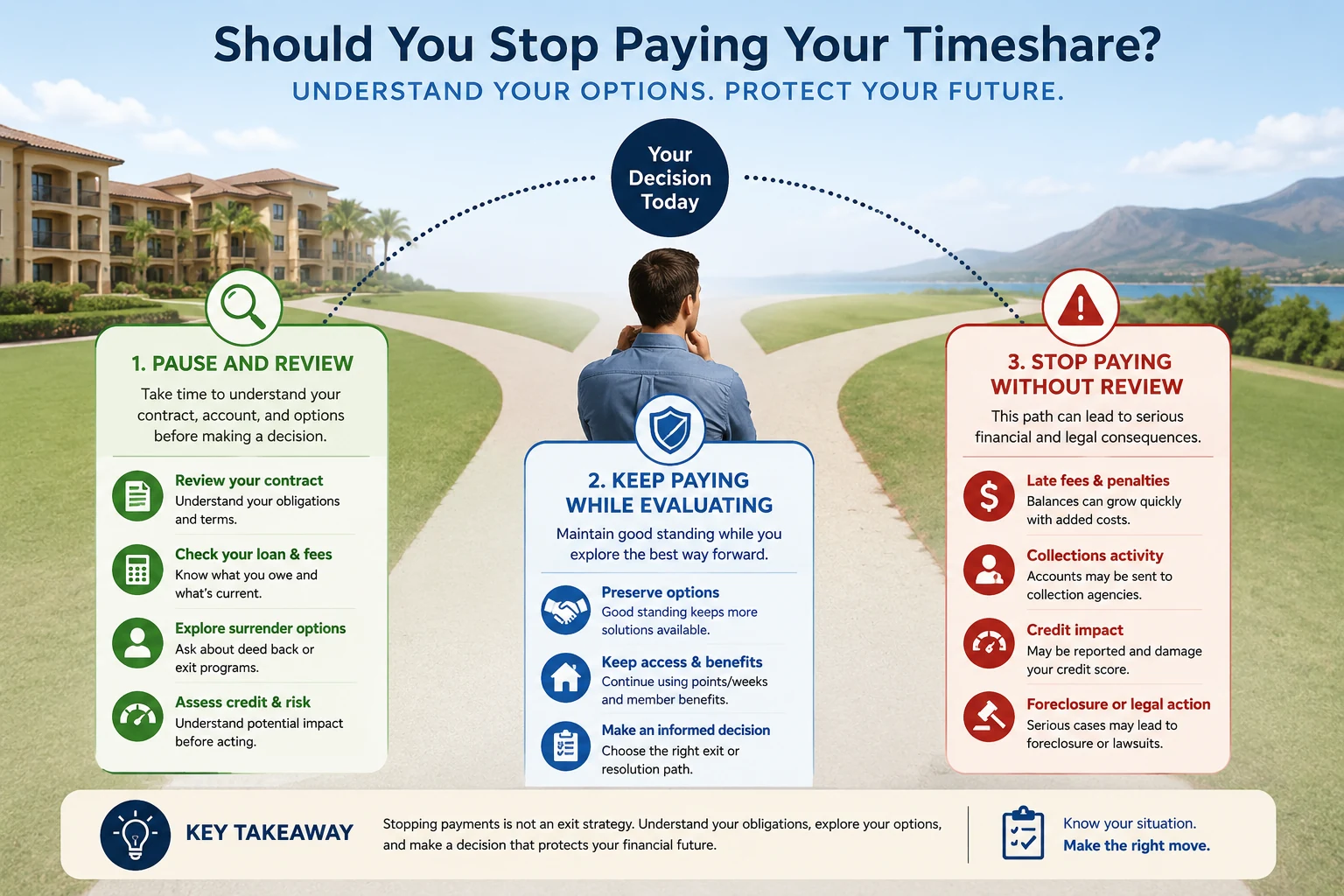
About This Guidance: TTCA evaluates timeshare nonpayment by separating the purchase loan, annual maintenance fees, and continuing ownership obligation rather than treating them as one payment decision. This guidance focuses on how loan default and maintenance-fee nonpayment can lead to different consequences, how account status and ownership structure affect risk, and what surrender, transfer, hardship, or other resolution options should be reviewed before stopping payments.

Why the Type of Payment Matters
Stopping a timeshare payment can mean defaulting on several different obligations, and those obligations do not create the same consequences.
A missed purchase-loan payment may create a more direct lender, collection, credit-reporting, or foreclosure risk. Unpaid maintenance fees may continue accumulating even after the original loan has been paid off. Special assessments, membership dues, or other recurring charges may also remain enforceable under the ownership documents.
That is why the first step is identifying exactly what you are considering not paying. The likely consequences—and the resolution options that may still remain—depend on the type of balance, the ownership structure, and how far the account has already progressed.
Compare the Obligations
Timeshare Loan Default vs. Maintenance-Fee Nonpayment: What Changes?
A timeshare loan and maintenance fees are separate obligations, even when they relate to the same ownership. Defaulting on the purchase financing may create a more direct lender, credit, collection, or foreclosure path, while unpaid maintenance fees can continue creating annual balances and enforcement risk even after the original purchase loan has been paid off.
Stopping Timeshare Loan Payments
If the timeshare purchase was financed, stopping loan payments creates a default on the financed purchase obligation.
- Missed payments may be reported to credit bureaus.
- Interest, penalties, and default charges may continue.
- The remaining loan balance may move to collections or legal enforcement.
- Foreclosure or another remedy may become possible depending on the ownership and financing.
- Paying an exit company or surrendering the timeshare does not automatically eliminate the loan balance.
Stopping Timeshare Maintenance-Fee Payments
Maintenance fees are recurring ownership obligations and may remain due even when the original purchase loan is already paid off.
- Late fees, interest, or penalties may be added.
- Reservations, exchanges, or owner privileges may be restricted.
- The balance may move into internal or third-party collections.
- Future maintenance fees may continue while the ownership remains active.
- Some surrender, transfer, or hardship options may require the account to remain current.
No Loan Does Not Mean No Obligation
Paying off the purchase price removes the financing balance, but it does not necessarily end the costs and responsibilities attached to the ownership.
- Annual maintenance fees may continue for as long as the ownership remains active.
- Special assessments, club dues, taxes, or other charges may still apply.
- Nonpayment can still create delinquency and collection activity.
- The ownership may still require a formal surrender, transfer, resale, or other documented resolution.
- A zero loan balance is not the same as a completed exit.
Is your timeshare already paid off? If your concern is specifically the annual maintenance-fee bill, see What Happens If You Stop Paying Timeshare Maintenance Fees? for the detailed delinquency, collections, credit, and enforcement process.
Before deciding whether to stop paying, identify the obligation first. Purchase financing, recurring ownership fees, and other contractual balances can lead to different consequences—and default may also eliminate options that were available while the account was current.
What Happens After You Stop Paying a Timeshare?
Stopping a timeshare payment usually begins a default process—not a documented exit. What happens next depends heavily on which obligation went unpaid.
If you stop paying the purchase loan, the financed balance may become delinquent, accumulate interest or default charges, move into collections, affect credit reporting, or eventually become subject to foreclosure or another enforcement remedy. The lender or financing party may pursue the loan even while other ownership obligations remain active.
If you stop paying maintenance fees, assessments, or other recurring charges, a separate delinquency may develop. Late charges, account restrictions, collections, liens, or other enforcement may follow while annual obligations continue to accrue.
If both the loan and annual fees go unpaid, the owner may be dealing with multiple accounts and multiple enforcement paths at the same time. Resolving one balance does not automatically resolve the others.
The ownership itself is a separate question. A collection account, foreclosure, surrender, deed-back, contract termination, or transfer may eventually change the ownership status, but those outcomes should not be assumed from missed payments alone.
Before treating the timeshare as resolved, obtain written confirmation addressing the remaining debt, ownership or membership status, future annual fees, and whether you have been formally released from further responsibility.
Before deciding not to pay, identify which options are still available under the account’s current status. The goal is not to assume every possible consequence will occur, but to avoid entering default before understanding which cleaner resolution paths may disappear.
Action Step
Separate the Loan, Annual Fees, and Ownership Before You Stop Paying
Before intentionally missing another payment, create a simple account snapshot showing what you owe, who controls each obligation, how far each account has progressed, and what could remain unresolved if you stop paying.
List each obligation separately: purchase loan, maintenance fees, special assessments, membership dues, taxes, collection balances, or other recurring charges.
Confirm the current balance and account status for each obligation, including whether it is current, late, in collections, or already subject to enforcement.
Identify who controls each account: lender, developer, association, management company, trustee, membership provider, or collection agency.
Verify whether a purchase loan remains and request the current payoff amount rather than assuming the loan and ownership can be resolved together.
Ask which options are available before default, including surrender, deed-back, hardship assistance, payment relief, resale, transfer, or another written resolution.
Define what proof would show the matter is finished, including written confirmation of the loan, ownership status, remaining balances, and responsibility for future fees.
Quick Win
Write down three separate answers before deciding to stop paying: What debt would remain? Who would still own the timeshare? What written document would prove that future payment obligations have ended?
What to Check Before You Stop Paying a Timeshare
Before intentionally defaulting, verify whether a documented alternative is still available while the loan or fee account is current or only lightly delinquent. The purpose is not to delay an unavoidable decision. It is to avoid creating collections, credit exposure, or additional costs before knowing whether a cleaner resolution is available.
Developer Surrender or Deed-Back
Some developers, resorts, or associations have formal programs that allow qualifying owners to return an ownership. Requirements vary, but eligibility may depend on the loan being paid off, annual fees being current, or other account conditions being satisfied.
A verbal statement that the developer “takes timeshares back” is not enough. Request the current requirements and approval process in writing.
Resale or Transfer
A legitimate resale or transfer can change ownership without intentional default, but it only works when the ownership is transferable and a qualified recipient can actually be found.
Before relying on this path, verify the loan balance, transfer restrictions, closing requirements, outstanding fees, and what written documentation will confirm that responsibility has changed.
Payment Relief or Hardship Review
If the immediate problem is affordability rather than a desire to permanently exit, ask whether the lender, developer, association, or program administrator offers a payment arrangement, hardship review, temporary relief, or another account-resolution option.
These measures may help prevent escalation, but temporary payment relief should not be confused with ending the ownership.
Negotiated Resolution or Written Release
In some circumstances, an owner may be offered a settlement, account closure, surrender arrangement, or other negotiated resolution. The important question is exactly what the agreement resolves.
A payment settlement may address an outstanding balance without ending ownership. A surrender may address ownership without automatically eliminating separate financing. Obtain written terms addressing the loan, existing balances, ownership status, and future fees before treating the matter as resolved.
The objective is not to exhaust every possible exit strategy before stopping payments. It is to determine whether default would unnecessarily eliminate a cleaner path that is available today.
Frequently Asked Questions
Stopping a timeshare purchase loan and stopping annual maintenance fees can create different consequences. These answers explain what may happen to the debt, credit exposure, ownership, and future obligations when a timeshare payment goes into default.
What happens if you stop paying a timeshare?
The unpaid account will usually become delinquent rather than the timeshare being immediately canceled. Depending on what you stop paying, consequences may include late charges, interest, account restrictions, collections, credit reporting, foreclosure, contract termination, or other enforcement.
Stopping payment starts a default process; it does not by itself prove that the ownership or remaining debt has ended.
Is stopping a timeshare loan payment different from stopping maintenance fees?
Yes. A timeshare purchase loan is financing used to acquire the ownership and may create a more direct path to lender default, collections, credit reporting, and foreclosure or another financing remedy.
Maintenance fees are recurring ownership or membership charges and may continue even after the purchase loan has been paid off. If your loan is already paid off and the annual fee is the specific problem, see What Happens If You Stop Paying Timeshare Maintenance Fees? for the detailed maintenance-fee process.
Does stopping timeshare payments cancel the contract or ownership?
Usually not. Missing payments changes the status of the account, but it does not automatically create a surrender, deed-back, transfer, cancellation, foreclosure, or written release.
Before treating the timeshare as ended, obtain written confirmation addressing the ownership or membership status, remaining debt, outstanding balances, future fees, and whether you have been formally released.
Can stopping timeshare payments affect your credit?
It may. Missed purchase-loan payments may have a more direct credit-reporting path. Other unpaid balances may also create credit exposure if they move into collections, become part of a judgment, or lead to foreclosure activity.
The potential effect depends on the obligation, who holds or collects the debt, whether information is reported, and how far the account progresses.
Can a timeshare be foreclosed on if you stop paying?
Foreclosure may be possible in some circumstances, particularly when a deeded timeshare secures purchase financing or when unpaid charges create an enforceable lien against the timeshare interest.
Other ownership structures may use different collection, repossession, suspension, or termination procedures. Foreclosure should not be assumed to be automatic—or treated as a predictable, consequence-free way to exit.
What happens if the timeshare is already paid off?
Paying off the purchase loan removes the financing balance, but it does not necessarily end maintenance fees, assessments, taxes, membership dues, or other recurring obligations attached to the ownership.
If the purchase loan is gone and your concern is specifically annual maintenance fees, the dedicated maintenance-fee nonpayment guide explains that process in greater detail.
What should you check before deciding to stop paying a timeshare?
Identify the purchase-loan balance, maintenance fees, assessments, dues, taxes, collection balances, and any other obligations separately. Confirm who controls each account and whether it is current, delinquent, in collections, or already subject to enforcement.
Then verify whether surrender, deed-back, hardship assistance, payment relief, resale, transfer, or another documented resolution remains available before default eliminates an option you could have used while the account was current.
Bottom Line
Stopping timeshare payments can sometimes become part of how an unresolved ownership eventually reaches an end, but nonpayment itself is not an exit strategy with a guaranteed outcome. A purchase-loan default, unpaid maintenance fees, and the ownership interest can each follow different paths.
Before intentionally defaulting, identify exactly what you would stop paying, how much remains owed, whether the account is still current, and which surrender, hardship, transfer, or other documented options may still be available. Default can add collection costs, credit exposure, or enforcement risk—and it may eliminate options that were easier to use before the account became delinquent.
The ownership should not be treated as resolved until written documentation confirms what happened to the loan, outstanding balances, ownership or membership status, and responsibility for future fees.
Before You Stop Paying
Understand What Nonpayment Could Leave Unresolved
Stopping a timeshare loan payment, maintenance fee, assessment, or membership due may affect the debt, account standing, credit exposure, ownership status, and available exit options in different ways. The Timeshare Decision Intelligence Report™ helps organize your documents, balances, ownership structure, account status, and possible resolution pathways before you make a decision that may be difficult to reverse.
Get the Timeshare Decision Intelligence Report™ Customized ownership review • Payment and account analysis • No exit-company sales pitchIndependent educational decision support. This is not legal advice, contract cancellation, an exit service, a resale service, lender negotiation, debt settlement, or a promise that a timeshare can be exited.
Related Guides
If stopping payments is part of a larger financial or exit decision, these guides can help you understand the surrounding risks and available paths:
Collections, Credit, and Enforcement
- What Happens When Timeshare Maintenance Fees Go to Collections?
Understand what collection activity may mean for the balance and ownership. - Can a Timeshare Affect Your Credit Score?
See how loans, collections, and foreclosure activity may affect credit. - Can a Timeshare Be Foreclosed On?
Learn when unpaid loans, fees, or assessments may create foreclosure risk. - Can a Timeshare Put a Lien on Your House?
Review whether timeshare debt can affect property beyond the timeshare.
Ownership and Exit Decisions
- Can’t Afford Your Timeshare Anymore?
Review practical next steps when ownership costs become unmanageable. - What Happens If You Inherit a Timeshare?
Understand how an inherited ownership, unpaid fees, and estate decisions may interact. - Timeshare Exit Guide
Compare surrender, resale, transfer, and other possible exit paths. - How Timeshare Exit Companies Work
See how third-party exit services may approach communication, payments, and ownership resolution.