
Maintenance-Fee Delinquency Guide
What Happens If You Stop Paying Timeshare Maintenance Fees?
Missing a maintenance-fee payment changes the status of the account. It does not automatically cancel, surrender, transfer, or release the timeshare ownership.
The account may first accumulate late charges and lose reservation or exchange privileges. If the balance remains unresolved, it may move into collections, create credit exposure, or progress toward lien enforcement, foreclosure, termination, or legal collection activity. This guide explains how the risk can change over time—and which resolution options may become harder to access as the account escalates.
Check the Account Before It Escalates
Four facts can shape what happens next
A recently missed payment and an account already in collections may involve very different risks and options.
- How much is past due, including fees, interest, and assessments?
- Is the account still handled internally or by an outside collector?
- Is the ownership deeded, points-based, membership-based, or right-to-use?
- Which surrender, hardship, payment, or negotiated options remain available?
The longer the balance remains unresolved, the more expensive the situation may become—and the fewer clean resolution options may remain.
About this guidance: Timeshare Travel Club Authority’s guidance draws on experience with maintenance-fee billing, delinquent accounts, late charges, special assessments, suspended owner privileges, internal recovery, third-party collections, credit reporting, liens, foreclosure, contract termination, and surrender or hardship options. Consequences can vary by developer, resort association, ownership structure, governing documents, account status, unpaid balance, jurisdiction, and how long the fees remain unresolved, so owners should verify the process and available resolution options connected to their specific account.
Why Timing Changes the Risk
A recently missed maintenance fee and an account that has remained unpaid for months are not the same situation.
At an earlier stage, the owner may still be dealing with ordinary billing reminders, late charges, and temporary account restrictions. Once the balance moves into collections or enforcement review, the situation may involve additional costs, credit-reporting exposure, foreclosure risk, or legal collection activity.
Timing can also affect the options still available. Some surrender, deed-back, hardship, payment-plan, or negotiated resolution programs may require the account to be current or only lightly delinquent.
The longer the balance remains unresolved, the more difficult it may become to pursue a cleaner, documented resolution.
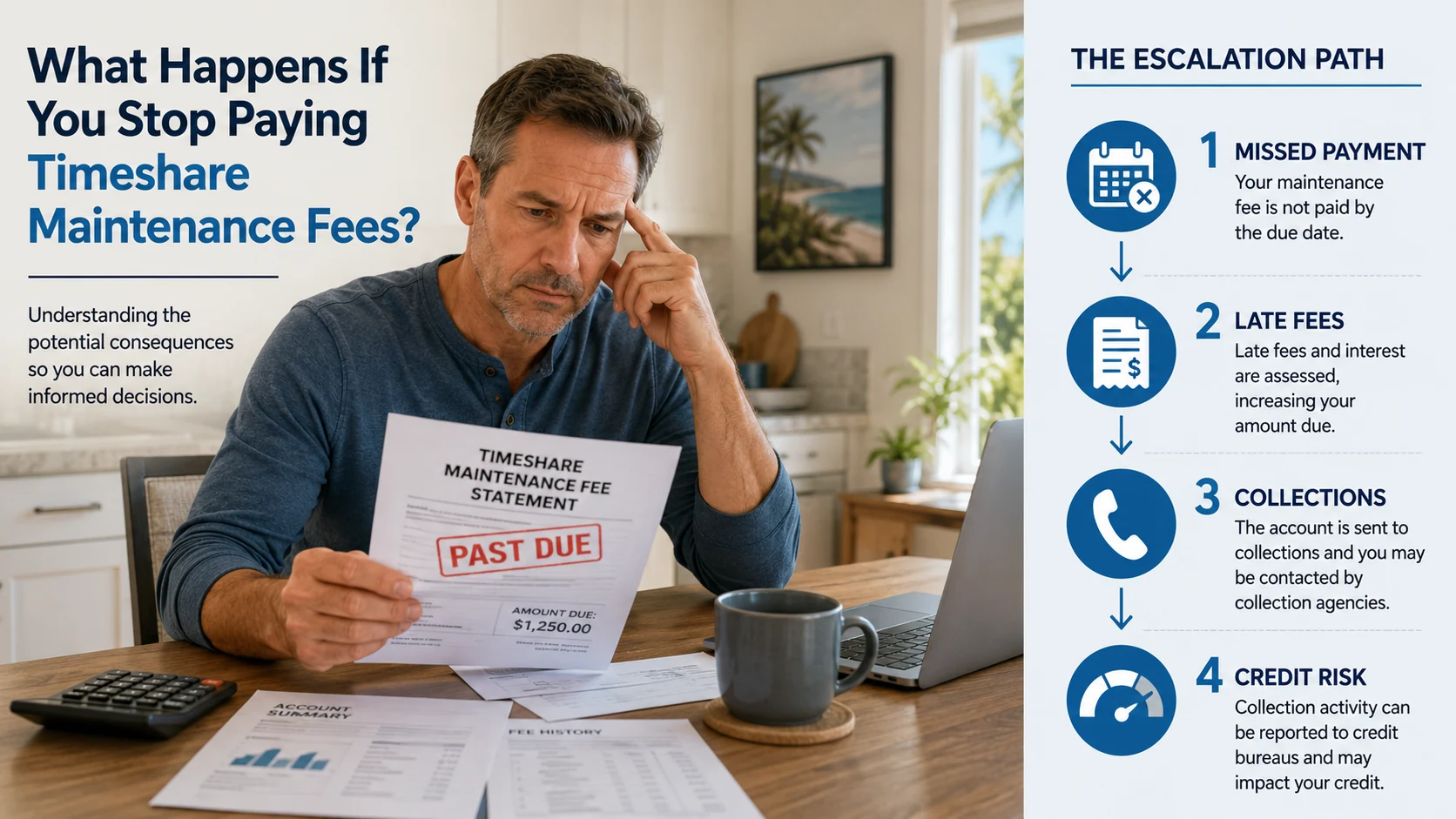
The cards below show how the likely consequences can change as an unpaid maintenance-fee account moves from ordinary delinquency toward collections or enforcement.
Escalation Path
Early Missed Payment vs. Escalated Nonpayment
A recently missed maintenance fee and a long-term unpaid account are not the same situation. As the balance remains unresolved, the account may move from ordinary billing and restrictions into collections, credit exposure, foreclosure review, or legal enforcement.
Missed or Recently Past-Due Maintenance Fees
At this stage, the account may still be handled internally by the resort, developer, association, or management company.
- Late fees, interest, or administrative charges may be added.
- Billing reminders, emails, letters, or calls may increase.
- Reservations, exchanges, or owner benefits may be restricted.
- The balance may still be easier to discuss or resolve directly.
- Some surrender, hardship, or payment options may still be available.
Longer-Term Nonpayment or Default
Once the account has remained unpaid or moved outside ordinary billing, the situation may become more expensive and harder to control.
- The balance may be referred to a third-party collection agency.
- Credit-reporting exposure may increase.
- Foreclosure, lien enforcement, or legal collection may become possible.
- Late fees, interest, and collection costs may continue to grow.
- Clean surrender or transfer options may become harder to access.
The key distinction is timing. Early delinquency can still create fees and restrictions, but escalated nonpayment may add collections, credit, and enforcement risk before the ownership itself is resolved.
System Insight
A Delinquent Account Is Not the Same as a Resolved Ownership
- Missing a maintenance-fee payment changes the account status, but it does not automatically cancel, transfer, surrender, or release the ownership.
- The billing account, collection balance, and ownership record may be handled separately by the resort, developer, association, management company, or outside collector.
- Collections or foreclosure may address the debt and ownership differently, so one process should not be assumed to resolve every obligation.
- Future maintenance fees may continue while the ownership remains active, even when reservations or other owner benefits have been restricted.
- Owners should obtain written confirmation showing what balance was resolved, whether the ownership ended, and whether future maintenance-fee obligations remain.
Before the Account Escalates
Understand Your Maintenance-Fee Risk Before Missing Another Payment
A recently missed fee and an account already in collections can lead to very different outcomes. The Timeshare Decision Intelligence Report™ helps organize your ownership documents, unpaid balances, account standing, surrender possibilities, and potential exposure before you make a payment decision that may be difficult to reverse.
Need a clearer view of your specific ownership situation?
Review the Report Option Or continue reading about collections, credit, and foreclosure riskWhat Usually Happens First When Maintenance Fees Go Unpaid
The first stage is usually account delinquency, not immediate foreclosure or cancellation.
The resort, developer, association, or management company may add late fees, interest, penalties, or administrative charges to the unpaid balance. Reservations, exchanges, owner benefits, or other usage privileges may also be restricted while the account is past due.
Initial contact often comes through internal billing efforts, including:
- mailed notices;
- emails or account messages;
- collection calls;
- updated statements; or
- warnings that the account may be referred outside the company.
At this stage, the owner may still be communicating directly with the resort, developer, association, or management company rather than a third-party collection agency. That can make it easier to confirm the balance, dispute an error, ask about a payment arrangement, or determine whether a surrender or hardship option is still available.
However, internal billing does not mean the problem is paused. Fees and interest may continue to accumulate, and the account may move into collections or enforcement if the balance remains unresolved.
A missed payment changes the account status. It does not, by itself, transfer the ownership, cancel the contract, or end future maintenance-fee obligations.
When Unpaid Maintenance Fees Move Toward Collections
If maintenance fees remain unpaid, the account may move beyond ordinary billing reminders and be referred to an internal recovery department, third-party collection agency, law office, or other collection partner.
The timing varies. Some accounts remain with the resort or association for months, while others may be referred outside sooner. Once that happens, the situation can become more difficult and more expensive to resolve.
The balance may now include:
- unpaid maintenance fees;
- late charges or interest;
- special assessments;
- administrative or collection costs; and
- other amounts permitted by the contract or governing documents.
Communication may also become more formal. Instead of ordinary billing notices, the owner may receive collection letters, settlement offers, demands for payment, or warnings about possible credit reporting or enforcement.
Collections Do Not Automatically End the Timeshare
A collection agency may pursue the unpaid balance, but collection activity does not necessarily mean the timeshare has been surrendered, transferred, canceled, or foreclosed.
The debt and the ownership can move on separate tracks. Even if a balance is paid or settled, the owner may still need written confirmation showing whether the ownership remains active and whether future maintenance fees will continue.
Collection activity is evidence that the account has escalated—not proof that the timeshare obligation has ended.
Once an account has moved beyond ordinary billing, the collection process can involve additional notices, claimed balances, credit-reporting concerns, settlement terms, and ownership questions. For a more detailed explanation, see What Happens When Timeshare Maintenance Fees Go to Collections?
Can Unpaid Maintenance Fees Affect Your Credit?
Unpaid timeshare maintenance fees may affect your credit, but the impact is not always immediate or handled the same way as a missed timeshare loan payment.
A past-due maintenance fee may initially remain within the resort, developer, association, or management company’s billing system. During this stage, the account may accumulate late charges and lose usage privileges without necessarily appearing on a credit report.
The risk can increase if the balance is referred to a third-party collection agency. At that point, the unpaid debt may be reported to the credit bureaus, depending on how the collector handles the account and whether applicable reporting requirements are met.
Credit exposure may also become more serious if the situation leads to:
- a reported collection account;
- a lawsuit or judgment, where applicable;
- foreclosure of a deeded timeshare interest; or
- negative reporting connected to a separate financed timeshare loan.
Maintenance Fees and Loan Payments Are Different
A timeshare loan is a financed credit obligation, so missed loan payments may create a more direct path to credit reporting.
Maintenance fees are recurring ownership or membership obligations. They may create credit consequences after the balance is escalated, referred to collections, or pursued through another enforcement process.
That distinction is why owners should not assume either that one missed maintenance-fee payment will immediately damage their credit or that unpaid maintenance fees can never appear on a credit report.
What to Check
If the account is already past due or in collections:
- identify who currently owns or services the balance;
- request written information showing the amount claimed;
- review whether the debt has been reported to any credit bureau;
- check the reported information for errors; and
- keep copies of any payment, settlement, surrender, or release documentation.
The important question is not only whether the resort reports a missed fee directly. It is whether the unpaid balance later becomes a collection or enforcement matter that creates a reportable credit event.
Owner takeaway: Credit risk depends on whether the unpaid balance remains inside the resort’s billing system or moves into collections, who reports the account, and whether the situation escalates into foreclosure or another formal enforcement process.
Can Unpaid Maintenance Fees Lead to Foreclosure or Legal Action?
Unpaid timeshare maintenance fees can sometimes lead to foreclosure, a lawsuit, lien enforcement, or other collection action—but not every delinquent account reaches that stage.
The outcome depends on the ownership structure, governing documents, applicable law, unpaid balance, and how the developer, resort, association, or management company chooses to enforce the obligation.
Deeded Timeshare Ownership
With a deeded timeshare, unpaid maintenance fees or assessments may create a lien against the timeshare interest. If the lien remains unresolved, the managing entity may have the right to pursue foreclosure under the governing documents and applicable state law.
For example, Florida law allows unpaid timeshare assessments to become a lien against the timeshare interest and permits judicial or trustee foreclosure procedures that may result in the owner losing that interest. Other jurisdictions may use different procedures and notice requirements.
Points, Memberships, and Right-to-Use Agreements
A non-deeded membership may be handled differently. Instead of a real-estate foreclosure, the company may pursue collections, restrict or terminate usage rights, cancel the membership under the contract, or seek a money judgment where permitted.
That is why the word foreclosure should not be applied to every timeshare account in the same way. The available remedies depend on what the owner actually purchased and which documents govern the obligation.
Legal Action Is Possible, but Not Automatic
A developer, association, collector, or other claimant may decide to pursue the unpaid balance through legal action. Whether that happens—and how quickly—can depend on the amount owed, the age of the debt, the ownership type, and the enforcement policies involved.
Owners who receive a lien notice, foreclosure notice, summons, or other legal document should not assume it is an ordinary billing reminder. The document may contain deadlines or rights that depend on the governing law and should be reviewed promptly.
The important distinction is that foreclosure or legal action may eventually resolve part of the account, but the owner should still obtain written documentation showing:
- what happened to the timeshare interest;
- whether the unpaid balance was resolved;
- whether any amount remains due; and
- whether future maintenance-fee obligations have ended.
For a deeper explanation of how unpaid fees, loan balances, and ownership structure can affect foreclosure risk, see Can a Timeshare Be Foreclosed On?
Foreclosure and legal action are not inevitable, but waiting for enforcement is not the same as choosing a documented exit. The account may accumulate fees, collection pressure, and fewer resolution options before ownership is finally addressed.
Nonpayment Risk
Consequences May Begin Before the Timeshare Ownership Ends
The biggest risk is assuming that stopping maintenance-fee payments will quickly force the resort, developer, or association to take the timeshare back. In reality, the account may first accumulate late charges, lose usage privileges, move into collections, create credit-reporting exposure, or face foreclosure or legal enforcement.
Nonpayment can also reduce the options available to the owner. Some surrender, deed-back, hardship, payment-plan, transfer, or negotiated-resolution programs may require the account to be current or only lightly delinquent. By the time the ownership is formally addressed, the balance and financial consequences may already be more difficult to resolve.
Before missing another payment, identify how far the account has progressed and which resolution options may still be available. The goal is not to assume every consequence will occur, but to understand what could change once the account moves deeper into delinquency.
Action Step
Check the Account Before Missing Another Maintenance-Fee Payment
Before allowing the balance to escalate, confirm what is owed, who is handling the account, whether a loan is also involved, and which documented resolution options may still be available.
Quick win: Write down four facts before making your next payment decision: what is unpaid, who is collecting, whether the ownership is still active, and what document would prove that future maintenance-fee obligations have ended.
Maintenance-fee pressure may be connected to more than the unpaid bill. Financing, ownership type, account standing, surrender eligibility, transfer limits, and collection exposure can all affect what options remain. The free preview can help identify which factors may deserve closer attention before the account escalates further.
Free Ownership Review Preview
Which Ownership Factors May Be Increasing Your Maintenance-Fee Risk?
Unpaid maintenance fees may be only one part of the situation. The free Ownership Risk Profile™ Preview helps identify whether financing, rising annual costs, account standing, collection exposure, transfer restrictions, or uncertain surrender options may be adding pressure before you decide what to do next.
Get a preliminary look at the pressure points in your ownership.
Try the Free Ownership Risk Profile™ Free preview • Educational screening tool • No exit-company sales pitch❓ Frequently Asked Questions
These questions address the most common concerns owners have about unpaid timeshare maintenance fees, including collections, credit exposure, foreclosure risk, continuing annual charges, and whether nonpayment ends the ownership.
What happens if I stop paying timeshare maintenance fees?
The account will usually become delinquent rather than cancel automatically. Late fees, interest, account restrictions, internal collection efforts, and third-party collections may follow. If the balance remains unresolved, credit reporting, foreclosure, lien enforcement, or legal collection activity may become possible, depending on the ownership and governing documents.
Does stopping maintenance-fee payments cancel the timeshare?
Usually, no. Nonpayment changes the account status but does not automatically surrender, transfer, cancel, or release the ownership. The timeshare may remain active until there is a documented resolution, such as an accepted surrender, completed transfer, foreclosure, contractual termination, settlement, or written release.
Can unpaid timeshare maintenance fees go to collections?
Yes. The resort, developer, association, or management company may first pursue the balance internally and later refer it to a collection agency, law office, or outside recovery partner. The claimed balance may include maintenance fees, late charges, interest, assessments, and collection-related costs.
Can unpaid maintenance fees affect my credit?
They can, particularly if the balance moves to third-party collections or becomes part of a formal enforcement process. Maintenance fees may not follow the same direct reporting path as a financed timeshare loan, but collection reporting, foreclosure activity, or other enforcement can create credit consequences.
Can a timeshare be foreclosed for unpaid maintenance fees?
In some cases, yes. A deeded timeshare may be subject to a lien and foreclosure when assessments remain unpaid and the governing documents and applicable law permit enforcement. Points programs, memberships, and right-to-use agreements may instead be handled through collections, termination, or other contractual remedies.
Will maintenance fees continue after I stop paying?
They may. If the ownership remains active, future annual maintenance fees and assessments can continue even when the account is delinquent, reservations are restricted, or an earlier balance has been sent to collections. Obtain written confirmation before assuming future obligations have ended.
What should I check before deciding not to pay?
Confirm the total amount owed, whether a separate loan is involved, who currently handles the balance, how far the account has escalated, and whether surrender, deed-back, hardship, payment-plan, transfer, or settlement options remain available. Also identify what written document would prove that the ownership and future fees have ended.
Bottom Line
Stopping timeshare maintenance-fee payments usually does not cancel the timeshare or immediately end future obligations.
At first, the account may accumulate late charges, lose reservation privileges, or move through internal billing. If the balance remains unresolved, the situation may escalate into third-party collections, credit-reporting exposure, foreclosure, lien enforcement, or legal collection activity depending on the ownership structure and governing documents.
The most important distinction is between the unpaid balance and the underlying ownership. Paying, settling, or disputing a balance does not necessarily prove that the timeshare has been surrendered, transferred, foreclosed, canceled, or otherwise released.
Before missing another payment, confirm:
- what amount is currently owed;
- whether a separate timeshare loan is involved;
- who is handling the account;
- which resolution options remain available; and
- what written document would prove that the ownership and future maintenance-fee obligations have ended.
Nonpayment may eventually produce an outcome, but it should not be treated as a predictable or documented exit strategy.
Understand What Maintenance-Fee Nonpayment Could Leave Unresolved
Missing maintenance-fee payments can affect the balance, account standing, collection exposure, usage rights, and available resolution options without necessarily ending the ownership. The Timeshare Decision Intelligence Report™ helps organize your documents, unpaid amounts, ownership structure, surrender possibilities, transfer limitations, and potential next-step pathways before the situation becomes harder to control.
Get the Timeshare Decision Intelligence Report™ Customized ownership review • Maintenance-fee and account analysis • No exit-company sales pitchIndependent educational decision support. This is not legal advice, contract cancellation, an exit service, a resale service, lender negotiation, debt settlement, or a promise that your timeshare can be exited.
Related Guides
If unpaid maintenance fees are part of a larger exit or financial-risk decision, these guides can help you understand what may happen next:
Maintenance Fees and Usage
- Timeshare Maintenance Fees: Why They Keep Increasing
See why annual fees rise and how they can create payment pressure. - Can You Rent Out Your Timeshare?
Review whether rental income can realistically offset annual fees. - Why Is It So Hard to Book a Timeshare?
Understand why availability problems occur before making a larger financial decision.
Credit and Financial Risk
- Can a Timeshare Affect Your Credit Score?
Understand how loans, collections, and unpaid obligations may affect credit. - Can a Timeshare Put a Lien on Your House?
Review whether unpaid timeshare debt can affect other property.
Cancellation and Exit Options
- Timeshare Rescission Period: Can You Cancel a Timeshare After Signing?
Learn how the short cancellation window may change your options. - Timeshare Exit Options Compared
Compare surrender, resale, transfer, third-party help, and other exit paths. - How to Get Out of a Timeshare Legally
Learn what documentation shows the ownership has actually ended.