
Timeshare Cancellation Guide
Timeshare Rescission Period: Can You Still Cancel After Signing?
A timeshare rescission period is a short cancellation window that may allow a recent buyer to cancel a purchase after signing. The exact deadline and procedure can depend on the governing law, the transaction, and the instructions in the purchase documents.
The decision: Is your cancellation window still open—and what exactly must you do before the governing deadline expires?
This guide explains how to identify and act on a timeshare rescission window. Rescission rights and procedures can depend on jurisdiction, transaction type, contract language, document delivery, and other facts. Use your governing purchase documents and applicable law for the actual deadline and required procedure.

The first step in a timeshare rescission is to find the exact deadline, notice instructions, and delivery requirements in the purchase documents.
Quick Answer
Can You Still Cancel a Timeshare After Signing?
If you recently signed a timeshare contract and want to cancel, first determine whether your rescission period is still open. The deadline, when the clock started, where notice must be sent, which delivery methods are permitted, and what counts as timely notice can depend on the governing law and your purchase documents.
Do not rely on a general internet estimate for how many days you have. Find the cancellation or rescission provision in your documents and follow those instructions carefully.
Start Here
Find These 6 Things in Your Purchase Documents Now
Before drafting a letter or searching for general cancellation advice, identify the rules that actually apply to your purchase.
-
1
The rescission or cancellation provision
Look for sections labeled cancellation, rescission, buyer’s right to cancel, right of withdrawal, or similar language.
-
2
The exact deadline
Identify the number of days allowed and whether the documents describe them as calendar days, business days, or another measurement.
-
3
The event that started the clock
The relevant starting point may involve signing, receiving required documents, or another event. Do not assume the signing date is always the only date that matters.
-
4
The correct recipient and address
Determine exactly who must receive the notice and where the documents instruct you to send or deliver it.
-
5
The permitted delivery method
Review whether notice may or must be mailed, personally delivered, electronically transmitted, or provided another specified way.
-
6
What determines whether notice was timely
Identify whether the governing instruction focuses on sending, postmark, delivery, receipt, or another event.
The Deadline
How Does the Timeshare Rescission Deadline Actually Work?
A rescission period is not simply a general number of days that applies identically to every purchase.
The length of the period can vary, and so can the event that begins the countdown. The procedure may also specify how notice must be given and what event establishes that the notice was timely.
That is why a statement such as “you usually have X days” is not enough to make a cancellation decision safely.
Timing Details
Calendar Days, Business Days, Sending, and Receipt Are Not the Same Thing
Small timing details can materially change how a rescission deadline is calculated.
Calendar days vs. business days
Do not assume weekends or holidays are excluded unless the governing rule says they are. If the documents specify calendar days, those days are generally counted differently from a provision that specifically uses business days.
When the period begins
The countdown may be tied to contract execution, delivery of required documents, or another legally relevant event. If different dates appear in your paperwork, identify which one the rescission provision says controls.
Sending vs. delivery vs. receipt
These are different events. Depending on the governing rule, timeliness may turn on when notice is sent, postmarked, delivered, received, or otherwise completed.
The Cancellation Notice
What Should a Timeshare Rescission Notice Do?
The purpose of the notice is generally straightforward: clearly communicate that you are exercising your right to cancel the purchase.
The exact information required can depend on the contract and governing rule, but a practical notice often identifies the buyer, the purchase or contract, and the intent to cancel.
Follow any specific wording, signature, delivery, or recipient requirements in your documents.
If you need help organizing the notice, see TTCA’s Timeshare Rescission Letter guide .
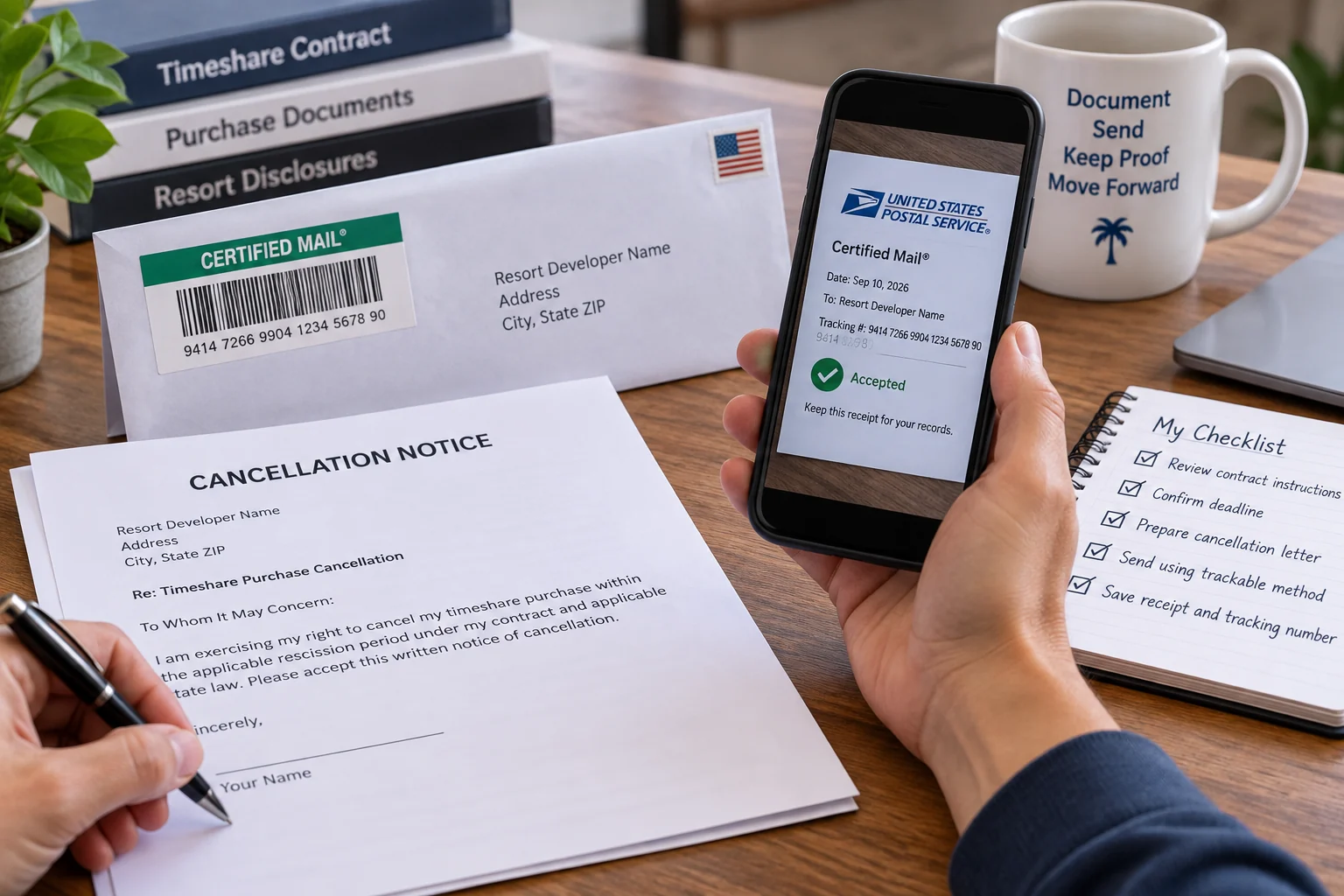
Follow the cancellation instructions in your purchase documents and preserve evidence showing when, where, and how your rescission notice was sent.
Preserve the Record
Keep Proof of What You Sent, Where You Sent It, and When
A cancellation notice is much easier to document when you preserve a clear record of the process.
- Keep a copy of the final signed cancellation notice.
- Keep the page or section containing the cancellation instructions.
- Preserve the recipient name and address you used.
- Keep mailing, tracking, delivery, transmission, or other available proof.
- Save relevant dates and confirmation records together.
- Keep the records even after the cancellation appears to have been processed.
If mailing is permitted, a trackable method such as certified mail with return receipt can help document when and where the notice was sent. However, follow the actual delivery instructions governing your purchase rather than assuming one method is required everywhere.
Avoidable Problems
Common Mistakes That Can Complicate a Timeshare Rescission
- Relying on a general rescission-period estimate instead of the governing deadline.
- Counting from the wrong starting date.
- Sending notice to a salesperson instead of the recipient identified in the documents.
- Using a delivery method that does not match the applicable instructions.
- Assuming a phone call alone satisfies a written cancellation requirement.
- Waiting until the final day when earlier action was possible.
- Failing to keep a copy of the notice and evidence showing when it was sent.
- Spending so much time researching why to cancel that the actual deadline becomes the secondary concern.
My Take
If I Wanted Out During the Rescission Period, I Would Keep the Process Simple
If I had just signed and wanted out, I would spend less time explaining why I changed my mind and more time proving that I followed the correct cancellation procedure before the deadline.
I would identify the exact deadline, confirm when the clock started, verify where notice has to go, use an allowed delivery method, and keep evidence showing what I sent and when I sent it.
I also would not rely on a salesperson telling me verbally that everything had been handled unless that matched the actual cancellation process in my documents.
If the deadline had already passed, I would stop treating the situation as a rescission problem and move on to the options that actually remain.
After the Window Closes
What If the Timeshare Rescission Period Has Already Passed?
Once the rescission deadline has expired, the question changes.
You are no longer evaluating a short statutory or contractual cancellation window. You are evaluating what options may remain under the ownership agreement, developer policies, market conditions, and your particular circumstances.
Those possibilities may include developer surrender, resale, transfer, negotiation, or outside assistance depending on the ownership.
Start with Can You Cancel a Timeshare After the Rescission Period? rather than trying to use a rescission process that no longer applies.

Once the rescission window has closed, the decision changes. The next step is to understand which ownership, developer, resale, transfer, or exit options may still be available.
Get clearer timeshare guidance.
Get practical TTCA guidance on ownership, cancellation, costs, resale, transfer, and the decisions that come next.
Frequently Asked Questions
Timeshare Rescission Period FAQ
How many days do I have to cancel a timeshare?
The rescission period can vary based on the jurisdiction and transaction. Check the cancellation provision in your purchase documents and the law governing the purchase rather than relying on a single general day range.
Does the rescission period start when I sign the contract?
It may, but not every governing rule uses exactly the same trigger. The relevant starting point may involve contract execution, receipt of required documents, or another event. Check the rule that applies to your purchase.
Do weekends count toward the timeshare rescission period?
That depends on whether the governing rule uses calendar days, business days, or another definition. Do not automatically exclude weekends or holidays unless the applicable rule says to do so.
Can I cancel my timeshare by calling the salesperson?
Do not assume a phone call satisfies the cancellation requirements. Follow the notice and delivery procedure stated in your purchase documents and governing rule.
Should I send my cancellation by certified mail?
If mailing is permitted, a trackable method such as certified mail with return receipt can help preserve evidence. But the correct delivery method is the one permitted or required by the governing instructions.
Do I have to explain why I am cancelling?
The exact content requirements depend on the governing documents and law. In general, focus on clearly exercising the cancellation right and satisfying the required procedure rather than writing a lengthy argument about why you changed your mind.
What happens if I miss the rescission deadline?
Once the rescission window has closed, the decision moves into a different category. You may need to evaluate developer surrender, resale, transfer, negotiation, or other exit-related possibilities rather than relying on the original rescission right.
TTCA Decision
During a Rescission Period, Procedure Matters More Than Persuasion
If your rescission window is still open and you have decided to cancel, your priority is to identify the correct deadline and follow the applicable notice procedure accurately.
Confirm the trigger date, recipient, delivery method, and timeliness rule, then preserve evidence showing what you sent and when. If the deadline has already passed, shift to the options that actually remain rather than trying to force a rescission process that may no longer apply.
Continue From Here
Choose the next step that matches where you are in the process.

How to Write a Timeshare Rescission Letter
Organize a clear cancellation notice while still following the exact wording, recipient, deadline, and delivery instructions that govern your purchase.
Can You Cancel a Timeshare After the Rescission Period?
Understand how the decision changes once the original cancellation window has expired and what options may still deserve review.
Review the Timeshare Exit Guide
Compare surrender, resale, transfer, and outside-help paths if rescission is no longer available and you are considering a broader ownership change.

Free Timeshare Self-Review
Need a clearer view of your ownership beyond the rescission deadline?
If the immediate cancellation question is resolved, TTCA’s free Timeshare Self-Review can help you look more broadly at how the ownership is working for you today.
- Your current ownership costs
- How often you actually use it
- Your booking experience
- The benefits you really use
- Fit with your travel habits
- Questions worth reviewing next
Private • Self-guided • Instant result. This tool does not determine legal rescission rights or deadlines. By subscribing, you’ll also receive practical TTCA timeshare guidance and updates.