
Timeshare Collections Guide
Can a Timeshare Send You to Collections? What Happens Next
Yes. Unpaid timeshare obligations can move into collections—but the stage of collection and the type of balance matter.
A missed loan payment, maintenance fee, club due, special assessment, or other required charge may first be handled internally by the lender, developer, resort, or association before the account is placed with an outside collector. Understanding what is unpaid and who controls the account is the first step in evaluating what may happen next.
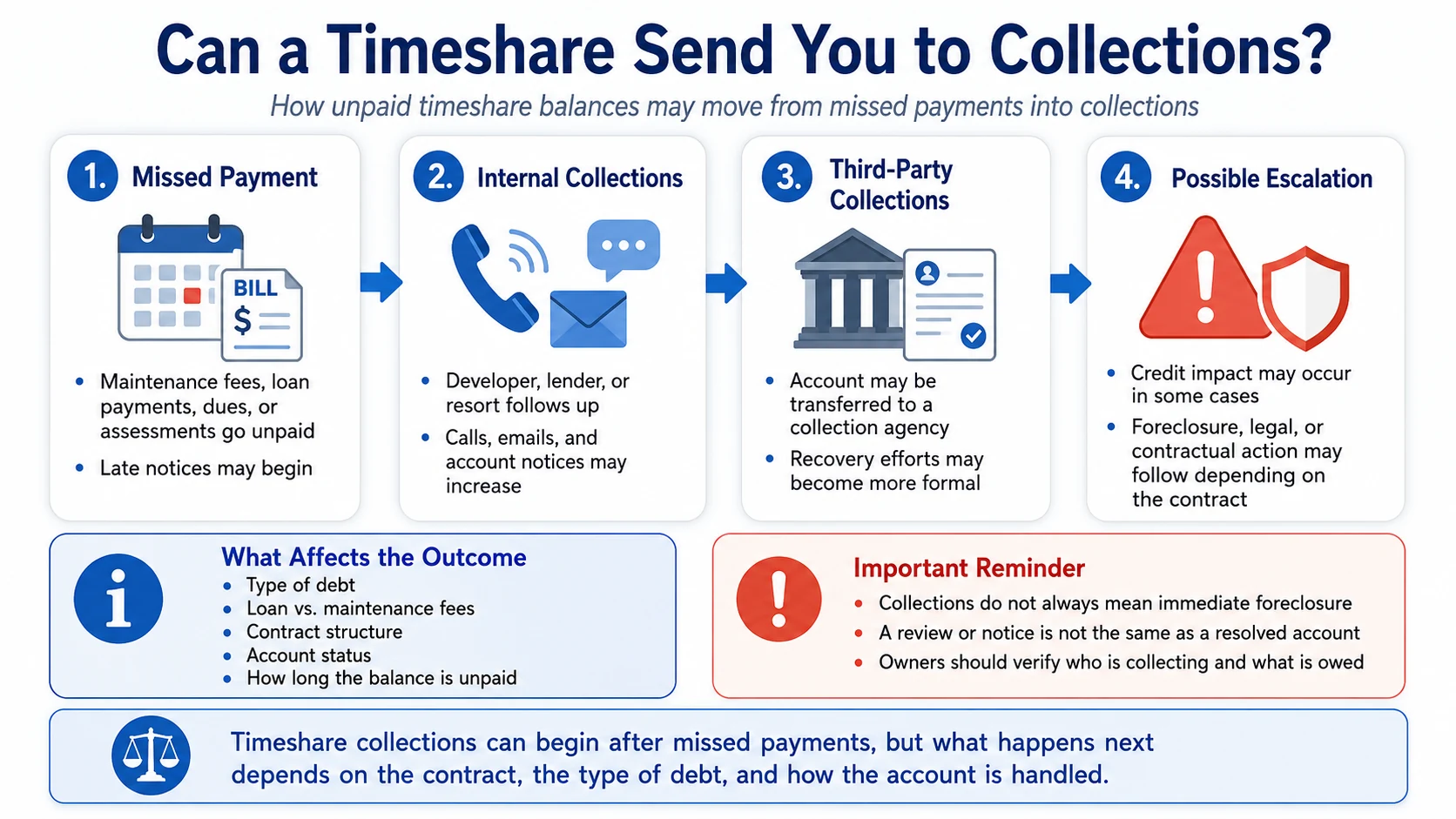
About This Guidance: TTCA evaluates timeshare collection issues by separating the unpaid balance from the broader ownership consequences that may follow. This guidance focuses on how loan delinquencies, maintenance fees, dues, assessments, and other charges may move from internal recovery to third-party collections, how account standing may affect surrender, transfer, resale, or other ownership options, and what owners should verify before responding to a collection notice or making a payment decision.
Before the Account Escalates Further
Collections Risk Depends on What Is Unpaid and Where the Account Stands
A missed loan payment, maintenance fee, special assessment, or club charge may follow a different collection path. The Timeshare Decision Intelligence Report™ helps organize the ownership documents, account status, unpaid obligations, collection exposure, and questions that may affect surrender, transfer, or other next-step options.
Need a clearer view of the risks surrounding a delinquent account?
Review the Report Option Or continue with the collection stages belowCollections Can Begin Before an Outside Agency Is Involved
A timeshare account does not need to be with a third-party agency before collection activity begins.
The developer, lender, resort, management company, or owners’ association may first handle the delinquency internally through notices, calls, late charges, account restrictions, or payment requests.
If the balance remains unresolved, it may later be transferred, assigned, or placed with an outside collection agency. The timing and process can vary depending on the type of debt, the account, and the organization handling it.
Important Distinction
“In Collections” Can Describe Different Stages
An account may be undergoing internal collection activity while the original developer, lender, resort, or association still controls the balance. It may also be placed with a third-party collection agency after earlier efforts do not resolve the delinquency.
Before deciding how serious the situation may be, identify what is unpaid, who currently controls or services the balance, and whether the account is still internal or has moved to an outside collector.
Collection Stages
Internal Collections vs. Third-Party Collections
Both stages involve an unresolved balance, but the party handling the account and the level of escalation may differ.
Internal Collections
The developer, lender, resort, management company, or owners’ association is still handling the delinquent account directly.
Communication may include account notices, calls, late fees, payment requests, usage restrictions, or discussions about bringing the account current.
Third-Party Collections
The balance has been transferred, assigned, or placed with an outside collection agency or law office.
Communication may become more formal and focused on recovering the past-due amount rather than explaining the broader ownership status or available resort programs.
Why Timeshare Collection Outcomes Vary
Timeshare collection activity does not follow one fixed path.
What happens next depends on the type of obligation, how long the account has been delinquent, who is handling it, and what the ownership documents allow.
A missed loan payment may be treated differently from unpaid maintenance fees. Special assessments, club dues, taxes, or other account charges may also follow different collection and enforcement processes.
Timing can matter as well.
An account in the early stages of delinquency may leave more room to:
- Clarify the balance
- Request account records
- Correct a billing issue
- Discuss payment arrangements
- Determine whether a deed-back or surrender option remains available
- Understand the consequences before the account escalates
As the delinquency continues, the situation may become more difficult to resolve. Late fees, interest, collection charges, account restrictions, credit reporting, foreclosure notices, or other enforcement actions may be added depending on the debt and contract.
The most important factors include:
- Whether the account is still eligible for surrender, transfer, or another resolution
- What is unpaid: Loan payments, maintenance fees, assessments, dues, or another obligation
- Who is collecting: The original lender, developer, resort, association, servicer, or an outside collector
- How long the account has been delinquent
- Whether the ownership remains active
- What escalation steps are permitted under the governing documents
Collections are therefore not only about the amount currently due. They can also affect account standing, available ownership options, and what may happen if the balance remains unresolved.
Risk Point
Delinquency Can Narrow Your Options Before the Account Reaches an Outside Collector
Some deed-back, surrender, transfer, or account-resolution programs require the ownership to be current and in good standing. Once payments are missed, the owner may need to resolve part or all of the delinquency before the program will review a request.
Waiting can also allow late fees, interest, collection costs, or other enforcement steps to accumulate. Not every delinquent account follows the same path, but owners should verify which options remain available before assuming those pathways will still be open later.
What to Confirm When Collection Notices Begin
A collection notice should not be ignored, but it should not be answered without first understanding what it represents.
Start by identifying whether the communication came from the developer, lender, resort, management company, owners’ association, servicing company, or an outside collector. The organization contacting you may indicate whether the account is still in an internal recovery stage or has already escalated.
Then determine what type of obligation is unpaid. A timeshare loan, maintenance fee, special assessment, club due, tax, or administrative charge may involve different parties and consequences.
The immediate goal is not to solve every ownership issue in one conversation. It is to establish:
- Who is handling the account
- What obligation is delinquent
- How the balance was calculated
- Whether additional charges are accumulating
- Whether the ownership remains active
- Whether the delinquency affects surrender or other ownership options
- What may happen if the account remains unresolved
Once those facts are clear, the owner is in a better position to evaluate the next step without confusing an early collection notice with a final ownership outcome.
Action Step
Verify the Collection Stage Before Taking Action
Gather the basic account facts before making a payment, ignoring the notice, disputing the balance, or assuming the ownership can no longer be resolved.
- Confirm whether the account is still internal or has moved to a third-party collector.
- Identify whether the unpaid balance involves a loan, maintenance fees, dues, assessments, or another charge.
- Review an itemized balance showing late fees, interest, collection costs, and other additions.
- Check how long the account has been delinquent and which notices have already been issued.
- Ask whether the delinquency affects deed-back, surrender, transfer, resale, or other ownership pathways.
- Keep copies of notices, statements, emails, payment records, and written account-status responses.
How Timeshare Collections May Affect Your Credit
One of the most common concerns is whether a delinquent timeshare account will damage the owner’s credit.
The answer depends on the type of debt and how the account is handled.
A financed timeshare loan may create different credit exposure from unpaid maintenance fees, club dues, or assessments. Reporting practices can also vary among lenders, developers, associations, servicing companies, and third-party collectors.
An account may remain in internal collections for a period of time without appearing on a credit report. Another account may already involve a lender or outside collector that reports delinquency. Owners should therefore avoid assuming that no credit-report entry means the account is harmless or resolved.
Credit reporting is also only one part of the potential impact. An unresolved delinquency may affect:
- Account standing
- Use of the timeshare or club benefits
- Eligibility for a deed-back or surrender program
- Transfer or resale options
- Added fees and collection costs
- Possible foreclosure or other enforcement steps
Collections do not automatically mean immediate credit damage, foreclosure, or legal action. But the absence of one consequence does not prevent other ownership or financial consequences from developing.
The practical step is to verify both the reporting status and the broader account status rather than evaluating the situation only through the credit report.
Owner takeaway: A collection notice does not automatically mean foreclosure, a lawsuit, or credit damage has already occurred. It does mean the account is delinquent and may be moving through a more formal recovery process, so the owner should identify what is unpaid, who is handling the balance, and which ownership options may still be available.
❓ Frequently Asked Questions
These questions focus on how a timeshare account may enter collections, how collection stages differ, and what consequences may develop if the delinquency remains unresolved.
Can a timeshare send you to collections?
Yes. A developer, lender, resort, management company, owners’ association, servicing company, or outside collection agency may pursue unpaid timeshare obligations. The process and possible consequences depend on what is unpaid, the account status, the ownership structure, and who is handling the balance.
What kinds of timeshare payments may go to collections?
Collection activity may involve unpaid loan payments, maintenance fees, club dues, special assessments, taxes, late fees, interest, or other contractual charges. Different types of balances may be controlled by different parties and may not follow the same collection path.
What is the difference between internal and third-party collections?
Internal collections means the original lender, developer, resort, association, or servicing company is still handling the delinquent account. Third-party collections means the balance has been transferred, assigned, or placed with an outside collection agency or law office.
Moving to an outside collector generally represents a more escalated collection stage, but it does not by itself prove that foreclosure, a lawsuit, or credit reporting has already occurred.
Do timeshare collections always affect your credit?
Not always. Credit impact may depend on whether financing is involved, whether the account is reported, and the practices of the lender, developer, servicer, association, or collection agency. An account may also create ownership consequences even when nothing has appeared on a credit report.
Is a timeshare collection account the same as foreclosure?
No. Collections generally involve efforts to recover an unpaid balance. Foreclosure is a separate enforcement process that may occur later in some situations depending on the ownership, debt, governing documents, and applicable procedures. Not every collection account progresses to foreclosure.
Can delinquency affect a deed-back or surrender request?
It can. Some developer-controlled deed-back, surrender, or owner-assistance programs require the loan to be paid off and the account to be current. Owners should verify eligibility before assuming a direct return option will remain available after the account becomes delinquent.
What should you do when collection notices begin?
Identify who sent the notice, what type of balance is unpaid, how long it has been delinquent, and whether the account is still internal or already with an outside collector. Review the amount, preserve the notices and account records, and ask how the delinquency may affect available ownership options.
Bottom Line
A timeshare can be sent to collections when required payments remain unpaid.
The account may first be handled internally by the lender, developer, resort, management company, or owners’ association. If the delinquency continues, the balance may later be placed with an outside collection agency or law office.
Collections do not automatically mean that foreclosure, a lawsuit, or credit reporting has already occurred. They do indicate that the account has moved into a more formal recovery stage and may continue to escalate.
The owner’s next step should be based on what is unpaid, who is handling the account, how long the balance has remained unresolved, and whether the delinquency has affected surrender, transfer, or other ownership options.
If the account has already reached an outside collector and you are deciding whether to pay or settle, the separate guide Timeshare Debt Collection: What Owners Should Know Before Paying addresses what the payment may resolve and whether the underlying ownership could remain active.
A Delinquent Timeshare Account Can Affect More Than the Balance Due.
The consequences of missed payments can depend on whether the balance involves financing, maintenance fees, dues, assessments, or another obligation—and whether the account is still internal or has already escalated. The Timeshare Decision Intelligence Report™ helps organize the ownership documents, loan status, unpaid balances, account standing, collection exposure, and ownership pathways that may affect what you do next.
Get the Timeshare Decision Intelligence Report™ Customized ownership review • Decision-support report • No exit-company sales pitchIndependent decision support. This is not legal advice, debt validation, lender negotiation, credit repair, contract cancellation, an exit service, or a promise that collections, foreclosure, or credit consequences can be prevented.
Related Guides
These guides address the next stages and related risks that may arise when a timeshare account becomes delinquent.
Collection Notices and Unpaid Balances
- Timeshare Debt Collection: What Owners Should Know Before Paying
Use this guide when the account is already with a collector and you need to understand what paying or settling may resolve—and whether the underlying ownership could continue. - What Happens If You Stop Paying Timeshare Maintenance Fees?
Review how unpaid maintenance fees may lead to notices, added charges, collections, account restrictions, or further escalation.
Credit and Escalation Risk
- Can You Exit a Timeshare Without Ruining Your Credit?
Understand why credit exposure can depend on the type of debt, reporting practices, account status, and how the ownership is ultimately resolved. - Timeshare Foreclosure: What Owners Should Know
Learn how an unresolved delinquency may progress beyond collection activity and why foreclosure depends on the ownership, debt, and enforcement process. - Can a Timeshare Put a Lien on Your House?
Review the distinction between claims involving the timeshare interest and broader financial consequences that may arise in some situations.
Ownership Resolution Options
- What Is a Timeshare Deed-Back Program?
Understand why developer surrender programs often require the loan to be paid off and the account to be current before a request will be reviewed. - How to Get Out of a Timeshare: Legal and Practical Options
Compare surrender, deed-back, resale, transfer, negotiated resolution, and other broader ownership pathways.