
Received a Timeshare Collection Notice? What to Verify Before Paying
You receive a collection letter, email, or phone call about an unpaid timeshare balance.
The amount may involve:
- Past-due maintenance fees
- Missed loan payments
- Special assessments or club dues
- Late fees and interest
- Collection or legal costs
- Other charges tied to the ownership
At this stage, the question is no longer whether a timeshare account can be sent to collections. The account may already be with a developer, lender, resort, homeowners association, servicing company, law office, or third-party collection agency.
The immediate question is:
What would paying, settling, or disputing this balance actually resolve?
A collection demand usually focuses on money already due. It may not explain whether:
- The ownership remains active
- Future maintenance fees can continue
- The payment would merely bring the account current
- A settlement would close only the collection balance
- The timeshare would be surrendered, transferred, foreclosed, or released
- Additional parties still control other obligations connected to the account
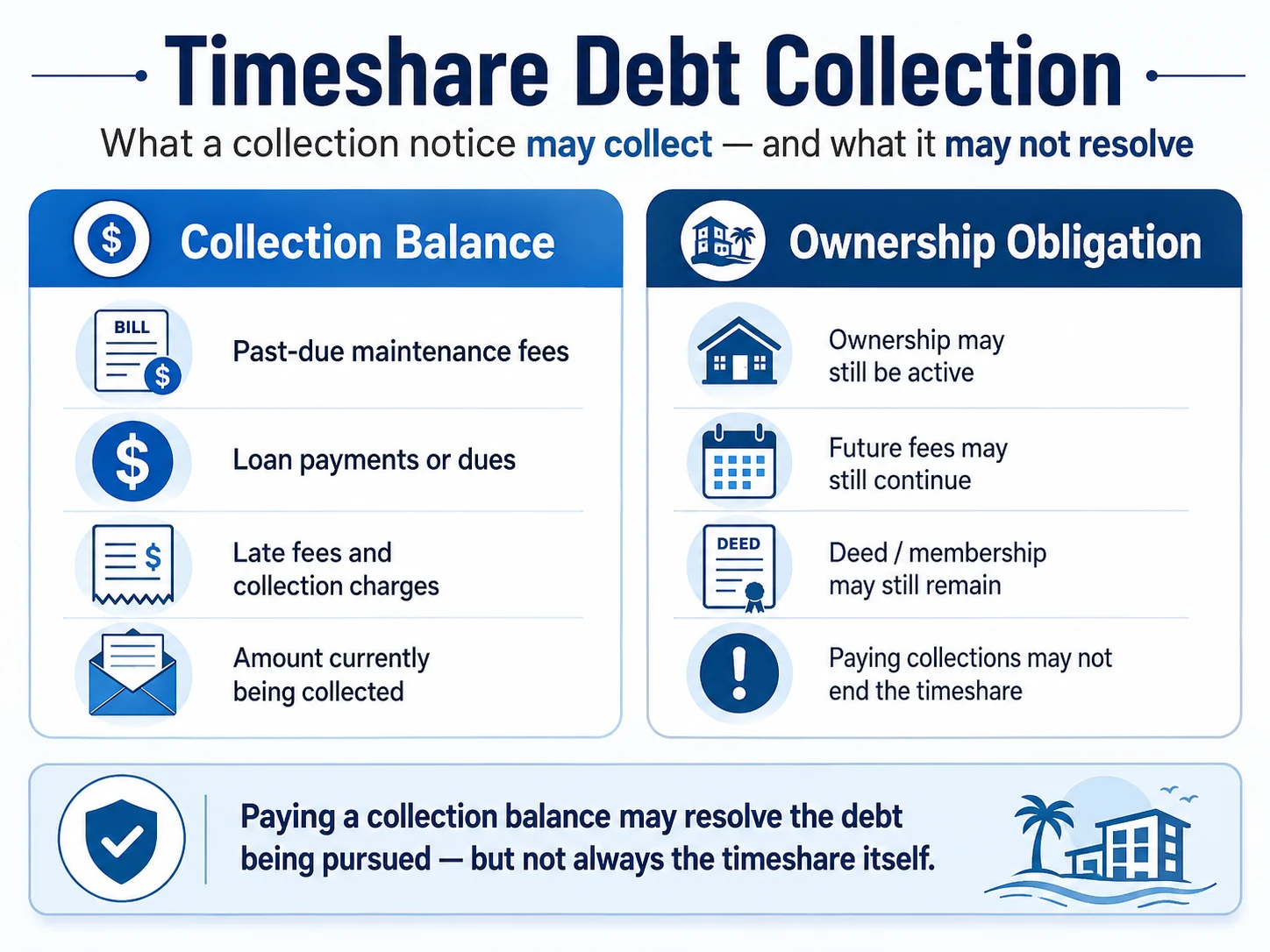
That distinction is critical. Paying a collector may resolve the amount being pursued without ending the underlying timeshare or preventing future charges.
Before sending money or agreeing to a settlement, owners should verify who is collecting, what the balance covers, whether the amount is itemized, and what the written terms say about the ownership afterward.
This guide explains what to confirm after receiving a timeshare collection notice, how to evaluate a proposed payment or settlement, and why resolving the debt is not always the same as resolving the timeshare.
Quick Answer
What Should You Verify Before Paying a Timeshare Collection Notice?
Confirm who is collecting the debt, what type of balance is being pursued, which billing period it covers, and whether late fees, interest, legal costs, or collection charges have been added.
Most importantly, determine what the proposed payment or settlement would actually resolve. Paying the collection balance may satisfy the amount currently being pursued without ending the timeshare ownership, stopping future maintenance fees, or closing every obligation connected to the account.
Before You Pay or Accept a Settlement
A Collection Payment May Resolve the Debt Without Resolving the Timeshare
A collection demand may involve maintenance fees, loan balances, assessments, late charges, legal costs, or other amounts tied to the ownership. The Timeshare Decision Intelligence Report™ helps organize the account history, ownership documents, collection terms, future-fee exposure, and unresolved questions before you pay, settle, dispute, or assume the timeshare will be closed.
Need a clearer view of what the collection demand may—and may not—resolve?
Review the Report Option Or continue with the ownership distinction belowA Collection Balance Is Not Always the Same as the Ownership
A timeshare collection notice usually focuses on a specific amount that is already past due.
That amount may represent unpaid maintenance fees, loan payments, assessments, interest, late charges, collection costs, or another balance tied to the account.
What the notice may not explain is whether the underlying ownership remains active.
That matters because resolving the amount being collected could produce several different outcomes:
- The past-due balance is paid, and the account becomes current
- A specific debt is settled for less than the full amount
- The collector closes its file, but the timeshare remains active
- Future maintenance fees or dues continue
- A separate surrender, transfer, foreclosure, or release process is still required
Before paying or accepting a settlement, distinguish between resolving the collection balance and resolving the ownership itself.
Important Distinction
Paying the Debt May Not End the Timeshare
A collector may be pursuing one defined balance, such as unpaid fees, loan payments, assessments, interest, or collection costs. Paying that balance may satisfy the debt currently being pursued without transferring, surrendering, canceling, or otherwise ending the underlying ownership.
Unless the written terms also address the ownership itself, future maintenance fees, dues, assessments, or other obligations may continue after the collection account is paid or settled.
What a Timeshare Collection Notice May Include
Not every collection demand involves the same type of debt.
The notice may include one or several categories of charges:
- Loan principal and interest: Amounts tied to financing used to purchase the timeshare
- Maintenance fees or club dues: Recurring charges required to keep the account in good standing
- Special assessments: Additional amounts imposed for repairs, reserves, improvements, or other property-related expenses
- Late fees and default interest: Charges added after a payment becomes delinquent
- Collection or legal costs: Expenses added after the account moves into a more formal recovery process
- Taxes, administrative fees, or other account charges: Additional obligations connected to the resort, club, or ownership structure
The total shown on the notice may combine several of these amounts without making the breakdown immediately clear.
Before deciding whether the balance is accurate, request or review an itemized statement showing:
- The original amount due
- The billing period involved
- Payments or credits already applied
- Interest and late fees
- Collection or legal charges
- The current total
- Whether additional charges are still accumulating
An itemized balance helps clarify what is being collected. It does not, by itself, confirm what happens to the ownership after the debt is resolved.
Why the Identity of the Collector Matters
The organization contacting you may not control every part of the timeshare account.
A third-party collection agency may have authority to collect a specific balance but may not have authority to:
- Approve a deed-back or surrender
- Transfer or cancel the ownership
- Waive future maintenance fees
- Close a resort or club account
- Change the deed or membership records
- Confirm that every related obligation has been resolved
The developer, lender, homeowners association, resort, club, or management company may still control those broader ownership questions.
Before sending money, confirm:
- The legal name of the company collecting
- Whether it owns the debt or is collecting for another party
- Which party currently owns or services the account
- Whether the collector can negotiate only the past-due balance
- Who can confirm the status of the underlying ownership
- Whether separate loan, resort, association, or club balances remain
A collector’s statement that the account will be “settled” or “closed” may refer only to the collection file. It should not automatically be interpreted as confirmation that the timeshare ownership will also end.
Risk Point
A Settlement Can Close the Collection File While Leaving the Ownership Active
A payment agreement may resolve the amount assigned to a collector without transferring the deed, terminating the membership, canceling the contract, or releasing future ownership obligations.
Before accepting a settlement, confirm in writing whether it applies only to the past-due debt or also includes a formal ownership release. Without clear written terms, future maintenance fees, dues, assessments, or other charges may still continue.
What to Verify in a Payment or Settlement Agreement
A proposed payment or settlement should be reviewed for more than the dollar amount.
The agreement should clearly identify the balance being resolved, the party receiving the payment, and what happens after the money is received.
Look for written answers to questions such as:
- Does the payment satisfy the full balance or only part of it?
- Will any unpaid amount remain?
- Will interest, late fees, or collection costs continue?
- Will the account be reported as paid, settled, current, or closed?
- Does the agreement apply only to the collection account?
- Does it also address the loan, resort account, deed, points contract, or club membership?
- Are future maintenance fees, dues, or assessments released?
- Is a separate surrender, transfer, foreclosure, or cancellation process required?
- Who will update the ownership and account records?
- When will written confirmation of completion be provided?
Words such as paid, settled, or closed may describe only the collector’s file. They do not automatically confirm that the timeshare ownership has ended.
The agreement should be read based on what it specifically says—not what the owner assumes will happen afterward.
Action Step
Get Written Answers Before Sending Money
Before paying or accepting a settlement, verify what the agreement resolves and which ownership obligations may remain afterward.
- Confirm the collector’s legal name and the party it represents.
- Request an itemized balance showing the original debt and all added charges.
- Identify whether the agreement resolves the full balance or only the assigned collection amount.
- Ask whether the deed, points contract, membership, or resort account remains active.
- Confirm whether future maintenance fees, dues, or assessments can continue.
- Keep the signed agreement, payment receipt, correspondence, and final account-status confirmation.
Does Paying Timeshare Collections End the Ownership?
Paying or settling a timeshare collection balance does not automatically end the ownership.
The payment may:
- Satisfy the past-due amount
- Bring an account current
- Resolve the debt assigned to the collector
- Complete a negotiated settlement
- Stop collection activity on that specific balance
None of those outcomes necessarily transfers the deed, terminates a points contract, closes a club membership, or releases future ownership obligations.
Ending the ownership may require a separate event, such as:
- A recorded transfer
- An approved deed-back or surrender
- A written contract termination
- A completed foreclosure
- A formal cancellation or release
- Another ownership-resolution process recognized by the responsible party
The written documentation should identify both the debt outcome and the ownership outcome.
A receipt showing that the collection account was paid may be useful evidence of payment, but it may not prove that the timeshare itself was relinquished.
How Paying or Settling May Affect Credit Reporting
Paying or settling a collection balance may change how the account is handled or reported, but the result can depend on the type of debt and the parties involved.
A timeshare loan may be reported differently from unpaid maintenance fees, assessments, or club dues. The lender, developer, association, servicing company, or outside collector may also follow different reporting practices.
Before agreeing to payment terms, ask:
- Whether the account has already been reported
- Which organization is furnishing the information
- How the account is expected to be described after payment
- Whether the collection entry and the underlying loan or resort account are separate
- When account records are expected to be updated
- What written confirmation will be provided
Paying a balance does not necessarily remove earlier account history, and resolving the collection file may not resolve separate reporting by a lender or another account holder.
Credit reporting is also distinct from ownership status. An account could be paid or settled while the timeshare remains active, or the ownership could be resolved while an earlier delinquency still appears in account records.
Owners should therefore verify both outcomes separately:
How will the debt be reported, and what happens to the timeshare ownership after the agreement is completed?
Owner takeaway: Do not evaluate a timeshare collection agreement only by the amount being requested. Confirm separately what happens to the debt, how the account may be reported, whether the ownership remains active, and whether future fees or other obligations can continue.
❓ Frequently Asked Questions
These questions focus on what owners should verify after receiving a timeshare collection notice and before paying, settling, or assuming the ownership has been resolved.
What should you verify before paying a timeshare collection notice?
Verify who is collecting, what type of debt is involved, which billing period the balance covers, how the amount was calculated, and whether interest, late fees, legal costs, or collection charges have been added. Also confirm what the payment would resolve and whether the timeshare would remain active afterward.
Does paying a timeshare collection account end the ownership?
Not automatically. Payment may satisfy the amount being pursued without transferring the deed, terminating a points contract, closing a club membership, or releasing future maintenance fees. The ownership outcome should be confirmed separately in writing.
Can a collector settle the debt but leave the timeshare active?
Yes. A collector may have authority to resolve a particular past-due balance without having authority to cancel, transfer, surrender, or otherwise end the ownership. A settlement should clearly state whether it applies only to the debt or also includes a formal ownership release.
What does it mean when a collection account is marked paid, settled, or closed?
Those terms may describe the status of the collection file rather than the underlying timeshare. A closed collection account does not necessarily mean the deed, membership, loan, resort account, or future ownership obligations have also been closed.
Can future maintenance fees continue after a collection settlement?
They may continue if the ownership remains active. Unless the agreement includes a recognized surrender, transfer, foreclosure, cancellation, or written release of future obligations, the resort or association may continue billing maintenance fees, dues, or assessments.
Should a collection balance be itemized before payment?
An itemized balance can help identify the original debt, billing period, payments or credits, interest, late charges, collection costs, and current total. It also helps distinguish a loan balance from maintenance fees, assessments, or other account charges.
Can paying or settling a timeshare collection improve your credit?
Payment may change the account status, but the reporting outcome depends on the debt, the reporting party, and how the account is updated. Paying does not necessarily remove earlier delinquency history, and separate loan and collection entries may be handled differently.
What records should you keep after paying or settling?
Keep the written agreement, itemized balance, correspondence, payment receipt, account statements, and any final confirmation describing the debt status and ownership status. A payment receipt alone may not prove that the timeshare has been transferred or released.
Bottom Line
A timeshare collection notice usually addresses money that is already past due. It does not necessarily explain what happens to the ownership after the balance is paid or settled.
Before sending money, verify the identity and authority of the collector, the charges included in the balance, and the exact effect of the proposed agreement.
The written terms should make clear whether the payment resolves only the collection debt or also addresses the loan, deed, points contract, membership, resort account, future fees, and ownership obligations.
A paid or closed collection file is not automatically proof that the timeshare has ended. Treat the debt outcome, credit-reporting outcome, and ownership outcome as separate questions that each require confirmation.
For the broader progression from missed payments through internal and third-party collection activity, see Can a Timeshare Send You to Collections? What Happens Next.
Resolving the Collection Balance May Not Resolve the Timeshare.
A collection agreement can involve several separate issues: the balance being pursued, the status of any loan, future maintenance fees, credit reporting, the deed or membership, and whether the ownership will remain active. The Timeshare Decision Intelligence Report™ helps organize the documents, account history, settlement terms, ownership status, and unresolved questions before you commit to a payment that may address only part of the problem.
Get the Timeshare Decision Intelligence Report™ Customized ownership review • Decision-support report • No exit-company sales pitchIndependent decision support. This is not legal advice, debt validation, lender negotiation, credit repair, contract cancellation, an exit service, or a promise that a collection balance, ownership obligation, or credit issue can be resolved.
Related Guides
These guides can help you understand how a timeshare account reaches collections, what may happen after nonpayment, and which ownership-resolution options may still require separate action.
Collection Stages and Unpaid Balances
- Can a Timeshare Send You to Collections? What Happens Next
Review how a delinquent account may progress from internal notices to third-party collection activity and possible escalation. - What Happens When Timeshare Maintenance Fees Go to Collections?
Understand how unpaid maintenance fees may be handled and why future charges can continue while the ownership remains active. - What Happens If You Stop Paying Timeshare Maintenance Fees?
Review the broader consequences of stopping payments, including added charges, account restrictions, collections, and possible enforcement.
Credit and Enforcement Risk
- Can You Exit a Timeshare Without Ruining Your Credit?
Learn why credit impact depends on the debt, reporting practices, account status, and how the ownership is ultimately resolved. - Timeshare Foreclosure: What Owners Should Know
See how unresolved loan or ownership obligations may progress beyond collection activity in some situations.
Ownership Resolution Options
- What Is a Timeshare Deed-Back Program?
Understand why direct surrender programs may require the loan to be paid off and the account to be current. - How to Get Out of a Timeshare: Legal and Practical Options
Compare deed-back, surrender, resale, transfer, negotiated resolution, and other ownership pathways.