
Should You Stop Paying Your Timeshare? What Happens Next
Many timeshare owners eventually reach the same breaking point.
The payments keep coming. The vacation value may no longer feel worth it. Maintenance fees may keep increasing. A loan balance may still be active. Or the ownership may simply feel impossible to use, sell, or exit.
So the question becomes understandable: Should you stop paying your timeshare?
In most cases, stopping payments should not be treated as a simple exit strategy. It is a default decision that can trigger different consequences depending on what you stop paying: a loan, maintenance fees, special assessments, membership dues, or another contract obligation.
The real question is not just “Can I stop paying?”
It is “What happens after I stop paying, and what options might I lose before the timeshare is actually resolved?”
This guide explains what may happen if you stop paying a timeshare, how outcomes differ based on the type of obligation, and what to review before making a payment decision that could affect collections, credit, foreclosure, surrender options, or future fees.
Quick Answer
Should You Stop Paying Your Timeshare?
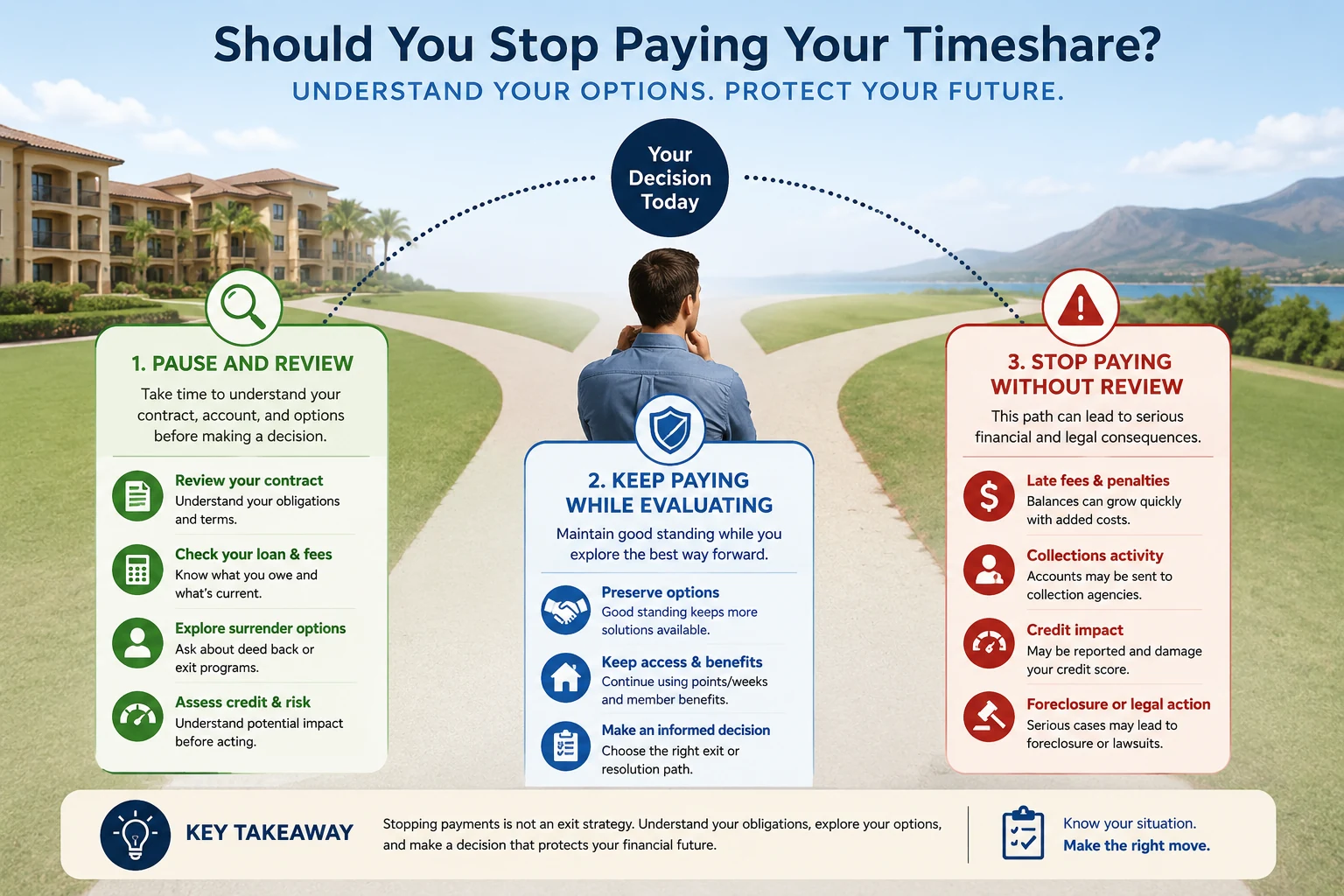
You generally should not stop paying a timeshare without first reviewing what obligation you are defaulting on and what consequences may follow. Stopping payments usually does not automatically cancel the ownership, end future fees, or create a clean exit.
What happens next can depend on whether you stop paying a timeshare loan, maintenance fees, special assessments, membership dues, or another balance. Possible consequences may include late fees, collections, credit reporting, foreclosure exposure, legal action, loss of usage rights, or loss of surrender and transfer options.
System Insight
Stopping Payments Is a Risk Decision, Not an Exit Strategy
Stopping payments may change the account status, but it does not automatically cancel the ownership, end future fees, remove a loan balance, or create a documented release. In many cases, it starts a default path rather than an exit path.
The outcome depends on what is being stopped: a financed loan payment, maintenance fee, special assessment, membership due, or another balance. Each obligation may trigger different consequences, including collections, credit reporting, foreclosure exposure, legal action, or loss of surrender and transfer options.
Why the Type of Payment Matters
Not all timeshare payments create the same risk when they stop.
A missed loan payment may be treated differently from an unpaid maintenance fee. A paid-off ownership may still create annual fee obligations. A membership or travel club agreement may involve different remedies than a deeded timeshare.
That is why the first step is not deciding whether to stop paying. The first step is identifying what obligation you are actually defaulting on and what options may still be available before the account escalates.
Nonpayment Scenarios
Loan Payments vs. Maintenance Fees vs. Paid-Off Ownership
Stopping payment can create very different consequences depending on what kind of obligation is involved. A loan default, unpaid annual fees, and paid-off ownership with ongoing dues are not the same risk profile.
Stopping Timeshare Loan Payments
If the purchase was financed, missed loan payments may create a more direct default and credit-reporting risk.
- Late payments may be reported.
- Interest, penalties, or default charges may continue.
- Collections or foreclosure may become possible.
- A larger balance may increase enforcement pressure.
Stopping Maintenance Fee Payments
If the ownership remains active, unpaid maintenance fees may continue to accumulate even if the purchase loan is paid off.
- Late fees and penalties may be added.
- Reservations or owner benefits may be restricted.
- The account may move to collections.
- Future fees may continue until ownership is resolved.
Paid-Off but Still Billed
A paid-off timeshare may feel less risky, but ongoing fees, assessments, or membership obligations may still continue.
- No loan balance does not mean no obligation.
- Maintenance fees may still be due each year.
- Some surrender options may require good standing.
- Nonpayment may reduce available surrender, transfer, or resolution paths.
Owner takeaway: The risk is not just whether you stop paying. It is what you stop paying, whether the account is still in good standing, and what options may disappear once default begins.
What Usually Happens After You Stop Paying a Timeshare
Stopping payment usually starts a process. It does not usually create an immediate, documented exit.
The first stage is often account delinquency. The resort, developer, lender, association, or management company may send notices, add late fees, charge interest, restrict reservations, or suspend certain owner benefits.
If the balance remains unpaid, the account may move into internal collections or be referred to a third-party collection agency, law office, servicer, or outside collection partner. At that point, communication may become more formal and the balance may include additional costs.
Credit risk may also increase depending on what is unpaid and who reports the account. A financed timeshare loan may create more direct reporting risk, while unpaid maintenance fees may become a credit issue if they are sent to collections or tied to enforcement activity.
In some cases, the account may move toward foreclosure, lien enforcement, legal action, or contract termination, depending on the ownership structure and applicable documents.
The important point is that these outcomes do not happen in the same way for every owner. Some accounts remain in collections. Some are resolved through payment or surrender. Some escalate further. Others may involve different paths depending on whether the timeshare is deeded, right-to-use, financed, paid off, or membership-based.
Stopping payment may eventually lead to an outcome, but it is rarely the same as a clean release. The owner still needs written confirmation showing whether the ownership, account balance, future fees, and any collection activity have actually been resolved.
Before deciding to stop paying, the safer next step is to identify what choices are still available while the account is current or only lightly delinquent. Once the account moves into collections, foreclosure review, or legal escalation, the same options may become harder to access.
Review Your Risk Before You Choose a Path
Before moving from “I might stop paying” to an actual decision, it helps to pause and organize the risk factors.
The best next step depends on whether the issue is a loan, maintenance fee, assessment, membership due, collection balance, or active default. It also depends on whether the account is still in good standing and whether a surrender, deed-back, payment arrangement, transfer, or other documented option may still be available.
That is why the decision should start with structure, not frustration.
Review Your Options Before the Account Escalates
Before moving from “I might stop paying” to an actual decision, it helps to pause and organize the risk factors.
The best next step depends on whether the issue is a loan, maintenance fee, assessment, membership due, collection balance, or active default. It also depends on whether the account is still in good standing and whether a surrender, deed-back, payment arrangement, transfer, or other documented option may still be available.
That is why the decision should start with structure, not frustration.
Then place the Options to Review Before You Stop Paying card block after this bridge.
I’d skip the soft Risk Score CTA in this spot. The page already has the Action Step and will have the final report CTA later. If we want a Risk Score CTA, we can use a lighter one-sentence text link inside the bridge instead of a full visual block.
Free Ownership Review Preview
Not Sure What Matters Most in Your Timeshare Situation?
Timeshare decisions can depend on several factors at once, including ownership type, loan status, annual fees, usage fit, transfer rules, surrender options, resale difficulty, and account standing. The free Ownership Risk Profile™ Preview can help you identify which issues may deserve closer attention before you choose a next step.
Want a quick read on your ownership factors?
Try the Free Preview Free preview • Educational decision support • No exit-company sales pitch❓Frequently Asked Questions
These questions address the most common concerns owners have before deciding whether to stop paying a timeshare loan, maintenance fees, or other recurring obligations.
Should I stop paying my timeshare?
Usually, you should not stop paying without first reviewing what obligation you would be defaulting on and what consequences may follow. Stopping payments may lead to late fees, collections, credit reporting, foreclosure exposure, legal action, or loss of surrender and transfer options.
Does stopping timeshare payments cancel the contract?
No. Stopping payments does not automatically cancel the timeshare, end ownership, stop future fees, or create a documented release. It may change the account status, but the ownership obligation may remain unresolved until there is a formal transfer, surrender, foreclosure, cancellation, or written release.
What happens if I stop paying a timeshare loan?
Missed timeshare loan payments may create direct default risk. Depending on how the lender or developer handles the account, consequences may include late charges, collections, credit reporting, charge-off, foreclosure exposure, or legal enforcement.
What happens if I stop paying timeshare maintenance fees?
Unpaid maintenance fees may lead to late fees, account restrictions, internal collections, third-party collections, credit reporting risk, foreclosure exposure, or legal enforcement depending on the ownership structure and governing documents.
Can stopping payments make it harder to get out of a timeshare?
Yes. Some surrender, deed-back, transfer, hardship, or negotiated resolution options may require the account to be current or in good standing. Once the account moves into default, collections, or foreclosure review, fewer clean options may remain available.
Bottom Line
Stopping timeshare payments is usually not a clean exit strategy.
It may start a default path that can lead to late fees, collections, credit reporting, foreclosure exposure, legal action, account restrictions, or fewer surrender and transfer options. What happens next depends on what you stop paying, whether the timeshare is financed, whether the account is current, and how the contract allows the resort, developer, lender, association, or collector to respond.
The most important question is not only “Can I stop paying?”
It is “What am I defaulting on, what options could I lose, and what written proof would show the timeshare obligation is actually resolved?”
Before stopping payments, review the account structure, unpaid balance, available resolution options, and possible consequences. A decision made out of frustration may be understandable — but it should not be made blindly.
The Wrong Timeshare Exit Move Can Cost More Than the Problem You’re Trying to Solve.
Stopping payments, hiring an exit company, chasing resale promises, requesting a surrender, or transferring ownership can all lead to very different outcomes depending on your contract, loan status, fees, account standing, documents, and developer rules. The Timeshare Decision Intelligence Report™ helps organize those details so you can see which paths appear realistic before you commit to the wrong move.
Get the Timeshare Decision Intelligence Report™ Customized ownership review • Decision-support report • No exit-company sales pitchIndependent decision support. This is not legal advice, contract cancellation, an exit service, a resale service, lender negotiation, or a promise that your timeshare can be exited.
Related Guides
If you are deciding whether to stop paying your timeshare, these guides can help you understand the specific risk paths before you make a payment decision:
What Happens If You Stop Paying Timeshare Maintenance Fees?
Read this if your main concern is annual maintenance fees, late charges, future billing, or whether nonpayment ends the ownership.
What Happens When Timeshare Maintenance Fees Go to Collections?
Use this guide if your account has already been referred to collections or you want to understand what a collection notice may mean.
What Happens If You Inherit a Timeshare?
If the timeshare came through an estate, review how acceptance, ownership records, unpaid fees, and account status may affect responsibility before deciding whether to pay, refuse, transfer, or seek another option.
Can’t Afford Your Timeshare Anymore?
Review what to check before stopping payments, including loan balance, maintenance fees, account status, surrender options, resale limits, collections risk, and possible next steps.
Can a Timeshare Affect Your Credit Score?
Review this if you are concerned about missed payments, collection reporting, foreclosure reporting, or other credit consequences.
Can a Timeshare Be Foreclosed On?
Read this if you want to understand when unpaid loans, fees, assessments, or lien rights may lead to foreclosure of the timeshare interest.
Can a Timeshare Put a Lien on Your House?
Use this guide if you are worried that unpaid timeshare debt could affect property beyond the timeshare itself.
Timeshare Exit Guide
Before treating nonpayment as your next move, compare the broader exit paths that may apply based on your ownership, account status, and financial pressure.
How Timeshare Exit Companies Work
See how exit companies may handle communication, payment guidance, account strategy, and timelines before assuming an exit service protects you from payment-related risk.