
Timeshare Exit Verification Guide
How to Know If Your Timeshare Exit Is Really Complete
Signing paperwork, hiring an exit company, completing a transfer, or receiving a verbal confirmation does not necessarily mean every timeshare obligation has ended.
A completed exit should be supported by records showing what happened to the ownership, account, future fees, and any separate financing. The goal is not simply to prove that an exit process occurred. It is to verify that the parties controlling your obligations actually recognized the result.
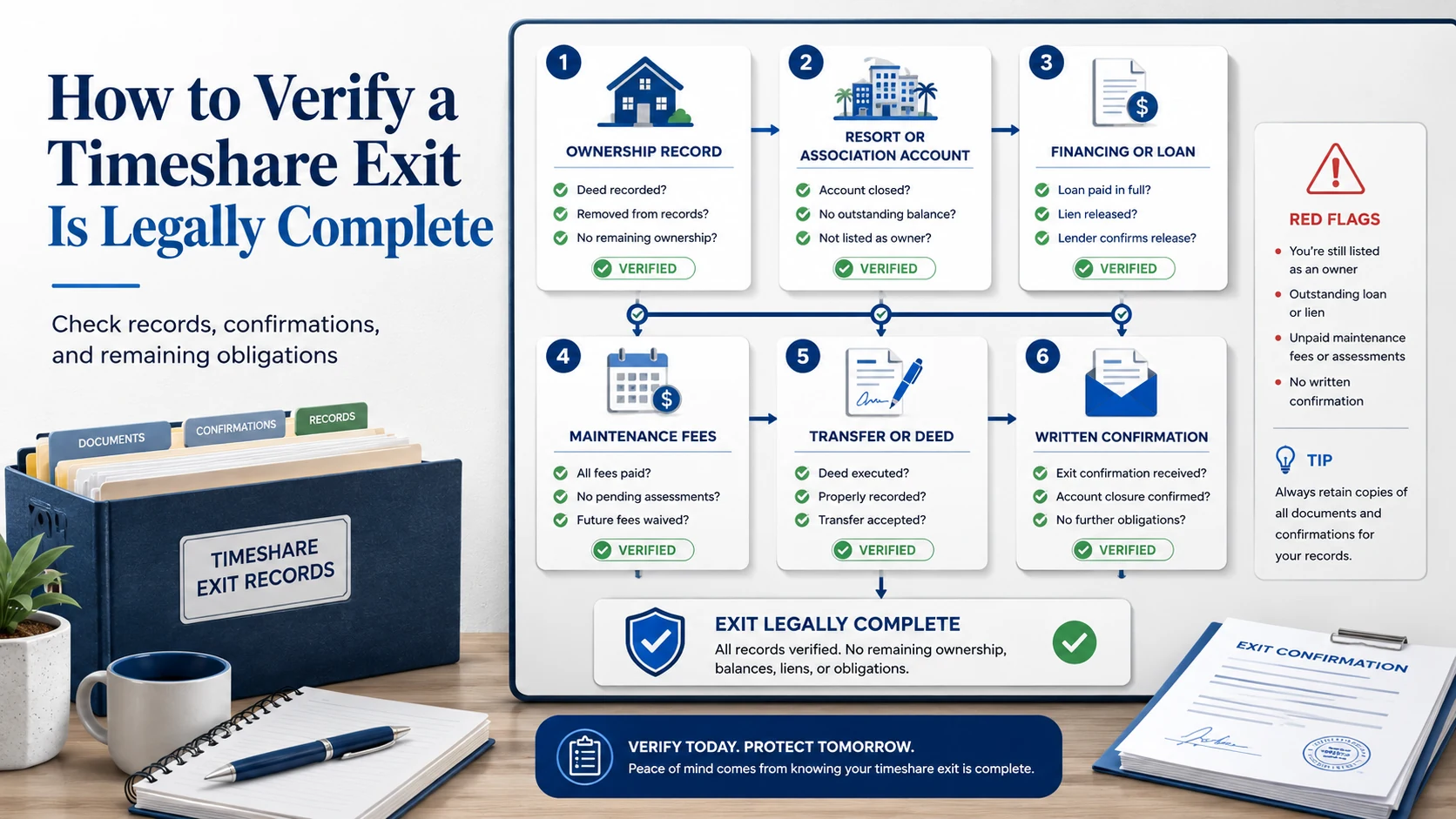
About This Guidance: TTCA evaluates timeshare exit completion by looking beyond the exit provider’s promise or paperwork to the records that actually control the owner’s continuing obligations. This guidance focuses on ownership and membership status, resort or association records, maintenance-fee responsibility, financing, transfer or cancellation documentation, and the practical signs that an exit has—or has not—been fully recognized.

How It Works
How to Verify That a Timeshare Exit Actually Ended Your Obligations
Exit paperwork is only one part of the process. The strongest verification comes from checking the records and obligations that existed before the exit and confirming that each now reflects the expected result.
TTCA Framework Insight: A timeshare exit should be evaluated as a chain of records and obligations, not as a single piece of paperwork. The stronger the agreement among ownership records, billing records, financing records, and final documentation, the more confidence you can have that the exit is truly complete.
Important Distinction
Choosing an Exit Path Is Different From Verifying That It Was Completed
Exit-strategy guides and comparison pages help owners understand how rescission, surrender, deed-back, resale, transfer, negotiated resolution, professional review, and other pathways differ. This page is not intended to compare those options or determine which one an owner should choose.
The question here begins after an exit pathway has been pursued: whether the authorized parties accepted the result, the relevant ownership and account records were updated, future fees ended, any separate financing was addressed, and written evidence confirms what obligations remain.
Before You Rely on an Exit Confirmation
One Document May Not Resolve Every Timeshare Obligation.
Ownership records, resort accounts, maintenance-fee responsibility, transfer approvals, and financing may be handled by different parties. The Timeshare Decision Intelligence Report™ can help organize the documents, identify unresolved obligations, and highlight which records or confirmations may still require verification.
Need help identifying what may still be unresolved?
Review the Report Option Or continue with the verification steps belowOwner takeaway: The question is not only whether an exit path sounds legal. The question is whether it produces written proof showing what ended, who accepted it, and whether any ownership, loan, maintenance fee, or transfer obligations remain.
Legal Exit Clarity
Not Every Exit Attempt Is a Legal Exit
Many timeshare exit problems come from confusing an action with a completed result. The legal question is not only what step was taken, but whether that step actually ended or transferred the obligation.
Legal Exit Path
A path that results in written cancellation, rescission, surrender acceptance, completed transfer, release, settlement, or another documented resolution recognized by the appropriate party.
Risky Shortcut
A move that may feel like an exit but leaves the obligation active, such as stopping payments, relying on verbal promises, ignoring notices, or assuming a transfer is complete without confirmation.
Support Service
An attorney, exit company, transfer service, or advisor may help pursue a result, but the service itself is not the legal exit unless it produces documentation that resolves the ownership.
This is why legal exit planning should focus on proof of resolution, not just the name of the method being used.
Why Ownership, Financing, and Fees May Be Separate Obligations
A timeshare relationship may involve several agreements and account systems rather than one single obligation.
The ownership or membership interest may be governed by the purchase agreement, deed, club documents, or transfer records. Financing may be controlled by a separate loan agreement. Maintenance fees, assessments, dues, taxes, or club charges may be billed through the developer, resort, association, or management company.
Because those responsibilities can be handled separately, resolving one does not always prove that the others ended.
When the household has more than one timeshare, vacation-club, or travel-club product, first identify every ownership and obligation so each contract, membership, loan, and fee account can be verified separately.
For example:
- A deed or ownership transfer may be completed while a separate loan remains active.
- A surrender may be accepted while an unpaid maintenance-fee balance still requires resolution.
- A membership may be terminated without automatically canceling linked financing.
- A settlement may address a delinquent account without transferring or canceling the ownership.
- A resort account may be closed while public ownership records still show the former owner’s name.
- An exit company may finish its contracted service before every account or record has been updated.
This is why the final documentation should be compared across the records that apply to the ownership.
Confirm whether:
- the ownership or membership record changed
- the resort or association account was updated
- future billing stopped
- any loan, lien, or financing balance was resolved
- delinquent balances or collection accounts were addressed
- the effective dates are consistent
- the documents clearly identify which obligations ended and which, if any, remain
A complete verification should not rely on one document viewed in isolation. The stronger evidence is a consistent set of records showing that the ownership, account, fees, and financing have each been addressed.
Free Ownership Review Preview
Not Sure Which Timeshare Obligations May Still Be Active?
A claimed exit may leave unanswered questions involving ownership records, financing, maintenance fees, transfer approval, account closure, or collection balances. The free Ownership Risk Profile™ can help identify which areas may require further verification.
- Identify ownership, financing, fee, or account issues that may remain unresolved.
- Review which documents, approvals, or record updates may still be missing.
- See which questions deserve attention before relying on an exit confirmation.
Get a quick read on the factors that may affect whether the exit is truly complete.
Try the Free Ownership Risk Profile™ Free preview • Educational decision support • No exit-company sales pitchRisk Point
An Incomplete Exit Can Leave Ownership or Account Obligations Active
A submitted transfer, surrender request, service agreement, recorded document, settlement discussion, or verbal confirmation may resolve only part of the relationship. If the appropriate ownership, billing, association, financing, or collection records were not updated, the former owner may still receive fees, statements, notices, or collection demands.
Conflicting records are a warning sign. Do not assume the exit is complete when one party confirms a change but another still shows an active ownership, unpaid loan, open account, continuing maintenance-fee responsibility, or unresolved balance.
Exit Completion Checklist
How to Verify That the Timeshare Exit Was Actually Completed
Start with the final documents you received, then compare them with the ownership, account, billing, financing, and collection records that should have changed. Before comparing those records, review Timeshare Ownership Documents Explained: What Each Record Tells You to understand what each document may—and may not—prove.
Review the Effective Date and Scope
Confirm that the cancellation, surrender, transfer, release, settlement, or closure document identifies the owners, contract or account, resort or club, effective date, and the obligation being resolved.
Confirm the Ownership Record
Verify that the developer, vacation club, resort, association, or transfer department no longer lists you as the active owner or member.
For a deeded interest, confirm that any required transfer or recording was completed.
Confirm the Resort and Billing Account
Obtain written confirmation that the account was closed or transferred and that future maintenance fees, assessments, dues, taxes, or related charges are no longer your responsibility.
A stopped automatic payment does not prove the obligation ended.
Verify Financing and Outstanding Balances
Confirm separately whether any loan, lien, maintenance-fee balance, assessment, or collection account was paid, canceled, released, settled, transferred, recalled, or otherwise resolved.
Do not assume that changing the ownership record automatically ends separate financing.
Monitor the Records After Completion
Watch for new invoices, annual-fee statements, loan notices, collection communications, association correspondence, or other records issued after the stated effective date.
Continuing charges or notices may indicate that one or more records were not updated.
Action Step
Request Written Confirmation From Every Party That Controls an Obligation
When the records are incomplete or inconsistent, contact the organization responsible for each ownership, billing, transfer, financing, or collection issue and ask for a written status confirmation.
Identify the exact contract or account by owner name, membership or contract number, resort, and effective date.
Ask whether the ownership is active, transferred, surrendered, canceled, or closed in that party’s current records.
Confirm the effective date and whether any approval, signature, recording, or processing step remains incomplete.
Ask whether future fees or billing remain and whether the account currently shows any balance.
Verify financing and collections separately rather than assuming an ownership change resolved those accounts.
Save the response with the exit documents and note any conflicting information that still requires follow-up.
Quick Win
Use one verification question with every organization: “Please confirm in writing whether this account or obligation has been fully closed, transferred, released, or otherwise resolved—and identify anything that remains outstanding.”
When Professional Review May Be Appropriate
Not every timeshare exit requires professional review. Clear cancellation confirmations, completed transfers, accepted surrender documents, closed accounts, and resolved financing may provide enough evidence for an owner to verify the result directly.
Independent review may be worth considering when the records do not agree or the remaining obligations are unclear.
Examples include:
- the resort says the ownership was transferred, but the association continues billing you
- a deed was recorded, but the developer or club still lists you as the owner
- a surrender was accepted, but no written release explains whether future fees ended
- the ownership account was closed, but a separate loan remains active
- collection notices continue after a settlement or claimed account closure
- an exit company says the process is complete but cannot provide final documents from the parties controlling the ownership
- the effective dates, balances, owner names, or account numbers conflict across documents
- the developer, lender, association, or transfer department disputes whether the exit was valid
- foreclosure, lien, credit-reporting, estate, tax, or title concerns remain unresolved
The type of professional review should match the unresolved issue. A qualified attorney may be appropriate when there are questions about contract rights, title, releases, collections, foreclosure, or disputed obligations. A title or closing professional may help clarify recording or transfer records. A tax or financial professional may be appropriate when a settlement, debt resolution, or transfer creates financial-reporting questions.
The purpose of outside review is not simply to obtain reassurance. It is to determine which obligation remains active, which party controls it, what documentation is missing, and what action may be needed to correct or clarify the record.
Before paying for assistance, provide the complete exit file rather than only the final letter or agreement. The reviewer may need to compare the original contract, ownership documents, financing records, account statements, transfer paperwork, correspondence, and claimed proof of completion.
❓ Frequently Asked Questions
These questions address the documents, approvals, account updates, and remaining obligations that may determine whether a claimed timeshare exit was actually completed.
What document proves that a timeshare exit is complete?
There may not be one universal document. Proof could include a written cancellation confirmation, accepted surrender or deed-back agreement, completed transfer confirmation, recorded ownership document when applicable, signed release, settlement agreement, or account-closure notice.
The documentation should identify the ownership or account, the effective date, the party recognizing the result, and what obligations ended. It should also be compared with billing, financing, association, and ownership records.
Is a recorded deed enough to prove that I am no longer responsible?
Not necessarily. A recorded deed may show that a deeded interest changed hands, but it may not prove that the developer, resort, association, or billing department updated its records.
It also may not resolve a separate loan, lien, unpaid maintenance fees, assessments, or collection balance. Confirm the transfer across every record connected to the ownership.
Does an accepted deed-back or surrender automatically end future maintenance fees?
The written acceptance should explain the effective date and whether future fees have ended. Do not assume that submitting a request or signing preliminary paperwork stops future billing.
Confirm that the ownership and billing accounts were updated and ask whether any final fee, processing charge, assessment, or past-due balance remains.
Can a timeshare loan remain after the ownership is transferred or surrendered?
Yes. Financing may be governed by a separate agreement and controlled by a different lender or account servicer.
An ownership transfer, surrender, or membership termination should not be assumed to cancel the loan. Obtain separate written confirmation showing whether the financing was paid, released, settled, transferred, or remains active.
Is a letter from an exit company proof that the timeshare is gone?
Not by itself. An exit company’s letter may describe the work it performed, but the stronger evidence comes from the parties that control the ownership, transfer, financing, association, and billing records.
Ask for the final cancellation, surrender, transfer, release, settlement, or account-closure documents that support the company’s claim.
What should I do if the resort continues billing me after the exit date?
Compare the invoice with the effective date and scope of the exit documents. Then contact the organization issuing the bill and provide copies of the relevant confirmation or transfer records.
Ask for a written explanation of why the account remains active, which record has not been updated, and whether the charge relates to a period before or after the stated completion date.
Who should confirm that the timeshare account was closed?
The appropriate party depends on the account. The developer or vacation club may confirm membership status, while the resort, association, or management company may control annual fees and billing.
A lender, transfer department, title provider, collection agency, or account servicer may need to confirm other obligations separately.
What if the exit documents and account records do not agree?
Conflicting records suggest that the exit may be incomplete or that one organization has not processed the change. Identify which record is inconsistent and contact the party responsible for maintaining it.
Ask for written clarification and preserve all correspondence. Independent legal, title, financial, or other professional review may be appropriate when ownership, financing, billing, collection, or release records remain disputed.
How long should I keep my timeshare exit documents?
Keep the complete exit file for the long term, including the original contract, transfer or surrender documents, written acceptance, account-closure records, loan resolution, delivery evidence, and final statements.
These records may be needed later if billing resumes, ownership records conflict, collection activity appears, or questions arise about the effective date or scope of the exit.
Bottom Line: Verify the Records, Not Just the Promise
A timeshare exit should be considered complete only when the appropriate parties have recognized the result and the relevant ownership, account, billing, financing, and collection records reflect that change.
Signing paperwork, submitting a transfer, hiring an exit company, recording a document, or receiving a verbal assurance may be part of the process, but none of those steps alone proves that every obligation ended.
Look for a consistent paper trail showing:
- what ownership, membership, or account was resolved
- who accepted or authorized the result
- when the change became effective
- whether ownership and billing records were updated
- whether future maintenance fees and assessments ended
- whether financing, liens, or outstanding balances were addressed
- whether any obligation remains active
When the documents and records do not agree, treat the exit as requiring further verification rather than assuming the process is finished.
For owners who have not yet pursued an exit and are still deciding where to begin, see our broader guide: How to Get Out of a Timeshare: Where to Start Before Choosing an Exit Strategy
Timeshare Decision Intelligence Report™
Need Help Understanding What Your Exit Documents Actually Resolve?
A Timeshare Decision Intelligence Report™ can organize the documents you have, identify material findings and unresolved obligations, highlight verification gaps, and clarify which ownership, financing, billing, or account questions may still require attention.
- Review ownership and contract documents
- Identify unresolved obligations
- Highlight conflicting or missing records
- Clarify recommended next steps
Related Guides
If you are still comparing legal exit paths, these related guides can help you understand the broader options, costs, and risks before you act.
Exit Planning and Comparison
- How to Cancel a Timeshare Contract
Learn how rescission differs from broader exit options and why timing, loan status, and account standing matter. - Cost to Get Out of a Timeshare
Compare surrender costs, resale losses, legal fees, exit-company quotes, and unpaid balance issues. - Timeshare Exit Options Explained
Compare the main exit paths and when each option may or may not apply.
Surrender and Transfer Documentation
- Timeshare Exit Programs: Can You Give a Timeshare Back to the Developer?
Understand developer surrender, deed-back, voluntary-return, and hardship-style programs.
Billing and Account Obligations
- What Happens If You Stop Paying Timeshare Maintenance Fees?
Review the risks before using nonpayment as leverage or assuming it will end the ownership. - Can a Timeshare Affect Your Credit Score?
See how missed payments, collections, and default may affect your credit.
Third-Party Exit Assistance
- Timeshare Exit Companies: How They Work, Costs, and What to Know
Review how providers work before paying for or relying on a promised cancellation strategy. - Are Timeshare Exit Companies Legit or a Scam?
Identify warning signs, questionable guarantees, pressure tactics, and missing proof.