
Timeshare Exit Company Verification Guide
Are Timeshare Exit Companies Legit? Red Flags to Check Before Paying
Some timeshare exit companies provide real services. That does not mean every company, promise, or proposed strategy deserves your trust.
A professional website, positive reviews, attorney references, or a money-back guarantee can make an offer appear credible. The stronger test is whether the company’s identity, promised work, fees, refund terms, professional relationships, and definition of a successful exit can all be verified in writing.
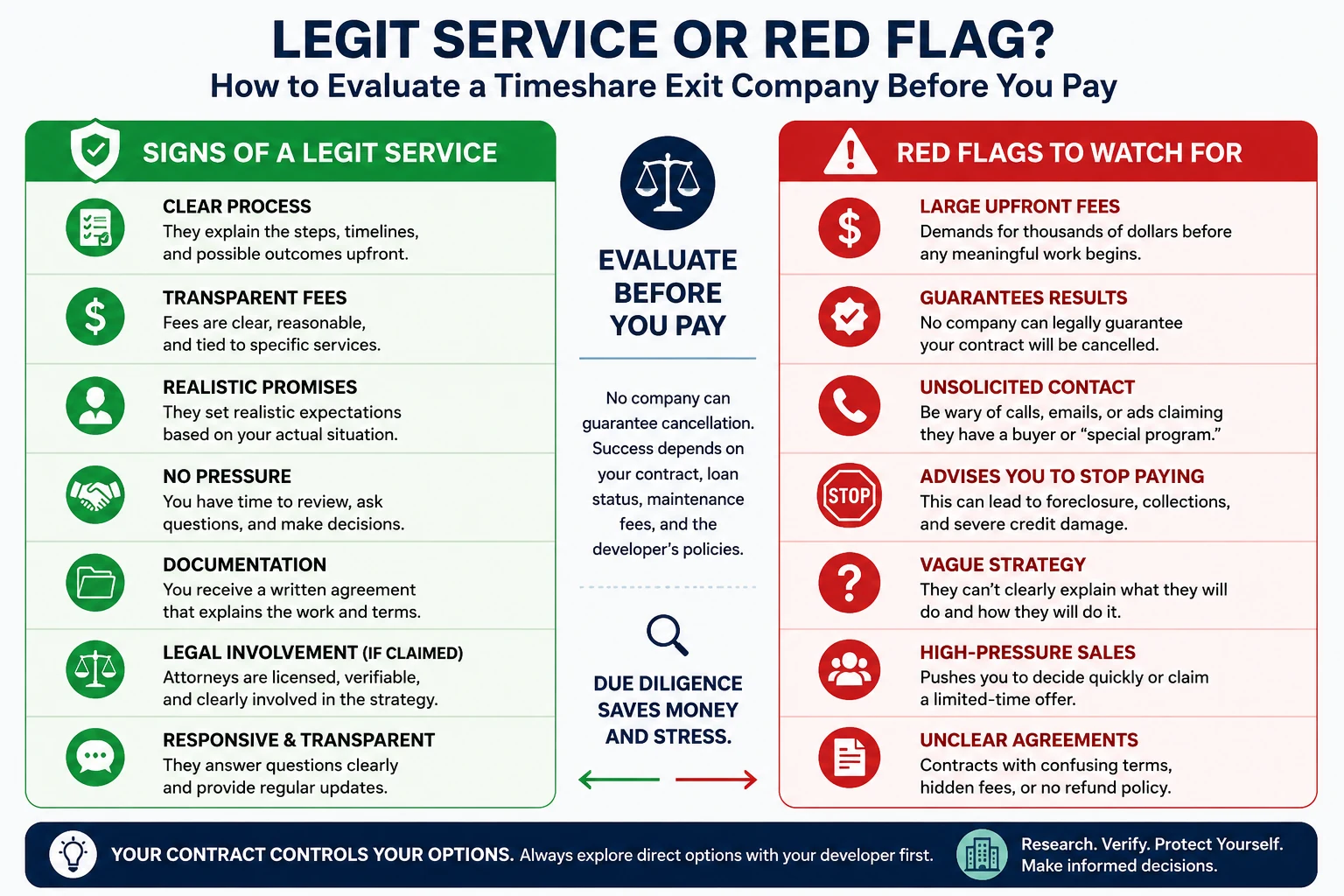
About This Guidance: TTCA evaluates timeshare exit companies by separating whether a business appears legitimate from whether its proposed strategy, fees, contract terms, and promised outcome are actually appropriate for the owner. This guidance focuses on company verification, written service agreements, attorney or professional involvement, upfront fees, refund conditions, stop-payment recommendations, review and rating claims, and the documentation needed to confirm what the company will do and what a successful exit would mean.

How It Works
How to Evaluate a Timeshare Exit Company Before You Pay
A legitimate-looking business is only the starting point. Evaluate the company, the service being sold, the written agreement, and the promised outcome as separate parts of the same decision.
TTCA Framework Insight: Business legitimacy and exit effectiveness are not the same question. A real company can offer an expensive or inappropriate strategy, so the provider, process, contract, and outcome should each be verified before payment.
Before You Trust the Sales Pitch
A Credible-Looking Company Can Still Offer the Wrong Strategy for Your Ownership
Reviews, attorney references, guarantees, and polished sales materials do not confirm that the proposed service fits your contract or account. The Timeshare Decision Intelligence Report™ helps organize your ownership documents, loan status, account standing, transfer limits, unresolved questions, and material risks before you rely on a costly third-party promise.
Need an independent review before signing?
Review the Report Option Or continue with the credibility checks belowA timeshare exit company may look legitimate from the outside, but the real test is not the logo, sales pitch, or number of promises. The real test is whether the company explains its process clearly, ties its strategy to your actual contract, and avoids advice that could create more risk than relief.
Important Distinction
A Real Business Is Not Proof That Its Exit Claims Are Credible
A company may be properly formed, maintain an office, advertise nationally, collect positive reviews, or work with attorneys and still make claims that are difficult to verify. Basic business legitimacy tells you that the company exists. It does not prove that its promised result, timeline, refund protection, or legal strategy is reliable.
Evaluate the specific offer—not only the company’s appearance. The service agreement, written deliverables, fee terms, attorney relationship, payment advice, and explanation of what happens if the exit fails provide stronger evidence than branding or sales confidence alone.
For a broader explanation of exit-company services, costs, and the typical process, see Timeshare Exit Companies: How They Work, Costs, Risks, and Alternatives.
Evaluate the Offer, Not Just the Company Name
A legitimacy check should move beyond whether the business exists and focus on whether the specific offer can be verified.
Before relying on reviews, guarantees, or attorney references, compare the sales presentation with the written agreement. The most important questions are often found in the details the company is willing—or unwilling—to put in writing.
Review four areas separately:
- The company: Confirm its legal business name, physical address, contact information, ownership, and how long it has operated under that name.
- The service: Identify the exact work being promised, who will perform it, and what written deliverables you will receive.
- The payment terms: Review the upfront amount, added fees, refund conditions, cancellation rights, and any deadlines that could limit recovery.
- The claimed outcome: Ask what the company means by “exit,” “cancellation,” “resolution,” or “success,” and which outside party must approve or confirm that result.
Pay close attention when the sales representative makes stronger promises than the agreement.
Statements such as “we guarantee cancellation,” “our attorneys will handle everything,” or “you will never pay another maintenance fee” should appear clearly in the written contract if they are truly part of the service. If the agreement uses narrower language, broad disclaimers, or a different definition of success, rely on the agreement—not the verbal promise.
Also ask what happens if the developer refuses, the strategy changes, the case takes longer than expected, or the company closes the file without obtaining the result you expected.
A credible offer should become clearer as you review the paperwork. If the details become more vague, restrictive, or difficult to explain, that is a reason to pause before paying.
Trust Check
Credibility Signals vs. Exit Company Red Flags
No single signal proves that an exit company is trustworthy. Look for consistency between the sales presentation, written agreement, company identity, fee terms, professional relationships, and the evidence the company is willing to provide before payment.
More Credible Signals
What a Verifiable Offer Looks Like
Consistent business identity
The legal name, address, website, agreement, payment recipient, and representatives can be connected to the same business.
Specific written deliverables
The agreement identifies what work will be performed, who will perform it, and what documentation the owner will receive.
Transparent fees and refund terms
The total price, added charges, refund conditions, deadlines, and definition of a successful result are clearly stated.
Verifiable professional involvement
Attorneys, law firms, contractors, or other partners are identified, along with their actual role and whom they represent.
Claims match the agreement
The promises made during the sales call are consistent with the written contract rather than narrowed by disclaimers or exclusions.
Time to review before signing
The company allows the owner to read the agreement, ask questions, verify claims, and consider alternatives without pressure.
Red Flags
What Should Make You Pause
Guaranteed cancellation claims
The company promises a certain result before fully reviewing the contract, financing, account status, or developer rules.
Verbal promises missing from the contract
Sales representatives make broad assurances that do not appear in the written agreement or are limited by fine print.
Large upfront fees with vague deliverables
Payment is required before the company clearly identifies the work, documentation, milestones, or refund protections.
Unclear attorney or legal-team claims
The company references legal support but will not identify the attorney, explain the relationship, or confirm who represents the owner.
Stop-payment advice without written risk disclosure
The owner is encouraged to stop paying without a clear explanation of possible collections, credit, foreclosure, or account consequences.
Pressure to sign immediately
The salesperson uses fear, expiring discounts, urgent deadlines, or claims that verification will jeopardize the opportunity.
How to Verify a Legitimate Timeshare Exit Company
Before evaluating promises or reviews, confirm which business is actually asking for your money.
Exit companies may advertise under a brand name that differs from the legal entity named in the agreement or receiving payment. That does not automatically indicate a problem, but the relationship should be clear and verifiable.
Check:
- The legal business name: Compare the website, service agreement, invoice, payment recipient, and refund policy.
- The physical address and contact information: Confirm that the company provides more than a mailbox, intake form, or sales number.
- Business-registration records: Look for the legal entity, formation date, current status, and names connected to the company.
- Attorney licensing: Verify any named attorney directly through the appropriate licensing authority rather than relying only on the company’s website.
- Complaint patterns: Look for repeated concerns involving refunds, undisclosed fees, pressure tactics, stop-payment advice, or unclear results.
- Recent name or ownership changes: Determine whether the company previously operated under another name or whether complaints refer to a related business.
- The payment recipient: Ask why payment is being made to a different company, law firm, financing provider, or processor when the names do not match.
Use the company’s legal name, not only its marketing name, when reviewing agreements and public information.
A mismatch does not necessarily prove misconduct. But the company should be able to explain clearly who is contracting with you, who receives the money, who performs the work, and which entity is responsible for refunds or disputes.
How to Evaluate Timeshare Exit Company Reviews and Ratings
Reviews can help identify patterns, but they should not be treated as proof that an exit company will produce the same result for every owner.
Positive testimonials often emphasize relief, communication, or a successful outcome. Negative reviews may focus on delays, refund disputes, limited updates, or results that did not match the sales presentation. Both can be useful, but only when the details are specific enough to evaluate.
Look for:
- Specific descriptions of the service: Credible reviews explain what the company actually did, how long the process took, and what documentation the owner received.
- Patterns across multiple sources: Repeated concerns about refunds, communication, pressure, or unclear results deserve more attention than one isolated complaint.
- Recent reviews: A company’s staff, ownership, service model, or contract terms may change over time.
- Responses to complaints: Review how the company addresses disputes, refund requests, missed expectations, and questions about completion.
- Evidence of the claimed outcome: A review saying “they got me out” is more useful when it explains whether the developer, lender, or resort confirmed the result.
- Signs of promotional language: Be cautious when many reviews use nearly identical wording, make broad claims without detail, or focus more on the salesperson than the outcome.
Also separate reviews about the sales experience from reviews about the completed service. A friendly consultation or responsive enrollment process does not prove that the ownership was later released.
The most useful reviews help you understand what happened after payment: what work was performed, how the company communicated, whether the strategy changed, how disputes were handled, and what written evidence confirmed the final result.
Owner takeaway: A credible-looking company is not enough. The strongest evidence is whether its sales claims, written agreement, refund terms, professional relationships, payment advice, and definition of success all tell the same clear and verifiable story.
How to Read Guarantees and Refund Terms
A money-back guarantee can sound reassuring, but its value depends entirely on how the agreement defines success, failure, eligibility, and the owner’s responsibilities.
Do not rely on the word “guarantee” by itself. Review the written terms for:
- The definition of a successful exit: The agreement may treat a deed transfer, foreclosure, loan settlement, account closure, or another outcome as success—even if that is not what the salesperson described.
- The refund deadline: Some guarantees require the owner to wait a specified period before requesting a refund.
- Owner-compliance requirements: A refund may be denied if the owner misses a payment, contacts the developer, fails to provide documents, rejects a proposed resolution, or does not follow company instructions.
- Excluded fees: Administrative, legal, filing, transfer, financing, or third-party charges may be nonrefundable even when the main service fee is covered.
- The request procedure: The agreement may require written notice within a narrow window or submission to a specific address.
- The company’s right to extend the process: Some contracts allow additional time before the owner becomes eligible for a refund.
- The dispute provision: Arbitration clauses, venue requirements, and limits on damages can affect how difficult it is to challenge a denied refund.
Compare the refund language with the sales presentation. If a representative says, “You get all your money back if we do not get you out,” ask where that exact protection appears in the agreement.
Also ask what event triggers a refund. Is it based on the developer refusing the request, the company failing to complete specific work, or the passage of a certain amount of time?
A credible refund policy should be understandable before payment. If the protection depends on broad company discretion, difficult procedural requirements, or a definition of success that differs from what you expected, the guarantee may provide less security than the sales pitch suggests.
How to Verify Attorney and Legal-Team Claims
References to attorneys or a “legal team” can make an exit-company offer sound more authoritative, but those terms do not always explain who is actually providing legal services.
Before relying on that claim, ask:
- Which attorney or law firm is involved? Request the full name, firm, office location, and state where the attorney is licensed.
- Who does the attorney represent? An attorney may represent the exit company rather than the individual owner.
- What legal work is included? Confirm whether the attorney will review the contract, provide advice, send correspondence, negotiate, file a claim, or only be available for limited consultation.
- Is the attorney named in the agreement? General references to a legal network or affiliated counsel are less useful than a clearly identified professional relationship.
- Will you communicate directly with the attorney? Ask whether you will receive an engagement letter, contact information, and copies of any legal correspondence.
- Are legal fees included? Confirm whether attorney services are part of the quoted price or may create additional charges later.
- What happens if legal review finds no viable claim? The agreement should explain whether the strategy changes, the service continues, or any refund rights apply.
Be cautious when a salesperson uses phrases such as “attorney-backed,” “legal cancellation,” or “our lawyers handle everything” but cannot identify the attorney or describe the legal work in writing.
A credible legal relationship should be verifiable before payment. The attorney’s role, client relationship, scope of work, fees, and communication process should be clear—not implied by marketing language alone.
Risk Point
Stop-Payment Advice Can Turn a Credibility Question Into an Account Problem
A company may be a real business, reference attorneys, and provide an actual service while still recommending payment changes that expose the owner to late fees, collections, credit reporting, foreclosure, or the loss of direct developer options.
Before following that advice, require a written explanation identifying who is making the recommendation, which payments are affected, what consequences may follow, and what responsibility the company accepts if the account escalates.
How to Evaluate Stop-Payment Advice
Stop-payment advice deserves closer scrutiny because it can create consequences separate from the exit-company service.
Before following that recommendation, ask:
- Who is giving the advice? Confirm whether it comes from a salesperson, case manager, attorney, or another professional.
- Which obligations are affected? Loan payments, maintenance fees, taxes, assessments, and club dues may create different risks.
- Why is nonpayment part of the strategy? The company should explain what result it expects and whether that outcome depends on collections, foreclosure, negotiation, or another escalation.
- What consequences may follow? Request a written explanation of possible late fees, credit reporting, collection activity, legal notices, or loss of direct developer options.
- What role will the company play if the account escalates? Ask who responds to collection letters, lender demands, or legal notices—and whether additional help costs extra.
- Is there an alternative if you keep paying? A credible provider should explain whether another strategy remains available.
Be cautious when nonpayment is described as routine, harmless, or certain to produce an exit. The recommendation, expected exposure, and company responsibilities should all be documented before any payment behavior changes.The recommendation, rationale, expected exposure, and company responsibilities should all be documented before payment behavior changes.
System Insight
The Written Agreement Becomes the Working Definition of the Service
- The legal entity on the agreement should connect clearly to the advertised brand and the business receiving payment.
- Attorney or law-firm involvement should be independently verifiable rather than supported only by marketing language.
- Sales promises should appear in the written agreement without being narrowed by conflicting disclaimers or exclusions.
- The refund policy should use the same definition of success that the salesperson used when describing the service.
- The company should be able to explain who is responsible for the work, updates, payment advice, refunds, and dispute resolution.
What a Credible Agreement Should Define
A credibility check should eventually lead back to the written agreement.
Before signing, confirm that it identifies:
- The legal entity providing the service and receiving payment
- The specific work, deliverables, and people responsible
- The total fee, payment schedule, and any added or nonrefundable charges
- How success and completion are defined
- The refund conditions, deadlines, and owner responsibilities
- What happens if the original strategy is rejected or does not work
Pay particular attention to terms that allow the company to change the strategy, extend the timeline, close the case, or define success differently from the sales presentation.
A credible agreement does not need to promise a result. It should clearly explain what the company will do, what the owner must do, what the service costs, and what protections apply if the expected outcome is not achieved.
Action Step
Verify These Details Before Signing an Exit-Company Agreement
Turn the company’s sales claims into specific facts you can confirm independently and compare with the written agreement.
Confirm the legal business identity and make sure the agreement, payment recipient, website, and refund policy refer to the same company.
Compare every verbal promise with the contract and ask that important guarantees, timelines, and deliverables be added in writing.
Verify attorney or law-firm claims independently and confirm who the attorney represents and what legal work is included.
Read the refund terms closely, including the definition of success, owner obligations, excluded charges, and request deadlines.
Research complaint patterns and recent reviews using the company’s legal name rather than relying only on testimonials shown by the seller.
Request all payment and account instructions in writing before changing loan payments, maintenance fees, or developer communication.
Quick Win
Ask the salesperson to identify the exact contract language supporting the strongest promise made during the call. If the written agreement does not match the claim, rely on the agreement—not the sales pitch.
These checks help evaluate the provider and its agreement. The next question is whether the proposed strategy fits the ownership facts the company may be relying on, including financing, account standing, transfer restrictions, and direct developer options.
Company credibility is only one layer of the decision. Before paying, compare the service with what the owner could pursue directly and ask what additional work, expertise, or documented value the company will provide for its fee.
Decision Insight
Legitimacy and Suitability Are Two Separate Decisions
Confirming that a company is real, its professional relationships are verifiable, and its agreement matches the sales presentation is an important first step. But those checks do not establish that the proposed service is necessary, appropriately priced, or suited to the owner’s situation.
Before paying, compare the company’s strategy with the ownership documents, financing, account standing, direct developer options, transfer restrictions, and expected outcome. A credible provider should be able to explain why its paid service is appropriate and what it will provide beyond options the owner may already have.
❓ Frequently Asked Questions
These questions address the most common credibility concerns owners should resolve before trusting an exit-company sales presentation or signing a service agreement.
Are timeshare exit companies legit, or are they scams?
Some companies provide real services, but legitimacy and service quality vary. A company should be able to verify its identity, explain its strategy, disclose its fees and refund terms, identify who performs the work, and place its strongest promises in the written agreement.
Guaranteed cancellation claims, vague deliverables, pressure tactics, unclear attorney involvement, large upfront fees with limited protections, and undocumented stop-payment advice are reasons to pause.
Does a money-back guarantee prove that an exit company is trustworthy?
No. The value of a guarantee depends on how the agreement defines success, refund eligibility, owner responsibilities, excluded charges, deadlines, and the procedure for requesting repayment. The written terms may provide less protection than the sales description suggests.
Is paying a large upfront fee automatically a red flag?
An upfront fee does not by itself prove misconduct, but it increases the importance of understanding exactly what work will be performed, what charges are refundable, what happens if the strategy does not produce the expected result, and whether important promises appear in the agreement.
Does attorney involvement prove that an exit company is legitimate?
No. Ask which attorney or law firm is involved, where the attorney is licensed, who the attorney represents, what legal work is included, whether you will receive an engagement letter, and whether legal fees are included in the quoted price.
Can I trust online ratings and reviews of timeshare exit companies?
Reviews can help identify patterns, but star ratings alone do not verify a company’s strategy or results. Look for detailed reviews discussing the work performed, communication after payment, refund disputes, timelines, and the documentation received at completion.
Separate reviews describing a friendly sales experience from reviews that explain the completed service and final outcome.
Do legitimate exit companies buy timeshares from owners?
Most exit companies sell services rather than purchase the ownership themselves. When a company claims that it or another party will buy the timeshare, ask for the buyer’s identity, purchase price, closing process, transfer costs, qualification requirements, and written proof showing when responsibility for the ownership ends.
Should I trust an exit company that tells me to stop paying?
Treat stop-payment advice cautiously. Ask who is making the recommendation, which payments are affected, what outcome the company expects, what collection or credit consequences may follow, and what responsibility the company accepts if the account escalates.
Bottom Line
Some timeshare exit companies provide real services, but a professional website, positive reviews, attorney references, or a money-back guarantee does not establish that a specific offer is trustworthy or appropriate.
Before paying, verify the company’s legal identity, written deliverables, total fees, refund conditions, professional relationships, payment advice, and definition of success. Those details should remain consistent from the sales presentation through the service agreement.
The final question is not simply whether the company exists. It is whether its claims, paperwork, strategy, price, and expected outcome are clear enough to justify paying for its help.
A Company Can Look Credible and Still Recommend the Wrong Strategy for Your Ownership.
Reviews, attorney references, guarantees, and professional sales materials may help you evaluate a provider, but they do not establish whether its proposed service fits your contract, loan balance, account standing, developer rules, transfer restrictions, or available direct options. The Timeshare Decision Intelligence Report™ helps organize those details, identify material risks and verification gaps, and clarify which questions should be resolved before you pay for outside help.
Get the Timeshare Decision Intelligence Report™ Customized ownership review • Decision-support report • No exit-company sales pitchIndependent decision support. This is not legal advice, contract cancellation, an exit service, a resale service, lender negotiation, or a promise that your timeshare can be exited.
Related Guides
These guides can help you evaluate the risks that may continue during an exit-company engagement and verify whether the promised outcome was actually completed.
Verifying the Outcome
- How to Verify a Timeshare Exit Is Legally Complete
Learn which documents may confirm release, transfer, account closure, and the end of future ownership obligations.
Payment and Account Risk
- How Much Does It Cost to Get Out of a Timeshare?
Compare exit-company fees with surrender, transfer, resale, legal review, and account-related costs. - What Happens If I Stop Paying My Timeshare?
Understand the possible fee, collection, credit, foreclosure, and account consequences of nonpayment. - Can a Timeshare Send You to Collections? What Owners Should Know
Learn how unpaid balances may move into collections and why hiring an exit company may not stop enforcement activity.