
How Timeshare Exit Companies Work: Step-by-Step Breakdown
Timeshare exit companies often advertise the outcome first.
They may promise a way out, a contract cancellation, a developer negotiation, or a path away from rising fees and ongoing obligations.
But what happens after you sign up is not always explained clearly.
Some companies review documents and contact the developer. Others use dispute, negotiation, legal, transfer, or surrender strategies. Some ask for authorization to communicate on your behalf, and some may advise owners to change how they handle payments or developer communication.
That is why the better question is not only “Can this company get me out?”
It is “How does the process actually work, what am I paying for, and what risks could appear along the way?”
This guide explains how timeshare exit companies typically work step by step, what owners should expect, where the process can become unclear, and what to ask before signing an agreement.
Quick Answer
How Do Timeshare Exit Companies Work?
Timeshare exit companies typically work by reviewing your contract, charging a fee — often upfront — choosing a strategy, communicating with the developer or resort, and attempting to resolve the ownership through negotiation, dispute positioning, surrender, transfer, or other contract-based approaches.
The process is not standardized. Some companies may ask for authorization or limited power of attorney, may advise changes in account handling, or may provide limited visibility into what is happening behind the scenes. Timelines and outcomes vary, and hiring an exit company does not guarantee that your timeshare will be released.
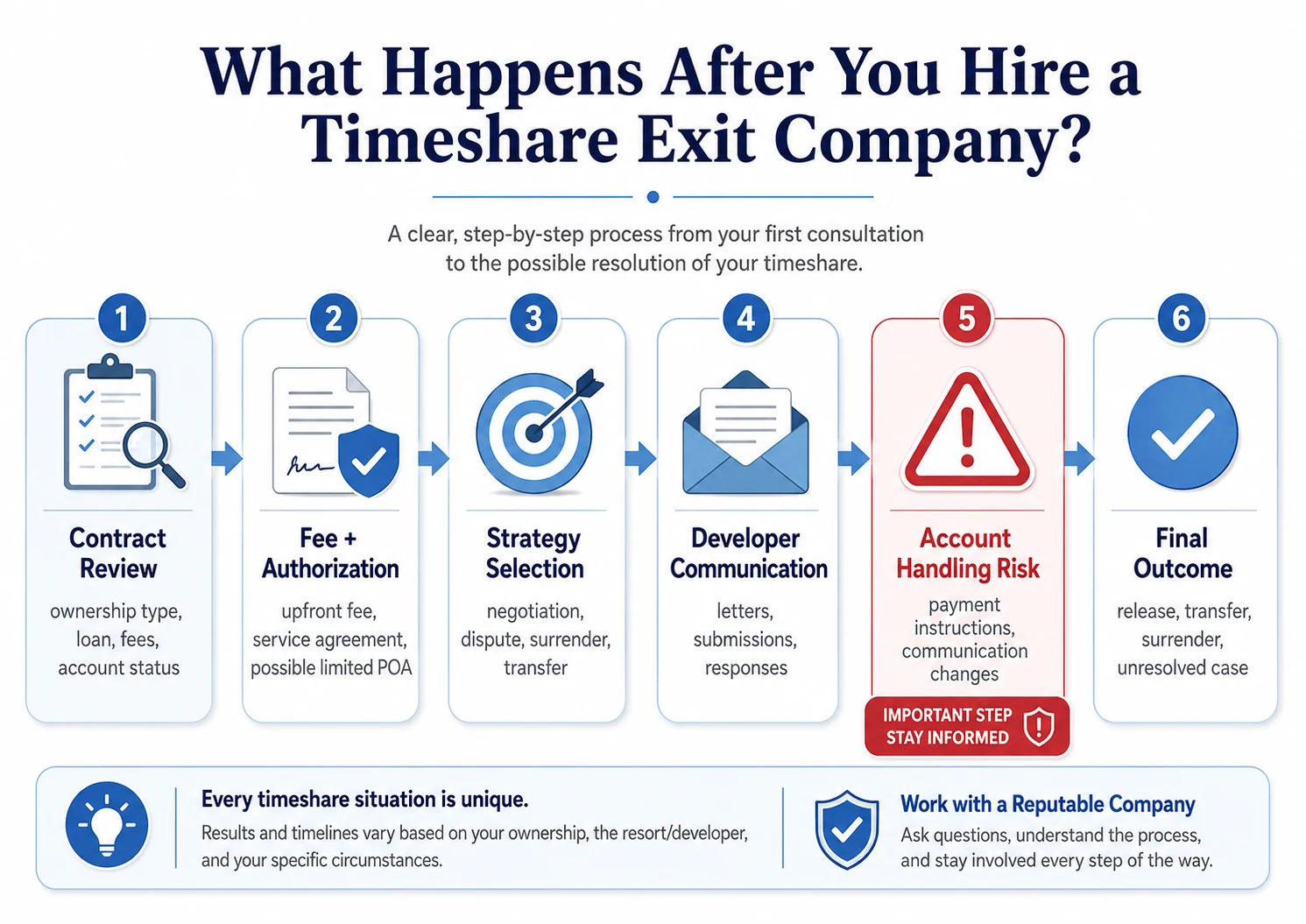
A timeshare exit company process usually sounds simple from the outside. But once you look closer, there may be several moving parts: documents, fees, authorization, developer communication, account instructions, timelines, and final resolution terms.
Important Distinction
Hiring an Exit Company Is Not the Same as Being Released From Your Timeshare
Signing an agreement with a timeshare exit company usually begins a process. It does not automatically end the ownership, erase a loan, stop maintenance fees, or guarantee that the developer will accept a surrender or release.
Until there is written confirmation that the ownership has been transferred, surrendered, released, or otherwise resolved, the underlying obligations may still matter. That is why owners should understand the process before paying fees, changing payment behavior, or assuming the obligation is over.
The Typical Timeshare Exit Company Process
Not every company follows the same process, but most exit-company services involve some version of the steps below.
Process Overview
What Usually Happens After You Hire a Timeshare Exit Company?
The exact details vary, but these are the common stages owners may encounter after signing an exit-company agreement. Use the cards below to jump to the step you want to review.
Step 1
Case Intake and Document Review
The company collects your contract, account details, resort information, loan status, fee status, and ownership documents.
Jump to Step 1 →Step 2
Fee Agreement and Authorization
You may be asked to sign a service agreement, pay an upfront fee, and authorize the company to communicate on your behalf.
Jump to Step 2 →Step 3
Strategy Selection
The company chooses an approach, which may involve negotiation, dispute positioning, developer contact, transfer, or surrender efforts.
Jump to Step 3 →Step 4
Developer or Resort Communication
The company may contact the developer, resort, association, loan servicer, or management company as part of its process.
Jump to Step 4 →Step 5
Account-Handling Instructions
Some companies may tell owners how to handle communication or payments during the process, which can affect risk.
Jump to Step 5 →Step 6
Timeline, Updates, and Outcome
The case may continue for months or longer, ending in resolution, continued dispute, transfer, surrender, or no clear change.
Jump to Step 6 →Step 1: Case Intake and Document Review
↑ Back to process overviewThe process usually starts with document collection.
A timeshare exit company may ask for the purchase agreement, financing documents, maintenance fee statements, owner account details, correspondence from the developer, and information about missed payments or collection notices.
This review helps the company understand what kind of ownership you have.
Important details may include whether the timeshare is deeded, points-based, right-to-use, trust-based, paid off, financed, current, delinquent, or subject to transfer restrictions.
A contract review does not mean an exit has been approved or guaranteed. It simply gives the company the information it needs to choose a strategy.
Step 2: Fee Agreement and Authorization
↑ Back to process overviewMany timeshare exit companies require a fee before work begins.
That fee may be described as a flat fee, service fee, legal fee, escrowed fee, administrative fee, or case fee. The amount, payment timing, and refund terms can vary widely.
Before signing, owners should understand:
What is being paid upfront
Confirm the total cost, payment timing, refund policy, and whether fees are held in escrow or paid directly to the company.
Who is doing the work
Ask whether the company uses internal staff, attorneys, outside law firms, transfer agents, resale channels, or third-party contractors.
What authority you are giving
Some companies may ask for limited power of attorney or another authorization allowing them to communicate with the resort, developer, association, or loan servicer.
Authorization may be part of the process, but it should be understood clearly. You should know who can speak on your behalf, what they are allowed to do, and whether they can make decisions that affect your account.
Step 3: Strategy Selection
↑ Back to process overviewAfter reviewing the documents, the company selects a strategy.
The strategy may depend on the contract, developer, account status, loan balance, fee status, purchase history, and whether the company believes there are grounds for negotiation or dispute.
Common approaches may include:
Developer negotiation
The company may contact the developer or resort to request surrender, deed-back, release, settlement, or another resolution.
Dispute or complaint positioning
Some companies may argue that the sale involved misrepresentation, pressure, incomplete disclosure, or other concerns.
Transfer or resale attempts
Some companies may look for a transfer path, buyer, recipient, or third-party process, although this depends heavily on transfer rules and demand.
Legal or attorney-supported approach
Some companies may involve attorneys or legal partners. If so, owners should understand who the attorney represents, what services are actually included, and whether legal work is part of the written agreement.
The key issue is clarity. Owners should not accept vague language like “we handle everything” without understanding the actual strategy being used.
System Insight
The Strategy Depends on the Contract, Not the Sales Pitch
A timeshare exit company may describe a standard process, but the actual strategy should depend on the ownership structure, loan balance, account standing, developer rules, transfer limits, and written contract terms. A strategy that worked for one owner may not work for another.
Step 4: Developer or Resort Communication
↑ Back to process overviewOnce the strategy is selected, the exit company may begin communicating with the developer, resort, association, lender, or management company.
This is often the part of the process owners cannot easily see.
The company may send letters, submit documents, request surrender, dispute the sale, negotiate terms, challenge account details, or attempt to move the case toward release or transfer.
Before hiring a company, ask how communication will be handled:
Will I receive copies of letters or submissions?
Owners should know whether they will see what is being sent on their behalf.
Who communicates with the developer?
Clarify whether communication comes from the company, an attorney, a transfer agent, or another third party.
What happens if the developer refuses?
Ask what the next step is if the developer rejects the request, delays, or does not respond.
Step 5: Account Handling During the Process
↑ Back to process overviewThis is one of the most important parts of the process to understand.
Some exit companies may instruct owners to stop communicating directly with the developer. Some may suggest redirecting correspondence. Some may advise owners about payment behavior.
This can create risk if the owner does not understand the consequences.
If a company tells you to stop paying a timeshare loan, maintenance fees, dues, assessments, or other charges, ask what could happen next. Nonpayment may lead to late fees, collection activity, credit reporting, foreclosure, legal notices, or reduced eligibility for certain developer options.
An exit company’s process does not automatically protect you from contract consequences.
Before changing payment behavior, make sure you understand the written risks and who is responsible if the account escalates.
Step 6: Timeline, Updates, and Outcome
↑ Back to process overviewTimeshare exit timelines vary.
Some cases may move quickly if a developer has a clear surrender process and the owner is eligible. Others may take many months or longer if the account is financed, delinquent, disputed, or tied to restrictive transfer rules.
Progress may not always be visible.
Owners may receive periodic updates, vague status reports, or limited information about what has actually happened. That is why communication expectations should be discussed before signing.
Possible outcomes may include:
Written release or surrender
The developer or association confirms that ownership obligations are released or transferred.
Transfer or resale completion
The ownership is moved to another accepted owner or entity through a recognized process.
Negotiated settlement
A negotiated agreement resolves some or all obligations under specific written terms.
Continued dispute or no clear change
The process continues without a confirmed release, or the owner remains responsible.
No matter what outcome is promised, the only result that matters is what is confirmed in writing.
Before You Pay for an Exit Process
Check Whether Your Ownership May Be Creating Exit Friction
The free Timeshare Risk Score can help identify whether your ownership appears relatively flexible, financially pressured, or more likely to create exit friction based on factors like loan status, fee pressure, missed payments, ownership type, and transfer limitations.
Free. Takes about 2 minutes.
Where the Process Can Become Risky or Unclear
The exit-company process can become difficult to evaluate when the company does not clearly explain what it is doing, how progress is measured, or what risks the owner may face along the way.
Common unclear areas include:
Large upfront fees
Some companies charge thousands of dollars before any resolution is achieved. Owners should understand exactly what the fee covers and what happens if the exit does not succeed.
Unclear strategy
If the company cannot explain whether it is negotiating, disputing, transferring, using attorneys, or pursuing surrender, the owner may not know what is actually being purchased.
Limited visibility
Some owners may receive few details about developer communication, case progress, or what has been submitted on their behalf.
Stop-payment advice
If an owner is told to stop paying, the consequences should be explained in writing. Nonpayment can create risks separate from the exit-company service.
No guaranteed outcome
Even if a company sounds confident, the result may still depend on the developer, contract terms, account status, and ownership structure.
Owner Risk
The Risk of Paying for a Process You Cannot Clearly See
A timeshare exit company may be working behind the scenes, but limited visibility can make it difficult to know what is happening, whether the strategy fits your contract, or whether your account is becoming more exposed. Before paying, ask how the process will be documented, how often updates are provided, and what risks may arise if the strategy does not work.
Before signing an exit-company agreement, ask questions that force the process into the open. The goal is not to assume every company is bad. The goal is to understand what you are paying for before you commit.
Action Step
Ask These Questions Before Hiring an Exit Company
Before paying an upfront fee or signing an agreement, ask direct questions about strategy, account handling, communication, and what happens if the case does not resolve.
What exact strategy will be used for my ownership: negotiation, surrender, dispute, transfer, legal review, or something else?
How much is due upfront, what work will be completed for that fee, what proof will I receive, and what refund rights exist if the exit is not completed?
Will I be asked to sign a power of attorney or authorization, and what authority does it give the company?
Will you advise me to stop paying any loan, maintenance fees, dues, or assessments during the process?
How often will I receive updates, and will I receive copies of letters, submissions, or developer responses?
What happens if the developer refuses the request or the ownership is not released?
Decision Insight
Direct Options Should Be Checked Before Third-Party Promises
Some owners may decide to hire outside help. But before paying for an exit-company process, it is usually worth checking whether the developer, resort, association, or program administrator has a written surrender, deed-back, hardship, or transfer process.
A third-party company may be offering to pursue options that already exist directly, or it may be using a strategy that carries additional cost and account risk. The comparison should happen before money is paid, not after the process is underway.
❓Frequently Asked Questions
Timeshare exit company questions usually involve process, cost, communication, account handling, and whether the company can actually produce the promised result. These answers explain what owners should understand before signing.
How do timeshare exit companies get you out of a timeshare?
Timeshare exit companies may try to resolve the ownership through developer negotiation, surrender requests, dispute positioning, transfer efforts, legal review, or other contract-based strategies. The exact process varies by company and depends on your contract, loan status, account standing, and developer rules.
How much do timeshare exit companies charge?
Costs vary widely. Some companies charge large upfront fees, while others may describe fees as legal, administrative, escrowed, or service-related. Before signing, ask for the total cost, refund policy, payment schedule, and what happens if the company cannot complete the exit.
Do timeshare exit companies guarantee results?
Owners should be cautious with guaranteed results. A timeshare exit outcome may depend on the developer, contract terms, loan balance, account status, and transfer rules. Even when a company sounds confident, the final result should not be assumed until there is written confirmation of release, transfer, surrender, or resolution.
How can I tell if a timeshare exit company process is risky?
A process may be risky if the company charges a large upfront fee, cannot explain the strategy, guarantees a result, tells you to stop paying without explaining consequences in writing, refuses to show what is being sent on your behalf, or cannot explain what happens if the developer rejects the request.
Will a timeshare exit company tell me to stop paying?
Some companies may advise owners about payment behavior during the process. If you are told to stop paying a loan, maintenance fees, dues, or assessments, ask for the risks in writing. Nonpayment may lead to late fees, collections, credit reporting, foreclosure, or other consequences depending on the contract.
Do I need to sign a power of attorney for a timeshare exit company?
Some companies may ask for limited power of attorney or another authorization so they can communicate with the developer or resort on your behalf. Before signing, confirm what authority is being granted, whether it is limited, whether it can be revoked, and whether the company can make decisions affecting your account.
Should I contact the developer before hiring an exit company?
In many situations, yes. Ask the developer, resort, association, or program administrator whether a written surrender, deed-back, hardship, owner assistance, or transfer option exists. Direct options may depend on whether the ownership is paid off, fees are current, and the account meets eligibility requirements.
Bottom Line
Timeshare exit companies do not all work the same way.
Most begin by reviewing your contract, charging a fee, selecting a strategy, and communicating with the developer, resort, association, or loan servicer. Some may request authorization or limited power of attorney. Some may advise changes in account handling. Some may provide regular updates, while others may offer limited visibility into what is happening behind the scenes.
The process matters because the result is not guaranteed.
Before hiring a company, understand the fee, strategy, authorization, communication process, timeline, refund policy, account-handling instructions, and what happens if the ownership is not released.
The safest decision is not based only on the promised outcome. It depends on whether the process is clear, realistic, documented, and aligned with your specific ownership.
Next Step
Review Your Timeshare Structure Before Hiring an Exit Company
Timeshare exit companies may describe a process, but whether that process fits your situation depends on your contract type, loan balance, account standing, maintenance fees, developer rules, resale limits, and transfer restrictions. The Timeshare Risk Intelligence Report™ helps you review those structural factors before paying an exit company, stopping payments, or relying on a promised outcome.
Start My Risk Intelligence Report Same-day report option available.Paid independent analysis. This is not legal advice, contract cancellation, an exit service, a resale service, lender negotiation, or a promise that your timeshare can be exited.
Related Guides
These guides can help you compare exit-company services with direct options, payment risks, and broader exit paths.
Timeshare Exit Companies
Review how exit companies work, what they may charge, warning signs, and how to compare them with other options.
Read the exit company guide →
Are Timeshare Exit Companies Legit?
Learn how to evaluate legitimacy, red flags, guarantees, reviews, and upfront-fee risk before hiring a company.
Read the legitimacy guide →
Timeshare Exit Guide
Start with the right exit path based on your situation before choosing resale, surrender, exit companies, legal review, or nonpayment.
Read the exit guide →
What Happens If I Stop Paying My Timeshare?
Understand collections, credit risk, foreclosure exposure, loan issues, and why nonpayment is not the same as a clean exit.
Read the stop-payment guide →
Can You Sell a Timeshare Back to the Developer?
Learn when a developer surrender, deedback, or take-back option may be available — and why it is not automatic.
Read the developer take-back guide →