
Independent Exchange Program Review
Is RCI Worth It? Reviews, Fees, and Exchange Value
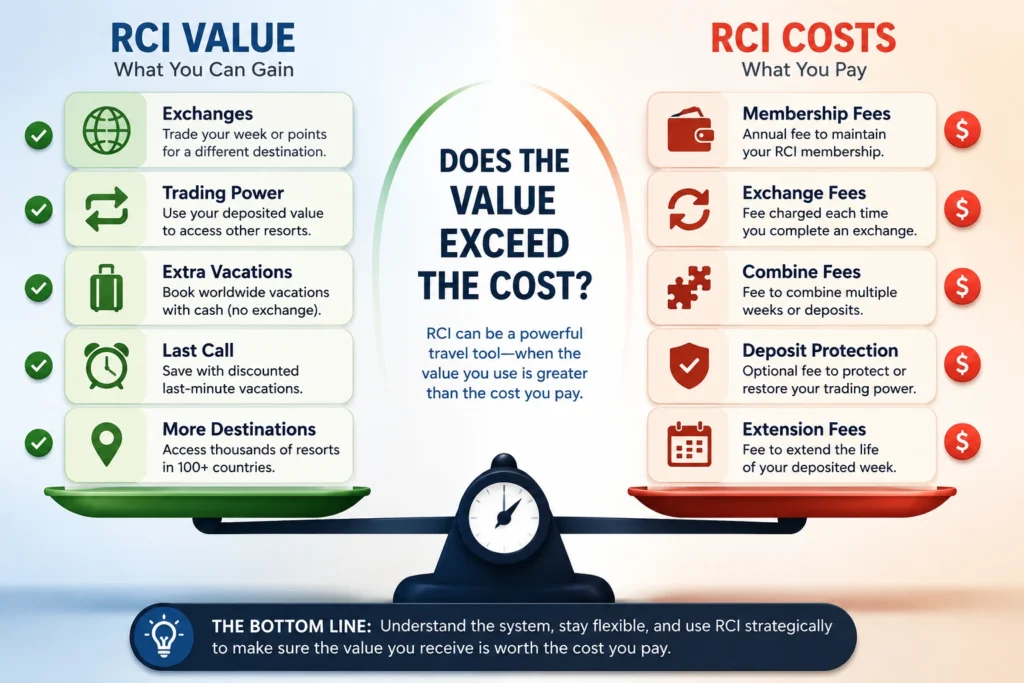
RCI can provide meaningful value for owners who exchange regularly, travel flexibly, and confirm vacations that compare favorably with booking similar accommodations independently.
Its value may be weaker when desirable exchanges are difficult to secure, Trading Power limits the realistic options, or membership, exchange, protection, combine, extension, and destination fees keep adding up. The real measure is the vacations you actually receive—not the number of resorts displayed in the network.
Continue Reading to Learn
What Determines Whether RCI Is Worth Using
- How membership, exchange, protection, and other fees affect value
- Why Trading Power and availability differ between owners
- When Extra Vacations and Last Call offers may make sense
- How flexibility changes the likelihood of confirming useful trips
- Whether RCI access still supports the value of the underlying ownership
About this guidance: Timeshare Travel Club Authority reviewed current RCI membership materials, exchange terms, published fee guidance, Trading Power information, protection and cancellation options, and owner-facing program features. Membership eligibility, fees, Trading Power rules, benefits, resort charges, and transaction terms may vary by ownership, RCI Weeks or Points participation, membership level, resort, and region—and may change. Owners should verify the terms shown in their own RCI account and confirm the complete cost before depositing vacation time, combining or extending Trading Power, purchasing protection, or completing a reservation.
Important Distinction
RCI Is an Exchange Company—not the Timeshare or the Investment
RCI generally provides exchange and travel access through an affiliated timeshare, vacation club, or membership program. Owners do not typically own an “RCI timeshare” as a separate property. They own the underlying timeshare or club interest and may use RCI as one of its benefits.
That distinction matters when evaluating cost, resale value, or whether the ownership is a good investment. RCI access may increase the practical travel value of an ownership, but it does not automatically increase resale demand, guarantee profitable exchanges, or make the underlying timeshare financially worthwhile.
Before You Keep Paying for RCI Access
RCI Only Adds Value When the Trips, Fees, and Underlying Ownership Still Fit
RCI access may sound valuable, but the practical benefit depends on your ownership costs, actual usage, travel flexibility, exchange results, trading power, transaction fees, rental options, and whether the vacations you receive compare favorably with independent booking. The Timeshare Decision Intelligence Report™ helps organize those details and identify whether exchange access still supports the broader ownership decision.
Need a clearer view of whether RCI still supports the value of your ownership?
Review the Report Option Or continue with the RCI cost and value review belowHow RCI Fees Affect the Value
The issue is not simply whether RCI charges fees. It is whether the complete cost of using RCI still produces vacations that feel worthwhile.
Owners should separate the cost into three layers:
- Access costs: What the owner pays to maintain RCI membership or access through an affiliated resort or vacation club.
- Transaction costs: What the owner pays to complete or modify an exchange, combine Trading Power, extend a deposit, protect a deposit, issue a guest certificate, or book another RCI travel option.
- Trip-specific costs: Resort fees, taxes, parking, housekeeping charges, mandatory all-inclusive fees, and other expenses collected for the stay.
Those charges should then be considered alongside the underlying ownership expenses. Maintenance fees, club dues, assessments, and financing may continue whether or not the owner successfully completes an RCI exchange.
This does not mean every ownership expense should be assigned entirely to one RCI vacation. It means the value should not be judged only by the exchange fee shown at checkout.
Owners who want to calculate those layers as one complete trip total can use How Much Does a Timeshare Exchange Really Cost?, to combine the allocated ownership cost, RCI transaction charges, and destination fees.
The practical comparison is:
What did the complete RCI trip cost, and what would a similar vacation have cost through a hotel, resort, vacation rental, travel package, or direct booking?
A cash-priced Extra Vacation or Last Call offer may still provide meaningful value. But it should be compared as a cash travel purchase—not automatically treated as proof that the underlying timeshare or deposited Trading Power delivered a valuable exchange.
Because fees and benefits can change, owners should verify current charges through their RCI account or affiliated vacation program before renewing, combining value, extending a deposit, or confirming a reservation.
Why Owners Have Such Different Experiences With RCI
Ask several owners whether RCI is worth it and you may receive very different answers.
Some owners exchange regularly, remain flexible, use cash travel offers selectively, and feel that RCI gives them vacations they would otherwise pay more to book. Others struggle to find trips that match their dates, destinations, accommodation needs, or available Trading Power.
Those differences often reflect more than the size of the RCI resort network. Practical value depends on:
- How often the owner actually uses RCI
- Whether available trips fit the owner’s travel habits
- How flexible the owner can be with dates, destinations, and resorts
- Whether the owner’s deposited value supports the requested trip
- Whether the most appealing options are exchanges or additional cash purchases
- Whether the complete trip cost compares favorably with independent booking
- What the owner expected when RCI access was originally presented
A large directory can create the impression of nearly unlimited vacation possibilities. But the meaningful measure is not how many resorts appear in the network.
It is how often the owner confirms vacations they genuinely want at a total cost they consider worthwhile.
Before concluding that RCI has no useful inventory, review these timeshare exchange tips for improving an ongoing search and identifying structural availability limits.
System Insight
RCI Value Depends on the Vacations You Confirm—not Just the Resorts You Can See
- Regular users generally have an easier time justifying the cost because RCI access produces actual travel rather than an unused membership.
- Flexible owners usually have more practical options because they can consider multiple destinations, resorts, seasons, and travel dates.
- Trading Power can affect which exchanges are realistic, but visible resorts should not be interpreted as equally available to every account.
- Last Call and Extra Vacations may provide value, but they are cash-based travel options and should be compared with public booking prices.
- Highly specific requests are harder to rely on when the owner needs one exact resort, peak period, destination, or larger unit.
The difference between a useful RCI membership and an expensive one usually comes down to how the program fits the owner’s real travel habits. The value check below highlights the situations where RCI is more likely to deliver practical benefits—and where the costs or limitations may outweigh them.
RCI Value Check
When RCI Is Worth It—and When It May Not Be
RCI can provide meaningful value for some owners and very little value for others. Click any card to review the circumstances that may strengthen or weaken the practical value of RCI access.
Worth It: You Use RCI Regularly
Confirmed vacations provide more meaningful value than exchange access that goes unused.
Worth It: You Use RCI Regularly
RCI is easier to justify when the owner consistently completes useful exchanges or books other RCI travel options at prices that compare favorably with public alternatives.
When several years pass without a worthwhile reservation, membership and exchange-related charges may become another recurring ownership expense.
Worth It: You Can Travel Flexibly
Flexible dates, destinations, resorts, and seasons generally create more practical choices.
Worth It: You Can Travel Flexibly
RCI can be useful when it expands the owner’s travel options rather than being treated as a guaranteed booking source for one exact vacation.
Owners who can consider different regions, date ranges, resort options, and lower-demand periods may find more opportunities compatible with their plans.
Worth It: The Complete Trip Beats Independent Booking
The strongest value exists when RCI delivers better pricing, space, accommodations, or resort quality.
Worth It: The Complete Trip Beats Independent Booking
An RCI vacation may be worthwhile when the total cost is lower than a comparable public booking or provides meaningful advantages such as additional bedrooms, kitchens, larger living areas, or a preferred resort.
The comparison should include the costs required to maintain access and complete the trip—not only the exchange fee.
May Not Be Worth It: The Best Options Require More Cash
Extra Vacations and rental inventory can be useful, but they change the value calculation.
May Not Be Worth It: The Best Options Require More Cash
Some owners become frustrated when appealing inventory appears through RCI but requires a separate cash payment rather than the use of deposited Trading Power.
Those offers may still be competitive, but they should be compared with direct resort rates, hotel packages, vacation rentals, owner rentals, and other public promotions.
May Not Be Worth It: Fees Keep Accumulating
Membership, exchange, combine, protection, extension, and destination charges can reduce the benefit.
May Not Be Worth It: Fees Keep Accumulating
Individual charges may appear manageable, but the combined expense can become substantial when added to maintenance fees, club dues, financing, taxes, resort charges, or mandatory all-inclusive costs.
The owner should compare the complete price of the trip rather than evaluating each fee in isolation.
May Not Be Worth It: You Need One Exact High-Demand Trip
RCI may feel less useful when its value depends on one resort, destination, unit size, or peak week.
May Not Be Worth It: You Need One Exact High-Demand Trip
Holiday periods, school breaks, premium beach and ski destinations, and larger accommodations may attract substantial demand.
When the value of RCI depends on confirming one difficult exchange, the owner may receive less practical benefit than expected.
Why RCI Reviews Are So Polarized
RCI reviews often fall at opposite ends of the spectrum. Some owners describe the program as a valuable way to access more destinations and larger accommodations, while others report frustration with fees, Trading Power, limited exchange options, or appealing inventory that requires an additional cash payment.
In many cases, both groups may be describing genuine experiences.
Owners who remain flexible, understand what their account can realistically access, and regularly confirm vacations they want may receive meaningful value. Owners who expect guaranteed premium inventory, one specific resort, a holiday week, or a larger unit may reach a very different conclusion.
Some reviews are primarily about RCI. Others also reflect disappointment with:
- The original timeshare purchase
- Maintenance fees or club dues
- Sales expectations about exchange access
- The strength of the ownership being deposited
- The vacation club or resort connected to the RCI account
Those issues are related, but they are not identical.
An owner can be unhappy with the underlying timeshare and still receive useful travel value through RCI. Another owner may like the home resort or club but use RCI too rarely to justify the additional expense.
Before relying heavily on a review, consider:
- Was the owner flexible with dates, destinations, and accommodation size?
- Were they trying to secure one difficult peak-season trip?
- Were they reviewing an exchange, Extra Vacation, Last Call offer, or another cash-based option?
- Were they comparing only the transaction fee or the complete ownership and travel cost?
- Did their underlying ownership still fit their budget and travel habits?
The polarized reviews make more sense once the owner’s expectations, costs, flexibility, and actual booking results are taken into account.
Owner takeaway: RCI is most valuable when it helps you confirm vacations you genuinely want at a total cost that still makes sense. If the best options require additional cash, repeated fees, or flexibility you do not have, the practical value may be weaker than the sales presentation suggested.
Is RCI a Timeshare or Timeshare Company?
No. RCI is not a timeshare, resort developer, or timeshare ownership company.
RCI is primarily a vacation exchange and travel-services company that may complement an affiliated timeshare or vacation club ownership. Depending on the membership and program, RCI may provide access to:
- Timeshare exchanges
- Extra Vacations
- Last Call vacations
- Cash rental opportunities
- Hotels and other travel-related services
- Member discounts or travel benefits
The owner’s actual timeshare is the resort, vacation club, deeded interest, points membership, or other ownership connected to the RCI account.
That distinction matters because phrases such as “RCI timeshare” can create the impression that RCI sold or controls the underlying ownership. In most cases, RCI provides an additional exchange and travel platform while the developer, resort, homeowners association, or vacation club manages the ownership itself.
When someone asks whether an “RCI timeshare” is a good investment, the real question concerns the underlying timeshare ownership, not RCI.
That ownership should be evaluated based on:
- Purchase price and financing
- Maintenance fees and club dues
- Home-resort or club usage
- Resale demand
- Transfer restrictions
- Booking rights
- Long-term affordability
- Whether exchange access transfers to a future owner
RCI may add travel and usage value, but it does not automatically make the underlying timeshare a financial investment, increase its resale value, or guarantee profitable vacation use.
The better question is:
Does the underlying timeshare provide enough vacation value—and does RCI add enough useful flexibility—to justify the combined costs?
For a complete explanation of the ownership that may sit behind an RCI membership, review What Is a Timeshare?
Can RCI Access Make a Timeshare More Useful or Valuable?
RCI access can make an affiliated timeshare or vacation club ownership more useful to the current owner. It may complement the ownership by providing exchange opportunities, Extra Vacations, Last Call vacations, rentals, and other travel-related services.
The practical value may improve when RCI helps the owner access:
- More destinations than the home resort or club provides
- Different travel dates, seasons, or resort options
- Larger or different accommodation types
- Extra Vacations or Last Call offers
- Cash rental opportunities
- Hotels, discounts, or other travel-related services available through the account
Those benefits can make the ownership more flexible and useful. However, personal travel value is not the same as resale value.
What the underlying timeshare may be worth on the resale market depends more heavily on:
- The resort, brand, and location
- Whether the ownership is deeded, points-based, or club-based
- The annual maintenance fees or club dues
- The season, week, unit type, or points allocation
- Reservation rights and booking restrictions
- Transfer rules and buyer eligibility
- Developer or vacation-club policies
- Current resale demand
- Whether RCI access or related benefits transfer to a new owner
A potential buyer may consider RCI access a useful benefit, but that benefit may not overcome high annual fees, weak resale demand, restrictive transfer rules, or an ownership that can be acquired inexpensively elsewhere.
RCI can therefore add personal usage value without adding meaningful market value.
Owners trying to determine what their timeshare may be worth should evaluate the underlying resort or vacation club ownership separately from the exchange and travel services available through RCI.
Risk Point
RCI Can Become Another Cost Layer When the Benefits Go Underused
RCI may provide meaningful value when an owner regularly completes useful exchanges or books other travel options at competitive prices. But when exchanges are rare, preferred trips remain difficult to confirm, or the most appealing options require additional cash, RCI can become another expense connected to an already costly ownership.
The larger risk is continuing to pay maintenance fees, club dues, membership costs, and transaction charges because RCI access still sounds valuable—even when the owner’s actual travel history no longer supports that conclusion.
RCI Weeks Cost Example
How an RCI Vacation Can Cost More Than the Exchange Fee
The exchange fee may be the most visible RCI transaction charge, but it is not necessarily the complete economic cost of the vacation. This example combines current published U.S. RCI Weeks fees with illustrative ownership and destination costs.
| Cost Component | Example Amount |
|---|---|
| Annualized purchase cost based on a $20,000 timeshare purchase evaluated over 10 years | $2,000 |
| Illustrative annual maintenance fees and club dues | $1,500 |
| Current published one-year RCI Weeks subscription fee | $109 |
| Current published RCI Weeks exchange fee | $299 |
| Current published Trading Power Protection fee in the lower-priced timing category | $89 |
| Illustrative resort, tax, parking, or destination charges | $200 |
| Total example cost | $4,197 |
The owner could still receive excellent value if a comparable vacation would cost substantially more or if the RCI reservation provides better accommodations, additional space, or a preferred resort. When similar public options are available for approximately the same total price, the financial advantage becomes less clear.
Important: The RCI subscription, exchange, and Trading Power Protection amounts reflect the current fees displayed on RCI’s official U.S. Weeks fee page when this guide was updated in 2026. RCI states that fees are subject to change. Maintenance fees and destination charges are illustrative and vary by ownership and resort. RCI Points members follow a different fee schedule.
Before You Renew or Pay Another Fee, Review Your Actual Use
Before renewing RCI access, combining Trading Power, extending a deposit, or paying another transaction fee, review what the program has actually provided during the last two years.
Consider how many reservations you completed, whether they were exchanges or additional cash purchases, whether they matched how you wanted to travel, and how the complete cost compared with booking similar accommodations independently.
RCI may still provide strong value when it delivers useful vacations, better accommodations, more space, or competitive pricing. Repeated fees become harder to justify when the account goes underused or the owner keeps paying primarily to preserve value that has been difficult to use.hen the owner rarely books, repeatedly pays to preserve unused value, or accepts available trips mainly to avoid losing a deposit.
Action Step
Calculate the Value of the RCI Trips You Actually Use
Review your recent booking history before deciding whether to renew, preserve deposited value, or continue paying because RCI access still appears useful.
Review your last two years of RCI usage, including exchanges, Extra Vacations, Last Call vacations, rentals, and unused membership periods.
Separate exchanges from cash travel purchases so you can see how much value came from deposited ownership and how much required additional payment.
Add transaction-related expenses such as exchange, combine, protection, extension, guest certificate, and reservation-change charges.
Include destination expenses such as resort fees, taxes, parking, housekeeping, and mandatory all-inclusive charges.
Compare each trip with a similar public booking based on dates, destination, accommodation size, resort quality, and total cost.
Decide whether the trips matched how you wanted to travel or whether you accepted them mainly because the inventory or deposit was available.
Quick Win
Start with your most recent RCI reservation. Identify whether it was an exchange or cash purchase, calculate its complete cost, and compare it with a similar trip you could have booked without RCI.
Before deciding whether RCI is worth it, compare the full cost of using RCI against the value of the vacation you actually receive. Owners who have not done a full ownership review may want to start with Total Cost of Timeshare Ownership before evaluating exchange value.
The difference between a useful RCI membership and an expensive one usually comes down to how the program fits the owner’s real travel habits. The value check below highlights where RCI is more likely to deliver practical benefits—and where the costs or limitations may outweigh them. For a deeper explanation of deposits, Trading Power, inventory matching, and exchange availability, see How Timeshare Exchange Programs Work.
❓ Frequently Asked Questions
These questions address RCI membership value, exchange fees, cash travel options, owner reviews, and the distinction between RCI and the underlying timeshare ownership.
Is RCI a timeshare or timeshare company?
No. RCI is primarily a vacation exchange and travel-services company. It may complement an affiliated timeshare or vacation club ownership through exchanges, Extra Vacations, Last Call vacations, rentals, and other travel-related services, but RCI is not the underlying timeshare ownership or resort developer.
Is RCI worth it if I travel only once a year?
It may be worth it when that annual trip provides accommodations, space, resort quality, or pricing that compares favorably with an independent booking. If the trip requires substantial added fees or does not match where you genuinely wanted to travel, the value may be weaker.
How much does RCI membership cost?
Membership costs depend on the account, ownership program, membership term, country, and whether access is included through an affiliated resort or vacation club. Owners should verify their current subscription or access charge directly through RCI or the program connected to the account.
Membership is only one potential cost. Exchanges, Trading Power Protection, combine transactions, deposit extensions, guest certificates, resort charges, taxes, and mandatory all-inclusive fees may apply separately.
What is the RCI exchange fee?
The exchange fee is the transaction charge for confirming an eligible exchange through RCI. The amount can vary by membership type, exchange format, destination, and current fee schedule. It is separate from maintenance fees, membership costs, resort charges, taxes, and optional products.
Are RCI Last Call and Extra Vacations worth it?
They can be worthwhile for flexible travelers who find cash-priced accommodations below comparable hotel, resort, package, or vacation-rental rates. These are generally additional travel purchases rather than traditional exchanges using deposited Trading Power, so the price should be compared with public booking alternatives.
Why does RCI show resorts that require an additional cash payment?
Some visible inventory may be offered as an Extra Vacation, Last Call vacation, rental, or another cash-based travel option instead of a traditional exchange. That inventory may still provide value, but seeing it in the RCI platform does not necessarily mean it can be confirmed using deposited Trading Power.
Why are RCI reviews so polarized?
Owner experiences vary based on travel flexibility, expectations, Trading Power, destination preferences, unit-size needs, total costs, and how often the account is used. Flexible owners who regularly confirm useful trips may view RCI very differently from owners seeking one specific peak-season exchange.
Does RCI access increase the value of a timeshare?
RCI may increase the personal travel or usage value of an affiliated timeshare by adding exchanges, Extra Vacations, rentals, and other travel services. It does not automatically increase resale value, buyer demand, or the market price of the underlying ownership.
Should I buy or keep a timeshare because it includes RCI access?
RCI access can be a useful complementary benefit, but it should not be the only reason to buy or keep an ownership. The underlying timeshare should still make sense based on its purchase cost, annual fees, home-use value, booking rights, transfer rules, and long-term fit.
Bottom Line
RCI can be worth it for owners who use the program regularly, remain flexible, and receive exchanges or other travel opportunities that compare favorably with booking independently.
It may provide less value when useful exchanges are rare, repeated fees are needed to preserve deposited value, or the most appealing travel options require additional cash payments.
RCI should also be evaluated separately from the underlying timeshare. It is an exchange and travel-services company that may complement an affiliated ownership through exchanges, Extra Vacations, Last Call vacations, rentals, and other travel benefits. It is not the timeshare, resort developer, or ownership company.
RCI can make a well-fitting ownership more useful. It generally should not be the main reason to keep a timeshare that has become too expensive, difficult to use, or poorly aligned with how you now travel.
Owners whose RCI access no longer fits their travel pattern can also compare timeshare exchange alternatives beyond RCI and Interval International before assuming RCI is their only outside exchange option.
Owners with eligible vacation time who want to compare another exchange pathway can also review 7Across fees, availability, and exchange value.
The Wrong Timeshare Exit Move Can Cost More Than the Problem You’re Trying to Solve.
Stopping payments, hiring an exit company, chasing resale promises, requesting a surrender, or transferring ownership can all lead to very different outcomes depending on your contract, loan status, fees, account standing, documents, and developer rules. The Timeshare Decision Intelligence Report™ helps organize those details so you can see which paths appear realistic before you commit to the wrong move.
Get the Timeshare Decision Intelligence Report™ Customized ownership review • Decision-support report • No exit-company sales pitchIndependent decision support. This is not legal advice, contract cancellation, an exit service, a resale service, lender negotiation, or a promise that your timeshare can be exited.
Related Guides
If you are evaluating whether RCI still provides enough value, these guides can help you understand exchange mechanics, compare networks, calculate ownership costs, and determine whether the underlying timeshare still fits.
Exchange Networks and Availability
- How Timeshare Exchange Programs Work
Understand why exchange availability depends on inventory, demand, deposited value, fees, request timing, and owner flexibility. - RCI vs Interval International
Compare RCI and Interval International by Trading Power, inventory access, fees, travel options, and program fit. - Is Interval International Worth It?
See how II value depends on owner flexibility, fees, exchanges, Getaways, and whether the complete trip cost beats independent booking.
Benefits and Travel Value
- Are Timeshare Benefits Worth It?
Compare exchange access, travel perks, bonus offers, and other benefits against the costs required to maintain them. - Are Timeshare Bonus Weeks Worth It?
Review bonus weeks, accommodation certificates, extra vacation offers, booking fees, restrictions, and practical travel value.
Ownership Cost and Value
- Total Cost of Timeshare Ownership
Review purchase price, financing, maintenance fees, dues, exchange costs, assessments, and travel-related charges. - Why Are Timeshares So Hard To Sell?
Understand why personal usage value, exchange access, and original purchase price may differ from current resale value. - Is Your Timeshare Worth Keeping?
Evaluate usage, benefits, costs, availability, and ownership fit before deciding whether to keep, sell, surrender, or exit.