
Timeshare Bonus Weeks and Bonus Time: Are They Worth It?
Timeshare bonus weeks can sound like a major ownership benefit: extra vacation time beyond the week, points, or membership access an owner already purchased.
The phrase may come up during a sales presentation, owner update, exchange-company promotion, or member-portal offer. Depending on the program, it could refer to an additional stay within the developer’s resort system, a discounted week through an exchange company, or a certificate redeemed through an affiliated travel platform.
The same benefit may also be described as bonus time, particularly when it provides additional short-notice or cash-based resort access rather than a guaranteed seven-night ownership week.
That distinction matters because bonus weeks and bonus time do not follow one standard set of rules. Availability, booking windows, eligible properties, expiration dates, unit sizes, and required fees may vary significantly depending on who issued the benefit and who controls the inventory.
A bonus week may be worthwhile when it creates a trip the owner already wants at a total cost below a comparable independent booking. It may provide little practical value when the dates, destinations, or added charges do not fit the owner’s travel needs.
The useful question is not simply:
“Did I receive a bonus week?”
It is:
“What type of bonus travel benefit is this, what can I actually book, and is the full cost better than my other options?”
This guide explains how developer bonus weeks, bonus time, exchange-company weeks, and certificate-based offers may differ—and what owners should verify before treating them as meaningful ownership value.
Quick Answer
Are Timeshare Bonus Weeks Worth It?
They can be, but only when the benefit produces travel you actually want at a total cost lower than a comparable independent booking. Flexible owners who can use the available dates, destinations, and unit types are generally more likely to find value.
Bonus weeks and bonus time are not always free, guaranteed, or equal to the ownership week or points originally purchased. The value depends on who issued the benefit, who controls the inventory, when it can be booked, what restrictions apply, and which fees must still be paid.
Before You Count Bonus Weeks as Real Value
Extra Vacation Time Only Matters If the Rules Fit How You Travel
Bonus-week value can depend on availability, expiration dates, booking windows, resort access, unit size, exchange-company rules, and the full cost of using the stay. The Timeshare Decision Intelligence Report™ helps organize those benefits alongside the purchase price, annual fees, loan obligations, and other ownership limitations before a bonus offer influences a larger decision.
Need to evaluate bonus-week promises within the full ownership picture?
Review the Report Option Or continue with the bonus-week distinctions belowImportant Distinction
“Bonus Week” and “Bonus Time” May Describe Different Benefits
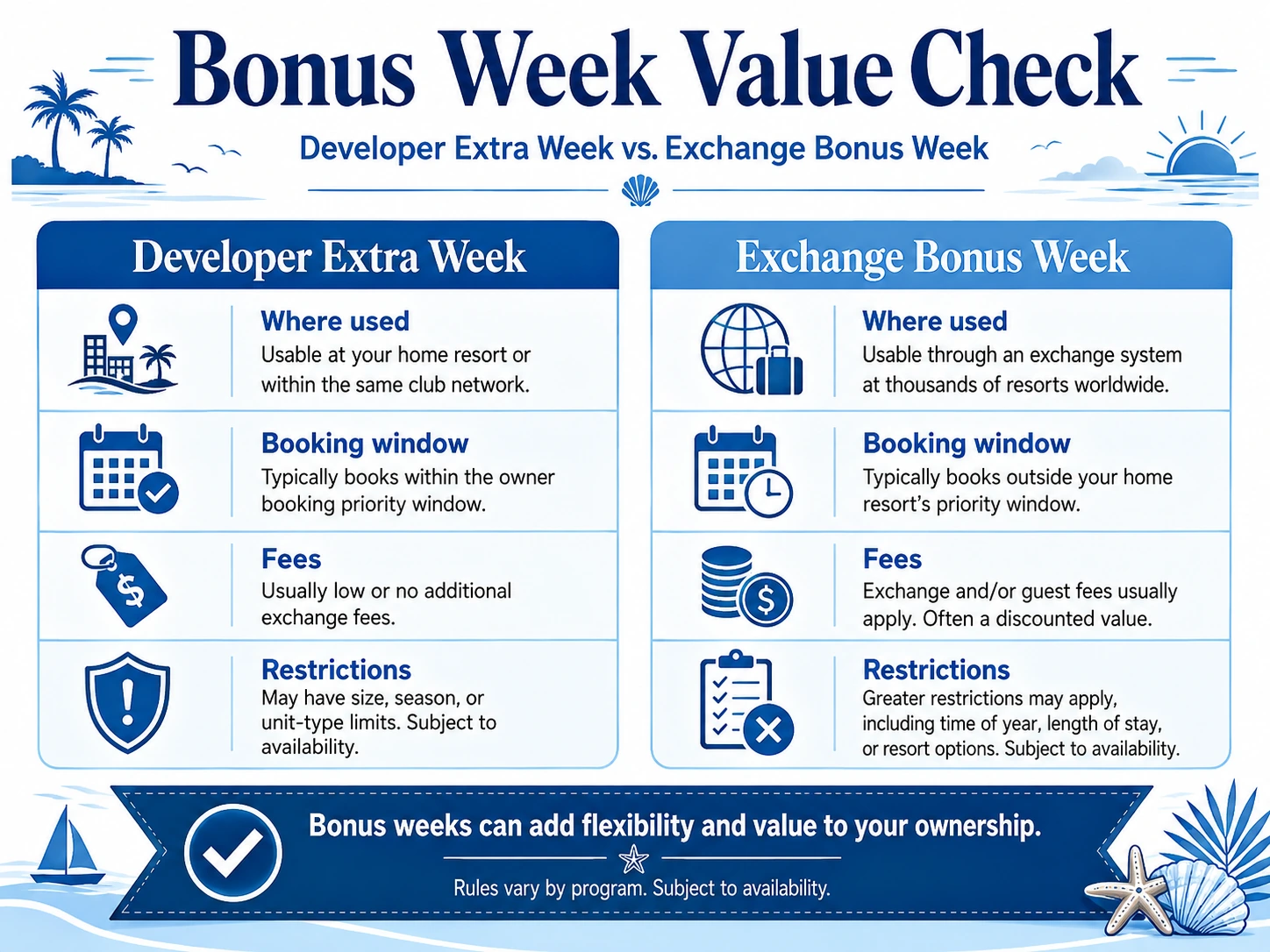
A bonus week may refer to an additional seven-night stay, a discounted exchange certificate, a developer extra-use week, or a promotional travel offer. Bonus time may describe shorter stays, cash-based reservations, open inventory, last-minute access, or extra use outside the owner’s regular allocation.
The labels alone do not reveal the real value. Owners need to identify who issued the benefit, who controls the inventory, whether the stay is guaranteed or availability-based, what fees apply, and when the benefit expires.
Three Common Ways Timeshare Bonus Weeks May Work
The same phrase can describe benefits controlled by very different systems.
A developer extra-use week may be connected to the owner’s resort, vacation club, membership level, or purchase agreement. An exchange-company bonus week may operate more like a discounted cash reservation or accommodation certificate. A third type may be promoted by the developer but redeemed through an outside exchange or travel platform.
The distinction affects where the owner can travel, which rules apply, and who should answer questions when the promised benefit does not work as expected.
Developer Extra-Use Week or Bonus Time
This benefit may provide additional access within the owner’s resort, developer group, or vacation club. It may depend on account status, season, room type, internal booking priority, and available inventory.
Bonus time may also involve shorter stays or cash reservations rather than a guaranteed full week.
Exchange Bonus Week or Travel Offer
This may function as a discounted week, accommodation certificate, last-minute stay, member rental, or promotional booking through an exchange company or travel platform.
Cash charges, booking fees, expiration dates, inventory limits, and resort-specific costs may still apply.
Developer-Issued Benefit Redeemed Elsewhere
The developer or resort may promote or issue the week, while an exchange company or affiliated travel platform controls redemption and inventory.
In that situation, the owner should compare the developer’s promise with the outside platform’s written booking rules, fees, and expiration terms.
System Insight
“Bonus” describes how the benefit is marketed—not necessarily how much it costs.
- A developer bonus week may still involve usage, housekeeping, resort, or all-inclusive fees.
- Bonus time may be limited to open inventory, shorter stays, or cash-based reservations.
- An exchange bonus week may require booking, certificate, guest, tax, or destination charges.
- A developer-issued benefit may still follow an outside exchange company’s redemption rules.
- The real value comes from the trip you can book at the final price—not the number of resorts advertised.
What Determines Whether a Bonus Week Is Worth It?
A bonus week is most valuable when it matches a trip the owner already wants to take.
The destination, dates, unit size, and total cost matter more than the label attached to the benefit. A discounted week at an unwanted property or during an unusable travel window may offer less practical value than an ordinary public reservation that better fits the owner’s plans.
Flexibility can make a major difference. Owners who can travel during shoulder seasons, accept different resorts, book on shorter notice, or use smaller units may have more opportunities than owners who need school-break dates, holidays, larger accommodations, or one specific destination.
The cost comparison should also include every required charge. A low advertised rate may be less compelling after booking fees, housekeeping, resort charges, taxes, guest certificates, or mandatory all-inclusive costs are added.
A useful bonus week generally has four characteristics:
- It can be used somewhere the owner actually wants to travel.
- The available dates fit the owner’s schedule.
- The complete cost is lower than a comparable independent booking.
- The trip would likely have been taken even without the promotional pressure.
If several of those conditions are missing, the week may still be a perk, but it should not be assigned much value when evaluating the ownership.
Bonus Week Value Check
When Bonus Weeks Are Worth It—and When They May Not Be
The practical value depends on the trip available, the complete price, and whether the benefit fits the owner’s normal travel habits. Select a card to review the distinction.
Worth It: The Destination and Dates Fit
The benefit works for a trip the owner already wants.
Worth It: The Destination and Dates Fit
A bonus week is easier to value when the available resort, travel window, and unit type match the owner’s actual plans. Flexibility may create more options, but the owner should not assign much value to inventory that is consistently unusable.
Worth It: The Final Price Is Lower
The complete cost beats comparable booking options.
Worth It: The Final Price Is Lower
Compare the usage price, booking charge, resort fee, taxes, housekeeping, and any required all-inclusive costs with similar public rates. The advertised bonus rate alone does not show the actual savings.
Worth It: It Replaces Planned Travel
The benefit reduces the cost of a trip already under consideration.
Worth It: It Replaces Planned Travel
Savings are more meaningful when the owner would have traveled anyway. A bonus week that creates an unplanned trip may still lead to transportation, dining, activity, and time-away costs that outweigh the lodging discount.
May Not Be Worth It: Availability Is Too Limited
The benefit rarely works for the dates or properties needed.
May Not Be Worth It: Availability Is Too Limited
Short booking windows, expiration dates, off-season inventory, unit restrictions, and limited resort choices can reduce the value considerably—especially for owners who need holidays, school breaks, or specific destinations.
May Not Be Worth It: Fees Erase the Savings
Added charges make the stay comparable to public pricing.
May Not Be Worth It: Fees Erase the Savings
Booking fees, housekeeping, resort charges, taxes, guest certificates, and mandatory meal plans can turn a low-cost offer into an ordinary travel rate. The final total should be compared before the reservation is treated as a benefit.
May Not Be Worth It: It Justifies a Larger Purchase
The bonus is being used to support an upgrade or renewal.
May Not Be Worth It: It Justifies a Larger Purchase
Extra weeks should not outweigh the purchase price, financing, annual dues, or long-term restrictions of the underlying ownership. If the ownership does not make sense without the bonus benefit, the bonus should remain secondary.
Owner takeaway: Judge a bonus week by the reservation you can actually complete—not by the word “bonus.” If the available trip does not fit your dates, destination, unit needs, or budget after every fee is included, the benefit may have little practical value.
Bonus Week Value Depends on the Whole Cost Picture
The word bonus can make the lodging component sound free or nearly free, but the full trip may involve several additional costs.
Depending on the program, the owner may still pay a usage charge, booking fee, certificate redemption fee, housekeeping charge, resort fee, taxes, guest certificate cost, or mandatory all-inclusive rate. Transportation, food, and other travel expenses also remain part of the decision, even when the lodging price is discounted.
Developer extra-use weeks should also be evaluated within the cost of the underlying ownership. A bonus stay may add value to a timeshare that already fits the owner’s budget and travel habits. It should not, however, be used to ignore a large purchase price, financing obligation, increasing maintenance fees, or benefits that are otherwise difficult to use.
The correct comparison depends on the decision being made.
For an individual trip, compare the total bonus-week price with a similar hotel, resort, owner rental, or public travel rate.
For a purchase, upgrade, or keep-or-exit decision, compare the benefit with the broader cost and usability of the ownership itself.
A bonus week can improve the value of an ownership that already works. It rarely changes the economics of an ownership that is otherwise unaffordable, restrictive, or poorly matched to the way the owner travels.
What Costs Should Owners Check Before Using a Bonus Week?
The cost review should match the type of benefit being offered.
A developer extra-use week may involve different charges and restrictions than an exchange-company certificate. A developer-issued week redeemed through an outside platform may require owners to review two sets of rules: the promise made by the developer and the redemption terms imposed by the booking company.
The most useful comparison is the complete cost of the trip, not the advertised price attached to the bonus week.
Cost Comparison
Compare the Full Price Before Assigning Value
Bonus-week structures vary, but each should be compared with the cost of booking a similar trip without relying on the timeshare benefit.
| Bonus-Week Type | Costs and Restrictions to Check | Value Question |
|---|---|---|
| Developer extra-use week or bonus time | Usage charges, housekeeping, resort fees, taxes, all-inclusive requirements, account-standing rules, eligible properties, seasons, unit sizes, and booking priority. | Does the benefit add usable travel beyond the week, points, or membership access you already pay for? |
| Exchange-company bonus week | Cash price, booking fee, guest certificate, resort charges, taxes, expiration dates, limited inventory, and short booking windows. | Is the complete price lower than a comparable hotel, resort, travel-site, or owner-rental booking? |
| Developer-issued week redeemed through exchange | Developer eligibility terms, certificate rules, exchange redemption charges, inventory limits, expiration dates, resort fees, taxes, and platform restrictions. | Do the original promise and the redemption rules produce a trip you can realistically use? |
| Promotional certificate or sales incentive | Activation charges, blackout dates, destination restrictions, travel deadlines, taxes, resort fees, redemption costs, and limits on guest use or transfer. | Would you have taken this trip anyway, or is the certificate encouraging additional spending? |
Important: This is not a universal fee list. Written terms vary by developer, resort, vacation club, exchange company, travel platform, and promotion.
Why Bonus Week Reviews Can Be So Mixed
Bonus-week reviews often sound contradictory because owners may be describing benefits that share the same name but work in completely different ways.
One owner may have received a developer extra-use week at a resort they already enjoy. Another may be describing a discounted exchange reservation available only during limited dates. A third may have a developer-issued certificate that must be redeemed through an outside travel platform with separate fees and inventory rules.
Their travel habits can also produce very different results. A flexible retiree who can book shoulder-season travel may find several useful options, while a family limited to school holidays may see little availability.
The review may therefore reflect the owner’s schedule, expectations, destination preferences, and total cost just as much as the benefit itself.
This is why one positive or negative review rarely proves that all bonus weeks are valuable or unusable. The better comparison is between the reviewer’s benefit structure and the written terms attached to your own account.
Risk Point
Bonus Weeks Can Make the Ownership Appear More Valuable Than It Is
Bonus weeks may provide useful travel when the dates, destinations, and total price fit the owner’s plans. The risk arises when the benefit is used to justify a purchase, upgrade, renewal, or long-term ownership cost without confirming whether the promised travel is realistically available.
A bonus benefit should not outweigh the purchase price, financing, maintenance fees, club dues, booking limitations, or other continuing obligations. If the ownership does not make sense without the bonus weeks, the bonus should not become the primary reason to proceed.
Before You Count a Bonus Week as Value, Verify the Rules
The more important a bonus week is to a purchase, upgrade, renewal, or keep-or-exit decision, the more carefully its terms should be documented.
A sales presentation may focus on additional vacations, lower lodging costs, or access to a large resort network. The written rules determine whether those benefits are usable.
Confirm where the week can be booked, who controls the inventory, whether the reservation is guaranteed or availability-based, and how far in advance it can be requested. Expiration dates, blackout periods, seasonal limits, unit restrictions, and account-standing requirements may narrow the benefit considerably.
Owners should also verify whether the benefit can be transferred to a guest, carried forward, rented, or replaced after expiration. Permission to add a guest does not automatically mean the week can be advertised or rented for profit.
When the explanation and written terms do not match, rely on the documented rules rather than the promotional description. A benefit that cannot be confirmed should not be counted as a major part of the ownership’s value.
Before relying on a bonus week, compare the written rules against the way you actually travel. A benefit that works well for flexible owners may provide little practical value for owners who need specific school-break weeks, larger units, peak-season availability, or a particular resort.
Action Step
Verify the Bonus Week Before You Count It as Value
Identify the type of benefit, who controls the reservation, and the full cost before relying on it as part of the ownership’s value.
- Confirm whether it is developer bonus time, an extra-use week, an exchange certificate, or a promotional travel offer.
- Identify who controls the inventory and handles the booking or redemption.
- Verify the eligible resorts, destinations, seasons, unit sizes, and minimum or maximum stay rules.
- Review booking windows, blackout dates, expiration terms, and account-standing requirements.
- Add every booking, usage, resort, housekeeping, tax, guest, and all-inclusive charge.
- Compare the complete price with a similar stay booked independently.
Should You Buy, Upgrade, or Keep a Timeshare Because of Bonus Weeks?
Usually, bonus weeks should not be the primary reason to buy, upgrade, renew, or keep a timeshare.
They may enhance an ownership that already fits the owner’s budget, travel habits, and reservation needs. An owner who regularly uses the core benefits and can also take advantage of extra weeks may receive meaningful additional value.
The analysis changes when the bonus benefit is being used to make an otherwise expensive or restrictive ownership appear more attractive. Extra vacation offers do not eliminate the purchase price, loan balance, annual maintenance fees, club dues, booking competition, or long-term obligations.
Owners should first decide whether the core ownership makes sense without the bonus week. Then the extra benefit can be evaluated as an additional perk.
A bonus week can make a suitable ownership more useful. It rarely makes an unsuitable ownership financially or practically sound on its own.
Decision Insight
Bonus Weeks Work Best as a Perk, Not the Reason to Own
Bonus weeks can add flexibility when the underlying timeshare already fits the owner’s travel habits, budget, and long-term plans. In that situation, extra-use opportunities may help the owner receive more value from an ownership that already works.
But bonus weeks do not correct high ownership costs, weak availability, restrictive booking rules, financing, or an ownership that no longer fits. Evaluate the core ownership first and the bonus benefit second.
Can You Rent Out a Timeshare Bonus Week?
Owners should not assume a bonus week can be rented to someone else.
Many bonus weeks, accommodation certificates, exchange offers, and developer extra-use benefits are intended for personal or approved guest use. A program may allow the owner to add another traveler through a guest certificate without allowing the reservation to be advertised, sold, or rented for profit.
That distinction is especially important when bonus-week rental income is mentioned during a sales presentation or by an outside resale or marketing company.
Claims that rental income can offset maintenance fees, loan payments, or upgrade costs should be supported by the written program rules. Owners should confirm whether commercial use is allowed, whether a guest certificate is required, and whether advertising the reservation violates the developer’s or exchange company’s terms.
The safer assumption is that a bonus week cannot be rented unless the written rules clearly permit it.
❓ Frequently Asked Questions
These questions address how timeshare bonus weeks and bonus time work, what costs may apply, and how much weight the benefit should carry in a larger ownership decision.
Are timeshare bonus weeks actually free?
Not necessarily. A bonus week may still involve booking, usage, housekeeping, resort, tax, certificate, guest, or mandatory all-inclusive charges. Review the complete price before assuming the stay is free.
What is the difference between bonus weeks and bonus time?
A bonus week often refers to an additional seven-night stay or certificate. Bonus time may involve shorter stays, cash-based reservations, last-minute availability, or extra use outside the owner’s regular allocation. The exact meaning depends on the developer or club.
Are developer bonus weeks different from exchange bonus weeks?
Yes. Developer benefits may be tied to a resort, club, or ownership agreement. Exchange bonus weeks may work as discounted reservations, accommodation certificates, or member travel offers through an exchange company or travel platform.
Can a developer bonus week be redeemed through an exchange company?
Sometimes. A developer may issue or promote the benefit while an exchange company or affiliated platform controls the inventory and redemption. In that situation, review both sets of written rules.
Can I rent out a timeshare bonus week?
Do not assume so. Some programs permit approved guest use but prohibit commercial rental or resale. Confirm the rule in writing before advertising or transferring the reservation for payment.
Are bonus weeks worth it for peak-season travel?
They may be harder to use during holidays, school breaks, and other high-demand periods. Owners who require specific dates, destinations, or larger units should confirm actual availability before assigning significant value to the benefit.
Should bonus weeks influence a timeshare purchase or upgrade?
They may add value to an ownership that already makes sense, but they should not outweigh the purchase price, financing, annual fees, booking restrictions, or long-term obligations.
Bottom Line
Timeshare bonus weeks and bonus time can provide real value, but only when the available trip fits the owner’s plans and the complete cost is competitive with booking independently.
The label alone does not explain the benefit. A developer extra-use week, exchange-company offer, promotional certificate, and developer-issued benefit redeemed through an outside platform may each follow different rules.
Before assigning value, confirm who controls the inventory, where and when the benefit can be used, when it expires, and which fees remain payable. Flexible owners may find meaningful opportunities, while owners who need peak dates, specific destinations, larger units, or guaranteed availability may find the benefit much harder to use.
Bonus weeks work best as an additional perk attached to an ownership that already fits the owner’s budget and travel habits. They should not become the primary reason to buy, upgrade, renew, or continue paying for an ownership that otherwise does not make sense.
Bonus Benefits Should Support the Ownership—not Just the Sales Story.
Bonus weeks may look valuable in isolation, but the larger decision can also involve financing, annual fees, booking access, expiration rules, usage restrictions, exchange costs, and long-term ownership obligations. The Timeshare Decision Intelligence Report™ helps organize those details, identify material limitations, and clarify what still requires verification before you buy, upgrade, renew, keep paying, or choose another path.
Get the Timeshare Decision Intelligence Report™ Customized ownership review • Decision-support report • No exit-company sales pitchIndependent decision support. This is not legal advice, contract cancellation, an exit service, a resale service, travel booking, benefit verification with the developer, or a promise that bonus inventory will be available.
Related Guides
These guides can help you compare bonus weeks with other travel benefits, exchange programs, ownership costs, and the broader question of whether the timeshare still fits.
Timeshare Benefits and Ownership Value
- Are Timeshare Benefits Worth It?
Compare exchange access, travel perks, bonus weeks, and other benefits against the costs and obligations of ownership. - Is Your Timeshare Worth Keeping?
Evaluate usage, annual costs, availability, benefits, and ownership fit before deciding what to do next. - Are Timeshare Cruise Benefits Worth It?
Review how cruise credits, certificates, travel-platform offers, taxes, port fees, and restrictions differ from bonus weeks.
Exchange Programs
- How Timeshare Exchange Programs Work
Understand how inventory, demand, timing, deposits, fees, and travel flexibility shape exchange availability. - Is Interval International Worth It?
Review membership fees, exchange fees, Getaways, availability, and the type of owner most likely to find value. - Is RCI Worth It?
Evaluate exchanges, Extra Vacations, Last Call offers, fees, and whether the program supports the value of the ownership. - 7Across Review: Fees, Availability, and Exchange Value
Understand how 7Across distinguishes Exchange Weeks from Bonus Weeks, Rental Weeks, hotel stays, and other separately priced travel.