Timeshare Exchange Comparison
RCI vs. Interval International: Which Is Better for Timeshare Owners?
RCI and Interval International can both provide valuable exchange access—but neither company is automatically better for every owner.
RCI may appeal to owners who value broad network reach and more visible trading-power or points mechanics. Interval International may work better for owners whose resort, developer, or vacation club is closely connected to its network. The more important comparison is how each system interacts with your ownership, exchange value, inventory access, travel requests, flexibility, and total cost.
About this guidance: Timeshare Travel Club Authority’s guidance draws on experience with RCI and Interval International memberships, fixed-week and points deposits, trading power, matching strength, developer-controlled inventory, internal priority periods, ongoing searches, exchange fees, upgrades, guest certificates, and resort-level charges. Exchange results can vary by ownership type, resort or club affiliation, deposit control, inventory supply, demand, booking timing, unit size, season, destination, membership rules, and travel flexibility, so owners should compare each system against the exchange access and vacation requests available through their specific ownership.
Important Distinction
RCI vs Interval International Is Not Just a Network Comparison
Many owners compare RCI and Interval International by resort count, brand affiliations, fees, or perceived quality. While those differences matter, they rarely explain why two owners using the same exchange company can have completely different results.
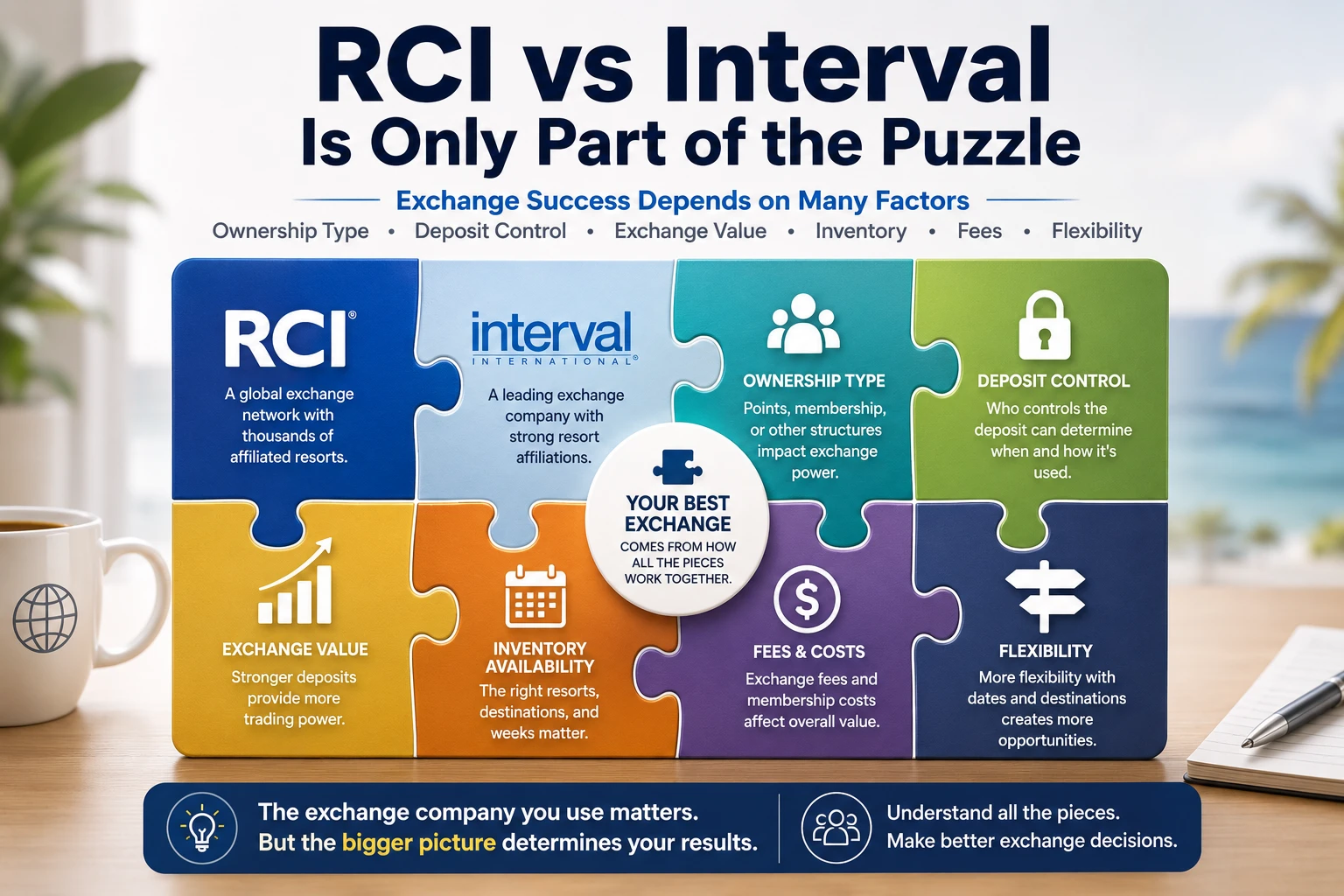
Exchange success often depends on factors that exist before the exchange request is ever made. Ownership structure, deposit control, exchange value, inventory availability, internal priority rules, and travel flexibility can all influence what an owner is able to see and confirm.
In many modern points-based clubs, memberships, and developer-managed programs, the owner may not control the exact inventory deposited into the exchange system. Instead, the club, developer, or program administrator may determine what inventory is made available for exchange. That can affect exchange outcomes regardless of whether the owner uses RCI or Interval International.
Before You Rely on an Exchange Program
RCI and Interval May Work Differently, But the Real Question Is Whether Exchange Access Fits Your Ownership.
RCI and Interval International can differ in resort networks, trading power, points rules, deposit systems, membership fees, exchange fees, booking windows, upgrade options, bonus weeks, and available inventory. But the right conclusion depends on your ownership type, travel flexibility, cost exposure, and whether the destinations you want are realistically available when you can travel. Before you keep paying because exchange access sounds valuable, the Timeshare Decision Intelligence Report™ helps organize your ownership details, usage fit, exchange limitations, and realistic next-step pathways.
Want a clearer read before relying on exchange value?
Review the Report Option Or continue reading belowSide-by-Side Comparison
RCI vs Interval International at a Glance
These are general system differences. The experience available to an individual owner may still depend on resort affiliation, ownership type, deposited inventory, exchange value, priority rules, and travel flexibility.
| Comparison Area | RCI | Interval International |
|---|---|---|
| Network positioning | Often associated with broader destination and resort reach. | Often associated with selected resort groups and developer affiliations. |
| Exchange-value visibility | Trading power or points requirements are generally more visible. | Matching strength matters, but it is generally less visible to the owner. |
| Unused exchange value | Some exchanges may leave remaining trading power available for later use. | Does not generally present exchange value through the same visible credit-style structure. |
| Deposit control | May depend more on the owner’s resort, club, or developer than on the exchange company itself. | |
| Inventory access | Can be affected by timing, ownership value, internal priorities, resort affiliation, and availability. | |
| Fees | Owners may encounter membership, exchange, combine, upgrade, guest-certificate, and other transaction fees. | Owners may encounter membership, exchange, upgrade, guest-certificate, and other transaction fees. |
| May fit owners who | Prefer visible exchange values, broad destination choice, and flexible search options. | Own within an affiliated resort group and want access aligned with that ownership network. |
| Main limitation | A large directory does not guarantee access to a specific resort, date, or unit. | Strong affiliations do not guarantee that the desired inventory will be available. |
Practical conclusion: RCI may offer advantages for one type of owner while Interval International works better for another. The more useful comparison is how each system interacts with the ownership and vacation request you actually have.
Why the Owner’s Position Matters More Than the Logo
An owner can have access to RCI or Interval International and still have a very different exchange experience than another owner using the same company.
That is because the exchange company is only the platform. The owner’s position inside that platform matters too.
A fixed high-demand week, a points-based club membership, a developer-controlled deposit, and a lower-demand resort week may all interact with the exchange system differently. That is why comparing RCI and Interval International without understanding the ownership behind the exchange can lead to the wrong conclusion.
System Insight
High exchange value does not guarantee a high-demand exchange.
- A strong deposit can improve exchange potential, but it does not force other owners to deposit equally desirable weeks.
- High-demand weeks are often used or rented by their owners rather than deposited into an exchange system.
- Points, club, and membership owners may not control the exact inventory deposited because the club, resort, or developer may control what is made available.
- Even comparable exchange value may not be enough if the desired destination, season, or unit size has far more demand than supply, particularly when owners choose to use or rent those weeks rather than deposit them for exchange.
The Paris Problem: Why High Exchange Value Still Does Not Guarantee Success
One of the most common exchange misunderstandings is assuming that a highly valuable ownership automatically guarantees access to another highly desirable destination.
For example, imagine an owner controls an exceptionally valuable New Year’s week in New York. On paper, that ownership may have strong exchange value because demand is high and supply is limited.
Many owners assume that means they should be able to exchange into an equally desirable New Year’s week in Paris, London, Hawaii, or another high-demand destination.
In reality, exchange value is only part of the equation.
Someone must first deposit the week you want.
That is where supply and demand become important. Owners of highly desirable weeks often use those weeks themselves, rent them, or place them into rental programs rather than depositing them into exchange systems. Even when those weeks are deposited, there may already be a long list of owners waiting for the same inventory.
The result is that an owner may have enough exchange value to request a vacation but still be unable to confirm it because the supply never becomes available or demand exceeds the available inventory.
Understanding that distinction helps explain why exchange value improves your opportunities but does not guarantee the outcome.
Regardless of which network an owner uses, these timeshare exchange tips explain how ongoing searches, Trading Power, timing, and flexibility affect actual results.
Owner takeaway: RCI and Interval International matter, but the real exchange outcome depends on the ownership behind the request: deposit control, exchange value, inventory access, internal priority, fees, and flexibility.
Why Some Owners See Inventory Before Others
Many owners assume that every available exchange is visible to every member at the same time.
That is not always how exchange systems operate.
In some situations, inventory may first be offered within a resort family, club, vacation ownership program, or ownership group before becoming visible to the broader exchange network. These internal priority structures are designed to provide additional benefits to owners within the same system before unused inventory is released more broadly.
As a result, two owners using the same exchange company may not necessarily see the same inventory at the same time.
This is another reason that comparing RCI and Interval International by resort count alone can be misleading. The inventory visible to a particular owner may depend on ownership affiliation, exchange value, timing, eligibility rules, and internal priority structures that exist behind the scenes.
The Wrong Comparison Can Lead to the Wrong Expectation
Use this tightened version:
RCI and Interval International are often compared as though they were hotel-booking platforms competing to offer the same inventory.
They are not.
Each company can only make available the exchange inventory deposited or released into its system. Neither can guarantee access to a specific resort, destination, unit size, or peak travel week simply because an owner has strong exchange value.
That means the better exchange company is not necessarily the one with the larger directory or the stronger brand affiliations. It is the one that works more effectively with:
- The ownership you have
- The exchange value available to you
- Your resort or club affiliation
- The destinations and dates you request
- Your flexibility with resorts, seasons, and unit sizes
- The total cost of completing the exchange
The more specific the request, the less useful a broad RCI-versus-Interval comparison becomes. At that point, inventory availability, priority rules, and owner flexibility may matter more than the exchange-company name.
Ownership Risk
Comparing Directories Instead of Exchange Outcomes Can Mislead Owners
A larger exchange directory does not guarantee easier access to the specific resorts, dates, unit sizes, or destinations an owner wants. Likewise, a smaller or more selective network does not guarantee better exchange results.
Owners who focus only on RCI versus Interval International may overlook the more important question: whether their ownership has the exchange value, deposit control, inventory access, flexibility, and cost structure needed to make the exchange they actually want.
Compare Each Exchange System to Your Actual Ownership
The useful comparison is not simply RCI versus Interval International. It is how the exchange company interacts with the ownership you already have.
A fixed week, floating week, points membership, developer-managed club, or trust-based ownership may each enter the exchange system differently. Those differences can affect deposit control, exchange value, booking priority, available inventory, fees, and the requests you can realistically confirm.
Before deciding which exchange company is better, review:
- Which system your resort or club uses
- Whether you control the deposited week or inventory
- How exchange value or matching strength is determined
- Whether internal owners receive priority access
- Which fees apply to the exchanges you expect to make
- Whether your preferred destinations and dates are realistically available
- How much flexibility you have with resorts, seasons, and unit sizes
An exchange company may be well regarded and still be a poor fit for a specific ownership or travel goal. The better system is the one that gives your ownership a realistic chance of producing vacations you will use at a total cost that still makes sense.
Action Step
Compare RCI and Interval Against the Ownership You Actually Have
Before deciding that one exchange company is better, confirm how each system applies to your resort, club, deposit rights, exchange value, travel goals, and total costs. For a broader explanation of the mechanics, see How Timeshare Exchange Programs Work.
Confirm your resort or club affiliation and whether your ownership provides access to RCI, Interval International, or both.
Find out who controls the deposit, including whether you select the week or the club, developer, or resort controls the inventory.
Review how exchange strength is determined, including trading power, points requirements, matching strength, season, unit size, and demand.
Compare the complete transaction cost, including membership, exchange, upgrade, combine, guest-certificate, resort, and destination fees.
Test the requests you are most likely to make by reviewing realistic destinations, seasons, dates, unit sizes, and booking windows.
Build flexibility into difficult searches by using backup destinations, wider date ranges, multiple resorts, and alternative unit sizes.
Quick Win
Choose one vacation you realistically want and compare both systems against that request. A practical search involving your dates, destination, unit size, fees, and ownership access will tell you more than a broad directory comparison.
Why the “Better” Exchange Company Depends on the Request
RCI may be the better fit for one vacation, while Interval International may work better for another.
An owner seeking broad destination choice, flexible dates, and visible exchange-value requirements may evaluate RCI differently from an owner trying to access resorts connected to a particular developer or vacation-club affiliation through Interval International.
The outcome also changes with the request itself. A flexible search across several destinations and travel periods may produce very different results from a request for:
- One specific resort
- A peak holiday week
- A large unit
- A high-demand destination
- A narrow travel window
That is why the most useful comparison is:
Your ownership + exchange access + destination request + flexibility + total cost
When those factors align, either exchange company can add meaningful value. When they do not, a large network or strong resort affiliation may still fail to produce the vacation the owner expected.
❓ Frequently Asked Questions
These questions can help owners compare RCI and Interval International more realistically before deciding which exchange system may fit their ownership and travel goals.
Is RCI better than Interval International?
Not for every owner. RCI may be a stronger fit for owners who value broad destination reach and more visible trading-power or points mechanics. Interval International may work better for owners whose resort, developer, or vacation club is closely aligned with its network.
The better choice depends on ownership type, resort affiliation, deposit control, available inventory, fees, travel goals, and flexibility.
Can owners choose between RCI and Interval International?
Often, no. Exchange access is usually tied to the resort, developer, vacation club, or membership program the owner has. Owners with multiple timeshares or separate memberships may have access to both systems, but many owners use whichever company is connected to their specific ownership.
Which has more resorts, RCI or Interval International?
RCI is generally associated with broader network reach, while Interval International is often associated with selected resort groups and developer affiliations. However, directory size does not show which resorts, dates, or unit sizes will actually be available to a particular owner.
Does RCI show trading power more clearly than Interval International?
Generally, yes. RCI commonly displays trading-power or points requirements more visibly. Interval International also evaluates exchange strength, but it does not typically present that value through the same visible credit-style structure.
Why do two owners using the same exchange company see different inventory?
Owners may have different resort affiliations, deposit values, unit sizes, seasons, internal priority access, membership levels, booking windows, or travel dates. One owner may also control a specific deposit while another relies on inventory managed by a club or developer.
Are RCI or Interval International exchanges guaranteed?
No. Strong exchange value can improve the chance of matching, but it cannot create inventory that has not been deposited or released. High-demand destinations, holiday weeks, large units, and specific resorts may remain difficult to confirm in either system.
Which exchange company has lower fees?
The answer depends on the membership, transaction, and request. Compare membership fees, exchange charges, upgrades, combine fees, guest certificates, resort charges, taxes, and destination-specific costs rather than looking at one advertised fee in isolation.
Should I buy a timeshare because it trades through RCI or Interval International?
Exchange access should usually be treated as an added benefit rather than the main reason to buy. The underlying timeshare or club should still make sense based on its own resorts, fees, booking rules, usage value, and long-term fit.
Bottom Line
RCI and Interval International can both provide useful exchange opportunities, but neither is automatically better for every timeshare owner.
RCI may be the stronger fit for owners who value broad destination reach and more visible trading-power or points mechanics. Interval International may work better for owners whose resort, developer, or vacation club is closely aligned with its network.
Neither company can guarantee access to a specific resort, destination, unit size, or peak travel week. The outcome still depends on deposited inventory, ownership value, internal priority rules, timing, fees, and flexibility.
The better exchange company is the one that works with your ownership, your typical vacation requests, and your total cost—not simply the one with the larger directory or stronger brand affiliations.
Owners who are not limited to those two networks can also explore timeshare exchange alternatives beyond RCI and Interval International, including independent exchanges, rental inventory, travel portals, cruises, and specialty programs.
Exchange Value Only Matters If It Produces Vacations You Can Realistically Use.
RCI or Interval International access may sound valuable, but the practical result depends on your ownership structure, deposit control, exchange strength, available inventory, annual costs, travel flexibility, and the vacations you actually want. The Timeshare Decision Intelligence Report™ helps organize those details, identify material limitations and verification gaps, and clarify whether exchange access still supports the broader ownership decision.
Get the Timeshare Decision Intelligence Report™ Customized ownership review • Decision-support report • No exit-company sales pitchIndependent decision support. This is not legal advice, an exchange service, a reservation service, contract cancellation, an exit service, a resale service, or a promise that specific exchange inventory will be available.
Related Guides
These guides can help you understand exchange mechanics, compare each program, and decide whether exchange access still supports the cost of ownership.
Exchange Program Basics
- How Timeshare Exchange Programs Work
Learn how deposits, inventory, demand, fees, and flexibility affect exchanges. - Is RCI Worth It?
Review RCI trading power, inventory access, fees, and practical value. - Is Interval International Worth It?
Compare II exchanges, Getaways, fees, availability, and owner flexibility. - 7Across Review: Fees, Availability, and Exchange Value
Review an independent exchange option with its own deposit rules, Exchange Weeks, paid travel inventory, fees, and availability considerations.
Ownership Value and Cost
- Are Timeshare Benefits Worth It?
Compare exchange access and travel perks with the costs you continue paying. - Are Timeshare Cruise Benefits Worth It?
Compare cruise discounts, credits, certificates, taxes, port fees, cabin upgrades, and public cruise pricing before treating cruise perks as meaningful exchange-program or ownership value. - Is Your Timeshare Worth Keeping?
Evaluate usage, availability, fees, benefits, and long-term ownership fit. - Total Cost of Timeshare Ownership
Review maintenance fees, dues, exchange charges, assessments, and travel costs. - Why Timeshare Owners Stop Using Their Timeshare
See how rising costs, limited availability, and changing travel habits reduce usage.