
Practical Exchange Strategy
Timeshare Exchange Tips: How Trading Power, Timing, and Availability Really Work
Better exchange results require more than searching early. Owners must understand the hidden currency behind exchange matching, how inventory enters the system, and whether the requested vacation is realistically accessible.
Deposit timing, early requests, and flexibility can improve the opportunity to match. But they cannot always overcome weak Trading Power, limited destination inventory, internal-owner priority, developer-controlled deposits, or restrictions the owner may never see. The goal is not simply to search harder. It is to build a request the exchange system can realistically fulfill.
This Guide Explains
What Really Determines an Exchange Match
- Why Trading Power functions as the currency of exchange
- What owners can control—and what developers or clubs may control
- Why ongoing searches may match inventory before it appears online
- How destination supply and resort size affect availability
- When a narrow request should be broadened or reconsidered
About this guidance: This guide draws on current exchange-program practices and practical industry knowledge about Trading Power, ongoing searches, inventory matching, developer-controlled deposits, and exchange limitations. The exact formulas used by RCI, Interval International, 7Across, and other exchange companies remain proprietary, and developer or club policies can affect when inventory is deposited, who receives priority, and what owners are allowed to access. Owners should verify the rules, fees, Trading Power, deposit controls, and restrictions that apply to their specific ownership before making an exchange decision.
Trading Power Is the Currency of Timeshare Exchange
An exchange company does not give every deposited ownership equal access to every available vacation. It compares the value of what the owner is offering with the value, demand, and availability attached to the vacation being requested.
RCI makes this easier to understand because many Weeks members can see a numerical Trading Power value for both their deposit and available inventory. A deposit valued at 10 will not normally confirm a week requiring 20. The owner may need to combine eligible deposits for a fee, choose different inventory, or wait to see whether the required value falls closer to check-in.
Other exchange companies may apply a similar value comparison without displaying a number. The owner may simply see fewer resorts, receive no ongoing-search match, or be unable to access inventory that another member can confirm.
Owners can recognize many of the ingredients used to calculate exchange value, including supply, demand, season, unit size, resort quality, and deposit timing. What they usually cannot see is how those factors are weighted or combined.
That is why searching earlier does not solve every exchange problem. An early request gives the system more opportunities to evaluate future deposits, but the ownership must still carry enough value to qualify for the requested vacation.
How It Works
How Trading Power Is Applied During Exchange Matching
The exact formula may remain proprietary, but the system still has to compare the value of the deposited ownership with the value and availability of the vacation being requested.
TTCA Framework Insight: Searching earlier creates more opportunities to encounter future deposits, but it does not automatically increase the Trading Power of the ownership being exchanged.
When Exchange Value Is Unclear
Determine Whether the Exchange Problem Is the Program—or the Ownership
Poor exchange results do not always mean the exchange company is the only problem. The underlying ownership, maintenance costs, deposit controls, internal restrictions, travel habits, and realistic inventory access may all affect whether continued ownership still makes sense. The Timeshare Decision Intelligence Report™ helps organize those factors before you spend more money, combine deposits, upgrade a membership, or make a larger ownership decision.
Need a clearer view of your specific ownership and exchange situation?
Review the Report Option Or continue reading about internal priority, restrictions, and request strategyWhat Timeshare Owners Can—and Cannot—Control
Most exchange advice focuses on depositing early, searching often, and remaining flexible. Those actions can help, but they address only part of the exchange equation.
Owners usually have the greatest influence over when they begin searching, how broadly they structure the request, and which travel alternatives they are willing to consider. Owners of some fixed or floating weeks may also control when their week is deposited.
That control becomes more limited when a developer or vacation club manages the inventory. The operator may decide when weeks are bulk deposited, which unit types enter the exchange system, whether internal owners receive priority, and whether the member can deposit inventory directly.
The exchange company then applies its own value calculations, eligibility rules, matching priorities, and inventory-display practices. As a result, an owner may do everything reasonably possible and still face a limitation created elsewhere in the system.
Exchange Control Map
Who Controls Each Part of the Exchange Process?
Exchange results reflect decisions made by the owner, the developer or club, and the exchange company. The owner does not control all three.
What the owner may control
- How early the search or request begins
- Flexibility across dates and destinations
- The number of acceptable resorts
- Unit-size and season flexibility
- Deposit timing when direct deposits are permitted
- Whether eligible deposits are combined for a fee
What the operator may control
- When inventory is bulk deposited
- Which resorts and unit types enter the system
- Whether owners can deposit directly
- Internal-owner exchange priority
- Geographic or competitor restrictions
- How much future inventory is released
What the exchange system controls
- The proprietary exchange-value formula
- How active requests are prioritized
- Which inventory each member can view
- Eligibility and matching requirements
- Deposit combination and extension rules
- When required value may be reduced
Decision takeaway: The best owner strategy is to improve the factors within personal control while recognizing when a developer policy, exchange-value gap, or inventory limitation is preventing the match.
Destination Supply Matters More Than the Resort Directory Suggests
A destination can appear prominently in an exchange-company directory and still offer very limited practical availability.
The real opportunity depends on how many participating resorts and units exist, how often inventory is deposited, whether owners typically use or rent their weeks, and how much demand exists for the requested season.
Orlando generally offers a deeper inventory pool because it has many large vacation-ownership resorts. Myrtle Beach during summer can be far more constrained because peak-season owners may use or rent their weeks instead of depositing them. Major urban destinations such as New York, London, and Paris usually have even fewer participating properties competing against intense demand.
The practical question is not merely whether the exchange company lists resorts in the destination. It is whether enough suitable inventory is likely to enter the system during the period you want to travel.
Destination Feasibility
The Same Exchange Strategy Can Produce Very Different Results
Resort count, property size, seasonality, owner usage, and destination demand all influence whether a request has a realistic inventory pool.
Deep Resort Markets
Example: Orlando
- Many participating resorts
- Large properties with substantial unit counts
- More frequent inventory deposits
- Broader mix of dates and unit sizes
Peak Leisure Markets
Example: Myrtle Beach in Summer
- Fewer or smaller participating resorts
- Strong peak-season demand
- Owners may use or rent their weeks
- Less inventory may reach exchange
Major Urban Destinations
Examples: New York, London, and Paris
- Very few participating properties
- Limited unit counts
- Extremely high destination demand
- Strong competition for each deposit
Availability reality: A destination appearing in the resort directory does not mean enough inventory will enter the exchange system to support a narrow or peak-season request.
Why the Best Exchange Inventory May Never Appear in Your Search
The inventory shown during an instant online search is not necessarily every week that has entered the exchange system.
Both RCI and Interval International state that newly available inventory may be evaluated against active ongoing searches or exchange requests before it is released for instant confirmation. That means a qualifying member can receive a match without the week ever appearing in the general online results.
This is why repeatedly refreshing the website is not always the strongest strategy. A properly structured request allows the system to evaluate incoming inventory automatically, including weeks deposited while the owner is not actively searching.
However, an ongoing request is not simply a place in a first-come, first-served line. The ownership must still meet the exchange company’s value, eligibility, unit-size, date, resort, and priority requirements. A request with insufficient Trading Power may remain unmatched even when related inventory enters the system.
Online results should therefore be interpreted as:
Inventory that is currently available to that particular member after the system applies matching, access, and exchange-value rules.
Two owners searching at the same time may see different results because their deposits, memberships, internal affiliations, and exchange value are not identical.
Inventory Matching Flow
What Happens Before a Week Appears Online?
Newly deposited inventory may pass through several matching checks before it becomes available for an instant exchange.
Inventory enters the system
An owner, resort, developer, or club deposits eligible vacation inventory with the exchange company.
Active requests are evaluated
The system compares the new inventory with qualifying ongoing searches and exchange requests already on file.
Qualified matches are offered
A member whose request meets the value, eligibility, date, unit, and priority requirements may receive the match first.
Remaining inventory appears online
Inventory that remains accessible may then be displayed for instant exchange to eligible members.
Search visibility insight: The inventory visible online may be what remains after qualified active requests have already been considered—not every week that entered the exchange system.
Why Starting Early Helps—but Does Not Guarantee a Match
Beginning an exchange request early gives the system more time to evaluate inventory as it enters. RCI says inventory may arrive anywhere from two years to shortly before travel, while both RCI and Interval allow some exchange activity as far as two years ahead. Interval also advises members to include multiple resorts or travel periods because broader requests create more matching opportunities.
The benefit of starting early is exposure to more deposit cycles. It does not automatically strengthen the ownership being exchanged. A request can remain open for months without matching when the deposited value is insufficient, the criteria are too narrow, internal owners receive priority, or little suitable inventory enters the system.
Not all inventory is deposited two years in advance. Developers may release inventory later through bulk deposits, and owners of fixed or floating weeks may need to pay future maintenance fees before depositing. A request opened near the beginning of the eligible window may therefore need more time before the most relevant inventory begins arriving.
Even so, an unchanged request should not remain open indefinitely without review. Historical exchange-industry experience showed that most successful ongoing-search matches occurred within the first 60 days. This is not a current published guarantee, but it provides a useful checkpoint: when a request has searched through multiple inventory cycles without success, the probability may be declining.
At that point, the owner should reassess the request rather than assuming more waiting will solve the problem.
Search Review Timeline
When Should You Reassess an Ongoing Exchange Request?
Give the system time to evaluate incoming deposits, but use the first 60 days as a practical checkpoint rather than waiting indefinitely without changing the request.
Allow the request to search
Let the system compare the request with newly deposited inventory. Avoid repeatedly narrowing or restarting it without a clear reason.
Review the request criteria
- Are too few resorts included?
- Are the dates or unit size too narrow?
- Does the deposit carry enough exchange value?
Broaden or reconsider
Consider additional resorts, dates, destinations, smaller units, paid inventory, another exchange pathway, or an independent booking.
Timing exception: A request opened nearly two years before travel may deserve additional time because some owners, developers, and clubs have not yet deposited inventory that far in advance.
Internal Exchange Priority Can Reduce Outside Availability
Large vacation clubs often use their affiliated exchange company for more than outside exchanges. The system may also support internal movement among resorts within the same developer or club.
A Marriott owner, for example, may receive priority for eligible Marriott-to-Marriott exchanges before the same inventory becomes accessible to an owner from an unrelated system. Similar internal preference structures may exist within Hilton, Wyndham, Hyatt, and other resort networks.
Smaller developers can also use an exchange-company affiliation to facilitate internal exchanges among their own properties. The exact priority period and eligibility rules vary, but the practical result is the same: some deposited inventory may be evaluated for affiliated owners before it becomes broadly available to outside members.
This helps explain why a resort can participate in RCI or Interval International while still providing limited availability to the exchange company’s wider membership.
Internal priority is not universal. Some hotel-based or all-inclusive programs do not need an internal exchange process because owners or members already reserve from inventory managed through the operator. Others may restrict internal or external access to protect room rates, manage sales exposure, or discourage members from visiting nearby competing resorts.
Owners should therefore ask:
- Does my developer provide internal exchange priority?
- Does the requested resort favor owners from its own club?
- Is there a regional restriction preventing access to nearby properties?
- Is the exchange company receiving meaningful inventory—or only occasional deposits?
- Does my ownership type qualify for the same inventory as other members of the developer’s system?
A directory listing alone will not answer those questions.
Exchange Risk
Depositing a Valuable Week Does Not Guarantee Access to an Equally Desirable Vacation
Once vacation time is deposited, the owner may lose the ability to use, rent, or otherwise control that original week. The exchange received in return will still depend on Trading Power, destination supply, internal priority, developer restrictions, unit-size rules, and the inventory that actually enters the system.
This risk is greater when the owner deposits first and investigates availability afterward. A desirable home week may be surrendered while the requested destination remains inaccessible, the required exchange value is higher than expected, or only less suitable alternatives become available.
Build a Request the Exchange System Can Realistically Match
A strong exchange request is broad enough to create opportunity without becoming so vague that it no longer fits the trip.
The most common mistake is requesting one or two exact resorts during a narrow travel window and assuming that enough time will eventually produce a match. That strategy can work only when suitable inventory actually enters the system and the deposited ownership carries enough exchange value to qualify.
A more practical request usually focuses first on the destination, then expands across multiple acceptable resorts, date ranges, and unit sizes. Owners should also decide in advance which compromises are acceptable and which would make the exchange less valuable than booking another way.
Action Step
Broaden the Request Before Assuming the Exchange Is Impossible
Review the request as a complete strategy. The goal is to increase the number of acceptable matches without accepting a vacation that no longer delivers useful value.
Expand the resort list. Request multiple acceptable properties instead of relying on one or two exact resorts.
Widen the travel window. Include several weeks or arrival dates when work, school, and other commitments permit.
Review unit-size flexibility. A smaller unit may open more inventory, but confirm that it still fits the traveling party.
Consider nearby destinations. A broader regional request may provide better supply than a single highly constrained market.
Confirm the exchange-value gap. Ask whether the deposited ownership is strong enough for the requested inventory.
Compare the complete cost. Include exchange, combination, extension, upgrade, resort, and housekeeping charges.
Quick Win
Ask the exchange company to review the request rather than merely extending it. Confirm whether the limitation appears to be Trading Power, destination supply, internal priority, narrow criteria, or an ownership that does not qualify for the desired inventory.
When Another Travel Path May Be More Realistic
An exchange should not be treated as the only acceptable way to take the trip.
After reviewing Trading Power, destination supply, ongoing-search results, internal priority, and the complete transaction cost, an owner may find that the desired exchange is technically possible but no longer practical.
Another travel path may deserve consideration when:
- The request has remained unmatched after meaningful review and broadening.
- The destination has very little exchange inventory.
- The deposited ownership lacks enough value for the requested season or unit.
- Combining deposits would require additional fees or sacrifice future vacation time.
- The available alternatives do not fit the party size, dates, or travel purpose.
- A rental, Getaway, Extra Vacation, hotel stay, or direct booking costs less than completing the exchange.
- Waiting longer could lead to higher airfare or fewer acceptable accommodations.
This does not necessarily mean the exchange membership has no value. It may mean that this particular destination, season, or unit is a poor fit for the ownership being used.
Owners should compare the exchange against the complete independent-booking cost—not merely the exchange transaction fee. That comparison should include:
- The portion of annual maintenance fees supporting the deposited ownership
- Exchange, combination, extension, protection, or upgrade fees
- Resort, destination, housekeeping, and occupancy charges
- Differences in cancellation flexibility
- The value of vacation time or deposits being surrendered
- The cost of waiting while airfares or alternative accommodations change
A paid travel option can sometimes produce better value than forcing an exchange. The purpose of exchange ownership is to support useful travel—not to make every trip depend on inventory the system may never provide.
Owner Takeaway
Better Exchange Results Come From Better Expectations—not Just More Searching
Owners can improve their chances by starting early, placing a broad request, understanding the exchange value available, and comparing the destination’s realistic inventory supply. But no amount of searching can guarantee access to inventory that rarely enters the system, is reserved for internal owners, or requires stronger Trading Power. The most useful strategy is to improve the factors within your control, recognize when the request is structurally difficult, and compare exchange with other travel options before spending more money or sacrificing additional vacation time.
Frequently Asked Questions
Exchange availability depends on more than when an owner searches. Trading Power, destination supply, developer controls, request breadth, and matching priority can all affect the result.
Does searching earlier increase my Trading Power?
Not by itself. Searching early gives the exchange system more time to evaluate future deposits, but it does not automatically increase the exchange value of the ownership already deposited.
Depositing early may help preserve value when the owner controls the deposit, but developer-controlled or bulk-banked inventory may limit how much influence the owner has over timing.
Why can another owner see inventory that I cannot?
Owners may see different results because their Trading Power, ownership type, club affiliation, unit size, membership eligibility, internal priority, and deposited value are different.
Some exchange systems display only inventory the member is currently qualified to confirm.
Is an ongoing search better than checking availability manually?
An ongoing search can be more effective because newly deposited inventory may be compared with active requests before it appears for instant online confirmation.
The request still must meet the program’s Trading Power, eligibility, date, resort, unit-size, and priority requirements.
How long should I wait for an exchange request to match?
The first 60 days can serve as a practical review point. If the request remains unmatched, reassess its dates, resorts, unit size, destination supply, and exchange-value requirements.
A request opened nearly two years before travel may deserve more time because not all owners, resorts, and developers deposit inventory that far in advance.
Does a resort directory listing mean the resort will be available?
No. A directory listing shows that a resort participates in or is affiliated with the exchange system. It does not show how often the resort deposits inventory, which seasons are released, how many units become available, or whether internal owners receive priority.
Can combining deposits improve my exchange options?
It may. Some programs allow eligible deposits or exchange value to be combined for a fee, which can help bridge a gap between the value of the deposited ownership and the requested vacation.
Owners should compare the combination fee, the value of the additional vacation time being used, and the full cost of the exchange against booking independently.
What should I do when the exchange still does not match?
Broaden the resort list, widen the dates, consider smaller units or nearby destinations, and ask the exchange company whether Trading Power, eligibility, internal priority, or limited inventory is preventing the match.
Also compare paid inventory, another exchange company, rentals, hotel stays, and direct booking before spending more money or surrendering additional vacation time.
Bottom Line
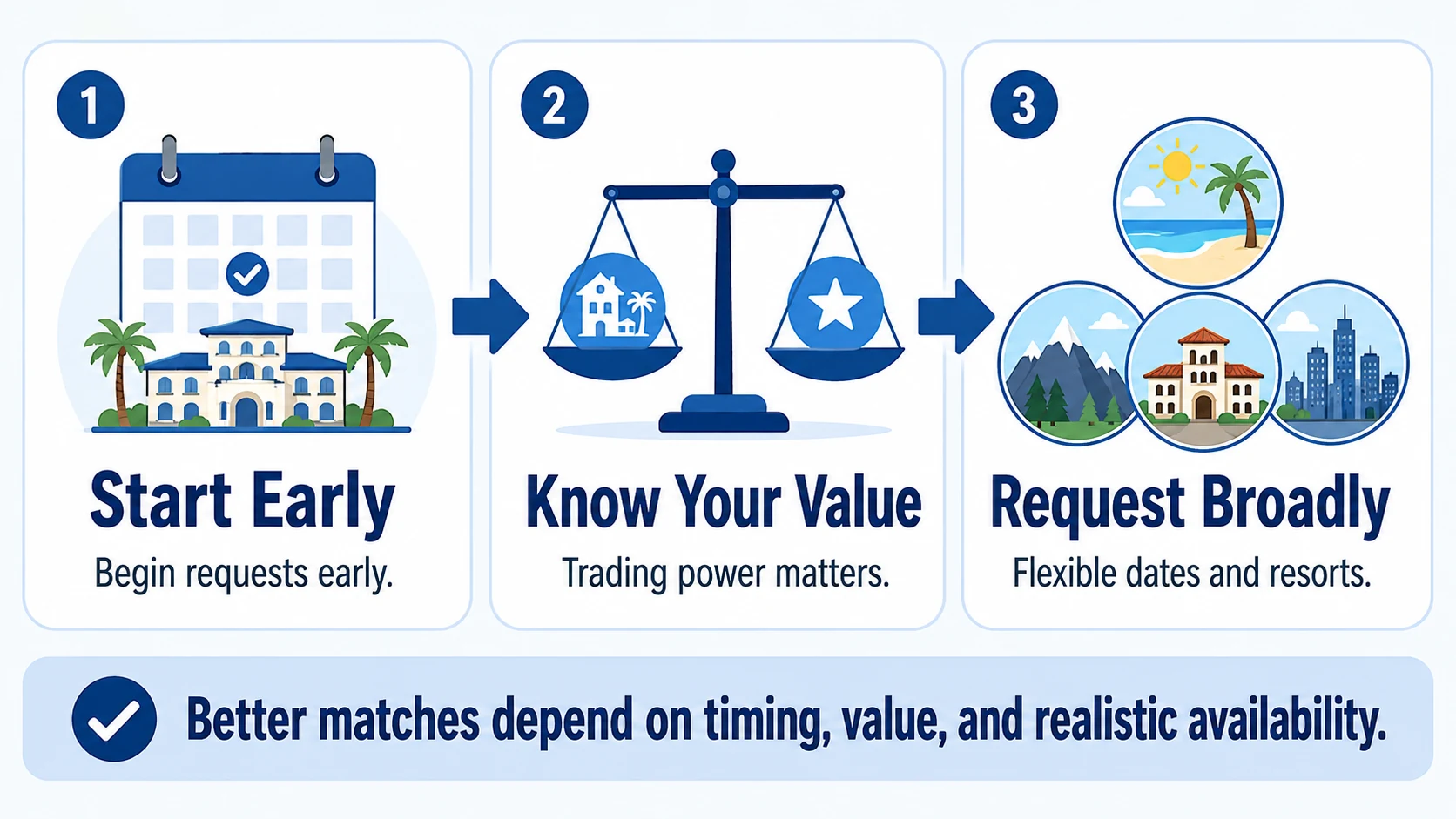
Better exchange results come from starting early, requesting broadly, and understanding the value of the ownership being exchanged.
But some limitations cannot be fixed by searching more. Weak Trading Power, scarce destination inventory, internal priority, developer-controlled deposits, and narrow eligibility can prevent a match.
A resort’s presence in the directory confirms participation—not availability or equal access. When a request remains unmatched, verify the likely barrier, broaden the search, and compare the full exchange cost with other travel options.

Personalized Decision Support
Exchange Frustration May Be a Symptom of a Larger Ownership-Fit Problem
Limited availability, weak Trading Power, developer-controlled deposits, rising fees, and changing travel habits can all affect whether the ownership still supports the vacations you actually want.
The Timeshare Decision Intelligence Report™ helps organize your ownership facts, costs, exchange limitations, unresolved questions, and realistic options before you spend more money, combine deposits, upgrade a membership, or make a larger ownership decision.
View the Timeshare Decision Intelligence Report™What the Report Can Help You Evaluate
- ✓ Whether the exchange problem reflects the ownership, the program, or both.
- ✓ How fees, financing, access, and travel habits affect ongoing value.
- ✓ Which facts or restrictions still need to be verified.
- ✓ Whether keeping, changing, transferring, or reconsidering the ownership deserves attention.
Related Guides
These guides provide deeper context on exchange-company differences, booking limitations, alternative travel options, and the broader mechanics behind timeshare exchange availability.
Understand How Exchange Programs Work
- How Timeshare Exchange Programs Work
Learn how deposits, requests, memberships, fees, and inventory move through an exchange system. - RCI vs. Interval International
Compare the two major exchange networks, including affiliations, availability, fees, and owner fit. - Why Is It So Hard to Book a Timeshare?
Understand how reservation windows, inventory controls, seasonality, and competition affect booking access.
Evaluate Specific Exchange Options
- Is RCI Worth It?
Review RCI fees, Trading Power, availability, paid travel options, and practical exchange value. - Is Interval International Worth It?
Evaluate Interval membership, exchanges, Getaways, availability, and the complete cost of using II. - 7Across Review
Examine 7Across deposit pathways, fees, Exchange Weeks, paid inventory, and availability considerations.
Compare Other Travel Paths
- Timeshare Exchange Alternatives
Explore independent exchanges, rentals, travel portals, cruises, specialty programs, and direct-booking alternatives. - Are Timeshare Bonus Weeks Worth It?
Learn how bonus and paid weeks differ from traditional exchanges and when the added cost may make sense.