
Timeshare Credit-Risk Guide
Can a Timeshare Affect Your Credit Score? What Owners Should Know
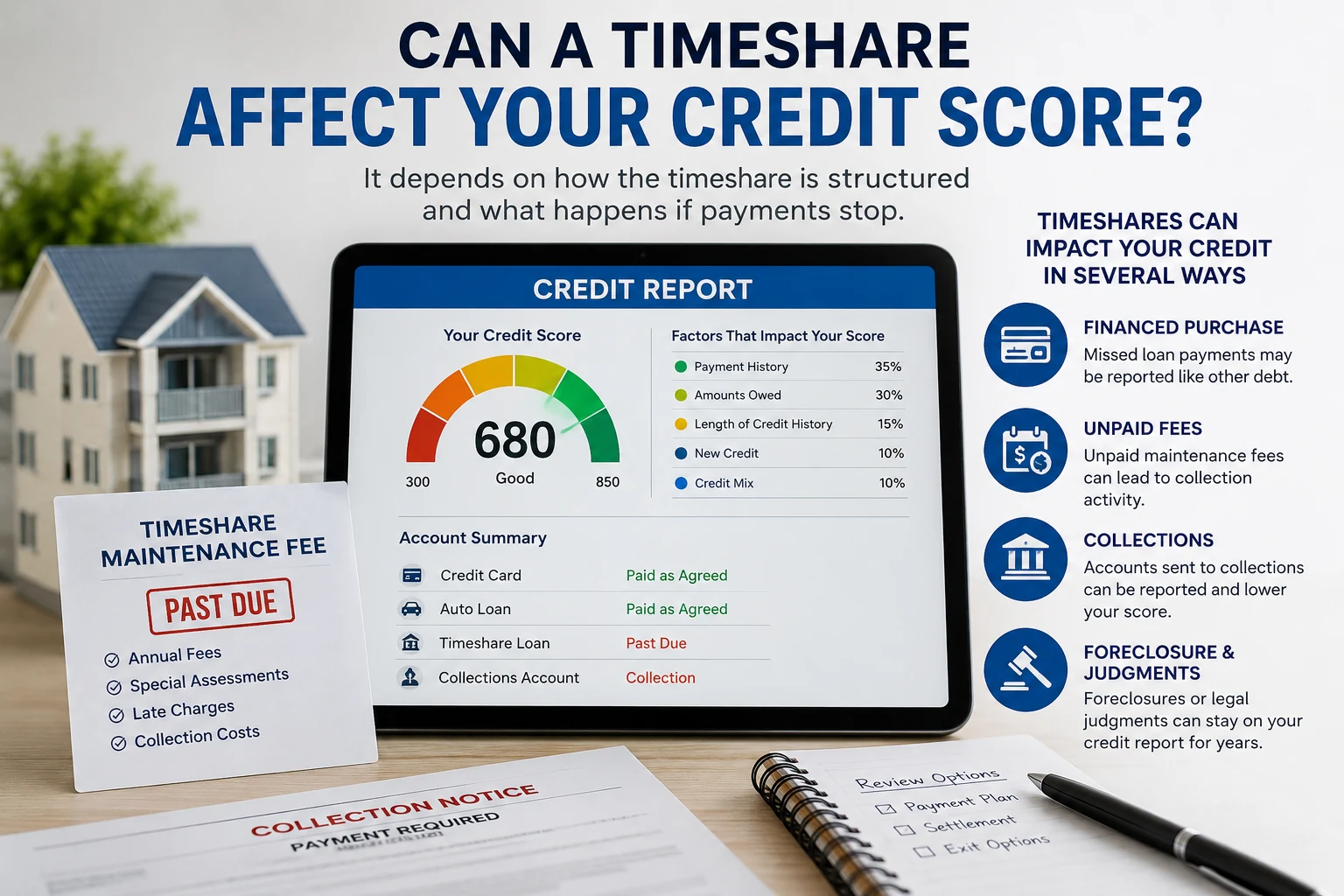
Simply owning a timeshare does not automatically damage your credit. The risk usually comes from the financing, unpaid balances, or negative account activity connected to the ownership.
A reported timeshare loan, late payment, unpaid maintenance-fee balance, collection account, or enforcement process may create different forms of credit exposure. Some obligations may appear directly, while others may remain within the resort’s billing system unless the account escalates. This guide helps you identify what may be reported, what currently appears on your credit file, and whether the underlying ownership remains active.
Trace the Credit Exposure
Four questions clarify the real risk
The relevant issue is the account activity—not simply the fact that you own a timeshare.
- Is there an active timeshare loan, and does it appear on your credit report?
- Are maintenance fees, assessments, or other balances currently past due?
- Has a lender, collector, or other party reported negative account activity?
- Does written documentation confirm whether the ownership itself has ended?
Credit status and ownership status are separate questions. A paid, settled, or updated balance does not necessarily prove that future timeshare obligations have ended.
About this guidance: Timeshare Travel Club Authority’s guidance draws on experience with timeshare financing, reported loan accounts, maintenance-fee billing, late payments, delinquent balances, collections, settlements, ownership enforcement, credit-report entries, and documented exit or transfer processes. Potential credit effects can vary by account type, reporting party, payment history, ownership status, collection stage, proposed resolution, and what is furnished to the credit bureaus, so owners should review both their current credit files and the underlying timeshare records before making a payment, nonpayment, or exit decision.
Before You Make a Payment Decision
Credit Risk Depends on the Account—not Simply the Timeshare
A financed purchase, unpaid annual fees, reported delinquency, and an unresolved ownership obligation may create different risks. The Timeshare Decision Intelligence Report™ helps organize your loan status, account history, documents, ownership costs, and unresolved questions before you stop paying, accept a settlement, or assume the timeshare has been resolved.
Need a clearer view of the financial and ownership factors involved?
Review the Report Option Or continue with the credit overview belowSystem Insight
Credit impact depends on what is actually reported—not simply whether you own a timeshare.
- A financed purchase may appear as an active credit account when the lender reports the balance and payment history.
- A paid-off ownership may not appear on the credit report if there is no active financing or other reported account.
- Annual fees may remain within the resort or association’s billing system rather than appearing as a monthly credit obligation.
- Credit exposure can change when an account becomes delinquent and negative activity is reported by a lender or another account holder.
- Credit status and ownership status are separate questions because resolving a balance does not necessarily prove that the timeshare obligation has ended.
Timeshare Loans, Annual Fees, and Reported Activity Affect Credit Differently
The word timeshare can describe several separate financial obligations.
A purchase loan, annual maintenance fee, special assessment, and reported delinquency are not the same type of account. They may be managed by different parties and may reach a credit report through different processes.
A financed purchase generally creates the clearest direct connection to credit because the lender may report the account and its payment history.
Annual maintenance fees and club dues may be handled internally by the resort, homeowners association, developer, or management company. They may not appear as monthly credit accounts, but an unresolved balance can still create later credit exposure if the account moves beyond ordinary billing.
Other reported activity may appear only after an account becomes delinquent or enters a more formal recovery or enforcement process.
The practical starting point is to identify:
- Whether there is an active timeshare loan
- Which party bills the annual ownership charges
- Whether any payment is already past due
- Whether negative account activity has been reported
- Whether the ownership remains active despite any payment or settlement
This page provides the broad credit overview. The narrower guides on collections, maintenance-fee nonpayment, and foreclosure address those specific stages in greater detail.
Why the Type of Timeshare Obligation Matters
The word “timeshare” can refer to several different financial obligations.
A purchase loan, annual maintenance fee, special assessment, collection balance, and foreclosure record do not affect credit in the same way. Some may be reported directly. Others may only create credit risk after the account becomes delinquent, is assigned to a collector, or moves into a formal enforcement process.
Before assuming a timeshare will or will not hurt your credit, it helps to separate the type of obligation from the stage of escalation.
Credit Risk Paths
How Different Timeshare Obligations May Reach Your Credit Report
The potential credit impact depends on whether the account involves direct financing, unpaid recurring charges, or negative activity that has already been reported.
Financed Timeshare Purchase
A timeshare loan may appear as an active credit obligation if the lender reports the account.
- The balance may appear while the loan is active.
- Payment history may be reported.
- Late or missed payments may create direct credit exposure.
Unpaid Annual Fees or Assessments
Recurring ownership charges may remain within the resort or association’s billing system at first.
- The account may not appear as a monthly credit obligation.
- Late charges or penalties may accumulate.
- Credit exposure may change if the unpaid balance escalates.
Delinquency or Enforcement Activity
Credit risk is generally more direct once negative account activity is furnished to a credit bureau.
- The reporting party and account type matter.
- Paying later may update the status without removing earlier history.
- Credit status and ownership status should be verified separately.
The central question is not simply whether you own a timeshare. It is whether a related obligation appears on your credit file—or could create reportable activity if the account becomes delinquent.
Can You Exit a Timeshare Without Ruining Your Credit?
A timeshare exit does not automatically damage credit. The risk usually comes from what happens to the loan, maintenance fees, assessments, and account status while the ownership is being resolved.
An exit may carry less credit exposure when required payments remain current, the lender or developer recognizes the resolution, and the owner receives written confirmation that the ownership and related obligations have ended.
The risk increases when payments stop before a completed rescission, surrender, deed-back, resale, transfer, or other documented resolution is in place.
The Account Remains Current While the Exit Is Completed
These conditions may reduce the likelihood that the exit process creates avoidable delinquency or negative reporting.
Rescission is completed within the applicable cancellation period.
A developer-approved surrender or deed-back is completed while eligibility requirements are met.
A resale or transfer is recognized by the resort, association, lender, or other required party.
Written confirmation explains what happened to the loan, fees, ownership, and future obligations.
Payments Stop Before the Ownership Is Resolved
These conditions may allow the account to become delinquent while the promised or attempted exit remains incomplete.
Loan payments stop before the lender has approved or recognized a resolution.
Maintenance fees or assessments become delinquent and move toward collections or enforcement.
An owner relies on an exit-company promise without confirmation from the parties controlling the account.
The ownership remains active while default, collections, foreclosure, or reporting activity continues.
No exit method is automatically credit-safe. The relevant questions are whether the required payments remain current, whether every balance is addressed, and whether the responsible parties have confirmed the outcome in writing.
Why an Active Timeshare Loan Changes the Credit Risk
A financed timeshare creates the clearest direct connection between the ownership and the owner’s credit profile. When the lender reports the account, the loan balance and payment history may appear while the financing remains active.
Stopping loan payments during an attempted exit may therefore create late-payment, default, charge-off, collection, or other reporting exposure before the ownership question is resolved.
A paid-off timeshare may carry less direct loan-related risk, but it is not automatically credit-safe. Maintenance fees, assessments, association charges, or other required balances may still escalate if they remain unpaid.
The first step in any credit-sensitive exit decision is to determine whether an active loan exists, who controls it, and whether the proposed exit actually resolves the financing as well as the ownership.
Does a Timeshare Always Show Up on Your Credit Report?
No. Simply owning a timeshare does not mean the ownership will appear as an active account on your credit report.
A financed timeshare is more likely to appear because the lender may report the loan balance and payment history. A paid-off ownership may not be listed, particularly when annual maintenance fees are billed internally by the resort, homeowners association, developer, or management company.
This can create a false sense of certainty. An owner may check a credit report, see no timeshare account, and assume the ownership carries no credit exposure.
The absence of an account today does not guarantee that later activity will never be reported. Credit exposure may change if:
- A reported loan becomes delinquent
- Another unpaid ownership balance escalates
- A new account or negative status is furnished to a credit bureau
- An enforcement process creates reportable activity
The practical distinction is between an ownership that does not currently appear and an ownership that could never affect credit. Those are not the same conclusion.
Owner takeaway: A timeshare that does not appear on your credit report today is not necessarily incapable of affecting credit later. The more important questions are whether a related financial obligation exists, whether the account is current, and what activity may be reported if the status changes.
Why an Exit Company Cannot Guarantee Credit Protection
An exit company does not control the lender’s reporting, the resort’s billing records, an association’s collection process, or whether a developer will approve a surrender.
Even when a company promises to pursue an exit, the loan and annual fees may remain due until the ownership is formally resolved. Stopping payments at the direction of a third party can therefore create credit exposure while the underlying account remains active.
Before relying on any credit-related assurance, ask who is responsible for keeping the account current, what the company will do about an active loan, and what written proof will establish that the ownership and future charges have ended.
Risk Point
Credit Risk May Develop Before the Ownership Issue Is Fully Resolved
Owners sometimes focus only on the final ownership outcome and overlook the account activity that may occur along the way. Late payments, delinquent balances, or another reported status may affect credit before the deed, membership, loan, or ownership obligation reaches a final resolution.
A later payment or settlement may update an account without removing earlier history, and it may not prove that future ownership obligations have ended. Credit status and ownership status should therefore be confirmed separately.
Before You Make a Payment, Nonpayment, or Exit Decision
Credit status and ownership status should be reviewed separately.
A payment may bring an account current or update a reported balance without transferring the ownership or ending future annual fees. Similarly, hiring an exit company or submitting a surrender request does not prove that the loan, membership, deed, or recurring obligations have ended.
Before acting, confirm what currently appears on the credit report, which balances remain active, who may report future activity, and what written documentation would prove that the ownership has been fully resolved.
Action Step
Check the Credit File and the Ownership Account Separately
Before stopping payments, accepting a settlement, or assuming there is no credit risk, confirm what is being reported and whether the underlying timeshare obligation remains active.
- Review whether a timeshare loan or related account appears on the credit report.
- Identify which lender, servicer, developer, association, or other party may report account activity.
- Check whether any payment is late, delinquent, settled, charged off, or reported under another status.
- Confirm whether annual fees or other ownership balances remain internal or have escalated.
- Ask what written documentation would prove that the ownership obligation has ended.
- Keep credit reports, account statements, agreements, receipts, and ownership-status confirmations together.
❓ Frequently Asked Questions
These questions address the broad relationship between timeshare ownership, financing, account activity, and credit reporting.
Can a timeshare affect your credit score?
Yes. A timeshare may affect credit when a related loan, late payment, delinquent balance, collection account, or other account activity is reported. Simply owning a paid-off timeshare does not necessarily affect the score.
Does a timeshare always appear on your credit report?
No. A financed purchase is more likely to appear because the lender may report the balance and payment history. A paid-off ownership may not appear as an active credit obligation, particularly when annual charges are handled internally.
Does timeshare financing affect your credit?
It can. A lender may review credit when financing is requested and may report the loan balance and payment history afterward. Late or missed loan payments may create more direct credit exposure than ordinary internal resort billing.
Can missing a timeshare payment lower your credit score?
It may when the payment or delinquency is reported. The result depends on the type of obligation, who controls the account, how late it becomes, and whether that organization furnishes information to a credit bureau.
Can unpaid maintenance fees affect credit?
They may create credit exposure if the balance moves beyond internal billing and negative activity is later reported through collections, enforcement, or another account process.
Does paying a timeshare balance remove negative credit history?
Not necessarily. Payment may update the balance or status without removing earlier late-payment or delinquency history. It also may not prove that the underlying ownership and future fees have ended.
Can you exit a timeshare without ruining your credit?
It may be possible when required payments remain current and the ownership is completed through a recognized, documented rescission, surrender, deed-back, resale, transfer, or other resolution. Credit exposure generally increases when payments stop before the process is complete.
Is a developer deed-back or surrender safer for credit?
It may carry less credit exposure when the developer formally approves the process, the loan and fees meet the eligibility requirements, and the owner receives written confirmation that responsibility has ended. Submitting a request alone is not enough.
Can a timeshare exit company protect your credit?
Not automatically. An exit company does not control lender reporting, resort billing, collections, or developer approval. Credit risk still depends on whether required payments remain current and whether the ownership and related balances are actually resolved.
Bottom Line
A timeshare can affect credit when a related loan, delinquent balance, collection account, or other negative activity is reported.
Exiting the ownership does not automatically hurt credit. The greater risk is stopping payments before the loan, fees, account status, and ownership have been formally resolved.
Before making a payment, nonpayment, or exit decision, confirm what is being reported, what obligations remain active, and what written proof will show that responsibility has ended.
Credit Risk and Ownership Status Should Be Reviewed Separately.
A timeshare decision may involve a reported loan, annual fees, delinquent balances, account standing, ownership documents, and unresolved future obligations. The Timeshare Decision Intelligence Report™ helps organize those details so you can understand what appears to be active, what still requires verification, and which next-step pathways may fit before you make another costly decision.
Get the Timeshare Decision Intelligence Report™ Customized ownership review • Decision-support report • No exit-company sales pitchIndependent decision support. This is not legal advice, credit repair, debt validation, lender negotiation, contract cancellation, an exit service, or a promise that credit or ownership consequences can be prevented.
Related Guides
These guides provide deeper information about the narrower payment, collection, and ownership stages that may create credit concerns.
Credit and Ownership Decisions
- How to Get Out of a Timeshare: The Complete Exit Guide
Compare legitimate exit pathways after identifying the credit, loan, fee, and account-standing risks connected to the ownership. - Should You Stop Paying Your Timeshare? What Happens Next
Review the broader risks of nonpayment before treating it as an ownership strategy.
Unpaid Fees and Collections
- What Happens If You Stop Paying Timeshare Maintenance Fees?
Understand how unpaid annual fees may affect account standing and potentially escalate over time. - Can a Timeshare Send You to Collections? What Happens Next
Review how a delinquent account may move from internal billing into more formal collection activity. - Received a Timeshare Collection Notice? What to Verify Before Paying
Use this guide when a collector is already involved and you need to understand what a payment or settlement may resolve.
Ownership Enforcement
- Timeshare Foreclosure: What Owners Should Know
Learn how ownership enforcement differs from ordinary account delinquency and why outcomes depend on the contract and ownership structure. - Can a Timeshare Put a Lien on Your House?
Review the distinction between obligations tied to the timeshare and broader property or judgment concerns.