
Timeshare Booking Challenges Explained
Why Is It So Hard to Book a Timeshare? Common Booking Challenges Explained
Paying annual fees does not guarantee that the resort, dates, or unit size you want will be available when you are ready to travel.
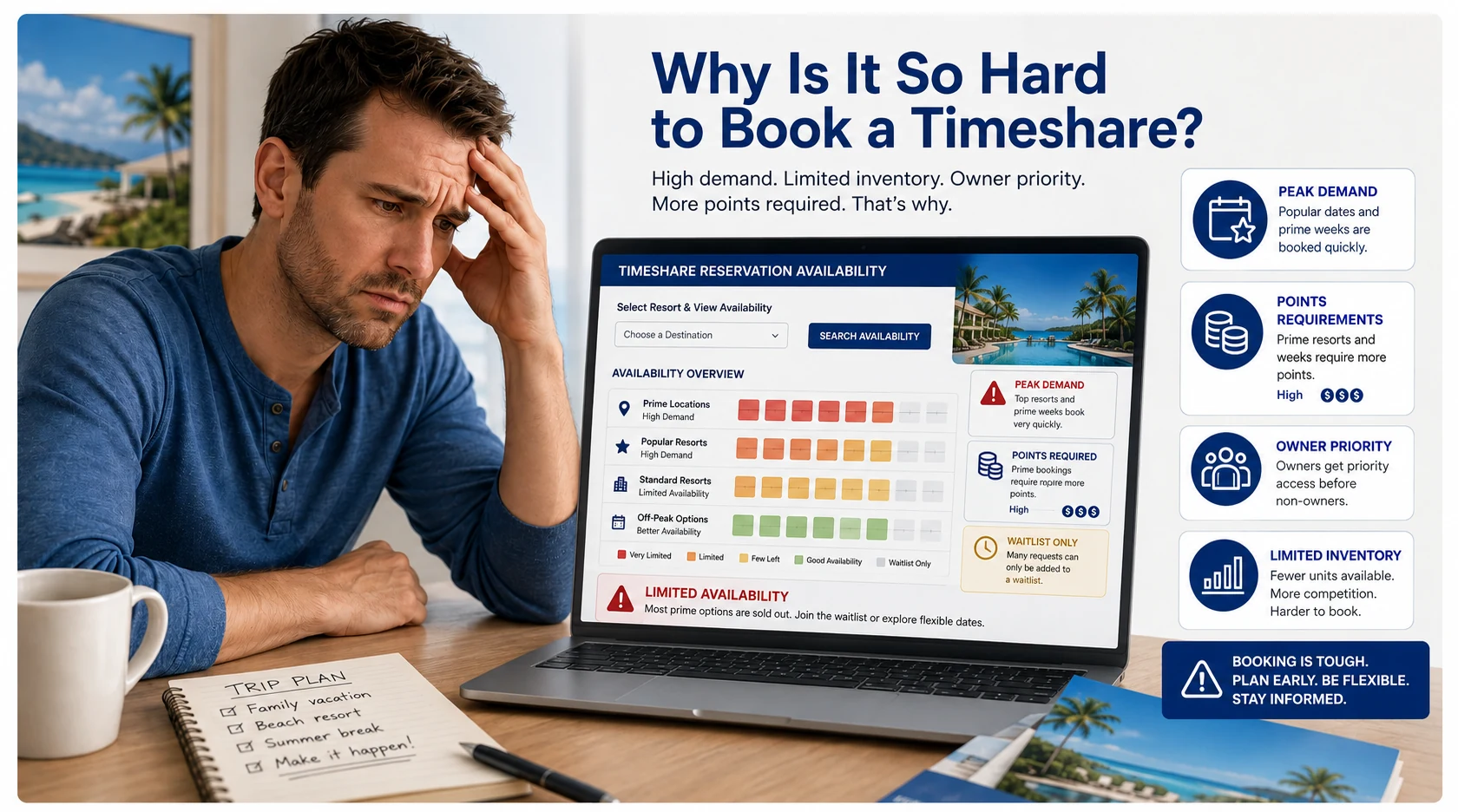
Timeshare reservations usually do not work like calling a hotel and choosing from every unsold room. Owners may be competing for a limited pool of inventory under booking windows, priority rules, points requirements, ownership tiers, and seasonal demand. This guide helps you identify what may be restricting your booking access—and whether the system realistically fits the way you need to travel.
Diagnose the Booking Problem
Four factors may be limiting your options
Availability may depend on more than whether a resort appears to have empty accommodations.
- How early your ownership allows you to book
- Which resorts, seasons, or inventory pools you can access
- How many points or credits the reservation requires
- How much flexibility you have with dates, locations, and unit size
The problem may not be that no rooms exist. It may be that the inventory available to your ownership is limited, restricted, or already claimed.
About this guidance: Timeshare Travel Club Authority’s guidance draws on experience with timeshare reservation systems, booking windows, home-resort priorities, points requirements, ownership tiers, exchange inventory, unit-size limitations, and high-demand travel periods. Availability can vary by developer, ownership type, resort, season, booking channel, priority status, and how early an owner requests the reservation, so owners should review the rules attached to their specific program rather than assuming availability works like a standard hotel booking.
Important Distinction
Resort Access and Booking Power Are Not the Same
Access describes the resorts, destinations, or programs that may be available through an ownership. Booking power describes what the owner can realistically reserve within that system.
Practical booking power may depend on home-resort priority, reservation windows, ownership tier, points requirements, season, unit size, exchange trading power, account status, and competition from other owners. A large resort network can therefore provide broad theoretical access while offering much narrower options for a specific trip.
Before You Buy More Points or Upgrade
Identify What Is Actually Limiting Your Booking Options
Reservation problems may involve booking priority, ownership tier, points value, season, unit size, exchange rules, account status, or restrictions within the ownership documents. The Timeshare Decision Intelligence Report™ helps organize those details before you pay for an upgrade, continue accepting unusable travel options, or make another ownership decision.
Need a clearer view of your ownership rights and booking limitations?
Review the Report Option Independent decision support • No exit-company sales pitchWhere Timeshare Booking Problems Usually Come From
Reservation difficulty is often caused by several limits working together. Identifying the specific source of the problem is more useful than assuming the entire system has no availability.
Home Resort / Floating Week
Availability May Depend on Season and Booking Window
Fixed weeks can be more predictable, but floating-week owners may compete with other owners for the same season, dates, unit size, and reservation window. Review how timeshare booking windows work to confirm when your priority begins and what inventory it actually covers.
Points or Club System
Points Add Flexibility, But Not Unlimited Inventory
Points may allow access to more resorts or dates, but owners still compete for high-demand locations. Prime weeks, larger units, and popular resorts may require more points or earlier booking.
Exchange Availability
The Exchange Company Only Shows What Is Available Through the Exchange
Exchange inventory depends on what other owners deposit, what resorts make available, and what the system allows the owner to see based on trading power, rules, timing, and demand.
Exchange reservations involve an additional layer of matching beyond the owner’s internal booking system. Our guide to timeshare exchange tips explains how Trading Power, ongoing searches, deposit timing, destination supply, and flexibility affect which exchanges an owner can realistically confirm.
System Insight
The Most Desirable Reservations Usually Face the Most Competition
- Peak dates fill first: Holidays, school breaks, summer weeks, ski season, and prime beach periods create predictable demand spikes.
- Larger units are more limited: Two-bedroom, three-bedroom, and specialty accommodations may disappear faster than studios or smaller units.
- Priority changes what remains: Owners with earlier booking windows or stronger reservation rights may reserve before general inventory opens.
- Late searches provide fewer choices: Remaining availability may involve smaller units, alternate resorts, or less desirable travel dates.
Why Can I Rent the Resort but Not Book It as an Owner?
Seeing a resort available for cash when the owner portal shows no availability can be one of the most frustrating timeshare booking problems.
The difference may come from separate inventory pools. A public rental may involve developer-controlled rooms, unsold inventory, hotel inventory, owner rentals, promotional allocations, exchange-company rentals, or accommodations released under rules that do not apply to the owner’s reservation channel.
A rental listing therefore does not necessarily prove that the exact unit and date were available through the ownership program.
Even so, repeated gaps between cash availability and owner availability deserve attention. If an owner regularly pays annual fees but still has to purchase the desired vacation separately, the ownership may not be providing enough practical booking value.
The useful comparison is not simply whether the resort has an empty room. It is whether the owner’s specific rights, priority, points, and booking channel provide reliable access to the trips the ownership was expected to support.
Is the Booking Problem Occasional or Structural?
Not every missed reservation means the ownership no longer works.
A single unsuccessful search may reflect unusual demand, a late booking attempt, a temporary inventory shortage, or a specific unit that filled quickly. Those problems may improve when the owner searches earlier, adjusts dates, uses a waitlist, or considers a different resort.
A structural problem is different. It appears repeatedly because the owner’s real travel needs do not match the reservation system.
Warning signs may include:
- The owner can travel only during holidays, school breaks, or other peak periods.
- The family consistently needs a larger unit that is rarely available.
- Preferred resorts regularly disappear before the owner’s booking window opens.
- The points balance does not reliably cover the desired trips.
- Exchange searches repeatedly return unsuitable dates, destinations, or accommodations.
- The owner must frequently pay cash elsewhere for vacations the timeshare was expected to provide.
The useful question is not whether the owner has ever encountered limited availability. It is whether the same booking barriers continue preventing the ownership from supporting the trips they realistically need.
Risk Point
Repeated Booking Failure Can Reduce the Practical Value of Ownership
Limited availability becomes more serious when the owner consistently cannot reserve the dates, resorts, or unit sizes the ownership was expected to support. In that situation, booking difficulty may be more than an occasional inconvenience.
The financial risk is continuing to pay maintenance fees, club dues, loan payments, and reservation-related charges while also paying separately for the vacations the owner actually wants to take.
When Limited Availability Becomes an Ownership Problem
Limited availability is not always a reason to exit a timeshare.
If an owner can plan early, travel outside peak periods, use smaller units, or remain flexible on destination, the ownership may still work. Some owners understand the rules and are able to reserve the trips they want year after year.
The problem begins when the ownership no longer matches the owner’s real travel pattern.
For example, an owner may only be able to travel during school breaks, holidays, or specific work-approved vacation windows. Another owner may need a two-bedroom or larger unit for family travel. Another may have purchased because they wanted access to a specific beach destination, ski resort, theme-park area, or international location.
If those stays are consistently unavailable, the ownership may become harder to justify.
Availability problems can also become more serious when the owner is paying ongoing costs for a system they cannot practically use. Maintenance fees, club dues, exchange fees, reservation fees, and loan payments can feel especially burdensome when the owner still has to pay cash elsewhere to book the vacation they wanted.
The key question is whether the booking problem is occasional or structural.
An occasional missed reservation may be frustrating. A repeated inability to book the trips that fit your schedule, family size, and travel preferences may signal that the ownership does not provide the practical value you expected.
Owner takeaway: Judge booking value by whether your ownership can reliably secure the dates, resorts, and unit sizes you actually need—not by the number of destinations shown in the broader resort network.
Action Step
Run a Booking Reality Check
Compare the trips you realistically need against the booking rights, inventory, points, and planning requirements your ownership actually provides.
List the dates and seasons when you can realistically travel, including school breaks, holidays, work-approved vacation periods, or other fixed travel windows.
Identify the resorts, destinations, and unit sizes you actually need, rather than relying on the size of the broader network.
Confirm your booking window and priority rights, including home-resort access, ownership-tier rules, and when general inventory opens.
Compare your points, week, or trading power with the requirements for the dates, resorts, and accommodations you want to reserve.
Track several actual booking searches, including the search date, available resorts, unit sizes, travel periods, restrictions, and unsuccessful results.
Compare the ownership option with renting independently, including the final price, cancellation terms, accommodation quality, and travel flexibility.
Quick Win
Save screenshots or notes from several booking attempts. A repeated pattern of unavailable dates, unsuitable units, or inaccessible resorts provides a clearer picture than one unsuccessful search.
When Booking Problems Become an Ownership-Fit Question
Occasional reservation frustration does not automatically mean the timeshare no longer works.
But repeated booking problems may deserve a broader review when the ownership cannot reliably support the dates, destinations, or accommodations the owner actually needs. This is especially important when the owner must keep paying annual fees while booking desired vacations elsewhere.
At that point, availability is only one part of the decision. Usage history, annual costs, loan status, points value, travel flexibility, resale limitations, transfer rules, and available developer options may also affect whether keeping the ownership still makes sense.
For the broader decision, continue with Is Your Timeshare Worth Keeping? How to Decide.
❓ Frequently Asked Questions
These questions address the most common reasons owners encounter limited availability and how to tell whether the problem involves timing, inventory, points, or the ownership itself.
Why is it so hard to book a timeshare?
Timeshare inventory is limited, and many owners may be competing for the same resorts, dates, and unit sizes. Availability can also depend on reservation windows, home-resort priority, ownership tier, points requirements, season, and exchange inventory.
Why does my timeshare show no availability?
The requested inventory may already be reserved, outside your current booking window, unavailable to your ownership type, or require more points or priority than your account provides. Account restrictions, expired usage rights, or exchange rules may also affect what appears.
Why can I rent the resort but not book it as an owner?
Cash rentals may come from developer inventory, unsold rooms, hotel allocations, owner rentals, promotional inventory, or exchange-company rental programs. Those rooms may not be part of the inventory available through your specific ownership channel.
Do timeshare points make booking easier?
Points may provide more destination and date choices, but they do not create unlimited inventory. Popular resorts, peak seasons, and larger units may require more points, earlier booking, or stronger priority rights.
How far in advance should I try to book?
The appropriate lead time depends on the program and the owner’s reservation rights. High-demand dates and larger units often require booking as soon as the applicable window opens, while more flexible trips may remain available later.
When do booking problems suggest the ownership may not fit?
A broader review may be appropriate when the owner repeatedly cannot reserve the dates, resorts, or accommodations they realistically need—even after understanding the rules and searching within the proper booking window.
Bottom Line
Timeshare booking problems usually reflect the difference between access on paper and usable reservation power.
An owner may have access to a large resort network, points program, club, or exchange company without having enough priority, points, inventory, or flexibility to reserve the trips they actually need.
Occasional limited availability may be resolved by booking earlier, understanding the reservation rules, using a waitlist, or considering alternate dates. Repeated problems are more significant—especially when the same peak dates, larger units, or preferred resorts remain inaccessible year after year.
The most useful question is not whether the ownership provides access to many destinations. It is whether the owner can reliably reserve suitable vacations within the dates, planning window, and accommodation requirements that fit their life.
When that does not happen, booking difficulty should be reviewed alongside the ownership’s annual costs, usage history, points value, restrictions, and overall travel fit.
Understand Why Your Ownership Is Not Producing the Reservations You Expected
Booking difficulty may involve reservation priority, points requirements, season rules, unit access, ownership tier, exchange limitations, account status, or restrictions contained in your ownership documents. The Timeshare Decision Intelligence Report™ helps organize those details, identify material limitations, and clarify what should be verified before you upgrade, buy more points, continue paying, or choose another ownership path.
Get the Timeshare Decision Intelligence Report™ Customized ownership review • Decision-support report • No exit-company sales pitchIndependent educational decision support. This is not legal advice, contract cancellation, an exit service, a reservation service, or a promise that specific inventory, benefits, transfers, or ownership options will be available.
Related Guides
These published guides can help you understand how reservation systems work, evaluate exchange access, and determine whether recurring booking problems affect the broader value of ownership.
Booking Systems and Availability
- Timeshare Points vs. Weeks: Flexibility, Availability, and Costs Compared
Compare fixed weeks, floating weeks, and points systems, including how each structure affects reservation predictability and booking flexibility. - How Timeshare Exchange Programs Work
Understand how deposits, trading power, timing, owner demand, fees, and available inventory affect exchange reservations. - Is RCI Worth It?
Evaluate whether RCI exchanges, Extra Vacations, Last Call stays, availability, and added fees provide meaningful ownership value. - Is Interval International Worth It?
Review how Interval International inventory, exchange fees, Getaways, membership costs, and travel flexibility affect practical value.
Ownership Fit and Cost
- Total Cost of Timeshare Ownership: What You Actually Pay Over Time
Review the purchase price, financing, maintenance fees, club dues, exchange charges, assessments, and other long-term expenses. - Can You Rent Out Your Timeshare? Rules, Gray Areas, and Rental Risks
Understand when unused reservations may be rented, which restrictions may apply, and why rental access can differ from owner availability.