
Timeshare Ownership Comparison
Timeshare Points vs. Weeks: Flexibility, Availability, and Costs Compared
Points are often presented as more flexible than traditional timeshare weeks—but flexibility only matters if the ownership can actually reserve the vacations you want.
Points, fixed weeks, and floating weeks create different tradeoffs between choice, predictability, booking competition, and cost. The better structure is not necessarily the one with the most options. It is the one that provides enough booking power for the destinations, dates, unit sizes, and trip lengths you actually need.
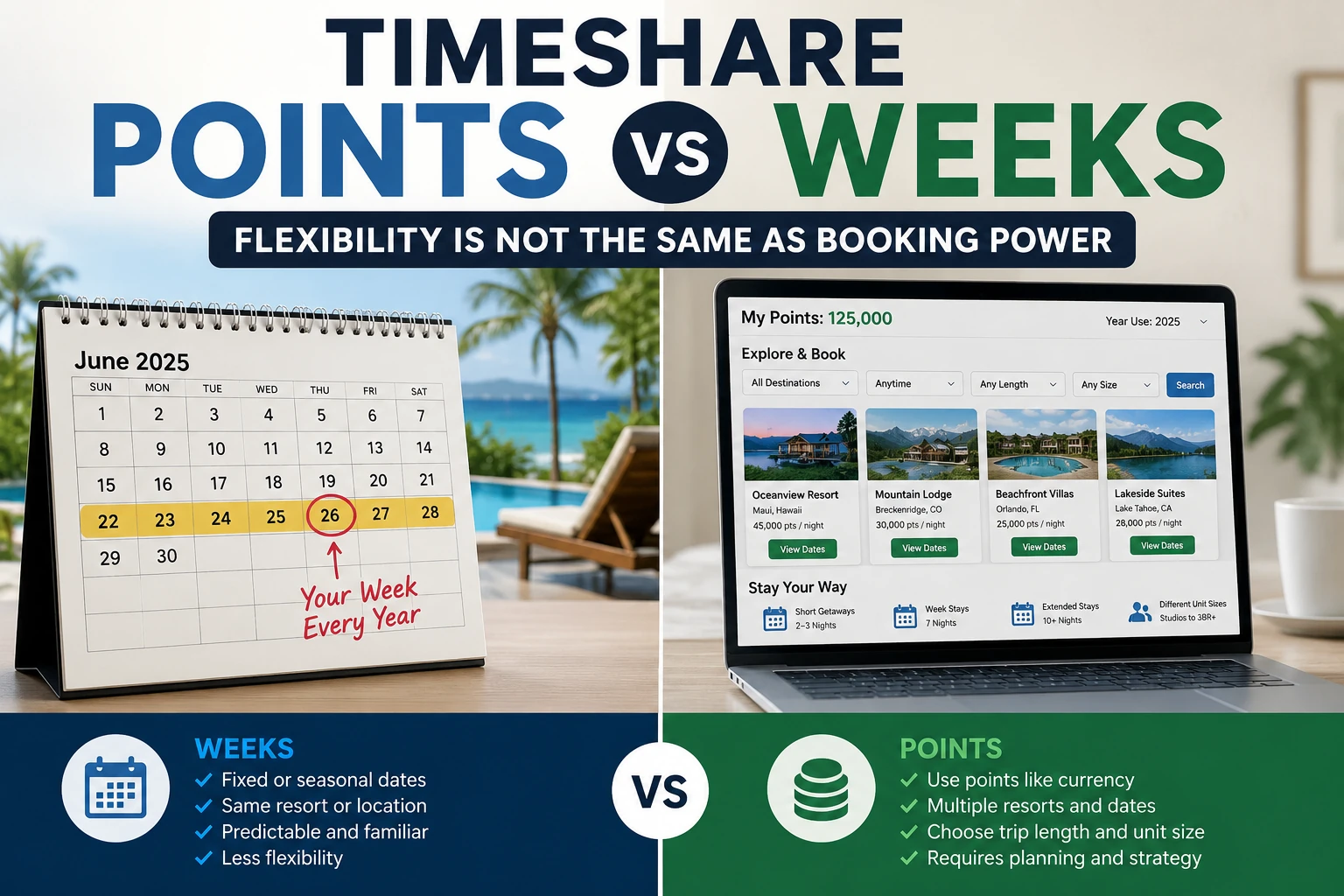
About This Guidance: TTCA evaluates timeshare ownership structures based on how reservation rights work in practice—not simply how flexibility is marketed. This guidance compares points, fixed weeks, and floating weeks through booking access, inventory competition, planning requirements, annual costs, conversion considerations, and long-term travel fit so owners can better judge which structure may work for them.
Before You Buy, Convert, or Upgrade
Flexibility Only Helps When the Ownership Has Enough Booking Power
A points balance, fixed week, or floating season should be evaluated against the resorts, dates, unit sizes, and trip lengths you actually need. The Timeshare Decision Intelligence Report™ helps organize the usage rights, annual costs, booking limitations, conversion terms, and ownership documents before you pay for more flexibility or give up rights you already hold.
Need a clearer view of what the ownership can realistically provide?
Review the Report Option Or continue with the ownership comparison belowImportant Distinction
Points Are a Travel Currency—not a Guaranteed Vacation
In a points-based program, every resort stay has a points price. The required amount may change based on the destination, unit size, season, day of the week, and number of nights. Friday and Saturday nights may cost more than midweek nights, while peak-season stays may require substantially more points than lower-demand travel.
The annual points allotment only establishes how much currency the owner receives. It does not guarantee that the owner has enough points—or that the desired inventory will remain available—to reserve the vacation they expected.
How Points, Fixed Weeks, and Floating Weeks Compare
The phrase “points versus weeks” can oversimplify the decision because week-based ownership may be fixed or floating.
Points, fixed weeks, and floating weeks primarily describe how vacation usage is allocated and reserved; they do not necessarily determine the underlying legal form of the ownership. If you need the broader foundation first, see What Is a Timeshare? Ownership Types, Points, Fees, Booking, and Exchange Explained.
Each structure creates a different balance of predictability, choice, booking competition, and complexity.
Ownership Structure Comparison
Fixed Weeks, Floating Weeks, and Points at a Glance
The strongest structure depends on whether the owner values predictable annual use, seasonal flexibility, or a broader range of reservation choices.
| Ownership Type | How It Usually Works | Potential Strength | Potential Limitation |
|---|---|---|---|
| Fixed Week | The ownership is tied to a specific annual week, resort, and sometimes unit or unit category. | Greater predictability when the owner wants the same vacation period each year. | Limited flexibility when the owner’s schedule, destination preference, or accommodation needs change. |
| Floating Week | The owner reserves within a defined season, resort, or ownership category, subject to program rules and availability. | More date choice than a fixed week while retaining a familiar week-based structure. | Popular dates may disappear quickly, leaving the owner with less desirable weeks within the permitted season. |
| Points | The owner receives an annual points allotment that can be spent on eligible resorts, dates, unit sizes, and trip lengths. | More potential combinations for owners who can plan early and adjust travel around availability. | The desired stay may require more points than the owner has, and sufficient points do not guarantee that inventory remains available. |
Timeshare Points Work Like a Travel Currency
In a points-based system, the owner receives an annual allotment of points that can be spent on available reservations. Points are also commonly used within vacation-club programs, although the points system does not by itself explain the underlying ownership or membership structure. For that broader context, see What Is a Vacation Club?
Every stay is assigned a points price. That price may change based on the resort, season, unit size, travel date, length of stay, and day of the week.
This is why the number of points purchased means very little without the current points chart.
An owner may receive what sounds like a large annual allotment but later discover that the desired two-bedroom unit, peak-season resort, or weeklong vacation requires more points than the account provides. The owner may technically have access to a broad network while lacking enough point currency to reserve the trips that motivated the purchase.
Points therefore involve two separate questions:
Do I have enough points for the reservation?
and:
Is the reservation still available when I am eligible to book it?
Having enough points does not solve an inventory shortage. Likewise, available inventory does not help when the owner lacks the points required to reserve it.
Before buying or adding points, compare the proposed annual allotment with several vacations you would realistically take, including the destinations, unit sizes, travel seasons, weekends, and number of nights you normally need.
The useful measure is not the size of the points balance. It is the amount of usable travel that balance can reliably purchase.
System Insight
Points are a currency used to compete for limited inventory—not a reservation guarantee.
- Every eligible stay has a points price based on factors such as resort, unit size, season, date, and trip length.
- High-demand periods may require more points during holidays, school breaks, summer, ski season, or peak beach travel.
- Weekend nights may cost more than midweek nights, reducing how far the annual allotment stretches.
- Having enough points does not guarantee availability if other owners reserved the inventory first.
- Booking priority and scarcity still matter because some owners may gain access before others.
Scarcity also helps explain why some clubs restrict owners from reserving desirable inventory primarily for commercial rental. Repeatedly booking peak resorts, larger units, or high-demand dates to rent to outsiders can reduce availability for owners trying to use their points for personal travel.
For a closer look at that distinction, see Can You Rent Out Your Timeshare? Rules, Gray Areas, and Rental Risks.
When Fixed Weeks May Work Better
A fixed week may work better for an owner who values certainty more than variety.
The owner generally knows the resort and annual travel period connected to the ownership. That can be especially useful when the week falls during a holiday, school break, ski season, summer vacation, or another period the household consistently wants.
A fixed week can also reduce some of the decision-making required by points systems. The owner may not need to compare points charts, track changing nightly values, or decide how to divide an annual allotment across several trips.
That predictability may carry real value when the week matches the owner’s long-term travel pattern.
The limitation is that life may stop matching the ownership. Work schedules change, children grow older, health needs develop, and preferred destinations shift. An owner who no longer wants or can no longer use the assigned period may need to exchange, rent, deposit, or otherwise reposition the week.
A fixed week is therefore not automatically better or worse. It is strongest when the owner wants the same basic vacation and weakest when flexibility becomes more important than certainty.
When Floating Weeks May Work Better—or Become Frustrating
A floating week may offer a middle ground between a fixed week and a points-based program.
Instead of receiving one assigned calendar week, the owner may reserve within a defined season, resort, unit category, or usage period. This can provide useful flexibility when the owner can travel on several possible dates.
The benefit depends on how much choice actually remains when the owner books.
A floating summer week may sound flexible, but the most desirable school-break or holiday dates may be reserved quickly. The owner may technically have access to the season while finding that only less convenient weeks remain.
Priority rules may also affect the outcome. Some owners may book earlier based on ownership tier, home-resort status, unit category, or another program rule.
Floating weeks tend to work best for owners who can plan early and accept several dates within the permitted season. They may be less effective for owners who need one specific peak week every year but lack guaranteed priority for it.
When Points May Work Better
Points may work better for owners who want different destinations, trip lengths, unit sizes, or travel patterns from year to year.
An owner may be able to use the annual allotment for a weeklong stay, divide it across shorter trips, choose a smaller unit to conserve points, or spend more points for larger accommodations or higher-demand periods.
That flexibility can be valuable for owners who plan early, understand the points charts, and can adjust travel around the available inventory.
Points may also suit households whose needs change. A couple may reserve a studio for one trip and a larger unit for a later family vacation. An owner may travel midweek to stretch the points balance or select lower-demand seasons to receive more nights.
The system becomes less useful when the owner needs predictable peak-season travel but lacks enough points, sufficient booking priority, or the ability to reserve far in advance.
A large destination network can also create unrealistic expectations. Access to hundreds of resorts does not mean the annual allotment can purchase every resort, season, or unit type within that network.
Points work best when the owner understands both the currency and the inventory. The real benefit is not theoretical choice—it is the ability to convert the annual allotment into vacations the owner genuinely wants.
Owner takeaway: Fixed weeks, floating weeks, and points solve different travel problems. A points balance may create more possible combinations, but its real value depends on what that currency can purchase and whether the desired inventory is still available when the owner books.
Why Points Can Feel More Flexible but Less Predictable
Points often appeal to buyers because they make the ownership appear customizable.
Instead of receiving one assigned week, the owner may be able to choose among different resorts, unit sizes, travel dates, and lengths of stay. That can create more possibilities than a traditional fixed week.
The tradeoff is that points usually require more decisions and more active management.
Owners may need to monitor booking windows, points charts, banking deadlines, borrowing rules, cancellation policies, transaction fees, housekeeping charges, and changes in nightly point values. They may also need to compare several destinations or dates before finding an option that fits both the points balance and available inventory.
This can make the ownership feel flexible in theory but unpredictable in practice.
With a fixed week, the owner can usually identify the resort and annual travel period more easily. With points, the value depends on what the annual allotment can buy at the time the owner is eligible to reserve.
A points owner may therefore have access to more potential choices while having less certainty about any one vacation.
That does not make points inherently worse. It means the owner must be comfortable managing the system and adjusting plans when the preferred reservation requires more points or is no longer available.
Risk Point
A Large Points Balance May Still Provide Too Little Booking Power
Buyers may focus on the number of points they receive without comparing that allotment with the vacations they actually expect to take. The owner may later discover that the preferred resort, unit size, weekend stay, or peak-season trip requires substantially more points than the account provides.
Purchasing additional points may increase spending power, but it may also add purchase costs, financing, annual dues, and long-term obligations without resolving inventory scarcity. More points do not guarantee that the desired reservation will be available.
Should You Convert a Timeshare Week to Points?
Some week-based owners are offered the opportunity to convert their ownership into a points program.
The offer may promise more resorts, shorter stays, different unit sizes, or broader travel flexibility. Those benefits may be useful, but conversion should be evaluated against the rights and predictability the owner already has.
A fixed or deeded week may provide a specific annual use right, home-resort priority, or access to a desirable season. Converting may replace that certainty with points that must be spent through a system governed by availability, points charts, reservation windows, and club rules.
The owner should also determine whether the conversion truly replaces the original structure or simply adds another membership layer. Some arrangements may introduce enrollment charges, club dues, transaction fees, or new reservation rules while the underlying deed and maintenance obligations remain in place.
Before converting, request the current points charts and price several realistic trips. Compare the proposed allotment with the resorts, unit sizes, seasons, weekdays, weekends, and trip lengths you normally use.
Also confirm what happens to:
- Existing home-resort or fixed-week priority
- Annual maintenance fees and club dues
- Banking, borrowing, and expiration rights
- Resale and transfer restrictions
- Future conversion or program-change options
The key question is not whether points offer more theoretical choices. It is whether the converted allotment provides more usable travel than the rights the owner would give up.
How to Compare Availability Before Choosing Points or Weeks
Availability should be evaluated using the owner’s real travel calendar—not a general list of resorts or destinations.
Start with the periods when the household can actually travel. Owners limited to summer vacation, school breaks, holidays, or specific event weekends face a different availability challenge than owners who can travel midweek or during lower-demand seasons.
Then compare how each ownership structure would handle those dates.
A fixed week may provide the clearest answer when it already matches the needed travel period. A floating week requires the owner to understand when reservations open and how many other owners compete within the same season. A points system requires both enough point currency and available inventory.
Before choosing or converting, review at least several realistic reservation examples:
- A preferred summer or holiday stay
- The unit size the household regularly needs
- A weekend-heavy trip versus a midweek stay
- A second-choice resort or alternate date
- The lead time required to secure each option
Do not evaluate availability only by asking whether a resort appears in the program directory. Confirm how far ahead the reservation opens, whether priority groups book first, how many points the stay requires, and what alternatives remain when the preferred option is unavailable.
The best ownership structure is the one that works during the dates the owner can actually travel—not the one with the longest destination list.
Owners who plan to use either structure through an outside exchange network should also understand how Trading Power, request timing, destination supply, and flexibility affect actual timeshare exchange results. A points balance or deposited week may provide exchange access, but it does not guarantee that the requested resort, season, or unit will be available.
What If You Only Travel Every Other Year?
Owners who travel every other year should compare the ownership’s billing cycle with the way usage is allocated.
Some programs offer biennial ownership or every-other-year points. Others provide points annually even when the owner does not expect to travel every year. In that situation, the owner may need to bank points, borrow from a future allotment, or combine several years of usage to reserve a larger trip.
Those options can sound convenient, but they may involve deadlines, transaction fees, expiration rules, or limits on how long points remain usable.
The financial obligation may also continue annually. An owner who travels every other year could still face yearly maintenance fees, club dues, or administrative charges, depending on the ownership structure.
A fixed or floating week may create a different challenge. If the owner receives annual usage but travels less often, the unused week may need to be exchanged, rented, deposited, or forfeited. An every-other-year week may align better with the travel pattern, but the owner should confirm exactly which fees are billed annually and which apply only during the use year.
The useful comparison is not simply whether points can be saved. It is whether the program allows the owner to combine usage without losing value or paying enough additional fees to erase the benefit.
How the Costs of Points and Weeks May Differ
Points and weeks may create different cost structures even when they provide similar vacation use.
A fixed or floating week commonly carries maintenance fees connected to the resort, unit category, ownership interest, or association budget. Those fees may continue whether the owner uses the week, exchanges it, rents it, or lets it expire.
A points owner may pay annual dues based on the points allotment, ownership interest, trust structure, or club formula. The account may also involve reservation charges, housekeeping fees, short-stay fees, transaction costs, banking or borrowing charges, and exchange-related expenses.
Neither structure is automatically less expensive.
Points may become costly when an owner needs to purchase more currency to reserve the desired trips. A fixed week may become costly when the owner no longer wants the assigned vacation and must pay exchange or rental-related fees to use it differently.
Before comparing ownership types, review:
- The annual maintenance fee or club-dues calculation
- Whether dues rise when additional points are purchased
- Reservation, transaction, and housekeeping charges
- Banking, borrowing, exchange, and cancellation fees
- Conversion or enrollment costs
- The expense of securing the unit size and season actually needed
The strongest comparison is the total annual cost divided by the travel the ownership can realistically provide—not the purchase price or points balance viewed alone.
Action Step
Match the Ownership Structure to the Trips You Actually Take
Compare the ownership against your real dates, unit needs, planning habits, and annual budget before buying points, converting a week, or paying for an upgrade.
- Price several realistic vacations using the current points chart or week-usage rules.
- Confirm the booking window and whether other owner groups receive earlier priority.
- Compare the unit sizes and peak travel periods your household actually needs.
- Review annual dues, transaction charges, housekeeping costs, and exchange fees.
- Check banking, borrowing, expiration, and every-other-year usage rules.
- Identify which fixed-week or home-resort rights may be lost through conversion.
Frequently Asked Questions
These answers clarify how points and weeks affect reservation flexibility, booking access, annual usage, and ownership value.
Are timeshare points better than weeks?
Not automatically. Points may provide more reservation combinations, while a fixed week may offer more predictable annual use. The stronger option depends on the owner’s destinations, dates, unit needs, planning habits, and annual budget.
How do timeshare points work?
Points function like a travel currency. The owner receives an allotment that can be spent on eligible stays, with different points prices assigned according to resort, season, unit size, day of the week, and trip length.
Does having enough points guarantee a reservation?
No. The owner needs both sufficient points and available inventory. Booking windows, priority rules, and competition from other owners may affect whether the desired stay can be reserved.
The applicable reservation date may also change based on the home resort, ownership group, requested stay, or booking channel. Review how timeshare booking windows work before assuming that having enough points means the reservation can already be requested.
What is the difference between a fixed week and a floating week?
A fixed week is generally tied to a specific annual travel period. A floating week allows the owner to reserve within a defined season or category, but the preferred dates remain subject to availability and program rules.
Are weekend nights more expensive in points?
They may be. Many systems assign different nightly values based on demand, and Friday or Saturday nights may require more points than midweek stays. Owners should review the current chart for their specific program.
Should I convert my timeshare week to points?
Conversion may add flexibility, but it can also introduce fees, club rules, new dues, and less predictable booking. Compare what the proposed points can reserve with the week rights and priority you may be giving up.
Are points or weeks better for every-other-year travel?
Either may work, depending on the program. Review biennial usage, annual billing, banking and expiration rules, and whether combining multiple years creates fees or lost value.
Bottom Line
Timeshare points, fixed weeks, and floating weeks provide different kinds of booking power.
A fixed week may be the strongest choice for an owner who wants the same resort and travel period each year. A floating week may provide useful flexibility within a season, but the best dates may still be competitive. Points may offer the widest range of possible resorts, unit sizes, dates, and trip lengths, but those choices depend on both the owner’s point currency and the inventory available when booking opens.
The mistake is assuming that a larger points balance automatically means greater vacation value.
Every stay has a points price. A buyer may own thousands of annual points but still lack enough currency for the preferred resort, larger unit, weekend-heavy stay, or peak-season vacation. Even when the balance is sufficient, scarcity and booking priority may prevent the reservation from being available.
The strongest ownership structure is therefore not the one that sounds most flexible during a sales presentation. It is the one that most reliably supports the owner’s real destinations, travel dates, unit needs, planning window, usage frequency, and annual budget.
Before purchasing more points, converting a week, or paying for an upgrade, determine what the proposed ownership can actually reserve—and what rights, fees, or predictability may change as a result.

Personalized Decision Support
Still Not Sure Whether Points or Weeks Fit the Way You Travel?
The better ownership model depends on more than whether points sound flexible or a week sounds predictable. Booking habits, travel frequency, destination preferences, annual costs, ownership rules, and the specific product being offered can all change the answer.
If you are considering a purchase, upgrade, conversion, or major ownership change, the Timeshare Decision Intelligence Report™ can help organize the details and identify the questions that should be resolved before you commit.
View the Timeshare Decision Intelligence Report™What the Report Can Help Clarify
- Whether the ownership structure fits how often, where, and how you actually travel.
- Which booking rules, points requirements, or week restrictions deserve closer review.
- How annual costs and long-term obligations may affect the value of the proposed choice.
- What should be verified before purchasing, converting, upgrading, or changing ownership.
Related Guides
These guides can help you understand how booking rules, inventory limits, rental activity, ownership costs, and exchange options affect the practical value of points and weeks.
Booking Power and Availability
- Why Is It So Hard to Book a Timeshare?
Understand how inventory limits, booking windows, priority groups, seasonality, and owner demand can affect availability. - Can You Rent Out Your Timeshare? Rules, Gray Areas, and Rental Risks
Review how guest use, cost recovery, commercial-rental restrictions, and high-demand inventory may be treated differently.
Points, Weeks, and Exchange Use
- How Timeshare Exchange Programs Work
Learn how deposited inventory, trading power, timing, flexibility, and exchange fees affect resort choices outside the home system. - Timeshare Bonus Weeks and Bonus Time: Are They Worth It?
Understand why additional travel offers may still involve availability limits, fees, expiration rules, and reservation restrictions.
Cost and Long-Term Ownership Fit
- Total Cost of Timeshare Ownership
Compare purchase costs, financing, maintenance fees, club dues, reservation charges, exchange fees, and other recurring expenses. - Is Your Timeshare Worth Keeping?
Evaluate whether the ownership’s booking power, benefits, annual cost, and travel fit still justify keeping it. - Why Are Timeshares Hard to Sell?
Understand how ownership structure, resale demand, transfer rules, financing, and annual obligations can affect resale value.