
Timeshare Lien and Judgment Guide
Can a Timeshare Put a Lien on Your House? What Owners Should Know
Unpaid timeshare debt can create lien and collection risk—but the property affected and the stage of enforcement matter.
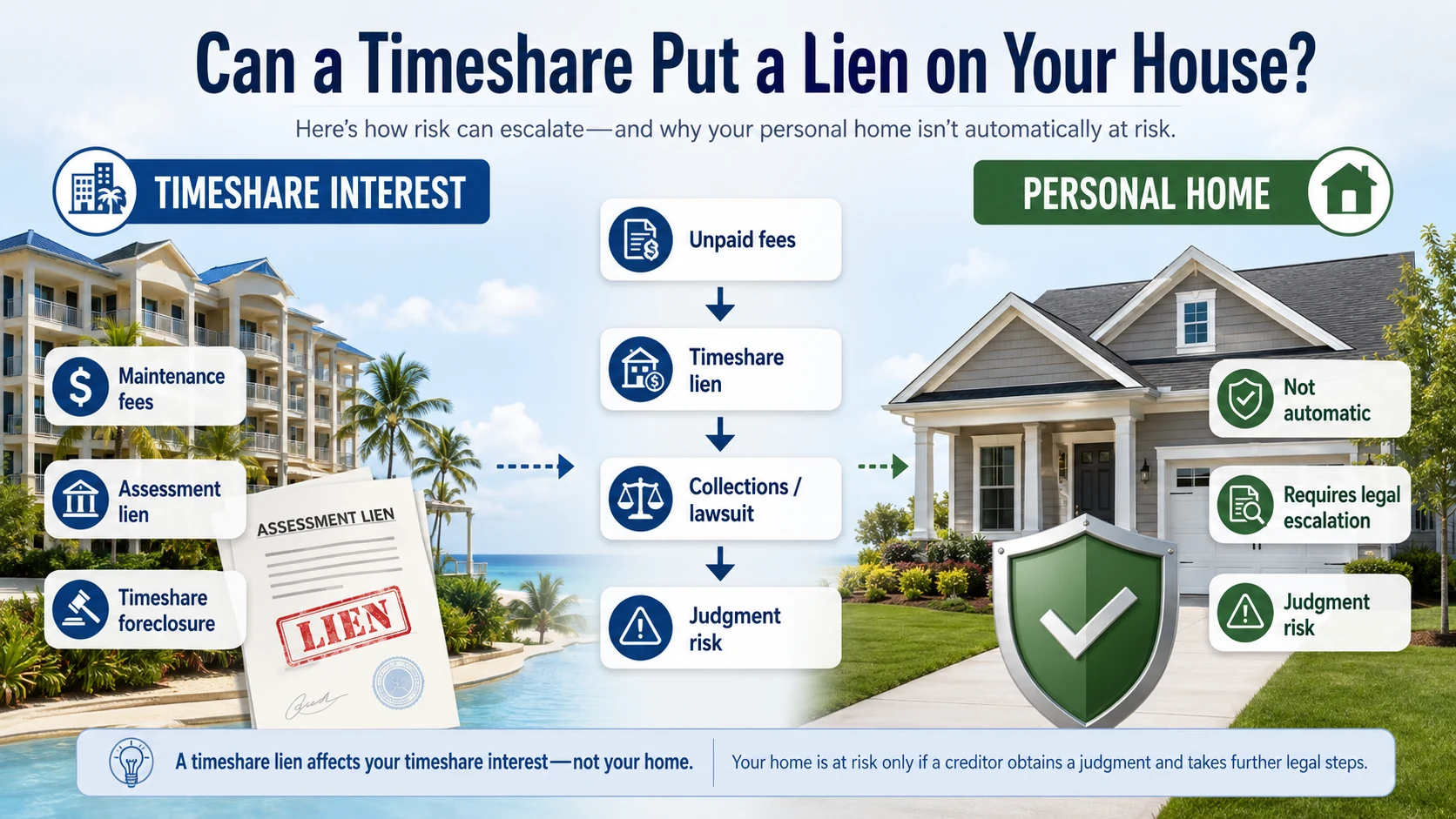
The more common first risk is a lien or enforcement claim tied to the timeshare interest itself. A claim involving a separate personal home would generally require a different and more advanced legal path, which may include a lawsuit, court judgment, and judgment-enforcement rights under applicable law. This guide helps you identify what property the notice actually names before assuming your home is either protected or immediately at risk.
Separate the Debt From the Property
Four details show how far the matter has progressed
A billing notice, collection letter, lien, foreclosure notice, lawsuit, and judgment are not interchangeable.
- What debt is unpaid: loan, maintenance fees, assessments, taxes, or legal costs?
- What property or ownership interest does the notice specifically identify?
- Has a lawsuit been filed or a court judgment already been entered?
- What deadline, cure amount, foreclosure step, or response requirement applies?
A lien against the timeshare is not automatically a lien against your home—but unresolved debt should not be ignored simply because the first enforcement action is limited to the timeshare interest.
About this guidance: Timeshare Travel Club Authority’s guidance draws on experience with unpaid timeshare loans, maintenance fees, assessments, collection notices, liens against timeshare interests, foreclosure, lawsuits, court judgments, and broader judgment-enforcement concerns. The property affected and available remedies can vary by debt type, ownership structure, contract, account status, court process, jurisdiction, and applicable property protections, so owners should verify what the notice identifies and whether the matter has progressed beyond enforcement against the timeshare itself.
System Insight
A lien against the timeshare and a lien involving your home are different enforcement events.
- Unpaid ownership charges commonly create risk against the timeshare interest first.
- A collection letter does not prove that a lien has been recorded against any property.
- A lien notice should identify the property or ownership interest being claimed.
- A personal-home lien would generally require a separate legal and judgment-enforcement path.
Before You Assume Your Home Is at Risk
The Debt, the Property, and the Enforcement Stage Must Be Reviewed Separately
Lien risk may depend on the ownership structure, unpaid balance, account status, collection activity, legal notices, and whether a lawsuit or judgment exists. The Timeshare Decision Intelligence Report™ helps organize those details before you ignore a notice, stop paying, accept a settlement, or assume the timeshare debt has already reached your personal property.
Need a clearer review of what property and obligations may be affected?
Review the Report Option Or continue with the lien distinctions belowWhy the Type of Lien Matters
The word lien can make every situation sound equally serious, but the property affected by the lien matters.
A lien tied to the timeshare interest may lead to foreclosure of the timeshare, loss of usage rights, collection activity, added costs, or credit consequences. That is serious, but it is not the same as a lien recorded against your personal home.
A lien involving your personal home usually suggests a more advanced legal path. That is why the next step is to separate the timeshare interest risk from the personal-home risk before deciding how serious the notice may be.
Lien Distinction
Timeshare Lien vs. Lien on Your House
A lien tied to the timeshare interest and a lien against your personal home are different issues. The difference usually depends on what debt exists, what property secures it, and whether the account has escalated into legal action.
Lien on the Timeshare Interest
This is usually tied to unpaid maintenance fees, assessments, taxes, or ownership-related charges connected to the timeshare itself.
- May attach to the timeshare interest, deed, usage rights, or ownership account.
- May allow the resort, association, trustee, or managing entity to pursue timeshare foreclosure.
- Does not automatically mean your primary residence has a lien against it.
- May still create credit, collection, legal, or exit-related complications.
Lien on Your Personal Home
This is usually a separate legal issue and is not the same as an ordinary timeshare assessment lien.
- May require a lawsuit, judgment, or other legal escalation before broader collection rights apply.
- Depends on the debt type, contract terms, court process, and applicable state law.
- May become a concern if unpaid debt turns into a judgment collection issue.
- Should be reviewed carefully before assuming your home is either protected or immediately at risk.
The key takeaway: the most common lien risk is usually tied to the timeshare interest first, but unresolved debt can become more serious if it moves into collections, a lawsuit, or a judgment.
How Timeshare Debt Can Escalate Beyond the Timeshare
Unpaid timeshare debt does not usually begin with a lien against the owner’s home.
The more common starting point is a delinquent loan, maintenance-fee balance, assessment, tax charge, or other obligation connected to the timeshare account. That may lead to late fees, suspended usage, internal recovery efforts, collections, or a lien against the timeshare interest.
The risk may become broader if the creditor pursues a lawsuit and obtains a court judgment.
A judgment is different from:
- A past-due account statement
- A collection letter
- A lien against the timeshare
- A foreclosure notice involving the timeshare interest
Depending on applicable law, a judgment may create additional collection remedies. Whether those remedies could involve other property—including a personal residence—depends on the debt, court process, available exemptions, and state-law enforcement rules.
The important progression is:
Timeshare debt or lien → possible collections or legal action → court judgment → possible broader judgment enforcement
Not every unpaid account follows that path. A collection notice does not mean a judgment exists, and a lien against the timeshare does not automatically mean a lien has been recorded against the owner’s home.
Owners who are still dealing with the collection stage should review What Happens When Timeshare Maintenance Fees Go to Collections? Owners who have received a foreclosure notice should review Can a Timeshare Be Foreclosed On?
Risk Point
“No Immediate Home Lien” Does Not Mean the Debt Can Be Ignored
The first enforcement action may be limited to the timeshare interest, but unpaid balances can still lead to collections, added legal costs, credit reporting, foreclosure, or a lawsuit. The risk may change as the account progresses.
Owners should identify the current stage rather than assuming the absence of a home lien means the account is harmless or fully contained.
Before reacting to a lien notice, separate the fear from the facts. The notice may involve the timeshare interest, an unpaid balance, a collection demand, a foreclosure process, or a legal claim. Those are not the same thing, and they do not create the same risk.
Action Step
Verify What Property the Notice Actually Applies To
Before paying, disputing, ignoring, or reacting to a lien notice, identify the debt, the property or ownership interest named, and whether the matter has entered a court process.
- Confirm whether the notice names the timeshare deed, ownership account, usage rights, or another property.
- Identify what is unpaid: loan payments, maintenance fees, assessments, taxes, or legal costs.
- Verify who sent the notice and whether that party currently controls or collects the account.
- Look for a case number, court name, judgment date, lien-recording information, or response deadline.
- Separate a collection demand from a foreclosure notice, lawsuit, judgment, or recorded property lien.
- Request written clarification if the notice does not clearly identify the affected property and claimed remedy.
Can a Timeshare Lien Affect Your Credit or Lead to Foreclosure?
A lien against the timeshare interest can still create serious consequences even when it does not involve the owner’s personal home.
Unpaid loan payments, maintenance fees, assessments, or taxes may lead to collections, credit reporting, loss of usage rights, or foreclosure of the timeshare interest. The exact path depends on the ownership structure, documents, account status, and applicable law.
The lien itself may not be the only source of credit risk. Missed payments, collection accounts, charge-offs, foreclosure reporting, or a court judgment may affect credit separately.
For a deeper explanation of reporting consequences, see Can a Timeshare Affect Your Credit Score?
If the lien is being enforced against the timeshare interest, see Can a Timeshare Be Foreclosed On? What Owners Should Know for the distinction between foreclosure, termination, loss of ownership rights, and any balance that may remain afterward.
The central point is straightforward:
A lien against the timeshare is not the same as a lien against your home—but it is still evidence that the account may have moved beyond ordinary billing.
❓ Frequently Asked Questions
These questions address the difference between a lien against the timeshare interest and a lien involving an owner’s personal home.
Can a timeshare company put a lien on your house?
Usually not automatically. The more common lien risk is tied to the timeshare interest itself. A lien involving the owner’s personal home would generally require a separate legal escalation, such as a lawsuit, court judgment, and available judgment-enforcement rights.
Can unpaid timeshare maintenance fees create a lien?
In some cases, yes. Unpaid maintenance fees, assessments, taxes, or related charges may create a lien against the timeshare interest when the governing documents and applicable law permit it. That is different from automatically placing a lien on the owner’s primary residence.
Does a collection letter mean a lien has been placed on my home?
No. A collection letter generally means someone is attempting to recover an unpaid balance. It does not, by itself, prove that a lawsuit has been filed, a judgment has been entered, or a lien has been recorded against any property.
Can a lien against the timeshare lead to foreclosure?
It may. A lender, association, resort, trustee, or another authorized party may be able to enforce a lien against the timeshare interest through foreclosure or another ownership-termination process. The exact remedy depends on the ownership structure and governing rules.
Can unpaid timeshare debt become a court judgment?
It may if the creditor files a lawsuit and the court enters judgment. A judgment is different from a billing notice, collection letter, or lien against the timeshare interest and may create additional collection remedies under applicable law.
What should I check after receiving a timeshare lien notice?
Confirm what property or ownership interest the notice identifies, what balance is claimed, who sent it, whether a court case exists, whether foreclosure has begun, and what response or cure deadline applies.
Bottom Line
Unpaid timeshare debt usually creates risk against the timeshare interest first—not automatically against the owner’s personal home.
A lien involving a residence would generally require a separate legal escalation, such as a lawsuit, court judgment, and broader judgment enforcement under applicable law.
Do not treat a collection letter, lien notice, foreclosure notice, lawsuit, and judgment as interchangeable. Before responding, confirm what debt is unpaid, what property or interest the notice names, and whether the matter has entered a court process.
Understand What Property Is Affected and How Far the Account Has Escalated
Lien risk may depend on the ownership structure, unpaid balance, loan status, maintenance fees, collection activity, legal notices, foreclosure exposure, and whether a lawsuit or judgment exists. The Timeshare Decision Intelligence Report™ helps organize those details, identify verification gaps, and clarify which next-step pathways may still be realistic.
Get the Timeshare Decision Intelligence Report™ Customized ownership review • Decision-support report • No exit-company sales pitchIndependent educational decision support. This is not legal or financial advice, court representation, debt negotiation, contract cancellation, a resale service, or an exit service.
Related Guides
These published guides explain the collection, credit, foreclosure, and nonpayment issues that may arise alongside a timeshare lien.
Liens, Collections, and Legal Escalation
- Can a Timeshare Be Foreclosed On? What Owners Should Know
Understand when a lien or unresolved default may lead to foreclosure or termination of the timeshare interest. - Can a Timeshare Go to Collections?
Learn when unpaid timeshare obligations may move from internal billing into collection activity. - What to Do After Receiving a Timeshare Collection Notice
Review what to verify when a collection letter identifies a balance, creditor, deadline, or possible next step.
Credit and Nonpayment Consequences
- Can a Timeshare Affect Your Credit Score?
Understand how missed payments, collections, charge-offs, foreclosure, or judgments may affect credit. - What Happens If You Stop Paying Timeshare Maintenance Fees?
Follow how unpaid fees may progress through late charges, suspended usage, collections, liens, or foreclosure. - Should You Stop Paying Your Timeshare? What Happens Next
Compare the broader consequences before using nonpayment as an ownership strategy.