
How to Get Out of a Timeshare: Real Exit Options That Actually Work
Getting out of a timeshare usually depends on three things: what your contract allows, whether the account is current, and whether the developer, resale market, or another exit path is actually available.
Some owners can cancel during the rescission period. Others may qualify for a developer surrender, deed-back program, resale, transfer, or negotiated exit. But many owners run into problems when they choose an option before understanding how their contract is structured.
This guide explains the main ways to get out of a timeshare, when each option may work, and why the best path usually depends on the details of your ownership.
Quick Answer
What Is the Best Way to Get Out of a Timeshare?
The best way to get out of a timeshare depends on what your ownership actually allows. Some owners may be able to cancel during rescission, return the timeshare to the developer, sell or transfer it, or use another exit path. The biggest mistake is choosing an option before confirming whether it fits the contract, loan status, maintenance fee balance, and developer rules.

Exit Path Check
Not Sure Which Exit Path Fits Your Situation?
Different exit options depend on different facts. A paid-off deeded timeshare, financed ownership, points-based interest, or account with unpaid fees may each require a different strategy.
Use the Risk Score tool to understand the contract and account factors that may affect your exit options.
Which Timeshare Exit Path May Fit Your Situation?
Not every owner has the same exit options. The right path usually depends on whether the purchase is recent, whether the loan is paid off, whether fees are current, and whether the developer or resale market offers a realistic path forward.
Owner Starting Point
Recently Purchased
- Review the rescission deadline immediately
- Cancellation may be possible only for a short period
- Written notice requirements usually matter
Paid Off and Current
- Developer surrender may be more realistic
- Deed-back options may require fees to be current
- Resale or transfer may be worth reviewing
Financed or Behind
- Exit options may be more limited
- Unpaid balances may create collection or credit risk
- Stopping payments can create additional consequences
The goal is to identify which path your contract, account status, and ownership structure actually support.
Why Getting Out of a Timeshare Can Be Difficult
Getting out of a timeshare can be harder than many owners expect because the obligation may involve more than a simple desire to stop using it.
A timeshare may include a purchase contract, financing agreement, deeded interest, usage rights, annual maintenance fees, special assessments, resort rules, and developer-specific policies. Those pieces can limit which exit options are realistic.
Common barriers include:
- An unpaid loan balance
- Past-due maintenance fees
- Special assessments or other unpaid charges
- A developer that does not currently accept voluntary surrenders
- Limited resale demand
- Transfer restrictions in the governing documents
- Points-based or right-to-use structures that are harder to evaluate
- Collection activity or default notices already in progress
If unpaid loans, maintenance fees, or assessments are part of the problem, the situation may also raise questions about whether a timeshare can be foreclosed on.
The real question is not just how to get out of the timeshare. It is which exit path the contract, account status, and ownership structure actually allow.
Important Distinction
Wanting Out Is Not the Same as Qualifying for an Exit
Most exit paths have conditions. A developer surrender may require the account to be current. Resale may depend on buyer demand. A transfer may require approval. Rescission may only be available for a short period after purchase.
The first step is not choosing the exit method. The first step is identifying which methods your ownership may actually support.
The Main Ways to Get Out of a Timeshare
There are several possible ways to get out of a timeshare, but not every option applies to every owner. The right path depends on timing, account status, loan balance, ownership type, developer policy, and resale demand.
The most common exit paths include:
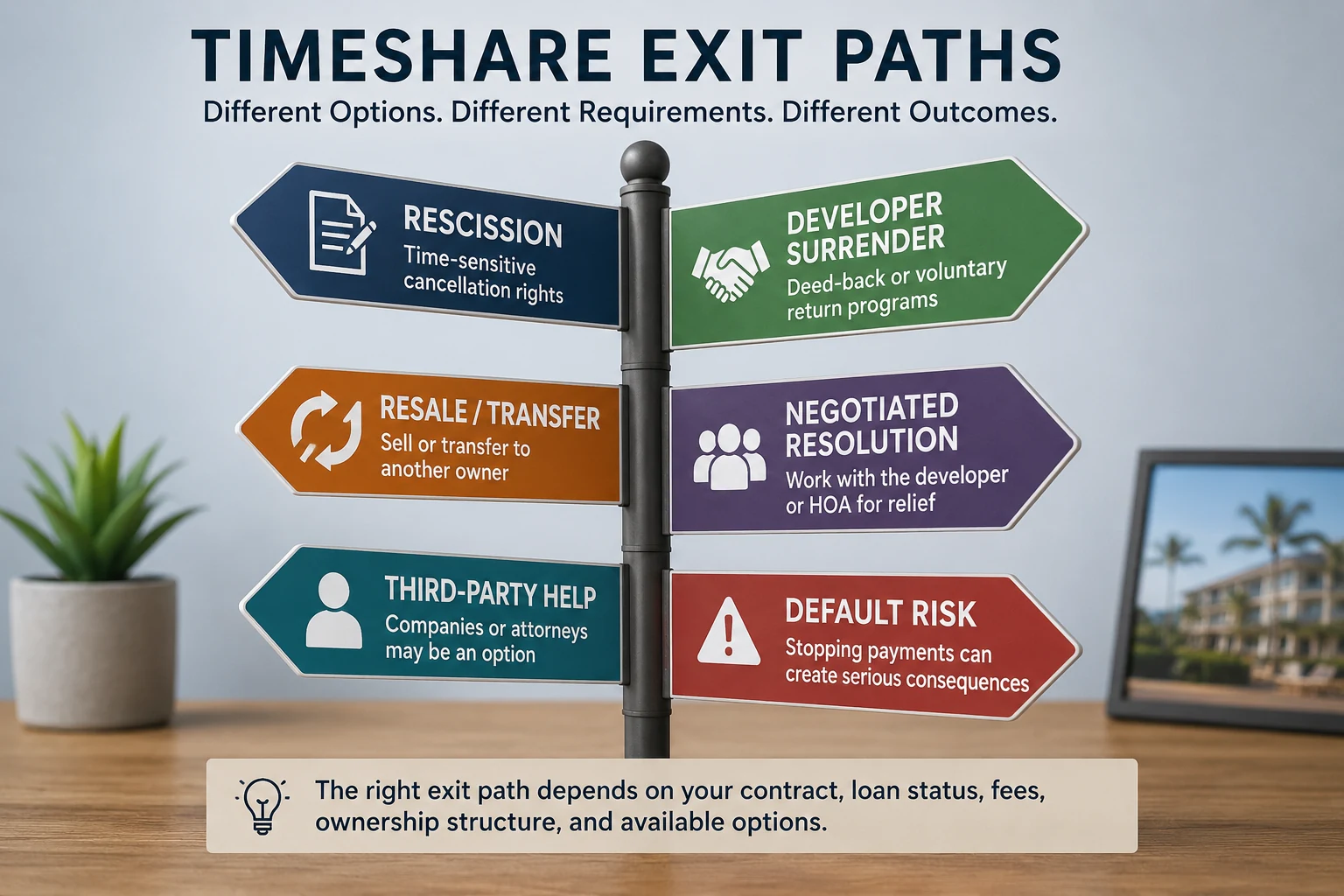
Each option has different requirements, costs, timelines, and risks. The key is to evaluate them in the right order.
An owner still inside the rescission period should not start with resale. An owner with a loan balance may not qualify for a deed-back. An owner with unpaid fees may have fewer options than someone whose account is current.
The sections below explain each path at a high level so you can understand which options may be worth reviewing in more detail.
Common Exit Paths
Rescission
Usually only available shortly after purchase. It often requires written cancellation within the deadline and may be the cleanest option if the owner still qualifies.
Developer Surrender
May allow qualified owners to return the timeshare. These programs often require the loan to be paid off and maintenance fees to be current.
Resale or Transfer
Depends on buyer demand, transfer rules, and whether fees or restrictions make the ownership difficult to move.
Negotiated Resolution
May apply when the owner is trying to resolve a balance, dispute, hardship issue, or account problem directly with the developer or association.
Third-Party Help
May be useful in more complicated situations, but should be reviewed carefully before paying fees or relying on guarantees.
Default
Default should not be treated as a simple exit strategy. Missed payments can create collection, credit, lien, foreclosure, or legal risk.
Owner takeaway: The strongest exit strategy is usually the one that fits the ownership first, not the one that sounds easiest in a sales pitch.
Risk Point
Choosing the Wrong Exit Path Can Make the Problem Worse
Many timeshare owners lose time and money because they start with the option that sounds easiest instead of the option their contract actually supports.
A resale listing may not help if there is no buyer demand. A deed-back request may fail if the loan is unpaid. Third-party help may not make sense if the owner is still inside the rescission period. Stopping payments may create collection, credit, lien, or foreclosure risk.
The risk is not just staying in the timeshare. The risk is choosing a path that does not match the ownership, account status, or available options.
What To Do Before Choosing a Timeshare Exit Path
Before choosing an exit strategy, start by gathering the facts that determine which options may be realistic. This helps avoid wasting time on paths that sound promising but do not fit the ownership.
Review these items first:
- Whether the purchase is still within the rescission period
- Whether there is an unpaid loan balance
- Whether maintenance fees and assessments are current
- Whether the timeshare is deeded, points-based, right-to-use, or a vacation club membership
- Whether the developer offers a surrender, deed-back, or voluntary return program
- Whether the ownership has any realistic resale or transfer demand
- Whether there are collection notices, default letters, or legal threats already in progress
- Whether any promised exit option requires upfront fees, guarantees, or broad powers of attorney
This step helps narrow the field before you spend money, stop paying, or commit to a strategy.
Action Step
Match the Exit Path to the Contract
Before committing to an exit strategy, compare the option against the facts of your ownership.
- Recent purchase: Check whether rescission is still available.
- Paid-off ownership: Review developer surrender, deed-back, resale, or transfer options.
- Financed ownership: Confirm how the unpaid loan affects eligibility.
- Past-due fees: Understand whether collections, liens, or foreclosure risk may apply.
- Points or vacation club membership: Review what you actually own and what can be transferred or canceled.
- Third-party assistance: Verify fees, promises, contract terms, and what the company is actually doing.
A realistic exit strategy starts with the contract — not with the option that sounds easiest.
When Contract Structure Determines the Exit Options
Some owners assume the exit process is mostly about finding the right company, program, or buyer. But in many cases, the contract structure determines which options are realistic.
A deeded timeshare, right-to-use product, points-based ownership, financed purchase, and paid-off account may each create different exit paths.
For example, a paid-off deeded interest may allow the owner to explore surrender, deed-back, resale, or transfer options. An unpaid loan may limit those paths. A right-to-use membership may require review of cancellation, termination, or usage-right provisions instead of assuming a real estate-style transfer applies.
Generic exit advice can be misleading because the question is not only whether an exit option exists. The question is whether that option applies to your specific ownership.
Why: This keeps the section valuable without restating too much.
Contract Risk Check
Not Sure Which Factors Matter Most?
Your exit options may depend on financing, payment status, ownership type, transfer rules, and whether a developer surrender or deed-back program is actually available.
Use the Risk Score tool to organize the contract and account factors that may affect your next step.
Can You Get Out of a Timeshare Yourself?
In some cases, yes. Some owners may be able to handle the process themselves if the ownership is straightforward, the account is current, and the exit path is clear.
For example, an owner may be able to send a rescission notice during the cancellation period, contact the developer about a surrender program, list the timeshare for resale, or complete a transfer through the resort’s approved process.
But self-help becomes harder when there is an unpaid loan, past-due maintenance fees, unclear ownership structure, collection activity, or a dispute about what the contract allows.
A do-it-yourself approach may be more realistic when:
- The rescission deadline has not expired
- The loan is paid off
- Maintenance fees are current
- The developer has a clear surrender or deed-back process
- Transfer rules are simple and documented
- There are no collection notices, legal threats, or disputed balances
It may be less realistic when the account is already in default, the loan is unpaid, or the owner is unsure what they actually own.
The goal is not to avoid help at all costs. The goal is to understand whether your situation is simple, complicated, or high risk before paying for assistance.
Important Distinction
Simple Exit Steps Are Not the Same as Simple Exit Eligibility
Some exit steps may look straightforward: send a letter, request a deed-back, list the timeshare, or contact the developer. But the real issue is whether the owner qualifies for that path.
A simple process can still fail if the ownership has an unpaid loan, past-due fees, transfer restrictions, or no developer-approved return option.
When a Timeshare Exit Company May or May Not Make Sense
A timeshare exit company may be worth reviewing when the situation is complicated, the owner is unsure what the contract allows, or previous attempts to resolve the ownership have failed.
But an exit company is not automatically the right solution. Some owners may still be inside rescission, qualify for a developer surrender program, or be able to complete a resale or transfer without paying a large third-party fee.
Before paying any company, review what the company is actually promising to do, how fees are structured, whether guarantees are conditional, and whether the strategy fits the owner’s contract.
A timeshare exit company may be less appropriate if:
- The owner is still within the rescission period
- The developer offers a direct surrender or deed-back path
- The promised result depends on stopping payments without explaining the risks
- The company asks for large upfront fees without clear deliverables
- The owner has not yet reviewed the contract, loan status, or account standing
The goal is not to assume all third-party help is bad. The goal is to avoid paying for a solution before confirming that the solution matches the problem.
Risk Point
Be Careful With Any Exit Strategy That Starts With Stopping Payments
Some owners are told that stopping payments is part of getting out. But missed payments can create consequences before an exit is resolved.
Depending on the ownership and account status, unpaid amounts may lead to late fees, loss of use rights, collections, credit reporting, lien issues, foreclosure risk, or legal action.
Stopping payments is not the same as canceling the contract. It is a risk decision that should be understood before it becomes the default strategy.
What Owners Should Do Before Paying for Help
Before paying for any timeshare exit service, slow the process down and verify the basics. A legitimate path should be clear enough to explain, and the owner should understand what is being done on their behalf.
Review these items first:
- What specific exit method is being used
- Whether the company has reviewed the actual contract
- Whether the loan is paid off or still active
- Whether maintenance fees are current or past due
- Whether the strategy requires the owner to stop paying
- Whether the company is contacting the developer, disputing the contract, negotiating, or using another method
- What fees are due upfront
- What happens if the exit is not completed
- Whether the owner remains responsible for payments during the process
Do not evaluate an exit offer only by whether it promises relief. Evaluate it by whether the strategy fits the actual ownership and whether the risks are clearly explained.
Action Step
Use a Simple Review Order Before You Decide
Before choosing a timeshare exit path, work through the options in the right order. This helps separate urgent opportunities from risky or unrealistic strategies.
- First: Check whether rescission is still available.
- Second: Confirm whether there is an unpaid loan balance.
- Third: Review whether maintenance fees and assessments are current.
- Fourth: Ask whether the developer offers a surrender, deed-back, or voluntary return option.
- Fifth: Review whether resale or transfer is realistic for the specific ownership.
- Sixth: Evaluate third-party help only after the direct options and risks are understood.
The right exit path is usually easier to identify after the ownership structure, payment status, and direct options are clear.
Why the Contract Should Come Before the Exit Strategy
Many owners start by asking which company, program, or method can get them out. But the better starting point is the contract itself.
The contract helps determine whether the ownership is deeded or right-to-use, whether there is a loan obligation, whether transfer restrictions apply, and whether the owner remains responsible for ongoing fees until the ownership is legally resolved.
That matters because the wrong strategy can create false confidence. A resale listing does not help if the ownership cannot realistically be sold. A surrender request may fail if the account is not eligible. A third-party process may not remove the owner’s obligations until the exit is recognized by the developer, association, or governing documents.
Owner takeaway: The exit strategy should follow the contract. It should not be chosen before the contract, loan status, account standing, and transfer rules are understood.
❓Frequently Asked Questions
Timeshare exit questions often depend on contract structure, loan status, maintenance fees, developer policies, and timing. These answers cover the most common situations owners ask about when trying to understand how to get out of a timeshare.
What is the best way to get out of a timeshare?
The best way depends on the ownership. Some owners may qualify for rescission, developer surrender, deed-back, resale, transfer, or another exit path. The right starting point is reviewing the contract, loan status, maintenance fee balance, and developer policies before choosing an option.
Can I give my timeshare back to the resort?
Sometimes. Some developers offer surrender, deed-back, or voluntary return programs, but eligibility often depends on whether the loan is paid off, fees are current, and the ownership meets the developer’s rules. Not every resort accepts every ownership back.
Can I get out of a timeshare if I still owe money?
It may be harder. An unpaid loan can limit resale, transfer, surrender, or deed-back options. Some owners may need to resolve the loan first, negotiate directly, or review whether another strategy applies. The loan status should be confirmed before assuming an exit option is available.
Can I stop paying to get out of a timeshare?
Stopping payments is not the same as canceling the timeshare. Missed payments may lead to late fees, collections, credit reporting, lien issues, foreclosure risk, or legal action depending on the ownership and account status. Owners should understand the risk before using default as a strategy.
Do timeshare exit companies actually work?
Some companies may help in certain situations, but an exit company is not automatically the right solution for every owner. Before paying, review what the company is doing, whether it has reviewed the actual contract, how fees work, and whether the strategy matches the ownership.
Can I sell my timeshare to get out?
Sometimes, but resale depends on demand, transfer rules, loan status, maintenance fees, and the specific resort or program. Some timeshares have little resale demand, and the owner usually remains responsible until the transfer is fully completed and accepted.
Bottom Line
Getting out of a timeshare is not about finding one universal solution. It is about matching the exit path to the contract, loan status, maintenance fee balance, ownership type, and available developer or transfer options.
Some owners may be able to cancel during rescission, return the timeshare to the developer, sell or transfer the ownership, or use another path. Others may face more complicated issues because of financing, past-due fees, collection activity, or unclear ownership terms.
The safest next step is to understand the structure of the ownership before choosing an exit strategy.
Contract Review
Need a Deeper Review of Your Timeshare Exit Options?
Your best exit path may depend on the contract, loan balance, maintenance fee status, ownership structure, developer policies, and risks connected to default or collections.
Get an independent, structured review of the contract factors that may affect your risk, exit feasibility, and next-step options.
Related Timeshare Exit Guides
If you are comparing exit options or trying to understand what happens after missed payments, these related guides may help clarify the next step.