
Timeshare Resale Market Explained
Why Are Timeshares So Hard to Sell? How the Resale Market Really Works
A timeshare may have cost thousands of dollars to purchase and still attract few buyers—or no buyer at all—on the resale market.
The difficulty is not simply finding the right listing website. Many sellers are competing against a large supply of similar ownerships, developer incentives do not transfer, annual fees continue after the sale, and buyers may be able to obtain comparable products for very little money. This guide explains what creates—or eliminates— resale demand before you pay to list, advertise, or transfer the ownership.
Understand the Buyer’s View
Four factors often weaken resale demand
A buyer compares the ownership’s future costs and restrictions—not what the original owner paid.
- Large numbers of owners may be selling similar products
- Maintenance fees and other obligations transfer to the buyer
- Some benefits disappear when the ownership is purchased resale
- The developer may still be selling a more attractive retail package
Resale value is determined by buyer demand and transferable benefits, not by the original purchase price or the quality of past vacations.
About this guidance: Timeshare Travel Club Authority’s guidance draws on experience with developer and resale ownerships, listing markets, transfer requirements, annual fees, resale restrictions, buyer demand, lost or reduced benefits, and developer surrender alternatives. Resale prospects can vary by brand, resort, season, ownership type, contract, fee level, loan status, booking rights, and transferable benefits, so owners should evaluate comparable listings and the specific rights a buyer would actually receive before paying for resale or transfer assistance.
Important Distinction
Vacation Value and Resale Value Are Not the Same
A timeshare may have practical value to an owner who uses it regularly, understands the reservation system, and believes the vacation experience justifies the annual cost. That is personal usage value.
Resale value is determined by what another buyer is willing to accept in the current market. That buyer evaluates the fees, booking rights, restrictions, transfer requirements, and long-term obligation—not the memories created or the original purchase price.
Before You Spend More Money Trying to Sell
Resale Difficulty May Point to a Different Ownership Decision
Resale potential can depend on the ownership structure, loan balance, annual fees, transfer rules, buyer restrictions, account standing, and realistic market demand. The Timeshare Decision Intelligence Report™ helps organize those details before you pay for another listing, trust a resale promise, lower the price again, or assume resale is your only possible exit path.
Need a clearer view of whether resale is realistic?
Review the Report Option Or continue with the resale-market realities belowCommon Timeshare Resale Myths vs. Market Reality
Much of the disappointment surrounding resale begins with assumptions carried over from the original purchase.
Owners may reasonably expect the purchase price, resort quality, or size of the discount to influence buyer demand. But the secondary market rewards different factors.
Resale Reality
What Owners Expect and What Buyers Actually Evaluate
The original sales process emphasizes vacation possibilities. The resale market emphasizes current demand, future costs, and whether the ownership is worth accepting.
The Original Purchase Price Should Establish Resale Value
Owners may expect the market to recognize what they paid, particularly when the resort is attractive or the original package included valuable incentives.
Current Buyer Demand Establishes Resale Value
Buyers compare the ownership with similar resale listings and other travel options. The original retail price usually has little influence on what buyers will pay today.
A Beautiful or Well-Known Resort Should Sell Easily
Resort quality may create vacation appeal, but owners may assume that appeal automatically produces a strong pool of resale buyers.
Buyers Evaluate the Entire Future Obligation
Maintenance fees, booking access, transfer rules, resale-buyer restrictions, and future assessments may matter more than the appearance of the resort.
Lowering the Price Enough Will Always Attract a Buyer
Owners may assume that a dramatic discount—or even a $1 asking price—will make the ownership too inexpensive to refuse.
Future Fees Can Outweigh a Low Purchase Price
A $1 price does not mean the ownership has no cost. It often means the seller values relief from future fees more than recovering money from the original purchase.
Why Buyer Demand Is So Limited
The timeshare resale market generally has more owners trying to sell than buyers actively looking to purchase.
That imbalance places downward pressure on both resale prices and the likelihood of completing a transfer.
Potential buyers can also compare timeshare ownership with hotels, vacation rentals, travel clubs, loyalty programs, credit card points, and direct resort bookings. Those alternatives may provide travel access without requiring the buyer to accept ongoing maintenance fees or a long-term ownership commitment.
A resale buyer therefore evaluates more than the vacation itself. The buyer may ask:
- What are the annual maintenance fees?
- How quickly have those fees increased?
- Can I reserve the dates and unit sizes I need?
- Do resale buyers receive the same benefits as direct purchasers?
- What happens if I later want to sell or surrender the ownership?
- Are comparable ownerships available for less?
Those questions reduce the number of buyers willing to move forward.
Demand can also vary significantly by ownership type. A desirable fixed week, well-positioned points package, or ownership with useful reservation priority may attract more interest than a product with high fees, weak booking power, or restricted resale benefits.
The central problem is not that no one ever buys a resale timeshare. It is that the pool of suitable buyers is often much smaller than the supply of available ownerships.
Why Resale Buyers May Hesitate Even at a Very Low Price
A low asking price does not remove the future obligation attached to the ownership.
A buyer who pays $1 may still become responsible for annual maintenance fees, special assessments, club dues, reservation charges, exchange costs, transfer fees, and other recurring expenses.
The buyer may also face limitations that did not apply to the original purchaser. Depending on the program, resale ownership may provide reduced reservation priority, fewer loyalty benefits, restricted club access, limited upgrade rights, or no access to certain internal programs.
Other concerns may include:
- Whether the ownership is fully paid off
- Whether the account is current and transferable
- Whether the developer has a right of first refusal
- Whether the buyer must pass an approval process
- Whether past-due fees or assessments remain
- How difficult the ownership may be to transfer again later
That is why lowering the price does not always create demand.
Even when a timeshare sells for very little—or is transferred for no purchase price—the seller may still incur transaction expenses. See what timeshare closing costs can include before evaluating the financial result of a resale.
The purchase price may become almost irrelevant when the buyer believes the annual cost, reservation limitations, or future transfer difficulty outweigh the vacation value.
Why Developer Sales Compete With Resale Listings
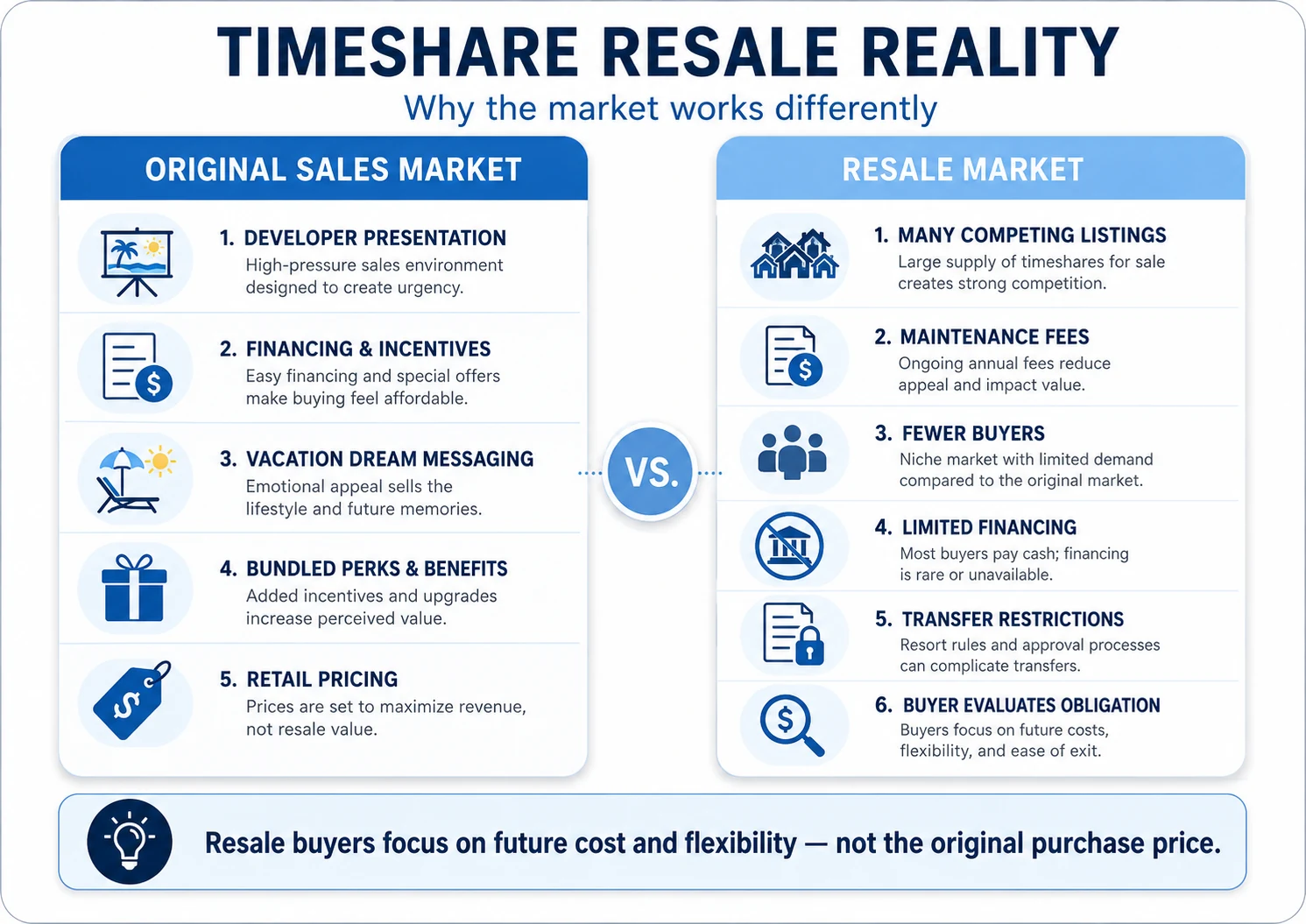
Resale owners are not competing only with other individual sellers. They are also competing with the developer’s sales operation.
Developers may offer financing, bonus points, trial stays, loyalty benefits, upgrades, promotional incentives, or access to programs that resale buyers do not receive.
A resale listing may be far less expensive, but some buyers still choose to purchase directly because the developer can package the ownership as a broader vacation experience and spread the purchase price across monthly payments.
The two markets therefore operate differently.
The developer may be selling convenience, financing, incentives, and immediate access to a branded ownership system. The resale seller is offering an existing ownership to a buyer who is often comparing the costs and restrictions more carefully.
Developers may also impose resale restrictions that reduce the value transferred to the new owner. When important benefits remain tied to direct purchase, the resale ownership becomes less competitive even when the price is dramatically lower.
This uneven competition helps explain why a timeshare can be expensive when purchased from the developer but have limited value when offered on the secondary market.
Owner takeaway: Timeshares are difficult to sell because resale buyers are evaluating a future financial and contractual obligation—not recreating the original sales experience that made the ownership feel valuable.
Why Some Timeshares Have Use Value but Little Resale Value
A timeshare can still work well for vacations while having little value on the resale market.
Those two conclusions are not contradictory.
An owner who understands the booking system, travels regularly, uses the available benefits, and believes the annual fees are reasonable may receive meaningful personal value from the ownership.
A new buyer may evaluate the same product very differently.
The buyer may not want the same resort, travel season, unit size, or reservation system. The buyer may also be less willing to accept annual fees, booking complexity, transfer restrictions, or the possibility of future assessments.
The current owner’s experience may also reflect benefits that will not transfer. Direct-purchase status, loyalty privileges, internal exchange access, reservation priority, or promotional programs may be reduced or unavailable to a resale buyer.
That creates a separation between use value and market value.
Use value asks whether the ownership delivers vacations that justify the cost for the current owner.
Resale value asks whether another person is willing to assume the ownership under the rights, restrictions, and costs that transfer today.
A timeshare may perform well under the first test and poorly under the second.
Why Timeshares Lose Value and Resale Prices Are Often So Low
Timeshare resale prices can appear completely disconnected from what the original owner paid.
That is because the retail purchase price and the secondary-market value are created by different forces.
The original price may include sales commissions, marketing expenses, developer profit, financing costs, promotional incentives, branded benefits, and the cost of an in-person sales operation. Those factors may help explain the retail price, but they generally do not transfer to a resale buyer.
Once the ownership enters the resale market, buyers focus on what they would receive and what they would be required to assume:
- Annual maintenance fees and possible special assessments
- Booking rights and reservation flexibility
- Benefits that transfer—or do not transfer—to resale buyers
- Transfer fees, approval requirements, and restrictions
- The number of comparable ownerships already available
- How difficult the ownership may be to sell again later
Prices may fall even further when owners are more interested in avoiding future costs than recovering the original purchase price. Some owners accept very little—or offer the ownership for free—because transferring the recurring obligation matters more than receiving sale proceeds.
A $1 listing does not mean the timeshare has no cost. It often means the seller is willing to give up any upfront value so someone else will assume the fees and future responsibilities.
Not every timeshare loses value equally. Ownerships with reasonable fees, desirable dates or locations, useful booking priority, transferable benefits, and limited competing inventory may retain more buyer interest. But the original purchase price should not be treated as a minimum resale value.
When Relying on Resale Can Become Risky
Resale is not automatically the wrong option.
Some ownerships may attract buyers when the loan is paid off, the account is current, the annual fees remain reasonable, the transfer process is manageable, and the buyer receives meaningful usage rights.
The risk comes from relying on resale without evidence that the market supports that expectation.
A listing can remain active for months or years while the owner continues paying maintenance fees, club dues, assessments, and loan payments. Advertising the ownership does not pause those obligations.
Owners may also spend money on repeated listings, appraisal claims, marketing packages, or resale companies promising access to buyers. Those expenses can increase the cost of waiting without improving the underlying demand for the ownership.
Resale becomes especially risky when it is treated as the only acceptable path.
If comparable listings remain unsold, similar ownerships are being offered for free, or resale buyers receive reduced benefits, lowering the asking price may not solve the real problem. The owner may need to compare resale with surrender, deed-back, transfer, developer assistance, or other documented options.
The decision should be based on actual buyer demand and transfer requirements—not the hope that a buyer will eventually appear.
Risk Point
Waiting for a Buyer Does Not Stop the Cost of Ownership
Maintenance fees, club dues, assessments, loan payments, and other obligations generally continue while a resale listing remains active. A long marketing period can therefore increase the amount spent on an ownership the seller no longer wants.
Owners should also be cautious about paying large upfront resale or advertising fees based on promises of strong demand, guaranteed buyers, or a sale at a price unsupported by comparable completed transfers.
Before You Decide Resale Is the Only Option
A weak resale market does not automatically mean the owner has no possible path forward.
It means resale should be evaluated alongside the ownership documents, account status, developer rules, and other options that may apply.
Start by determining whether the timeshare is actually transferable. An active loan, past-due maintenance fees, unresolved assessments, probate issue, or developer approval requirement may prevent a sale from closing even if a buyer is found.
Next, determine whether comparable ownerships are selling or merely being advertised. A long list of active listings does not prove there is meaningful buyer demand.
Owners should also check whether the developer or association offers a surrender, deed-back, hardship, or owner-assistance program. These options may have eligibility requirements, but they can provide a more direct path than waiting indefinitely for the resale market.
The goal is not to abandon resale prematurely. It is to avoid treating resale as the only solution when the market and ownership structure may not support it.
For a broader comparison of available pathways, see the Timeshare Exit Guide: How to Get Out of a Timeshare.
Action Step
Test the Resale Market Before Relying on It
Review completed-market evidence, transfer requirements, and continuing costs before paying for another listing or assuming a buyer will eventually appear.
- Compare similar ownerships by resort, season, unit size, points allotment, and annual fees.
- Distinguish completed transfers from listings that have remained advertised for months or years.
- Confirm whether the loan is paid off and the account is current enough to transfer.
- Review which reservation rights, benefits, and club privileges transfer to a resale buyer.
- Identify transfer fees, right-of-first-refusal procedures, approval rules, and required documents.
- Compare resale with surrender, deed-back, transfer, and other documented exit paths.
❓ Frequently Asked Questions
These questions address why resale demand is limited, why asking prices can be extremely low, and what owners should evaluate before relying on resale.
Why are timeshares so hard to sell?
The resale market often has more owners trying to sell than buyers willing to accept the ongoing obligation. Buyers also compare maintenance fees, booking rights, transfer rules, resale restrictions, and other travel alternatives before taking ownership.
Why do timeshares sell for so little on the resale market?
Resale value is based primarily on current buyer demand and comparable listings—not the original purchase price. Sales commissions, marketing costs, financing, incentives, and direct-purchase benefits may have contributed to the retail price without transferring to a resale buyer.
Why are some timeshares listed for $1?
A seller may value relief from future maintenance fees more than recovering money from the original purchase. The buyer still assumes the annual costs, rules, and long-term obligation, so a very low asking price does not make the ownership free.
Are timeshares impossible to sell?
No. Some timeshares can sell or transfer when the account is current, the loan is paid off, the fees are reasonable, the usage rights are desirable, and buyer demand exists. However, owners should expect many resale listings to take time or produce little financial return.
Why do timeshares lose value so quickly?
Timeshares often lose resale value because the original purchase price may include commissions, marketing, financing, incentives, developer pricing, and benefits that do not transfer to a resale buyer. The secondary market instead values current buyer demand, annual fees, booking rights, transfer rules, resale restrictions, and competing listings.
Do resale buyers receive the same benefits as direct purchasers?
Not always. Some programs restrict loyalty benefits, reservation priority, internal exchange access, upgrades, or other privileges for resale purchasers. The exact rights that transfer should be verified before the ownership is marketed.
Can I sell a timeshare if I still owe money?
An active loan can make resale more difficult because the balance may need to be paid before the ownership can transfer. Owners should confirm the payoff requirement, transfer rules, and whether the expected resale proceeds would cover the debt.
What should I do when resale demand is weak?
Review comparable transfers, annual costs, loan status, transfer restrictions, and resale-buyer benefits. Then compare resale with surrender, deed-back, developer assistance, transfer, and other documented exit options instead of waiting indefinitely for a buyer.
Bottom Line
Timeshares are difficult to sell because the resale market evaluates them as continuing obligations—not as recreations of the original vacation sales experience.
Buyers focus on maintenance fees, reservation rights, transfer restrictions, competing listings, and whether other travel options provide more flexibility without long-term ownership.
That does not mean every timeshare is impossible to transfer. But the original purchase price, resort quality, and a dramatically reduced asking price do not guarantee buyer demand.
Before relying on resale, verify what similar ownerships have actually transferred for, what rights a buyer would receive, whether the account is eligible to transfer, and how much the ownership will continue to cost while the listing remains active.
Understand Whether Resale Is Realistic—or Whether Another Path Deserves Review
Resale potential may depend on the ownership structure, loan balance, annual fees, account standing, transferable benefits, developer restrictions, and actual buyer demand. The Timeshare Decision Intelligence Report™ helps organize those details, identify material limitations, and clarify which next-step pathways may be realistic before you spend more money or continue waiting for a buyer.
Get the Timeshare Decision Intelligence Report™ Customized ownership review • Decision-support report • No exit-company sales pitchIndependent educational decision support. This is not a resale listing service, property appraisal, legal advice, contract cancellation, transfer service, or promise that a buyer can be found.
Related Guides
These published guides can help you evaluate resale value, transfer barriers, loan complications, and alternatives when buyer demand is weak.
Resale Value and Market Conditions
- Why Can’t I Sell My Timeshare?
Identify the specific ownership, pricing, account, and transfer issues that may be preventing a listing from attracting a buyer.
Transfer and Ownership Barriers
- Can You Sell a Timeshare If You Still Owe Money?
Review how an active loan, payoff requirements, and transfer approval can affect a potential sale. - Can You Transfer a Timeshare to Someone Else?
Understand why finding a willing recipient is only one part of completing a valid ownership transfer. - What Happens If You Inherit a Timeshare?
Review the additional ownership, probate, transfer, and acceptance questions that may arise with an inherited timeshare.
Extra Costs
- Timeshare Special Assessments: What They Are and When They Happen
Learn how unexpected charges can affect ownership costs, buyer interest, and transferability.