
Why Do Timeshares Lose Value?
Many owners are surprised to learn that a timeshare purchased for thousands of dollars may later have little resale value.
Sometimes the listing price is far below what they paid.
Sometimes similar ownerships are listed for $1 or given away.
That can feel confusing, especially if the resort is still attractive, the brand is recognizable, and the vacation experience still has value.
But the resale market does not usually value a timeshare the same way the original sales presentation did.
The original purchase price may include marketing costs, sales commissions, financing, incentives, and the emotional appeal of future vacations. The resale market usually looks at something different: buyer demand, ongoing maintenance fees, special assessments, usage limits, transfer rules, and whether someone is willing to take over the obligation.
The real question is not just “Why did my timeshare lose value?”
It is “Why does the resale market value this ownership so differently from the original purchase price?”
This guide explains why timeshares often lose resale value, why some ownerships lose more value than others, and what owners should review before spending more money trying to sell, transfer, or exit.
Quick Answer
Why Do Timeshares Lose Value?
Timeshares usually lose value because the resale market has more sellers than buyers, ongoing maintenance fees reduce buyer interest, and the original purchase price often includes sales costs, marketing, financing, commissions, and incentives that do not transfer to resale value.
A timeshare may still provide vacation use, but resale buyers usually evaluate the ownership based on future obligations, fees, restrictions, transfer rules, and market demand. That is why resale value can be much lower than the original purchase price — even when the resort itself remains desirable.
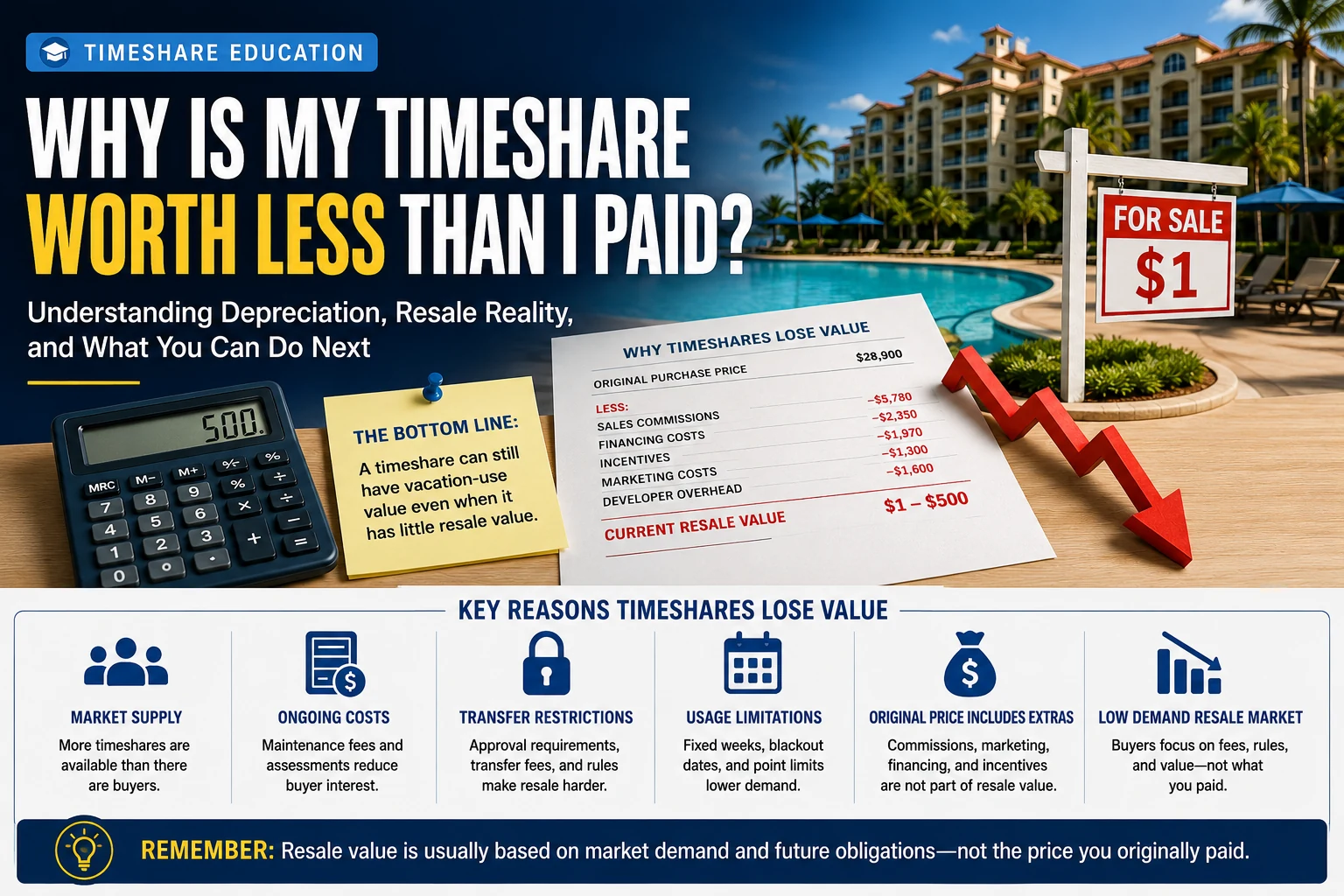
The Resale Market Values the Obligation, Not the Sales Experience
A timeshare can still have vacation-use value.
That does not mean it will have strong resale value.
The original purchase experience may include a resort tour, incentives, financing options, bonus points, travel credits, and the emotional appeal of future vacations. But those sales conditions usually do not transfer to the resale market.
A resale buyer is usually asking a different question:
“Do I want to take over this contract, these fees, these restrictions, and these future obligations?”
That is why the resale price can be dramatically lower than the original purchase price, even when the resort itself is still desirable.
Important Distinction
The Original Sale Prices the Vacation Dream. Resale Prices the Future Obligation.
At purchase, the price may reflect marketing, commissions, financing, incentives, and the sales experience. On resale, buyers usually focus on maintenance fees, special assessments, usage limits, transfer rules, and whether the ownership is worth taking over. That difference is one of the main reasons resale value can drop sharply.
Why Timeshares Don’t Hold Value Like Traditional Assets
Timeshares are often sold in a resort setting, but they usually do not behave like traditional real estate assets.
A home, condo, or investment property may increase in value because it can be sold into a broad real estate market. Demand, location, comparable sales, financing, and property appreciation may all support future value.
Timeshares are different.
Most timeshares are vacation-use products. The ownership may provide access to a resort, points system, week, unit type, or travel program, but the resale market usually does not treat that access like appreciating real estate.
Once the timeshare enters the resale market, buyers are not evaluating the original sales experience. They are evaluating the ongoing cost of taking over the ownership.
That means resale value depends less on what the owner paid and more on whether a buyer wants the usage rights enough to accept the fees, restrictions, transfer process, and future obligations.
Retail Purchase
What the Original Price Often Includes
The original purchase price may reflect more than the underlying vacation-use rights. It can include the cost of selling, financing, presenting, and packaging the ownership.
- Sales and marketing costs
- Commissions and presentation expenses
- Developer pricing and profit margin
- Financing options and promotional incentives
- Bonus benefits, points, or travel credits
Resale Market
What Buyers Usually Evaluate Later
Resale buyers usually focus on what they are taking over now: the usage rights, annual costs, restrictions, transfer rules, and whether the ownership is worth assuming.
- Maintenance fees and assessments
- Usage flexibility and booking limits
- Transfer rules and approval requirements
- Supply of similar resale listings
- Current buyer demand
The value gap appears because the original purchase price reflects a developer sales environment, while resale value reflects what another buyer is willing to take on.
What Causes Timeshare Value to Decline?
Most timeshare value loss comes from several factors working together.
The original purchase price may include sales costs, marketing, commissions, financing, incentives, and developer pricing that do not carry over to resale. Once the ownership is listed on the secondary market, buyers usually do not pay extra for the original sales experience.
Supply also matters. Many owners eventually try to sell, transfer, or give away their timeshares, which can create more listings than willing buyers. When buyers have many similar options, prices tend to fall.
Ongoing fees reduce buyer interest as well. A resale buyer may be able to purchase the ownership cheaply, but they still have to accept maintenance fees, special assessments, dues, taxes, or other recurring costs. That can make even a low purchase price feel unattractive.
Resale financing can also be limited. Developer sales may come with financing options or incentives, while resale transactions often require cash buyers or independent arrangements. That reduces the pool of people willing to buy.
Developer inventory can also compete with resale listings. Resorts may continue selling new ownerships with financing, bonuses, and benefits that resale buyers may not receive. In some programs, resale purchasers may also face restrictions or fewer benefits than direct purchasers.
That is why the resale market often values the obligation differently than the original purchase valued the experience.
Why Some Timeshares Are Listed for $1
A $1 timeshare listing can be confusing.
It does not always mean the resort has no vacation value. It usually means the seller is trying to transfer the ongoing obligation more than recover the original purchase price.
In many resale situations, the buyer is not only receiving usage rights. The buyer is also accepting future maintenance fees, special assessments, reservation rules, transfer requirements, and any limitations that come with the ownership.
That can make the obligation more important than the purchase price.
A seller may list a timeshare for $1 because they want to stop paying annual fees, avoid future assessments, or move on from an ownership they no longer use. Some sellers may even offer incentives, such as paying closing costs or covering a future fee, just to find someone willing to take over the contract.
This is why resale price alone can be misleading.
A low listing price often reflects the market’s view of future costs and obligations, not necessarily the quality of the resort or the vacation experience itself.
Owner Risk
Resale Expectations Based on the Purchase Price Can Lead to Costly Delays
The risk is assuming the timeshare should sell for something close to the original purchase price. If that expectation does not match resale demand, owners may spend months or years relisting, lowering the price, paying listing fees, or delaying other options while maintenance fees and assessments continue. A realistic resale review should focus on current buyer demand, transfer rules, fees, and whether the ownership is actually marketable.
Free Ownership Review Preview
Not Sure What Matters Most in Your Timeshare Situation?
Timeshare decisions can depend on several factors at once, including ownership type, loan status, annual fees, usage fit, transfer rules, surrender options, resale difficulty, and account standing. The free Ownership Risk Profile™ Preview can help you identify which issues may deserve closer attention before you choose a next step.
Want a quick read on your ownership factors?
Try the Free Preview Free preview • Educational decision support • No exit-company sales pitchWhat to Review Before You Spend More Trying to Sell
Before paying for resale listings, transfer help, advertising, or outside assistance, review whether the ownership is realistically marketable.
The question is not only whether the timeshare has a nice resort name or whether you paid a large amount for it. The practical question is whether a buyer would willingly take over the contract today.
That means looking at the same things a resale buyer would consider: maintenance fees, special assessments, usage restrictions, transfer requirements, current account standing, loan status, and the number of similar listings already available.
If the ownership has low resale demand, spending more money trying to recover the original purchase price may only extend the problem.
A better next step is to separate three questions:
What is the timeshare realistically worth on the resale market?
What ongoing costs continue while you try to sell?
What other paths may be available if resale is unlikely?
Action Step
Check Marketability Before Paying for Resale Help
If your timeshare has lost value, review the factors that actually affect resale demand before spending more money trying to sell it.
Compare active and recently completed resale listings for the same resort, ownership type, season, points level, or unit size.
Review whether similar listings are selling, sitting unsold, or being offered for very low prices.
Check annual maintenance fees, special assessments, dues, and other costs a buyer would inherit.
Confirm transfer rules, fees, approval requirements, and any restrictions on resale buyers.
Identify whether a loan balance or unpaid fees would block resale, transfer, surrender, or deed-back options.
Compare resale with other possible paths before paying additional listing or marketing fees.
Quick win: Look at what similar ownerships are actually listed for now — not what you paid, and not what a resale service says it might be worth.
Why Some Timeshares Lose More Value Than Others
Most timeshares lose resale value after purchase, but not all lose value in the same way.
Some ownerships may retain more buyer interest because they have lower fees, better usage flexibility, stronger brand demand, easier transfer rules, or a more desirable location, season, or points structure. Others may be harder to transfer because the fees are high, the booking system is restrictive, the ownership has limited usage value, or resale buyers receive fewer benefits than direct purchasers.
Maintenance fee levels matter because buyers are often more concerned about the future annual obligation than the upfront resale price.
Transfer rules also matter. If resale requires approval, fees, paperwork, or restrictions on future usage, buyer interest may drop.
Loan status can affect options too. A buyer may not want to assume an ownership with unresolved debt, and some developers may not allow transfer until the account is current or the loan is resolved.
This is why two timeshares purchased for similar prices can have very different resale outcomes later. The resale market does not just ask what the owner paid. It asks whether the ownership is still attractive to someone else today.
Owner takeaway: A timeshare can still have vacation-use value even when it has little resale value. Before spending more money trying to sell, compare current market demand, annual fees, transfer rules, loan status, and whether another path may be more realistic.
❓Frequently Asked Questions
These questions come up often when owners discover that their timeshare may be worth much less on the resale market than they originally paid.
Bottom Line
Timeshares often lose value because the resale market evaluates them differently than the original sales process did.
The original purchase price may include marketing, commissions, financing, incentives, and the emotional appeal of future vacations. Resale buyers usually focus on different factors: maintenance fees, special assessments, usage limits, transfer rules, buyer demand, and whether the ownership is worth taking over.
That does not always mean the timeshare has no vacation-use value.
It means resale value is usually based on market demand and future obligations, not what the owner originally paid.
Before spending more money trying to sell, transfer, or exit, review whether the ownership is realistically marketable, what ongoing costs continue while you wait, and whether another path may be more practical.
The Wrong Timeshare Exit Move Can Cost More Than the Problem You’re Trying to Solve.
Stopping payments, hiring an exit company, chasing resale promises, requesting a surrender, or transferring ownership can all lead to very different outcomes depending on your contract, loan status, fees, account standing, documents, and developer rules. The Timeshare Decision Intelligence Report™ helps organize those details so you can see which paths appear realistic before you commit to the wrong move.
Get the Timeshare Decision Intelligence Report™ Customized ownership review • Decision-support report • No exit-company sales pitchIndependent decision support. This is not legal advice, contract cancellation, an exit service, a resale service, lender negotiation, or a promise that your timeshare can be exited.
Related Guides
If your timeshare has lost resale value, these guides can help you understand why selling may be difficult and what other options may be worth reviewing.
Why Are Timeshares So Hard to Sell? A Reality Check
Understand why many owners struggle to find buyers and how oversupply, fees, transfer rules, and low demand can affect resale outcomes.
Why Can’t I Sell My Timeshare? What May Be Blocking a Sale
Review the specific issues that can prevent or delay a sale, including pricing expectations, unpaid balances, transfer restrictions, and weak buyer demand.
Timeshare Maintenance Fees: Why They Keep Increasing
Learn how rising annual fees can reduce buyer interest and make the ownership feel less valuable on the resale market.
Total Cost of Timeshare Ownership: What You Actually Pay Over Time
See how purchase price, financing, maintenance fees, special assessments, taxes, and exit costs can change the real long-term cost of ownership.
How to Get Out of a Timeshare: Legal and Practical Options
Compare broader exit paths if resale value is low and selling the ownership is not realistic.