
Timeshare Transfer Company Guide
Timeshare Transfer Companies: What They Do, Costs & How They Differ From Exit Companies
A timeshare transfer company can help move an ownership from one party to another—but that is not the same as finding a buyer or creating a way out of an unwanted timeshare.
Transfer companies, resale services, and exit companies may all appear to help owners get rid of a timeshare, but they solve different problems. Before paying a company, determine whether you need someone to complete a transfer, find a buyer, or help identify a realistic exit path.
About This Guidance: Timeshare Travel Club Authority provides independent guidance based on practical analysis of how timeshare ownership transfers are actually completed, including deed and assignment requirements, resort and developer approval processes, financing and account-status restrictions, transfer fees, ownership-record changes, and the documentation needed to confirm responsibility has truly moved to another party. This guide focuses specifically on the role of transfer companies, how their services differ from resale and exit companies, and what owners should verify before paying a provider to handle a transfer.
How It Works
Identify the Service You Actually Need Before Choosing a Company
The right provider depends on where the ownership stands today. Start by determining whether there is already a legitimate recipient, whether a buyer still needs to be found, and whether the ownership can actually be transferred under the resort’s current rules.
Identify the Recipient
Determine whether a buyer, family member, co-owner, heir, or other party has already agreed to receive the ownership. A transfer service generally needs somewhere legitimate for the ownership to go.
Define the Problem
If you already have a recipient, you may have a transfer problem. If you still need a buyer, you have a resale problem. If you simply want out and no transfer path exists, you have an exit problem.
Verify the Transfer Rules
Confirm financing, account status, transfer restrictions, recipient eligibility, developer approval, documentation requirements, and any fees before assuming the ownership can change hands.
Choose the Right Provider
Once the actual problem and transfer requirements are clear, compare companies based on the specific work needed—such as resale, deed preparation, title, escrow, closing, recording, or broader exit assistance.
TTCA Framework Insight: A company cannot solve the right problem if the problem has not been defined correctly. A transfer provider may be appropriate once a valid recipient and transfer path exist, but it should not be confused with a service that finds buyers or determines how an unwanted ownership can be exited.
What Does a Timeshare Transfer Company Actually Do?
A timeshare transfer company generally helps complete an ownership change that already has a legitimate path forward. Usually, that means there is a buyer, family member, heir, or other recipient who will receive the ownership, and the remaining work is getting the transaction properly documented and recognized.
Depending on the provider and ownership structure, a transfer company may help with:
- deed or assignment preparation;
- title or ownership verification;
- closing or escrow coordination;
- document signatures and notarization;
- recording a deed where required;
- resort, developer, HOA, club, or trustee submissions;
- transfer-fee coordination; and
- follow-up until ownership records are updated.
The term “timeshare transfer company” is broad. Some providers function more like title or closing companies, while others specialize in deed preparation or administrative processing. Owners should therefore evaluate the actual services being provided rather than relying on the company’s label.
A transfer is also more than signing a deed or assignment. The resort or ownership program may still need to approve the recipient, collect fees, update its internal records, and change the account responsible for future obligations.
And separate obligations do not necessarily move with the ownership. An existing loan, delinquent balance, lien, or other financial obligation may require separate resolution.
The key limitation: a transfer company generally completes a transaction; it does not automatically create one. If you do not yet have a viable recipient or approved transfer path, you may have a resale or exit problem instead.
If you already know who will receive the ownership and want to understand the transaction itself, see Timeshare Transfer: How to Transfer Ownership or a Deed.
Important Distinction
Transfer Company vs. Resale Company vs. Exit Company
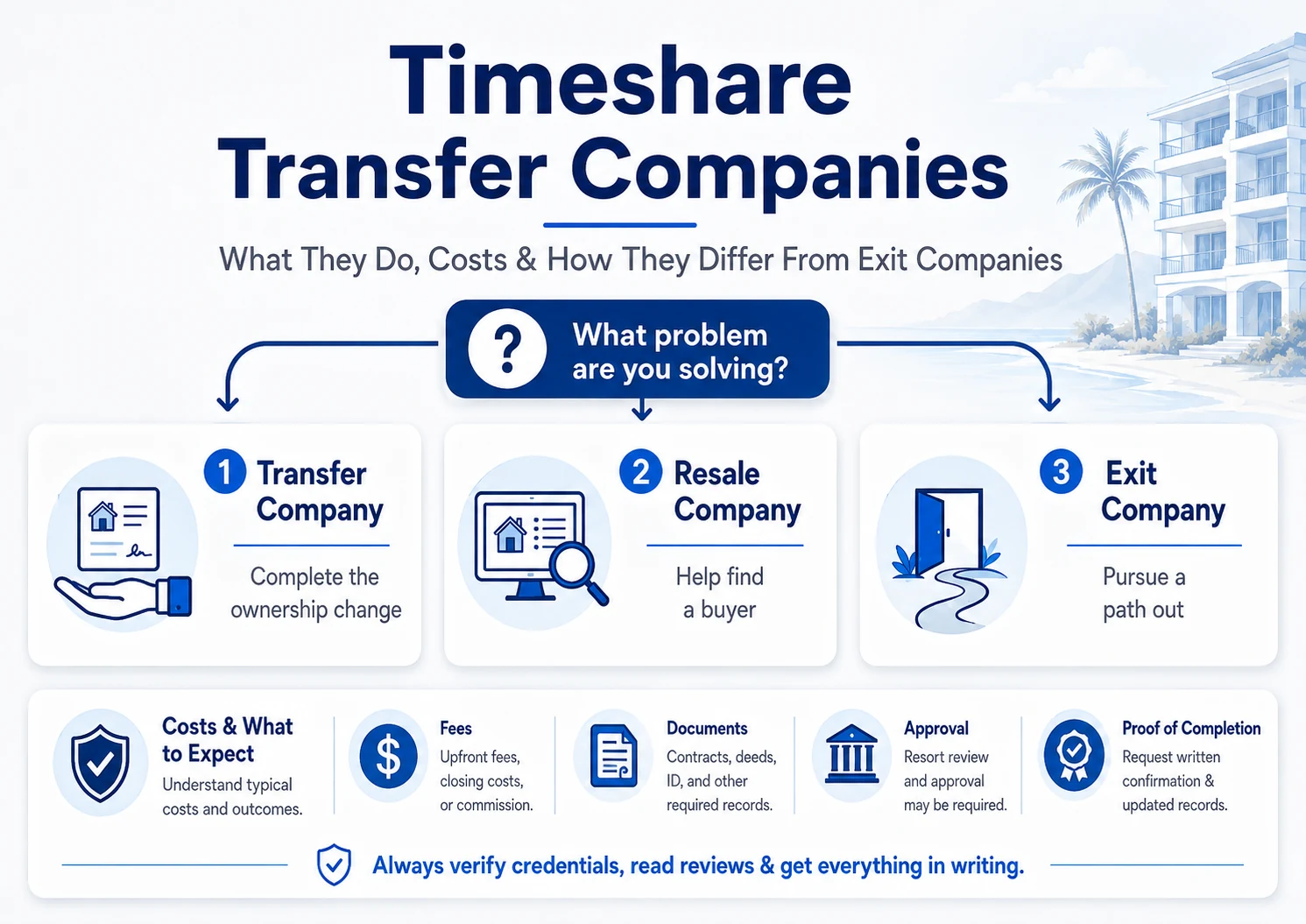
These companies can become involved when an owner wants a timeshare out of their name, but they do not necessarily perform the same job. The easiest way to distinguish them is to look at what problem the company is being hired to solve.
A transfer company generally completes an ownership change that already has a viable recipient. A resale company focuses on finding or connecting with a buyer. An exit company typically becomes involved when the owner wants out but does not yet have a clear resale, transfer, or developer-return solution.
Completes the Ownership Change
Usually makes the most sense when a buyer, family member, heir, or other legitimate recipient has already been identified. Services may include deeds, assignments, title work, escrow, closing, recording, resort submissions, and ownership-record updates.
Helps Find or Reach a Buyer
Focuses on marketing, listing, brokerage, or otherwise connecting an owner with someone willing to purchase the timeshare. A resale effort is not complete merely because the property is listed; a buyer still has to be found and the ownership ultimately transferred.
Pursues a Path Out of the Ownership
Typically serves owners whose primary goal is to end the obligation but who may not already have a buyer or recipient. Strategies can vary, so owners should understand how timeshare exit companies work and exactly what a provider proposes to do before paying for help.
The company name is not enough. A business may offer services that overlap more than one category. Review the actual agreement to determine whether the company is finding a recipient, completing an already-defined transfer, pursuing a surrender or other exit, or combining several services into one transaction.
What Transfer Companies Handle — and What Can Block the Transfer
A transfer company may coordinate the administrative work required to move an ownership, but it cannot eliminate conditions that prevent the transaction from being completed.
What the Provider May Handle
Depending on the service, that can include:
- deed or assignment preparation;
- title or ownership verification;
- escrow or closing coordination;
- recording;
- resort or developer submissions;
- transfer-fee processing; and
- follow-up on ownership-record changes.
The exact scope matters. One provider may handle a transaction from document preparation through resort confirmation, while another may perform only one part of the process.
What It Does Not Automatically Solve
A transfer company generally cannot:
- create a willing buyer or recipient;
- force a developer or HOA to approve a transfer;
- make an ownership attractive on the resale market;
- eliminate unpaid maintenance fees or assessments;
- cancel an existing loan; or
- guarantee that every developer benefit will transfer to the new owner.
That distinction is especially important with financing. Changing ownership does not automatically release the original borrower from a separate loan. If financing remains, see Can You Get Out of a Timeshare If You Still Owe Money?
What Can Complicate the Transaction
Additional requirements may arise when the ownership involves:
- active financing or liens;
- past-due fees or assessments;
- multiple owners;
- death, probate, or inheritance;
- trusts or LLCs;
- divorce or separation;
- deeded rather than membership-based ownership;
- right-of-first-refusal procedures;
- recipient-approval requirements; or
- inconsistencies between deeds, resort accounts, and other ownership records.
These issues do not necessarily make a transfer impossible. They can, however, change who must participate, what documents are required, what must be paid, and whether the ownership can be transferred at all.
A transfer company can coordinate the transaction, but it cannot substitute for eligibility. Before paying one, confirm that the ownership is transferable and that the proposed recipient can actually be recognized as the new owner.
How Much Do Timeshare Transfer Companies Cost?
There is no universal price for a timeshare transfer. The total depends on the ownership, location, services required, resort charges, and whether the transaction involves a sale, gift, financing, title work, or other complications.
If you already have a buyer or recipient and are trying to understand the transaction expenses themselves, see Timeshare Closing Costs: Fees When Selling or Transferring for a closer look at closing, recording, resort transfer, escrow, and other costs that may apply.
The most useful approach is to separate the costs into three categories.
Transfer-Company Fees
The provider may charge for services such as deed or assignment preparation, title verification, closing or escrow coordination, recording, resort submissions, and follow-up. Some providers bundle these services; others charge separately.
Resort and Transaction Costs
Additional expenses may include:
- resort or developer transfer fees;
- new-owner or enrollment charges;
- recording fees;
- taxes;
- title or escrow costs;
- attorney or other professional fees; and
- right-of-first-refusal or other transaction requirements.
These are not necessarily part of the transfer company’s own fee.
Existing Financial Obligations
A loan payoff, delinquent maintenance fees, assessments, taxes, or liens can substantially increase the amount needed to complete a transaction, but they are not the same as a transfer fee.
For example, if an owner owes $15,000 on the purchase loan, that balance is an existing financial obligation—not a $15,000 charge for transferring the timeshare.
Complex ownerships can also cost more to process. Multiple owners, estates, trusts, divorce-related changes, title problems, financing, and unusual recording requirements may require additional work.
Before paying, request an itemized written estimate that separates:
- the provider’s fee;
- deed, title, escrow, and recording costs;
- resort or developer charges;
- government fees or taxes;
- existing balances or loan payoff; and
- expenses that could be added if complications arise.
The number that matters is not simply the advertised transfer fee. It is the total cost required to get that specific ownership properly transferred and recognized by every party that matters.harge?” It is “What will it cost to get this specific ownership completely and properly transferred?”
Free Ownership Review Preview
Is a Transfer Actually a Realistic Option for Your Timeshare?
A willing recipient is only part of the transfer decision. Financing, account standing, ownership type, transfer restrictions, developer requirements, and unresolved balances can all affect whether the ownership can realistically move to someone else.
- Identify ownership factors that may complicate a transfer.
- Review whether financing or account status may limit your options.
- See which ownership details may deserve closer investigation before paying a provider.
Get a clearer preview of the ownership factors that may affect whether a transfer makes sense.
Try the Free Ownership Risk Profile™ Free preview • No transfer-company sales pitch • Educational decision supportHow to Choose a Timeshare Transfer Company
Start by confirming the transaction itself: what you own, who will receive it, and what the resort or ownership program requires to approve the transfer. Then compare providers based on the specific work needed.
Focus on five things:
- Scope of service. Confirm whether the fee includes deed or assignment preparation, title work, escrow, closing, recording, resort submissions, and follow-up.
- Recipient and transfer path. You should know who will receive the ownership and whether the resort will recognize the transaction.
- Total cost. Separate the provider’s fee from resort transfer fees, recording charges, title or escrow costs, taxes, and any loan or account balances.
- Failure terms. Ask what happens if the resort rejects the transfer, the recipient backs out, financing blocks the transaction, or additional requirements appear.
- Proof of completion. Know what documentation will show that the new owner has been accepted and that the former owner is no longer responsible for future ownership obligations.
Do not rely only on reviews or verbal promises. The written agreement should identify the services, fees, responsibilities, refund or cancellation terms, and what the company considers a completed transfer.
A strong provider should be able to explain the transaction from beginning to end: who receives the ownership, what must happen for the transfer to be approved, what it will cost, and how you will verify that it is finished.
Before You Pay a Transfer Company
Make Sure a Transfer Is Actually the Right Path for Your Ownership
If you are still unsure whether your timeshare can be transferred, whether financing or account restrictions could block the transaction, or whether you really need a transfer, resale, surrender, or broader exit strategy, the Timeshare Decision Intelligence Report™ can help organize the ownership facts, financial obligations, restrictions, and unresolved questions before you commit money to a third-party provider.
Need a clearer view of your specific ownership before choosing a provider?
Review the Report Option Or continue reading for the risks to verify before taking actionAction Step
Verify the Transfer Before Paying a Company to Handle It
Before signing an agreement or paying a transfer provider, confirm that the ownership can actually be transferred, the recipient is legitimate, and the proposed service covers the steps needed to complete the change.
Identify the recipient and confirm who or what will become the new recognized owner.
Request the current transfer requirements in writing from the resort, developer, HOA, club, trustee, or management company.
Confirm financing and account status, including any loan balance, maintenance fees, assessments, liens, or other amounts that could block the transaction.
Get an itemized estimate separating the provider’s fee from resort charges, recording costs, title or escrow fees, taxes, and other transaction expenses.
Understand what happens if the transfer fails because the recipient is rejected, financing cannot be resolved, or additional requirements appear.
Confirm the proof of completion you will receive showing that the ownership and applicable resort records were actually changed.
Quick Win
Ask one question before paying: “Who will own the timeshare when this is finished, and what written document will prove that I am no longer responsible for the ownership?” If the answer is vague, get more information before proceeding.
Owner Takeaway: A timeshare transfer company is most useful when there is already a legitimate recipient and a transfer the ownership program will recognize. If you still need someone to find a buyer—or you simply want out but do not yet know how—the problem may be resale or exit rather than transfer. Define the problem first, then pay for the service that actually solves it.
Frequently Asked Questions
Owners often encounter transfer, resale, and exit services at the same time. These answers clarify what a transfer company may do, when one may be useful, and what should be verified before paying for assistance.
What does a timeshare transfer company do?
A timeshare transfer company generally helps complete the legal or administrative change from the current owner to a new owner. Services may include deed or assignment preparation, title or closing work, recording, resort submissions, transfer-fee coordination, and ownership-record updates.
Do I need a company to transfer my timeshare?
Not always. The amount of assistance needed depends on the ownership structure, resort requirements, jurisdiction, and complexity of the transaction. Some owners use a transfer, title, closing, or deed-preparation service to coordinate the process, while simpler transfers may require less outside assistance.
How much does a timeshare transfer company cost?
There is no universal price. Total cost can include the provider’s service fee, deed or document preparation, title or escrow work, recording charges, developer transfer fees, taxes, and other transaction expenses.
Ask for an itemized estimate so you can distinguish the transfer company’s fee from costs imposed by the resort, government agencies, lenders, or other service providers.
Will a timeshare transfer company find a buyer for me?
Not necessarily. Finding or marketing to potential buyers is primarily a resale function. A traditional transfer company generally becomes most useful after a buyer or other legitimate recipient has already been identified.
Some businesses offer overlapping services, so confirm whether the company is marketing the ownership, supplying a recipient, completing the transfer, or combining several services.
Can a transfer company get me out of a timeshare if I do not have a buyer?
Not automatically. If there is no buyer, family recipient, approved transferee, or other legitimate destination for the ownership, there may not yet be a transfer for the company to complete.
In that situation, the underlying problem may be resale or exit rather than transfer. Ask the provider exactly who would receive the ownership and how that transfer would be approved before paying for the service.
Can I transfer a timeshare if I still owe money on it?
Financing can complicate or prevent a transfer. A lender may require payoff, refinancing, assumption approval, or another written arrangement before releasing the original borrower, and the resort may have separate requirements for changing ownership.
Do not assume that transferring the timeshare will also transfer or eliminate the loan. Confirm the lender’s requirements and the resort’s transfer rules separately before proceeding.
Are timeshare transfer companies the same as timeshare exit companies?
No. A transfer company generally helps complete an ownership change when there is already a viable recipient and transfer path. An exit company is typically hired when the owner’s broader objective is to end the ownership and a clear transfer, resale, or surrender solution may not yet exist.
Services can overlap, so evaluate what the provider actually agrees to do rather than relying only on the label the company uses.
How do I know when a timeshare transfer is really complete?
Do not rely only on a signed transfer agreement or the provider’s statement that the transaction is finished. Confirm that the applicable deed or assignment, resort account, ownership records, and billing responsibility have been updated.
Keep written evidence showing who became the recognized owner, when the change became effective, and whether the former owner remains responsible for any separate financing or other obligations.
Bottom Line
A timeshare transfer company can be useful when there is already a legitimate recipient, a permitted transfer path, and a defined transaction to complete. Its role may include preparing documents, coordinating title or closing work, recording a deed, submitting paperwork to the resort, and helping update ownership records.
But a transfer company is not automatically a resale company or an exit company. If you still need someone to find a buyer, you have a resale problem. If you simply want out and no viable recipient or transfer path exists, you may need to evaluate broader exit options instead.
Before paying any provider, confirm who will receive the ownership, whether the resort will approve the transfer, what the total cost will be, and what written evidence will prove the transfer is complete.
The right question is not simply, “Which timeshare transfer company should I hire?” It is “Do I actually have a transfer that can be completed—and is this the right type of company to complete it?”

Personalized Decision Support
Before You Pay a Transfer Company, Make Sure Transfer Is the Problem You Actually Need to Solve
A transfer provider may be useful when there is already a legitimate recipient and a transaction the ownership program will recognize. But if financing, account status, transfer restrictions, resale uncertainty, or the absence of a recipient is still unresolved, paying for transfer services may not address the real problem.
The Timeshare Decision Intelligence Report™ helps organize the ownership information, financial obligations, documents, restrictions, uncertainties, and decision considerations you provide so you can better evaluate whether transfer, resale, surrender, or another pathway deserves attention before committing additional money.
View the Timeshare Decision Intelligence Report™What Your Report Is Designed to Help Clarify
- ✓ Whether the ownership facts you provide support a realistic transfer pathway.
- ✓ Which financing, account-status, or ownership issues may require verification first.
- ✓ Whether transfer, resale, surrender, or another decision path deserves closer review.
- ✓ What questions and documentation should be resolved before paying an outside provider.
Related Guides
These guides can help you evaluate ownership changes, resale feasibility, direct-return options, and broader exit decisions. Guides already linked within this article are not repeated here.
Transfer & Ownership Changes
- Remove Someone From a Timeshare Deed or Ownership — useful for owners dealing with co-owner changes rather than a complete transfer to a third party.
- How to Know If Your Timeshare Exit Is Really Complete — reinforces the article’s emphasis on verifying ownership, billing, financing, and final documentation after a change.
Compare Other Ownership Paths
- Why Are Timeshares So Hard to Sell? — explains the resale-demand problem that exists before a transfer can even occur.
- Timeshare Deed-Back Program: What Owners Should Know — covers a direct developer-return pathway when transferring to another owner is not the appropriate solution.
- How to Get Out of a Timeshare: Where to Start Before Choosing an Exit Strategy — gives readers the broader decision framework when they discover they do not actually have a transfer problem.
Understand the Cost of Other Options
- Cost to Get Out of a Timeshare: What Owners May Pay — useful for comparing transfer-related expenses with the broader costs that can arise under other exit paths.