
Timeshare Sale & Transfer Cost Guide
Timeshare Closing Costs: Fees When Selling or Transferring
Selling, giving away, or transferring a timeshare can involve costs even when the ownership has little resale value or no money changes hands between the buyer and seller.
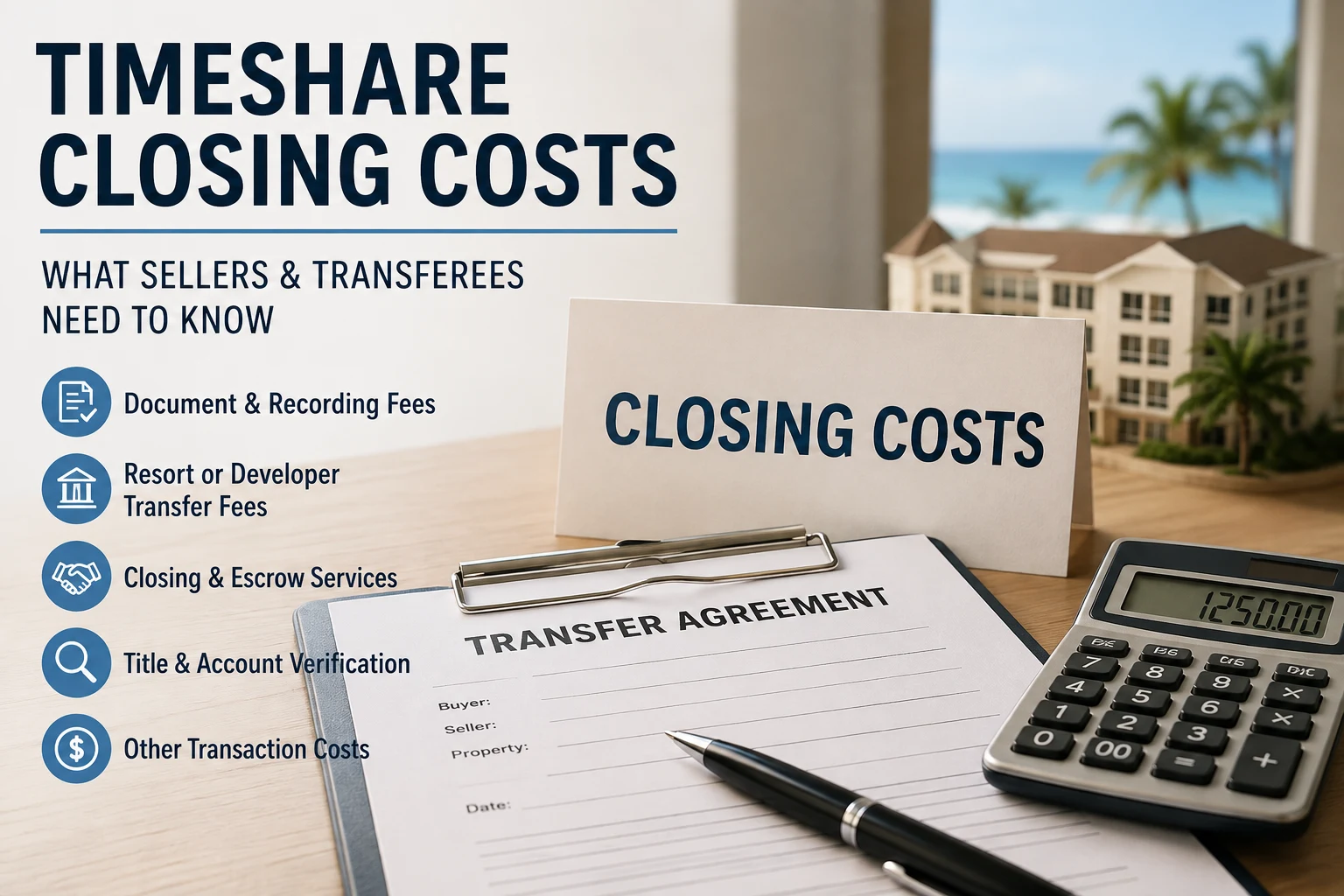
Closing and transfer expenses may include document preparation, recording, resort or developer transfer fees, escrow or closing services, and other transaction-specific charges. The amount quoted as a “closing fee” may not be the full amount an owner must resolve before the ownership can actually change hands.
About This Guidance: Timeshare Travel Club Authority provides independent guidance based on practical analysis of timeshare resale, transfer, closing, ownership, and exit processes. This guide focuses on the costs an existing owner may face when selling or transferring a timeshare, how those transaction expenses differ from outstanding ownership balances, and what should be verified before paying a closing or transfer provider.
How It Works
What Has to Happen Before a Timeshare Transfer Can Close?
Closing costs only make sense when there is a real ownership change to complete. Before focusing on the fee itself, confirm who will receive the timeshare, whether the transfer can proceed, and what the transaction will require.
Identify the Buyer or Recipient
Confirm who will receive the ownership through a sale, gift, family transfer, or another legitimate arrangement.
Confirm the Ownership Can Transfer
Verify the ownership status, applicable transfer requirements, financing, and any restrictions that could affect whether or how the transaction can proceed.
Identify the Transaction Costs
Determine the closing, recording, transfer, title, escrow, and resort-related charges and who is responsible for each one.
Complete and Verify the Transfer
Complete the required documents and processing, then verify that the ownership and future account responsibility actually changed.
TTCA Framework Insight: A quoted closing fee is only one part of the transaction. First establish that there is a legitimate recipient and a viable transfer path; then determine what it will actually cost to complete it.
Before You Pay to Transfer
Not Sure Whether You Actually Have a Viable Transfer?
If the buyer or recipient, financing, account balances, transfer requirements, or realistic exit path are still unclear, the Timeshare Decision Intelligence Report™ can help organize the ownership facts and unresolved questions before you commit money to closing, transfer, or exit services.
Need a clearer view of the ownership before paying transaction costs?
Review the Report Option Or continue reading to understand the costs of a sale or transferWhat Counts as a Timeshare Closing Cost?
Timeshare closing costs are the transaction expenses required to document, process, record, and complete a sale or transfer of ownership.
Depending on the ownership and how the transfer is handled, those costs may include:
- Closing or escrow service fees for coordinating the transaction and handling required documents or funds.
- Deed or assignment preparation fees when new ownership documents must be prepared.
- Recording fees charged to record a deed or other ownership document with the appropriate jurisdiction.
- Resort or developer transfer fees for updating the ownership or membership records.
- Estoppel or account-verification fees when the closing process requires confirmation of account status or current obligations.
- Title-related fees where title work is used as part of the transaction.
- Taxes or government charges that may apply to the transfer.
- Right-of-first-refusal processing fees when a resort or developer has a contractual review process before a resale can proceed.
A broker commission or resale fee may also be part of the overall transaction expense, but it is not necessarily the same thing as a closing fee.
The key is to ask for an itemized estimate rather than relying on one bundled number labeled “closing costs.” That makes it easier to see which charges are tied to completing the transfer and which expenses come from something else.
Important Distinction
Closing Costs Are Not the Same as Amounts You Already Owe
A closing quote may show what it costs to process and complete the transfer, but that number does not necessarily include every financial obligation tied to the ownership.
Existing loan balances, delinquent maintenance fees, assessments, taxes, late charges, liens, or other account obligations may have to be resolved separately before the transfer can be completed.
Costs to Complete the Transfer
Closing or escrow services, deed or assignment preparation, recording, resort transfer fees, title or account verification, and other charges tied directly to processing the ownership change.
Amounts Already Attached to the Ownership
Purchase financing, unpaid maintenance fees, assessments, taxes, late charges, liens, or other balances that may need to be cleared before the transfer can move forward.
The closing fee is not necessarily the total cost of getting the timeshare out of your name. To understand the real financial impact, separate the cost of processing the transfer from the obligations that already exist on the account.
Who Pays Timeshare Closing Costs — Buyer or Seller?
There is no universal rule that the buyer or seller must pay every timeshare closing cost. Responsibility depends on the transaction, the resort or developer requirements, and what the parties agree to.
In some resales, the buyer may pay the closing and transfer expenses. In others, the seller may cover some or all of those costs, or the expenses may be divided between the parties.
This matters especially when the timeshare has little resale value. A seller may decide that paying the closing or resort transfer fees is worthwhile if doing so makes it easier for a legitimate recipient to accept the ownership.
The important question is not what sellers or buyers “normally” pay. Before agreeing to the transaction, identify each charge, who is responsible for it, and whether that responsibility is documented in writing.
That leads to the more useful calculation: what will the transfer actually cost you after the sale price and seller-paid expenses are considered together?
What Will the Transfer Actually Cost You?
The amount a timeshare sells for does not necessarily tell you whether the transaction puts money in your pocket or costs you money to complete.
A more useful way to look at the transaction is:
Amount you receive from the buyer
minus seller-paid closing or transfer costs
minus any balances that must be resolved
= your practical financial result
For example, an owner may agree to sell or give away a low-value timeshare for a nominal amount and still pay the closing fee, resort transfer charge, or other required costs to complete the ownership change.
That does not automatically make the transaction a bad decision. If the transfer legitimately ends future ownership obligations, an owner may decide that paying a reasonable amount to complete it is preferable to continuing annual fees for years.
But the calculation should be made before the transaction begins. A low sale price, a “free” transfer, and a low quoted closing fee can each look attractive on their own while still producing a very different total financial result once every required cost is included.
The ownership change itself may also involve closing, recording, resort, or processing expenses. See Timeshare Closing Costs: Fees When Selling or Transferring for a breakdown of what those charges can include.
The next question is therefore more important than the closing fee itself: do you actually have a legitimate buyer or recipient and a transfer that can be completed?
Do You Actually Have a Buyer or Recipient?
Before spending money on closing or transfer services, confirm whether there is a real person or entity prepared to receive the ownership.
If You Already Have a Buyer or Recipient
You likely have a genuine transfer transaction to evaluate. The next priorities are to verify that the ownership can be transferred, identify the required costs, and confirm who will handle the closing and final ownership update.
At this stage, an itemized closing estimate is useful because there is an actual transaction behind it.
If You Do Not Have a Buyer or Recipient
Closing costs are probably not the main problem yet.
Without someone prepared to take the ownership, paying for deed preparation, closing services, or transfer processing does not solve the underlying issue. The more important question is whether resale, surrender, transfer, or another exit path is realistically available for your ownership.
That distinction matters because a closing service completes a transfer; it does not create a buyer or make an otherwise untransferable ownership marketable.
If you are still trying to determine which path may fit your ownership, the next step should be evaluating the ownership itself rather than paying transaction costs prematurely.
Free Ownership Review Preview
Not Sure Whether Selling or Transferring Is Realistic for Your Ownership?
If you do not yet have a confirmed buyer or recipient, the more useful question may be whether your ownership is realistically positioned for resale, transfer, surrender, or another exit path.
- Identify ownership and financing factors that may affect your options.
- Review conditions that may complicate resale, transfer, or surrender.
- See which parts of the ownership may deserve closer investigation before you pay for help.
Get a clearer preview of the ownership factors that may shape your next step.
Try the Free Ownership Risk Profile™ Free preview • No exit-company sales pitch • Educational decision supportAction Step
Get the Closing Quote in Writing Before You Commit
Once you have a legitimate buyer or recipient and a transfer that appears workable, ask for a written breakdown showing exactly what must be paid, who pays it, and what the closing provider will complete.
Confirm the buyer or recipient and make sure the transaction is tied to a specific person or entity prepared to receive the ownership.
Identify who will process the closing and what documents, escrow functions, recording, or account updates are included in that provider’s service.
Separate resort or developer charges from the closing-company fee so you can see which costs come from the ownership program itself.
Identify any existing balances that must be resolved before the transfer can proceed, including financing or unpaid account obligations.
Document who pays each charge so the buyer, seller, and closing provider are working from the same financial arrangement.
Ask what proves the transfer is complete and which record or written confirmation will show that ownership and future billing responsibility have changed.
Quick Win
Ask for one itemized estimate with three separate categories: closing or transfer service costs, resort or developer charges, and existing ownership balances. If those amounts are bundled together, ask for the quote to be broken out before you agree to pay.
What If You Still Owe Money on the Timeshare?
An outstanding purchase loan can materially affect whether a voluntary sale or transfer can be completed. Changing the ownership record does not automatically eliminate financing or release the borrower from the loan.
Before paying closing costs, confirm the current loan balance and what the lender or applicable transfer process requires. A buyer willing to take the timeshare does not necessarily mean the existing financing can transfer with it.
If your timeshare is still financed, see Can You Get Out of a Timeshare If You Still Owe Money? for a closer look at how an outstanding loan can affect resale, transfer, surrender, and other exit options.
Owner Takeaway: If you already have a legitimate buyer or recipient, focus on the itemized cost of completing and verifying the transfer. If you do not have someone prepared to receive the ownership, closing costs are premature—the more important question is whether you have a realistic resale, surrender, transfer, or other exit path.
Frequently Asked Questions
Closing and transfer costs can vary considerably between ownerships and transactions. These answers address several of the questions owners commonly encounter when preparing to sell or transfer a timeshare.
How much are timeshare closing costs?
There is no universal closing-cost amount. The total can depend on the ownership, resort or developer requirements, recording jurisdiction, transfer structure, and services used to complete the transaction. Ask for an itemized estimate rather than assuming one quoted fee includes every cost.
Who usually pays timeshare closing costs?
The buyer, seller, or both may pay closing and transfer expenses. Responsibility can depend on the transaction and what the parties agree to. With low-value timeshares, a seller may sometimes agree to absorb costs to make the transfer more attractive to a legitimate recipient.
What is a timeshare transfer fee?
A transfer fee is typically a charge associated with changing the ownership or membership records from the current owner to the recipient. It may be charged by the resort, developer, association, club, or other entity responsible for recognizing the ownership change.
Are maintenance fees part of timeshare closing costs?
Not necessarily. Maintenance fees are generally ongoing ownership obligations rather than transaction-processing costs. However, unpaid fees or other account balances may need to be brought current or otherwise resolved before a transfer can be completed.
Can the seller pay the buyer’s timeshare closing costs?
Yes, the parties may agree that the seller will pay some or all of the transaction expenses when the applicable process allows it. This can be particularly relevant when the timeshare has little resale value and the seller’s main objective is completing a legitimate ownership transfer.
Do I need a closing or transfer company to sell a timeshare?
Not every timeshare transfer uses exactly the same closing structure. The appropriate process depends on the ownership, documents, recording requirements, resort or developer procedures, and the complexity of the transaction.
If you are considering outside transfer assistance, see Timeshare Transfer Companies: Costs, Services & Risks for what these providers may do and what to verify before hiring one.
Can a timeshare be transferred if it still has a loan?
An outstanding loan can materially complicate a voluntary transfer. Changing the ownership record does not automatically release the borrower or eliminate the financing. The loan status and applicable transfer requirements should be verified before closing expenses are paid.
Are resale closing costs the same as the closing costs I paid when I bought the timeshare?
Not necessarily. A developer purchase and a later resale or transfer can involve different parties, documents, services, fees, and processing requirements. This guide focuses on costs associated with an existing owner selling or transferring the ownership.
How do I know the timeshare transfer is actually complete?
Do not rely only on signing documents or paying a closing provider. Look for the records appropriate to the ownership showing that the transfer was completed, such as recorded ownership documents, resort or developer account updates, written transfer approval, or other confirmation that the recipient is now recognized as the owner.
Bottom Line
Timeshare closing costs are only one part of what it may cost to complete a sale or transfer. The total financial result depends on the transaction expenses, who agrees to pay them, and whether any existing ownership balances must be resolved before the transfer can proceed.
Before paying a closing or transfer provider, confirm that there is a legitimate buyer or recipient, that the ownership can actually be transferred, and that the quote clearly separates closing costs, resort or developer charges, and existing obligations.
Most important, know what documentation will prove that the ownership and future billing responsibility have actually changed. A completed transfer—not simply a paid fee or signed document—is the outcome that matters.

Personalized Decision Support
If the Transfer Path Is Still Unclear, Organize the Ownership Before Paying Anyone
If you do not yet have a confirmed buyer or recipient, are unsure whether the ownership can be transferred, or are dealing with financing, account balances, transfer restrictions, or conflicting exit options, the Timeshare Decision Intelligence Report™ can help organize the facts and unresolved questions before you commit more money.
The goal is to determine what still needs verification, which obstacles may affect the transaction, and whether resale, transfer, surrender, or another ownership path deserves attention first.
View the Timeshare Decision Intelligence Report™What the Report Can Help Clarify
- Organize the ownership, financing, account, and transfer information you provide.
- Identify unresolved requirements or balances that may affect the transfer.
- Distinguish a genuine closing problem from a broader resale or exit-strategy problem.
- Establish what should be verified before paying a transfer, closing, or exit provider.
Related Guides
These guides can help you compare transfer, resale, and broader exit considerations before committing money to a closing or ownership change.
Selling & Transferring
- How to Transfer a Timeshare to Someone Else
Review the documents, approvals, account requirements, and verification steps involved in changing ownership.
Costs & Exit Planning
- How Much Does It Cost to Get Out of a Timeshare?
Compare the broader costs of surrender, resale, transfer, legal assistance, exit services, financing, and unpaid obligations.
Choosing an Exit Path
- How to Get Out of a Timeshare: Exit Strategy Guide
Compare rescission, surrender, resale, transfer, legal review, and other paths before committing to an exit strategy. - Why Are Timeshares So Hard to Sell? Resale Value Explained
Understand why many timeshares have limited resale demand, why resale prices can be very low, and how marketability can affect whether selling is a realistic exit path.