
Timeshare Exchange Decision Guide
Timeshare Exchange Alternatives: Beyond RCI and Interval International
Alternatives to RCI and Interval International now include more than smaller exchange companies. Owners may also encounter luxury exchange programs, cash getaways, hotel and vacation-rental platforms, cruises, and other member travel benefits.
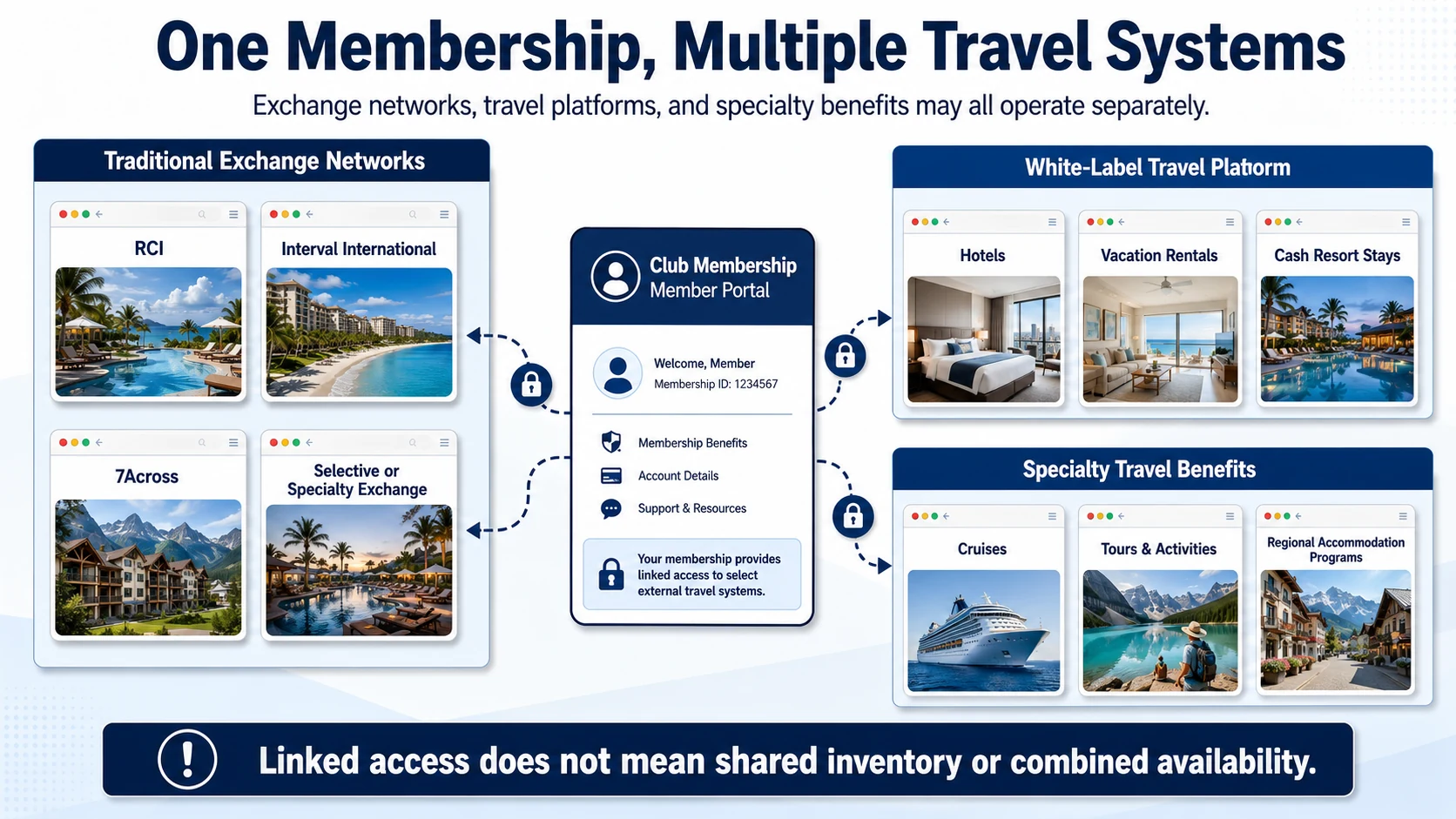
These services can add flexibility, but they do not all use the same inventory or booking system. A membership may link an owner to an exchange company, a separately operated hotel or rental platform, and other specialty travel providers. The key is understanding whether you are exchanging ownership value, purchasing travel through another provider, or using a separate membership benefit.
About this guidance: Timeshare Travel Club Authority’s guidance draws on experience with timeshare exchange, vacation-club servicing, white-label travel platforms, rental inventory, and specialty travel benefits. Exchange affiliations, eligibility rules, fees, inventory sources, and booking systems can vary by ownership and may change over time. Before relying on an advertised benefit, owners should confirm which company supplies the inventory, whether their specific ownership is eligible, how inventory enters the system, what must be used to book, who fulfills the reservation, and which cancellation terms apply.
How It Works
How a Membership Can Connect to Several Separate Travel Systems
A vacation club or membership may provide access to several exchange and travel benefits, but those services do not necessarily operate inside one shared reservation system. The developer or club may establish the relationship, while each outside provider controls its own eligibility, inventory, pricing, fees, and booking terms.
TTCA Framework Insight: Linked access and account registration do not create shared inventory—or guarantee that the owner’s timeshare can be exchanged through that provider. A valid inventory pathway must connect the specific ownership to the exchange system.
The Difference Comes Down to How the Trip Is Accessed
Not every alternative to RCI or Interval International is another exchange company. Some programs accept a deposited week or points, while others provide paid resort inventory, hotel and vacation-rental access, cruises, or specialty travel benefits. Even familiar exchange companies may offer more than one type of inventory.
The most useful way to compare these options is by their operating model: who provides the inventory, what the member must use to book it, and what limitation still applies.
Exchange Alternatives Compared
What Are the Main Types of Timeshare Exchange Alternatives?
Alternatives to RCI and Interval International do not all work the same way. Some are true exchange systems, some are limited to qualifying owners, and others provide additional ways to purchase travel without exchanging a timeshare. Familiar exchange companies may also offer more than one type of inventory.
Traditional Timeshare Exchange Network
True Exchange- RCI
- Interval International
- 7Across
- Trading Places International
The owner deposits or assigns an eligible week or uses qualifying points to request a stay from that exchange company’s inventory.
A deposited week, points, or assigned ownership value, plus an exchange fee.
Availability depends on what inventory actually enters that specific exchange network.
Selective or Eligibility-Based Exchange Program
Selective Exchange- SFX Preferred Resorts
- The Registry Collection
- Other qualifying specialty programs
Access depends on an accepted ownership, affiliated property, qualifying resort, or eligible membership relationship rather than being universally available to all timeshare owners.
An eligible ownership plus any membership, reservation, or transaction fees required by the program.
Eligibility and practical exchange access depend on the exact resort, ownership, membership tier, and inventory pathway.
Cash Getaway or Rental Resort Inventory
Paid Resort Inventory- RCI Extra Vacations
- RCI Last Call
- Interval Getaways
- 7Across Bonus or Rental Weeks
Resort stays are purchased without completing a traditional exchange. The program may describe them as getaways, bonus weeks, rental weeks, hot deals, or last-minute vacations.
Primarily cash, sometimes combined with member pricing, certificates, discounts, or promotional benefits.
Paid availability does not improve trading power or prove that more traditional exchange inventory exists.
White-Label Travel Platform
Commercial Travel Platform- Inspira-powered programs such as Prestige Travel 365
- arrivia-powered or other private-label travel platforms
- Other club-branded hotel and rental portals
A separate travel provider supplies the booking technology, inventory, pricing, and fulfillment while the platform appears under the club’s branding.
Usually cash, although some programs may also use credits, discounts, rewards, or other member benefits.
Inventory generally comes from commercial travel suppliers, not from exchanging a deposited timeshare.
Cruise and Specialty Travel Benefits
Specialty Travel Benefit- Cruzy
- Tour and activity platforms
- Regional or European accommodation programs
Separate providers offer cruises, activities, tours, or regional accommodations connected to the broader membership.
Cash, certificates, credits, discounts, or a program-specific benefit.
Pricing, eligibility, support, and booking terms must be evaluated separately from the core ownership and exchange program.
Personalized Decision Support
Is Exchange Access Only One Part of a Larger Ownership Decision?
Understanding exchange alternatives can help you compare travel options, but it may not answer whether the ownership still fits your costs, travel habits, booking experience, and expectations. The Timeshare Decision Intelligence Report™ organizes the ownership information, financial commitments, exchange affiliations, program benefits, documents, and unresolved questions you provide into a personalized written review.
Review the ownership as a whole—not only the exchange company attached to it.
Explore the Timeshare Decision Intelligence Report™ Personalized written review • Independent decision support • No exit-company sales pitchWhy Exchange Availability Is Not the Same as Hotel or Rental Availability
A hotel reservation system is designed to sell rooms that the hotel has chosen to make available. A vacation-rental platform displays homes, apartments, or villas that owners and property managers have actively listed for rent.
Traditional timeshare exchange works differently. As explained in our guide How Timeshare Exchange Programs Work: Deposits, Trading Power, Fees, and Availability, the exchange company cannot generally offer every unit at every affiliated resort simply because the property appears in its directory. A usable week, points allocation, or resort deposit must first enter that exchange system.
Exchange inventory may come from:
- An owner depositing a week
- A club assigning inventory to the exchange company
- A developer or resort depositing multiple units
- Unsold, unused, or promotional inventory made available under a separate arrangement
Until that happens, the exchange company may have no stay to offer for the requested resort and dates.
This is why a traveler may find dozens of hotel rooms or vacation rentals available in a destination while seeing little or no comparable timeshare exchange inventory. The hotel and rental listings are being offered for sale. The exchange company is searching only the inventory that has been contributed or allocated to its system.
A resort appearing in an exchange directory does not mean that the resort is currently available. It indicates that the property participates in or has a relationship with the network. Actual availability may be limited to certain dates, unit sizes, seasons, or deposits.
Owners comparing the two largest exchange networks can also review our RCI vs. Interval International comparison to understand how their affiliations, exchange systems, fees, and supplemental travel options differ.
The same distinction applies when a membership links to a white-label travel platform. The platform may display thousands of hotels and rentals because it connects to commercial travel suppliers. That broader selection can be valuable, but it does not increase the number of timeshare weeks available through RCI, Interval International, 7Across, or another exchange network.
For owners, the practical lesson is simple: exchange availability should not be evaluated like hotel availability. Flexible dates, destinations, unit sizes, and advance planning may improve the odds of finding a suitable exchange, but they cannot create inventory that has never entered the system.
When a Broader Travel Platform Can Add Real Value
Hotel, vacation-rental, cruise, or activity inventory is not traditional timeshare exchange, but it can still fill travel gaps that an exchange network may not serve well.
A broader platform may be useful for:
- Short hotel stays rather than a full resort week
- Cities with limited timeshare inventory
- Vacation homes for larger groups
- Cruises, tours, and activities
- Additional resort stays without another deposit
- Dates that do not match available exchange inventory
The strongest value comes when the platform provides a type of trip the owner could not reasonably obtain through traditional exchange. An owner who prefers city stays, cruises, shorter trips, or larger vacation homes may therefore receive meaningful flexibility from a separate travel provider.
A club-linked platform can also make several travel products easier to access through an existing membership relationship. However, the club may only provide the connection. A separate company may control the inventory, pricing, reservation, cancellation rules, and customer support.
Convenience should still be separated from financial value. Before booking, compare the complete member price with an equivalent reservation available directly from the hotel, cruise line, vacation-rental provider, or another reputable source.
A broader travel benefit is most useful when it provides better access, a meaningful net saving, or a trip the owner could not realistically obtain through the core exchange program.ner could not reasonably obtain through traditional exchange.
When Broader Travel Benefits May Be More Packaging Than Value
Broader travel benefits can make a membership more useful, but they can also make the program appear more valuable than it is. A long list of hotels, resorts, cruises, and activities may sound impressive even when the member receives little that could not be booked elsewhere.
The key issue is not how many options appear in the program. It is whether the member receives meaningful access, savings, or flexibility after all costs and restrictions are considered.
Warning signs include:
- Publicly available hotel or rental inventory being presented as exclusive membership access
- Large destination or property counts that combine exchange inventory with ordinary cash bookings
- “Up to” discounts being treated as typical savings
- Credits or certificates that require additional spending before they can be used
- Mandatory booking fees, resort charges, taxes, or all-inclusive fees that reduce the advertised value
- Cancellation terms that are more restrictive than booking directly
- Unclear responsibility when the club, platform provider, and accommodation supplier are different companies
- Benefits that expire, require upgrades, or are difficult to use during the member’s preferred dates
A large hotel count may be accurate while saying nothing about whether the member receives a better price, flexible cancellation, or hotel-loyalty benefits. A cruise certificate may still require taxes, port charges, gratuities, upgrades, or a substantial fare payment. A low-priced resort getaway may become less attractive after mandatory property, housekeeping, meal-plan, or destination fees are added.
A broader travel platform should be judged by the net result, not the size of its inventory or the number of benefits listed in a sales presentation. The strongest programs provide clear pricing, usable availability, reasonable terms, and a benefit the member can verify before committing additional money.
Risk Point
Rental Inventory Can Make Exchange Access Look Broader Than It Really Is
A sales presentation or membership program may combine exchange resorts, cash getaways, hotels, vacation rentals, cruises, and activities into one large inventory total. That can make the ownership appear to provide far more exchange availability than the exchange network actually receives.
The risk is greater when an owner purchases or upgrades without a clear explanation of which stays require a deposit, which require additional cash, which are supplied by outside companies, and which benefits the ownership can realistically use. A large travel-inventory count should not be treated as proof of stronger exchange access.
How to Evaluate an Exchange Alternative Before You Use It
The program name matters less than the transaction behind the booking. Before depositing ownership, paying a membership fee, using a certificate, or purchasing travel through a linked platform, verify exactly what the benefit provides and how the reservation will work.
Action Step
Verify What You Are Actually Accessing Before You Book
Before depositing a week, paying for another membership, using a travel certificate, or booking through a club-linked platform, identify the inventory source, complete cost, and company responsible for the reservation.
Identify the operating model. Confirm whether the reservation is a traditional exchange, cash getaway, hotel booking, vacation rental, cruise purchase, or another specialty benefit.
Determine who supplies the inventory. The club may market the benefit, while an exchange company, hotel wholesaler, cruise agency, or other third party actually provides the trip.
Confirm what you must use to book. Ask whether the transaction requires a deposited week, points, credits, a certificate, a membership upgrade, cash, or a combination of these.
Calculate the complete price. Include exchange or booking fees, annual dues, taxes, resort charges, housekeeping fees, meal plans, port expenses, and other mandatory costs.
Compare a similar public booking. Check the same property, dates, room type, occupancy, cancellation terms, and included benefits through the supplier or another reputable booking source.
Verify who handles problems and cancellations. Know whether support comes from the club, exchange network, white-label platform, cruise provider, accommodation supplier, or another company.
Quick Win
Ask one question before booking: “Is this reservation using my timeshare or exchange value, or am I purchasing a separate travel product?” The answer immediately clarifies which costs, availability rules, and comparison method should apply.
Which Timeshare Exchange Alternatives Are Still Active?
The exchange market includes several active companies beyond the standard RCI and Interval International relationship, but they should not all be treated as equal substitutes. Eligibility, inventory concentration, deposit rules, membership structure, and access can differ substantially.
7Across
7Across, formerly known as Dial an Exchange, operates a week-based exchange model and separately offers Bonus Weeks, Rental Weeks, and hotel bookings. Its current structure distinguishes deposited exchange value from travel that is purchased separately.
Owners should still confirm that 7Across will accept and verify their exact ownership, how the week must be deposited, and whether the network receives useful inventory for the destinations and dates they want.
For a closer look at eligibility, current fees, Deposit Credits, availability, and booking value, read our 7Across review.
SFX Preferred Resorts
SFX Preferred Resorts operates a selective exchange service with Gold and Diamond membership structures. Its program uses deposited ownership weeks, member requests, exchange confirmations, and additional bonus or travel benefits.
SFX may be relevant to an owner whose resort and ownership meet its acceptance standards. Before depositing, the owner should confirm eligibility, current membership and exchange fees, deposit validity, request procedures, and whether SFX regularly receives inventory that fits the owner’s travel pattern.
Trading Places International
Trading Places International continues to offer timeshare exchange, week deposits, exchange searches, request services, Hot Deals, and separate rental inventory. Its current platform also offers different membership and resort-specific arrangements.
Trading Places may be particularly relevant to owners whose resort or vacation club already has a relationship with the company. Fees, deposit privileges, membership benefits, and booking rules can vary by resort or owner program, so an individual owner should confirm the terms that apply to the exact ownership.
The Registry Collection
The Registry Collection is an RCI-operated luxury exchange program available through qualifying vacation ownerships and affiliated programs. It provides eligible members with access to a selective exchange portfolio and additional travel services.
It should not be treated as an open replacement for RCI or Interval International. Eligibility depends on the ownership or program through which membership is provided.
Arrivia-powered and Inspira-powered platforms, cruise benefits, hotel portals, and similar club-linked services belong in a different category. They may expand the member’s travel options, but they generally provide commercial travel or specialty benefits rather than deposited-week exchange.
The existence of these alternatives does not mean every owner should join another exchange network. The practical question is whether a company accepts the ownership, serves the desired destinations, offers workable deposit terms, and provides enough realistic availability to justify any additional dues and transaction fees.
Which Type of Alternative Fits the Trip You Want?
The best alternative depends less on the size of the program and more on what kind of trip the owner is trying to take. A traditional exchange network, cash getaway, hotel platform, and cruise benefit solve different problems.
An owner seeking another seven-night resort stay may benefit from comparing traditional exchange networks such as RCI, Interval International, or 7Across. The decision should focus on deposit eligibility, destination strength, request flexibility, exchange fees, and how long the deposited value remains usable.
A traveler planning a short city stay may receive more practical value from a hotel platform. Cities such as New York, London, or Paris often have extensive commercial hotel supply but relatively limited timeshare exchange inventory.
An owner who wants an additional resort vacation without depositing another week may prefer a cash getaway, rental week, or last-minute resort offer. In that situation, the relevant comparison is not trading power. It is the complete cash price compared with an equivalent public booking.
Vacation-home platforms may be more useful for extended families or larger groups that need several bedrooms, a kitchen, or accommodations outside a traditional resort setting.
Cruise and specialty travel benefits may suit members whose travel habits have expanded beyond resort stays. However, those benefits should be judged independently because cruise fares, certificates, credits, taxes, gratuities, port charges, and cabin upgrades may operate under entirely different rules.
No single system needs to meet every travel need. An owner may use traditional exchange for resort vacations, a hotel platform for short city stays, and a specialty provider for cruises or activities.
The goal is not to accumulate the largest number of memberships. It is to use each option where it adds practical value without creating unnecessary dues, duplicate fees, or unrealistic expectations.
How to Compare the Real Value of an Exchange Alternative
A low exchange fee, large resort directory, or advertised member discount does not reveal the complete value of a program. Owners should compare the total cost of the trip and the usefulness of the confirmed reservation—not one fee in isolation.
For a traditional timeshare exchange, the complete cost may include:
- The portion of the annual ownership cost used to generate the deposited week or points
- Exchange-company membership dues
- The exchange transaction fee
- Point-saving, extension, combination, or upgrade charges
- Guest-certificate fees
- Resort, housekeeping, destination, or all-inclusive charges
- Taxes and other mandatory expenses
The ownership cost should not be ignored simply because the maintenance fee was paid months earlier. It is part of what the owner spent to generate the week, points, or other value being exchanged.
A practical comparison is:
Allocated ownership cost + exchange membership and transaction fees + mandatory destination charges = complete exchange cost
For cash getaways, hotels, vacation rentals, cruises, and other paid travel, the calculation is different:
Cash booking price + applicable share of membership or certificate cost + taxes and mandatory fees + upgrades or excluded expenses = complete paid-travel cost
The phrase applicable share matters. If an annual membership provides access to several bookings, assigning its entire cost to one trip may overstate that trip’s expense. The owner should use a reasonable portion based on how often the membership or benefit is actually used.
For example, a discounted resort week may initially appear to cost $799. After adding a $250 resort fee, taxes, housekeeping charges, and an appropriate share of the annual membership cost required to access the offer, the actual price may be considerably higher.
The owner should then compare that complete cost with a genuinely similar public reservation using the same:
- Dates
- Property or location
- Unit or room type
- Occupancy
- Cancellation terms
- Included meals or benefits
- Mandatory property charges
The comparison should also account for what may be lost by booking through a club-linked or third-party platform. A lower rate may come with more restrictive cancellation terms, no hotel loyalty points, fewer elite-status benefits, or less direct support from the accommodation provider.
Price is not the only measure of value. An exchange may still provide strong value when it secures a larger unit, a difficult destination, or a stay that would otherwise be expensive. A broader travel platform may be worthwhile when it provides useful city, cruise, hotel, or vacation-rental inventory that is not realistically available through the owner’s exchange network.
However, a benefit that requires additional spending should not automatically be counted as part of the value of the original ownership. It should be evaluated as a separate travel purchase and compared on its own access, price, terms, and practical usefulness.
Can Owners Use More Than One Exchange Company?
Owners may have access to more than one exchange company, but they usually cannot freely choose between RCI and Interval International for the same ownership. The primary exchange relationship is generally established by the developer, resort, or vacation club.
Additional access may be possible when:
- The owner holds multiple timeshares with different affiliations
- The resort is dual-affiliated
- An independent exchange company accepts the owner’s exact week directly
- The club or developer has a separate inventory agreement
- The membership includes paid hotel, rental, cruise, or getaway benefits that do not require an exchange deposit
Creating an account with another company does not prove that the ownership can be exchanged through it. The alternative company must be able to accept, verify, receive, or otherwise connect usable inventory from that specific ownership.
Before paying another membership fee, confirm how the ownership enters the system, whether the developer or resort must cooperate, what the owner receives in return, and whether the company has realistic inventory for the destinations and dates the owner wants.
The practical question is not how many exchange accounts an owner can open. It is how many systems the ownership can actually use.
Frequently Asked Questions
These answers clarify exchange affiliation, independent exchange access, paid travel inventory, and what owners should verify before relying on an alternative program.
Can I choose between RCI and Interval International?
Usually not for the same ownership. The developer, resort, or vacation club generally determines the primary exchange affiliation. Exceptions may include dual-affiliated resorts, multiple ownerships, legacy arrangements, or specific developer programs.
Can I sign up for 7Across, SFX, or another independent exchange company?
You may be able to register, but registration does not guarantee usable exchange access. The company must accept your exact ownership, and a valid deposit, assignment, verification, or inventory pathway must exist.
Otherwise, the account may provide only cash getaways, rentals, hotels, or other paid travel benefits.
Are cash getaways and rental weeks the same as a timeshare exchange?
No. A traditional exchange uses a deposited week, points, or other ownership value. A cash getaway or rental week is a separate paid reservation and may not require any ownership deposit.
The stay may still provide good value, but it should be compared with similar public rates based on the complete price, unit type, cancellation terms, and mandatory fees.
Why can I find hotel rooms but no timeshare exchange availability?
Hotel rooms and vacation rentals are commercial inventory actively offered for sale. Traditional exchange availability depends on weeks, points allocations, or resort inventory actually entering that exchange company’s system.
A destination can therefore have extensive hotel availability but very little timeshare inventory available for exchange.
Does a large resort directory mean those resorts are available to book?
No. A directory generally shows properties associated with or represented by the network. It does not prove that a suitable unit is available for the dates, season, unit size, or destination you want.
Directory participation and live availability are different facts. Owners should evaluate actual search results, request outcomes, deposit rules, and realistic destination strength rather than relying on the advertised property count alone.
What Should You Verify Before Using an Alternative Exchange Company?
Before paying dues or depositing ownership value, confirm that the company can actually use your specific ownership—not merely allow you to register or browse travel offers.
Ask the developer, resort, or vacation club:
- Can this ownership be deposited or assigned outside its primary exchange relationship?
- Is a confirmed reservation required?
- Must the resort verify or release the week?
- Are there restrictions on transferring points, reservations, or usage rights?
Then ask the alternative exchange company:
- Will you accept my exact resort, ownership type, season, and unit?
- How does my ownership enter your exchange system?
- Can I place a request before committing the week?
- What happens if the deposit cannot be verified or accepted?
- How long does the deposited value remain valid?
- What current dues, exchange fees, extensions, and other charges apply?
- What destinations and unit types does the company realistically receive?
The most important question is:
“How does my specific ownership create usable exchange value in your system?”
A useful answer should explain the deposit, assignment, or verification process and what the owner receives in return. A general promise of broad resort access is not enough.
Also confirm whether any hotels, cruises, rentals, or getaway offers are true exchange benefits or separate cash travel products.nd paid benefits. An alternative company may be unable to accept the timeshare while still offering cash getaways, hotels, cruises, or other travel products. Those benefits may be useful, but they do not mean the ownership itself can be exchanged through that company.
Exchange alternatives should be evaluated by how inventory actually enters the system—not simply by whether an owner can register or access a website. A developer affiliation, resort relationship, accepted deposit, or other valid inventory pathway must exist before an ownership can produce usable exchange value. Hotels, rentals, cruises, and cash resort stays can still add meaningful flexibility, but they are separate travel products and should be judged by their complete cost, availability, terms, and practical usefulness.
Frequently Asked Questions
These answers clarify exchange affiliation, independent exchange access, paid travel inventory, and what owners should verify before relying on an alternative program.
Can I choose between RCI and Interval International?
Usually not. The developer, resort, or vacation club generally determines the ownership’s primary exchange affiliation. An owner at an RCI-affiliated program typically cannot simply enroll the same ownership with Interval International, and the reverse is also generally true.
Exceptions can include dual-affiliated resorts, multiple ownerships, legacy arrangements, or specific developer programs. Our RCI vs. Interval International comparison explains how the two networks differ, but affiliation eligibility still depends on the ownership.
Can I sign up for 7Across, SFX, or another independent exchange company?
You may be able to register, but registration alone does not create usable exchange access. The company must accept your exact ownership, and there must be a valid way for your week, reservation, points, or assigned inventory to enter its system.
Without a developer relationship, resort arrangement, direct deposit process, or another accepted inventory pathway, the account may provide only rental offers, cash getaways, or other travel benefits rather than a usable exchange.
Are cash getaways and rental weeks the same as a timeshare exchange?
No. A traditional exchange uses a deposited week, points, or other ownership value. A cash getaway or rental week is a separate paid reservation and may not require any ownership deposit.
The stay may still provide good value, but it should be compared with similar public rates based on the complete price, unit type, cancellation terms, and mandatory fees.
Why can I find hotel rooms but no timeshare exchange availability?
Hotel rooms and vacation rentals are commercial inventory actively offered for sale. Traditional exchange availability depends on weeks, points allocations, or resort inventory actually entering that exchange company’s system.
A destination can therefore have extensive hotel availability but very little timeshare inventory available for exchange. Our guide to how timeshare exchange programs work explains the inventory and deposit process in more detail.
Does a large resort directory mean those resorts are available to book?
No. A directory generally shows properties associated with or represented by the network. It does not prove that a suitable unit is available for the dates, season, unit size, or destination you want.
Directory participation and live availability are different facts. Owners should evaluate actual search results, request outcomes, deposit rules, and realistic destination strength rather than relying on the advertised property count alone.
Bottom Line
Timeshare exchange alternatives now include independent exchange companies, selective programs, cash resort stays, hotel and vacation-rental platforms, cruises, and other specialty travel benefits.
These options can add flexibility, but registration, linked access, and large inventory counts do not guarantee usable exchange availability. A valid pathway must connect the ownership to the exchange company, while paid travel products should be evaluated separately based on their complete cost and terms.
Before joining another program, depositing a week, or relying on an advertised benefit, confirm who supplies the inventory, what must be used to book, who fulfills the reservation, and whether the option actually fits how you travel.
This is more decisive and removes the repeated explanation about the exchange company accepting or receiving inventory.

Personalized Decision Support
Your Preliminary Profile Identifies the Pressure. The Report Helps Organize the Decision.
The Ownership Risk Profile™ helps identify potential pressure points based on your answers. The Timeshare Decision Intelligence Report™ goes further by organizing the ownership information, documents, financial commitments, uncertainties, and decision considerations you submit into a personalized written report.
If your ownership involves significant money, long-term obligations, uncertain exchange value, booking difficulties, or questions about whether the benefits still fit how you travel, a structured review can provide a clearer foundation before making an important decision.
View the Timeshare Decision Intelligence Report™What Your Report Is Designed to Provide
- Organize the ownership facts and financial commitments you provide.
- Identify uncertainties, missing information, and verification priorities.
- Compare practical decision paths and important tradeoffs.
- Provide a personalized framework to help you evaluate your next step.
Related Guides
Compare Exchange Programs
- Is RCI Worth It?
Evaluate RCI exchange access, fees, paid vacations, and practical membership value. - Is Interval International Worth It?
Review Interval exchanges, Getaways, costs, and whether the program fits how you travel.
Understand Availability and Ownership Value
- Why Is It So Hard to Book a Timeshare?
Learn why resort participation does not guarantee live inventory for your dates. - Are Timeshare Benefits Worth It?
Compare exchange access, travel discounts, and added perks against their real usefulness. - Total Cost of Timeshare Ownership
See how maintenance fees, exchange charges, club dues, and other costs combine over time.