
Timeshare Affordability Guide
Can’t Afford Your Timeshare Anymore? What to Do Before You Stop Paying
When a timeshare becomes unaffordable, the first decision should not automatically be whether to stop paying.
Start by identifying what is actually creating the financial pressure—the purchase loan, maintenance fees, assessments, travel costs, or several expenses at once. Your account status, remaining loan balance, ownership structure, and written program options can all affect what you can realistically do next.
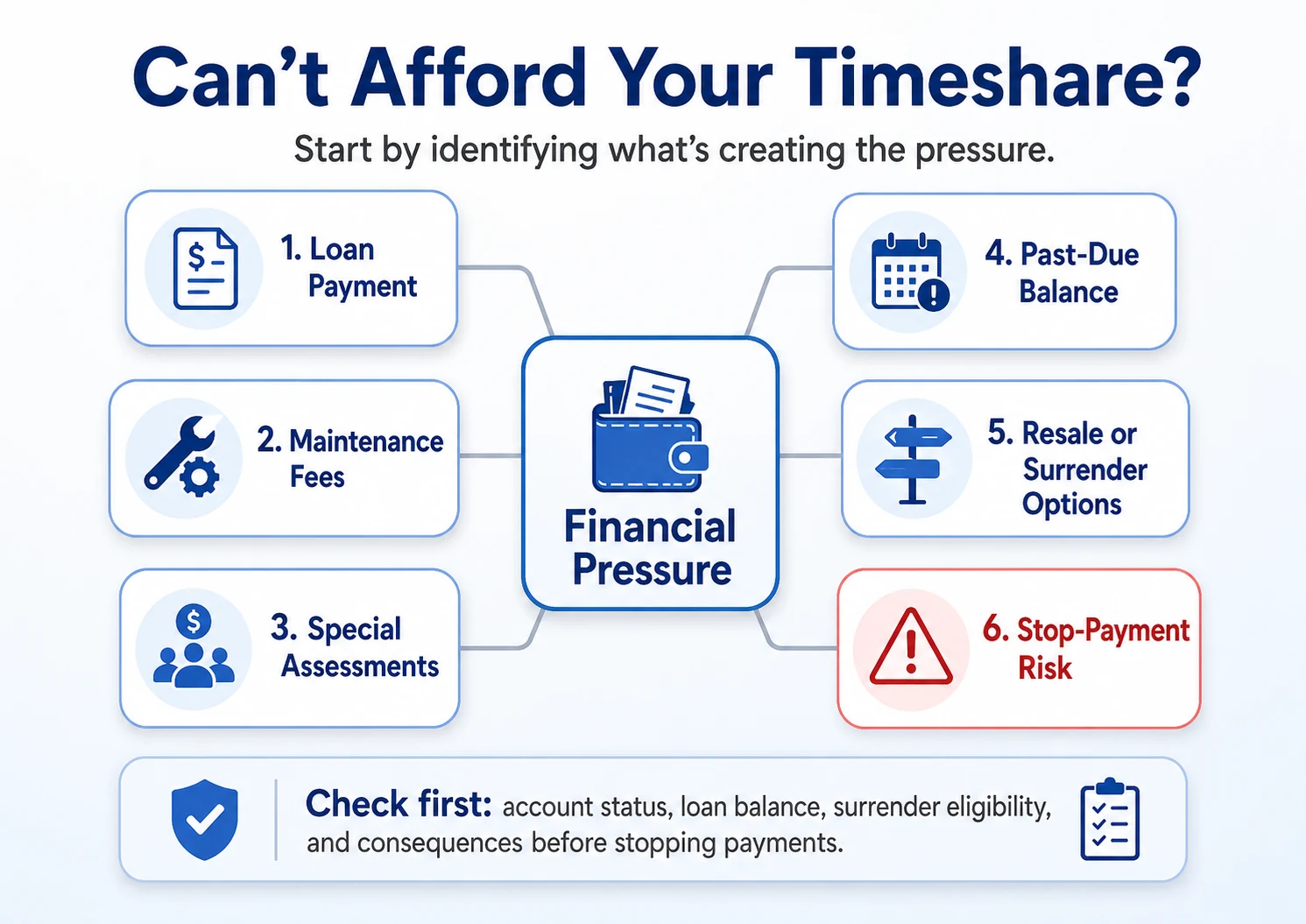
About This Guidance: TTCA evaluates timeshare affordability by looking beyond the next payment to the ownership obligations that may continue behind it. This guidance focuses on purchase financing, maintenance fees, assessments, account standing, written hardship or surrender options, transfer and resale limitations, and the potential consequences of nonpayment so owners can better understand which paths may realistically reduce or end their financial obligation.
Important Distinction
The Cost of Owning and the Cost of Using Are Different
Ownership costs may include the purchase loan, maintenance fees, club dues, taxes, and special assessments. Those obligations generally continue whether the owner travels or not.
Usage costs arise when the owner tries to take the vacation. Transportation, exchange fees, reservation charges, resort fees, all-inclusive costs, meals, parking, and other trip expenses can make the timeshare unaffordable even when the ownership account remains current.
Before Financial Pressure Becomes an Account Problem
Affordability Depends on the Full Cost, Account Status, and Options Still Available
A useful review should include the loan, maintenance fees, club dues, assessments, travel expenses, account standing, surrender rules, resale limitations, and the consequences of falling behind. The Timeshare Decision Intelligence Report™ helps organize those details before you stop paying, hire outside help, or make another costly ownership decision.
Need a clearer view of what is driving the financial pressure?
Review My Ownership Options Or continue with the affordability review belowWhat Is Making the Timeshare Unaffordable?
Not every affordability problem points to the same solution.
An owner struggling with a purchase loan may face different limitations from an owner whose loan is paid off but whose annual fees have become unmanageable. An owner who can afford the ownership bills but not the vacation itself may need to evaluate the timeshare differently from someone already receiving past-due notices.
Start by separating the financial pressure into the category that most closely reflects the current situation.
Financial Pressure Points
What Is Making the Timeshare Unaffordable?
Start by separating the pressure into categories. The right next step may be different depending on whether the issue is a loan, maintenance fees, assessments, missed payments, reduced usage, or exit uncertainty.
Payment Pressure
Loan Payments
If you still owe on the purchase loan, resale, transfer, surrender, and negotiation options may be more limited.
Annual Cost
Maintenance Fees
Rising annual fees can make ownership difficult even when the original purchase loan is already paid off.
Unexpected Cost
Special Assessments
Special assessments or one-time charges can create pressure that was not part of the original budget.
Account Status
Past-Due Balances
Once payments are late, available options may narrow and collection activity may become more likely.
Usage Problem
Reduced Usage
If you no longer use the ownership, even manageable fees may feel unreasonable compared with the value received.
High-Risk Pressure
Stop-Payment Risk
If you are considering nonpayment, review collections, credit, foreclosure, and loan consequences before acting.
A Simple Timeshare Affordability Test
A timeshare is not affordable simply because the loan payment and maintenance fee can still be paid.
The more complete test includes three categories:
1. Cost of owning the timeshare
Add the loan payment, interest, maintenance fees, club dues, taxes, assessments, and other required ownership charges.
2. Cost of using the timeshare
Add airfare or driving costs, rental cars, exchange fees, reservation charges, resort fees, all-inclusive charges, parking, meals, and other trip expenses.
3. Cost of keeping an ownership you rarely use
Consider how much is paid each year when reservations are unavailable, travel is no longer practical, or the vacation value no longer justifies the obligation.
The practical question is:
“Can I afford both the ownership and the vacations required to receive meaningful value from it?”
An owner who can pay the annual fees but cannot afford to travel may still have an affordability problem. For a fuller breakdown of these expenses, see Total Cost of Timeshare Ownership.
What to Do First If You Can’t Afford Your Timeshare
Start with the facts that determine which options may still be available.
First, confirm whether an active purchase loan remains. A financed ownership may be harder to sell, transfer, surrender, or return because many programs require the loan to be paid before ownership can change. If the purchase loan is still outstanding and your goal is to leave the ownership, see how an outstanding timeshare loan can affect your exit options before assuming surrender, resale, or transfer will resolve both obligations.
Next, calculate the complete annual cost. Include maintenance fees, club dues, assessments, taxes, reservation charges, and the expenses required to use the timeshare—not only the monthly loan payment.
Then verify the account status. Determine whether the account is current, recently late, in collections, or already subject to lien, foreclosure, or legal notices. Options that may be available while the account is current can become more limited after delinquency begins.
Contact the developer, resort, association, or management company directly and ask whether any written hardship, surrender, deed-back, payment, or owner-assistance program exists. Request the eligibility rules and release terms in writing.
Resale or transfer may also deserve review, but do not assume that finding a willing recipient is enough. Confirm the loan payoff, transfer restrictions, account requirements, fees, and realistic buyer demand.
The goal is to address the financial pressure before one affordability problem becomes several separate problems involving late fees, collections, credit exposure, or legal enforcement.
What If You Can’t Afford Your Timeshare Loan?
If the financed purchase is the main reason the timeshare has become unaffordable, start by separating the loan payment from the other costs of ownership. A timeshare may also carry maintenance fees, assessments, exchange fees, and travel costs, so reducing one expense does not necessarily make the overall ownership affordable.
Owners sometimes search for this problem as a “timeshare mortgage,” but the financing may actually be a developer loan, consumer loan, or another form of purchase financing. Review the current balance, interest rate, monthly payment, remaining term, and whether the account is current or already delinquent before deciding what to do next.
If the loan payment is no longer manageable, ask the lender or developer what options are available before simply stopping payments. Depending on the account and program, there may be payment arrangements, hardship options, payoff requirements, surrender restrictions, or other conditions that affect what can realistically happen next.
The key question is not only whether you can lower the monthly payment. It is whether the proposed solution meaningfully reduces the total financial obligation and leaves you with an ownership you can still afford and use.
Risk Point
Stopping Payments Can Turn an Affordability Problem Into an Account-Enforcement Problem
If loan payments, maintenance fees, dues, or assessments stop, the account may move into late fees, collections, credit reporting, liens, foreclosure, termination, or other enforcement activity depending on the ownership and obligation involved.
Nonpayment does not automatically end the ownership. Before using it as a strategy, identify what is owed, what property or membership rights may be affected, and which options could disappear once the account becomes delinquent.
Before making a payment decision, slow the process down enough to understand your current position. The goal is not to pressure you into continuing payments forever. It is to help you avoid making a financial decision without knowing what may happen next.
Action Step
Build the Full Affordability Picture Before Choosing a Path
Gather the ownership, usage, and account details that determine whether the problem can be managed or whether another ownership path needs review.
- Confirm the purchase-loan balance, interest rate, monthly payment, and current payoff amount.
- Total maintenance fees, club dues, taxes, assessments, and upcoming ownership charges.
- Estimate transportation, resort, exchange, reservation, meal, and other usage costs.
- Verify whether the account is current, recently late, in collections, or subject to notices.
- Request written hardship, surrender, deed-back, payment, or owner-assistance requirements.
- Compare the cost and consequences of keeping, selling, transferring, surrendering, or stopping payments.
What If You Are Already Behind?
Once payments have been missed, affordability is no longer the only issue. The account status may begin determining which options remain available.
Still current but close to missing payments
This is usually the best time to review hardship, surrender, payment, resale, or transfer options. Some programs require the loan and annual fees to remain current.
Recently late
Request a written account statement showing the unpaid amount, late fees, due dates, and current status. Ask whether bringing the account current would preserve eligibility for any owner-assistance or surrender program.
In collections
Confirm who owns or controls the debt, what amount is being claimed, whether the developer or association still has authority to resolve the account, and whether any deadline applies. The published collection guides explain this stage in more detail.
Facing a lien, foreclosure, or legal notice
Do not treat the notice as an ordinary billing reminder. Identify the property or ownership interest affected, the response deadline, and whether the matter involves a court or formal enforcement process.
Being behind does not necessarily eliminate every option, but it can change the order of decisions. The further the account progresses, the more important it becomes to verify balances, deadlines, and proposed resolutions in writing.
Decision Insight
Financial Pressure Changes the Strategy
When money is tight, timeshare decisions can become reactive. Owners may stop paying, hire the first company that promises help, or assume the developer will not work with them. But financial pressure does not remove the need to review the structure first.
The better strategy is to identify what is driving the pressure, confirm the account status, and then compare the available options in the right order. A financed owner, a paid-off owner, and an owner already in collections may need very different next steps.
❓ Frequently Asked Questions
These questions address affordability involving the loan, annual ownership costs, travel expenses, account status, and the risks of stopping payments.
What should I do if I can’t afford my timeshare anymore?
Start by separating the purchase loan, annual ownership charges, travel expenses, and any past-due balance. Then confirm the account status and ask the developer or association whether written hardship, payment, surrender, deed-back, resale, or transfer options remain available.
Can a timeshare be unaffordable even if I can still make the payments?
Yes. An owner may be able to pay the loan and maintenance fees but no longer afford airfare, transportation, exchange charges, resort fees, all-inclusive costs, meals, or other expenses required to use the ownership.
Can I get out of a timeshare if I have very little money?
Options may be limited when a loan or past-due balance remains, but the owner should still ask the developer directly about hardship, surrender, deed-back, payment, or owner-assistance programs. Be cautious about adding a large third-party fee to an existing affordability problem.
Can I give back a timeshare because I can no longer afford it?
Possibly, but acceptance is not automatic. Many programs require the loan to be paid off and the account to be current. Request the eligibility requirements, fees, effective date, and written release terms before assuming the ownership has ended.
What happens if I stop paying my timeshare?
Missed loan payments, maintenance fees, dues, or assessments may lead to late fees, collections, credit reporting, liens, foreclosure, termination, or other enforcement. Stopping payments does not automatically cancel the ownership.
Can I sell my timeshare if I still owe money?
An active loan often makes resale or transfer more difficult because the payoff may be required before ownership can change. Confirm the payoff amount, transfer rules, buyer demand, and whether likely proceeds would cover the debt.
Should I hire a timeshare exit company if affordability is the problem?
Review direct developer options first. Before paying a third party, examine the fee, contract, timeline, refund terms, promised method, and who will perform the work. A large upfront fee can deepen the original financial pressure.
What should I do if the account is already behind?
Request a written statement showing the balance, late fees, account status, collector information, and deadlines. If the account involves a lien, foreclosure, lawsuit, or other legal notice, review that document separately from an ordinary billing or collection demand.
Bottom Line
A timeshare can become unaffordable because of more than the mortgage.
The pressure may come from financing, rising maintenance fees, club dues, assessments, travel expenses, reduced usage, or a combination of costs that no longer produces enough value.
Before stopping payments, determine what is owed, what the next vacation would realistically cost, whether the account remains current, and which written hardship, surrender, resale, transfer, or payment options still exist.
The earlier those facts are reviewed, the better the chance of addressing the affordability problem before it becomes a collections, credit, lien, or foreclosure problem.
Understand the Full Cost, Account Status, and Options That May Still Be Available
Affordability may depend on the purchase loan, annual fees, assessments, travel expenses, usage value, account standing, surrender eligibility, resale limits, and the consequences of falling behind. The Timeshare Decision Intelligence Report™ helps organize those details, identify material risks and verification gaps, and clarify which decision paths may still be realistic before you stop paying or make another costly move.
Get the Timeshare Decision Intelligence Report™ Customized ownership review • Decision-support report • No exit-company sales pitchIndependent educational decision support. This is not financial or legal advice, debt negotiation, contract cancellation, a resale service, an exit service, or a guarantee that a particular ownership option will be available.
Related Guides
These published guides can help you review the full cost of ownership, understand what may happen if payments stop, and compare options before the account escalates.
Affordability and Ownership Costs
- Timeshare Special Assessments: What They Are and When They Happen
Understand how unexpected charges can increase financial pressure beyond regular maintenance fees. - How Much Does It Cost to Get Out of a Timeshare?
Compare the potential costs associated with resale, surrender, transfer, professional review, and other exit paths.
Before and After Payments Stop
- Should You Stop Paying Your Timeshare? What Happens Next
Evaluate the difference between loan payments, maintenance fees, and other obligations before using nonpayment as a strategy. - What Happens If You Stop Paying Timeshare Maintenance Fees?
Follow how unpaid fees may progress through late charges, suspended usage, collections, liens, or foreclosure. - Can a Timeshare Go to Collections?
Understand when unpaid timeshare obligations may move from internal billing into collection activity. - What to Do After Receiving a Timeshare Collection Notice
Review the creditor, balance, deadlines, account status, and response options after receiving a collection letter.
Ownership and Exit Options
- Can You Sell a Timeshare Back to the Developer?
Learn when a surrender, deed-back, or developer take-back program may be available and what eligibility requirements may apply. - Can You Sell a Timeshare If You Still Owe Money?
Understand how an active loan and payoff requirement can limit resale or transfer options. - Timeshare Exit Guide: How to Get Out of a Timeshare
Compare resale, surrender, deed-back, transfer, developer programs, and other possible exit pathways.