
Timeshare Transfer Guide
How to Transfer a Timeshare to Someone Else
You can often transfer a timeshare to another person, but finding someone willing to take it and signing paperwork are only the beginning. The ownership may also need developer, resort, HOA, trustee, or lender approval before the new owner is formally recognized and the former owner’s responsibility ends.
The decision: A transfer is not complete when the paperwork is signed. It is complete when the new owner is formally accepted and you have written proof that your future ownership obligations have ended.
This guide explains the transfer process for deeded timeshares, points, memberships, gifts, family transfers, and other ownership changes. Requirements can vary by developer, resort, association, trustee, ownership type, and jurisdiction. For provider-selection questions, see Timeshare Transfer Companies.
On This Page
- Can you transfer a timeshare?
- Use vs. ownership transfer
- What kind of transfer are you making?
- What changes the answer?
- Deeded vs. points or membership
- How a valid transfer usually works
- What can block a transfer?
- What does a transfer cost?
- What if you still owe money?
- What benefits may not transfer?
- Can you transfer only part?
- How do you know it is complete?
- Which situation fits you?
- My Take
- Frequently asked questions
- TTCA Decision
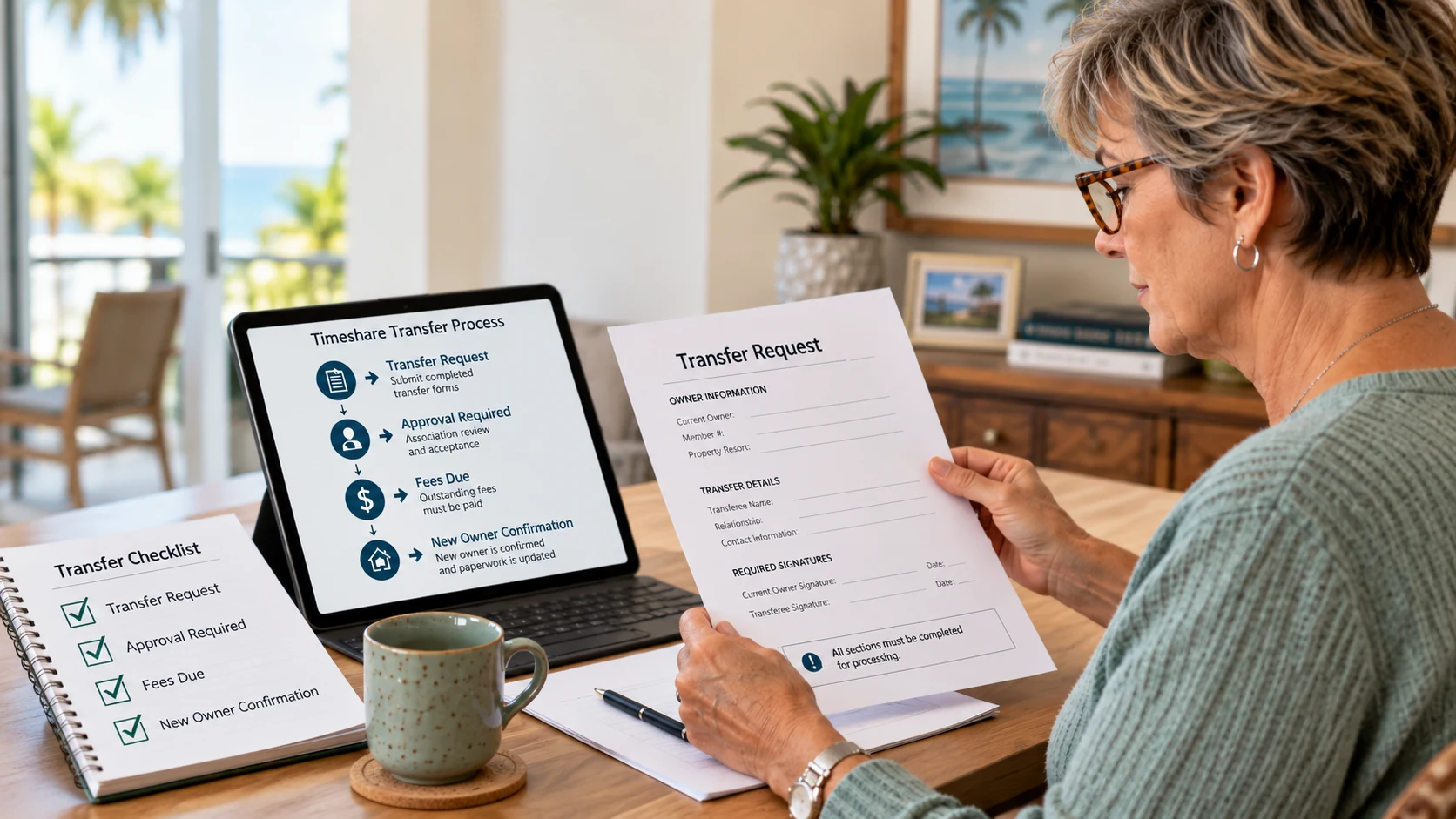
Signing transfer paperwork is only one step. A complete timeshare transfer may also require approval, payment of transfer-related fees, and formal confirmation that the new owner has been accepted.
Quick Answer
Yes, a Timeshare Can Often Be Transferred to Someone Else
A timeshare can often be transferred to another person through a sale, gift, family transfer, inheritance, or another approved ownership change.
The exact process depends on what you own, whether financing or unpaid fees remain, whether the recipient is eligible, and what approval or recording requirements apply.
Do not assume the transfer is complete merely because both parties signed a document. Confirm that the ownership record, resort or HOA account, any applicable loan, and future billing responsibility have all been updated.
What does it mean to transfer a timeshare?
A timeshare transfer changes the legal or contractual ownership from one person or entity to another. It is different from simply letting someone use the timeshare as a guest.
A complete transfer may require a deed, assignment, trustee or membership change, resort or developer approval, payment of transfer-related fees, and resolution of any loan or delinquent balance before the new owner is formally recognized.
Start With the Distinction
Are You Transferring Ownership or Just Letting Someone Use It?
- Guest useSomeone stays under your reservation or guest certificate, but you remain the owner.
- Authorized useA family member or other person may receive access or usage rights without becoming responsible for the ownership.
- Ownership transferThe legal or contractual ownership itself changes and the new person becomes the recognized owner.
Type of Ownership Change
What Kind of Transfer Are You Making?
- Sale to another buyerThe recipient pays an agreed amount and receives the ownership if all transfer requirements are met.
- Gift to a family memberThe ownership changes hands without a traditional resale transaction.
- Transfer to a spouse or co-ownerAn owner may be added or removed depending on the ownership structure and program rules.
- Inheritance or estate transferOwnership may pass through an estate, probate, beneficiary, or other succession process. If the ownership is changing because the original owner died, review Inherited a Timeshare first, because estate administration, disclaimer rights, and acceptance of the ownership can affect what transfer steps are appropriate.
- Trust-related transferSome ownerships may be transferred into or out of a trust where permitted.
These are all commonly called “transfers,” but the required documents and approvals can be different.
What Changes the Answer
The Transfer Process Depends on More Than the Recipient
- Ownership typeDeeded real estate, points, trust interests, memberships, and right-to-use products can require different transfer documents.
- FinancingAn outstanding loan can prevent or complicate a transfer.
- Account statusPast-due maintenance fees or assessments may have to be cleared first.
- Recipient eligibilitySome programs restrict who can receive or activate ownership.
- Resort or developer approvalThe ownership change may require formal review and acceptance.
- Right of first refusalSome programs reserve the right to review or match a proposed resale transaction.
- Transfer restrictionsCertain benefits, ownership rights, or partial-transfer arrangements may be limited.
- Recording requirementsA deeded ownership may require proper deed preparation and recording in the relevant jurisdiction.
Ownership Structure
Deeded Timeshare vs. Points or Membership Transfer
Deeded ownership
A deed may need to be prepared, executed correctly, recorded, and then supplied to the resort, HOA, management company, or developer so its internal ownership records are updated.
Points, trust, or membership ownership
The transfer may happen through an assignment, ownership-change form, trustee process, or developer-controlled procedure rather than a traditional deed.

TTCA Ownership PathFinder™
Keep, rent, sell or exit?
If you are considering transferring the ownership, the bigger question is whether transfer is actually the best path—or whether keeping, renting, selling, or exiting fits the situation better.
Answer five quick questions to compare Keep, Rent, Sell, and Exit based on what you own, the value you receive, what it costs, and what you want next.
Complimentary for TTCA visitors • About 2 minutes
You decide what happens next. We help you understand the paths.
The Transfer Process
How a Valid Timeshare Transfer Usually Works
- Confirm the ownership and account status.
- Confirm the recipient is eligible.
- Request the official transfer requirements.
- Resolve any loan, fee, or account barriers.
- Complete the required transfer documents.
- Pay legitimate transfer or recording fees.
- Obtain required approval.
- Record or process the ownership change.
- Confirm the new-owner account.
- Obtain written proof that former-owner responsibility ended.
What Can Stop the Transfer?
A Willing Recipient Does Not Guarantee the Transfer Can Close
- Outstanding loanThe recipient does not automatically assume the existing financing.
- Unpaid maintenance fees or assessmentsPrograms may refuse to process a transfer while balances remain.
- Approval requirementsThe developer, HOA, resort, trustee, or other controlling entity may need to approve the transaction.
- Transfer restrictionsSome ownerships restrict resale, gifts, partial transfers, or certain recipients.
- Right of first refusalA developer or association may have the contractual right to review or match a proposed sale.
- Incomplete documentationA signed deed or form does not help if it does not satisfy the actual transfer requirements.
If you have already checked the resort or developer requirements and still need help with resale, transfer, or another ownership-resolution path, Timeshare Specialists can provide an outside consultation.
Request a Consultation
A willing recipient does not guarantee that a timeshare transfer can close. Outstanding loans, unpaid fees, approval requirements, and transfer restrictions may still need to be resolved.
Transfer Costs
What Does It Cost to Transfer a Timeshare?
Potential costs can include:
- Resort or developer transfer feeSome programs charge a fee to review and update the ownership account.
- HOA or trustee processing feeTrust or association-controlled ownerships may have separate processing costs.
- Deed preparationA deeded transfer may require properly prepared transfer documents.
- Recording feesGovernment recording charges can apply to deeded ownership changes.
- Title or closing servicesSome transactions use third-party closing or title assistance.
- Taxes or government chargesThese can vary by jurisdiction.
- Outstanding maintenance fees or assessmentsPast-due balances may have to be cleared before processing.
- Lender payoff or loan-related costsFinancing can create a separate financial requirement.
For a closer breakdown of document preparation, recording, resort transfer fees, escrow, title work, and other transaction expenses, see Timeshare Closing Costs: Fees When Selling or Transferring .
Financing
What Happens If You Still Owe Money on the Timeshare?
The recipient does not automatically take over your timeshare loan.
Before the transfer can close, the lender may require:
- full payoff;
- payoff from sale proceeds;
- separate financing resolution;
- lender-approved assumption, if such an option actually exists; or
- another documented lender release.
For the deeper financing question, see Can You Get Out of a Timeshare If You Still Owe Money?
If you have already confirmed the lender and resort requirements and still need help exploring resale, transfer, or another ownership-resolution path, Timeshare Specialists can provide an outside consultation.
Request a ConsultationWhat the Recipient Actually Gets
What Benefits May Not Transfer to the New Owner?
A recipient should not assume they will receive every benefit the current owner enjoys. Depending on the program, some transferred or resale ownerships may have different access or benefit rules.
- Owner-status benefitsSome status levels may be tied to the original purchaser.
- Reservation priorityBooking windows or priority rules may differ.
- Loyalty benefitsHotel or program loyalty benefits may not transfer.
- Exchange privilegesExchange access or terms may change.
- Internal Club accessCertain internal programs may be restricted for transferred ownership.
- Promotional or legacy rightsBenefits originally granted through a sales transaction may not follow the ownership.
- Upgrade privilegesUpgrade opportunities may be limited or unavailable on resale or gifted interests.
Partial Ownership Changes
Can You Transfer Only Part of a Timeshare?
Sometimes, but not always.
Possible changes can include adding a spouse, removing a co-owner, transferring one ownership from a larger portfolio, or attempting to transfer only some points. Whether the program allows that depends on how the ownership is structured and how the developer, trustee, resort, or association records it.
Final Verification
How Do You Know the Timeshare Transfer Is Actually Complete?
- Ownership record updatedThe deed, assignment, trust record, or membership record reflects the new owner.
- Resort / HOA / developer account updatedThe recipient has their own recognized ownership account.
- Loan resolved where applicableThe former owner has written evidence of payoff, release, or another lender-approved resolution.
- Future billing endedThe former owner is no longer receiving maintenance-fee or assessment obligations.
- New owner confirmedThe recipient has formal confirmation that they are recognized as the owner.
- Documents retainedThe former owner keeps the recorded deed or assignment, approval, account update, and any payoff or release.
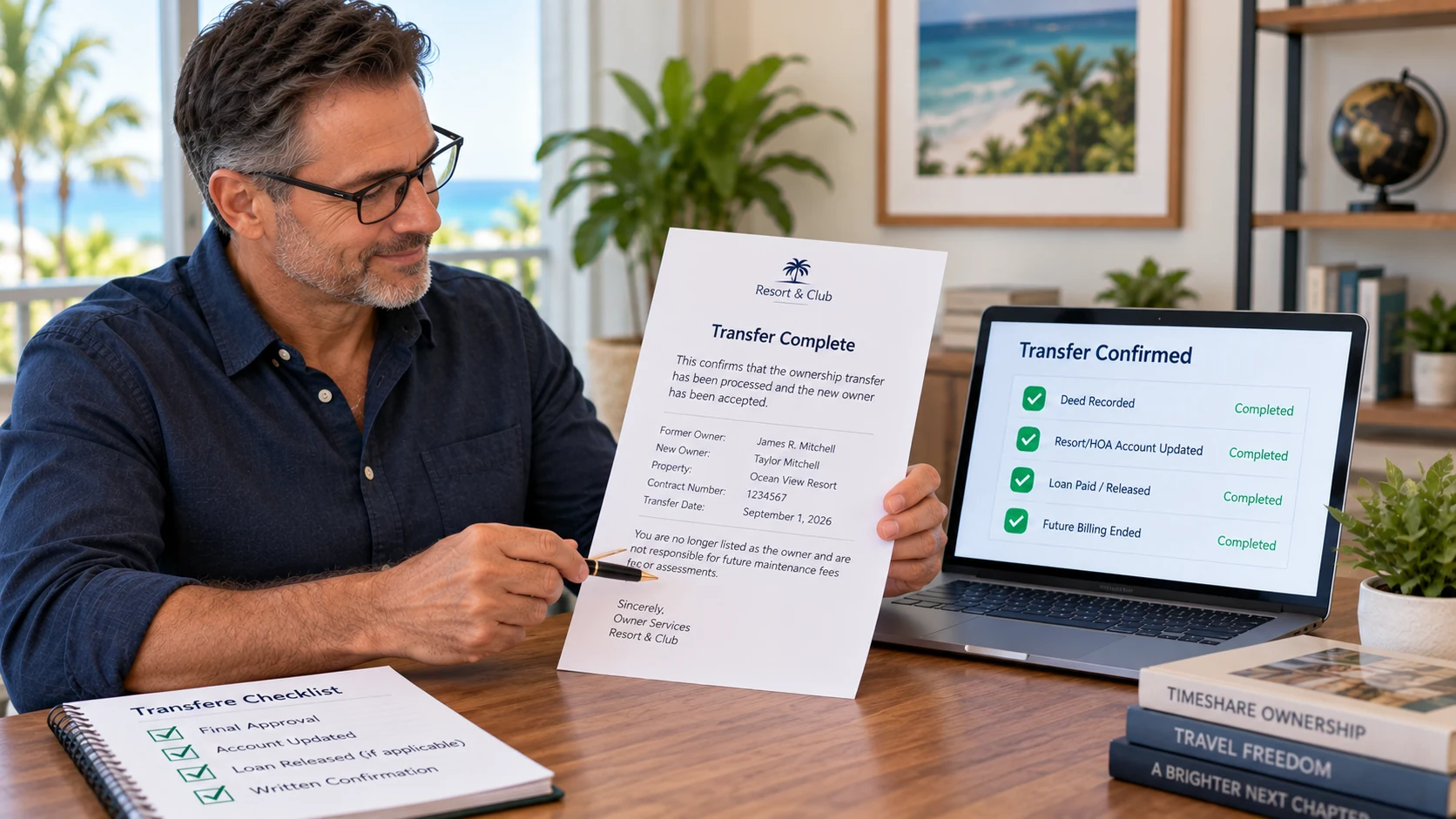
A timeshare transfer should not be treated as complete until the new owner is formally accepted, the resort or HOA account is updated, any applicable loan is resolved, and future billing responsibility has ended.
Which Situation Fits You?
Some Transfers Are Straightforward; Others Need More Verification
A straightforward transfer may be more realistic if:
- the ownership is paid off;
- maintenance fees are current;
- the recipient is already identified;
- the recipient understands the ongoing costs;
- transfer restrictions have been checked;
- required approval appears available; and
- the ownership documentation is clear.
More verification may be needed if:
- an outstanding loan remains;
- maintenance fees are delinquent;
- the recipient expects benefits that may not transfer;
- the developer has a right of first refusal;
- the ownership structure is unclear;
- only part of the ownership is being transferred; or
- you are being told that signing a form alone removes your responsibility.
If you have already checked the official transfer requirements and still need help with resale, transfer, or another ownership-resolution path, Timeshare Specialists can provide a consultation.
Request a ConsultationWhere does transfer fit among the four broader ownership paths?
- Keep
- Keep the ownership when the vacations, benefits, and ongoing costs still fit your travel plans and there is no compelling reason to change ownership.
- Rent
- Keep the ownership while exploring whether eligible unused usage can help offset some recurring costs, subject to the program’s rental rules.
- Sell
- A transfer to a buyer, family member, or other recipient generally falls within the Sell/Transfer path when the goal is to move ownership to someone else rather than end it through surrender.
- Exit
- If no viable recipient exists or transfer barriers cannot be resolved, developer surrender, deed-back, negotiated resolution, or another legitimate exit path may fit better.
My Take
I Would Judge the Transfer by the Result, Not the Paperwork
If I were transferring a timeshare, I would not treat the transaction as finished simply because I signed a deed, assignment, or transfer form.
I would confirm that the recipient had actually been accepted, the resort or association had updated its records, any financing issue had been resolved, and future billing had stopped.
I would also keep the final transfer and account-confirmation documents permanently.
For me, the transfer would be complete only when I could prove that the new owner was recognized and I was no longer responsible for the ownership.
Keep the transfer decision focused on what has actually changed.
Get independent TTCA guidance on transfers, financing, surrender, resale, and ownership-resolution decisions.
Frequently Asked Questions
Questions About Transferring a Timeshare
Can I transfer my timeshare to a family member?
Often, yes, but the recipient may still need to meet program requirements and the ownership change may require formal approval, recording, fees, or account updates.
Can I give my timeshare to someone for free?
Potentially. A gift does not eliminate the need to follow the official transfer process or resolve any outstanding loan, fees, or transfer restrictions.
Can someone take over my timeshare loan?
Do not assume so. The lender controls whether a loan can be assumed or transferred. The ownership can change only after the financing issue is resolved in a lender-approved way.
Do I need the resort’s approval to transfer a timeshare?
Sometimes. The resort, developer, HOA, trustee, or another controlling entity may have approval or account-transfer requirements depending on the ownership.
How much does it cost to transfer a timeshare?
Costs vary. They can include transfer fees, deed preparation, recording charges, title or closing services, taxes, outstanding fees, and lender-related costs.
Do all timeshare benefits transfer to the new owner?
No. Some loyalty benefits, reservation privileges, Club access, promotions, legacy rights, or upgrade benefits may be restricted or unavailable after transfer.
How do I know I am no longer responsible after the transfer?
Keep written confirmation showing the ownership record changed, the new owner was recognized, any applicable financing was resolved, and future billing to you ended.
TTCA Decision
A Timeshare Transfer Is Complete Only When the Ownership Records and Responsibility Actually Change
A timeshare can often be sold, gifted, inherited, or transferred to another person, but a signed agreement by itself may not complete the ownership change.
The recipient may need to be approved, fees and balances may need to be resolved, the deed or contractual ownership record may need to change, and any separate financing obligation may require its own resolution.
The transfer is complete when the new owner is formally recognized and you have written evidence that your future ownership responsibility has ended.
Continue From Here
Choose the Next Path Based on What Is Still Blocking the Ownership Change

Can You Get Out of a Timeshare If You Still Owe Money?
Understand how an outstanding loan can limit transfer, resale, surrender, and other ownership-resolution paths.
Timeshare Transfer Companies
Review what transfer providers actually do, what they may charge, and what to verify before hiring one.
Timeshare Deed-Back Programs: Can You Give It Back?
If a viable recipient is not available, see whether a direct surrender or deed-back path may fit better.

Free Timeshare Self-Review
Take a clearer look at how the ownership fits your situation.
The Timeshare Self-Review helps you step back from the immediate transfer question and look at how the ownership is working for you overall.
- How often you use it
- Your annual ownership costs
- Your booking experience
- The benefits you actually use
- Fit with your travel habits
- Ownership factors worth reviewing