
Vacation Ownership and Membership Products Explained
Timeshare vs. Vacation Club vs. Travel Club: What’s the Difference?
The names can sound interchangeable, but the contract behind the product may create very different rights, fees, booking rules, and long-term obligations.
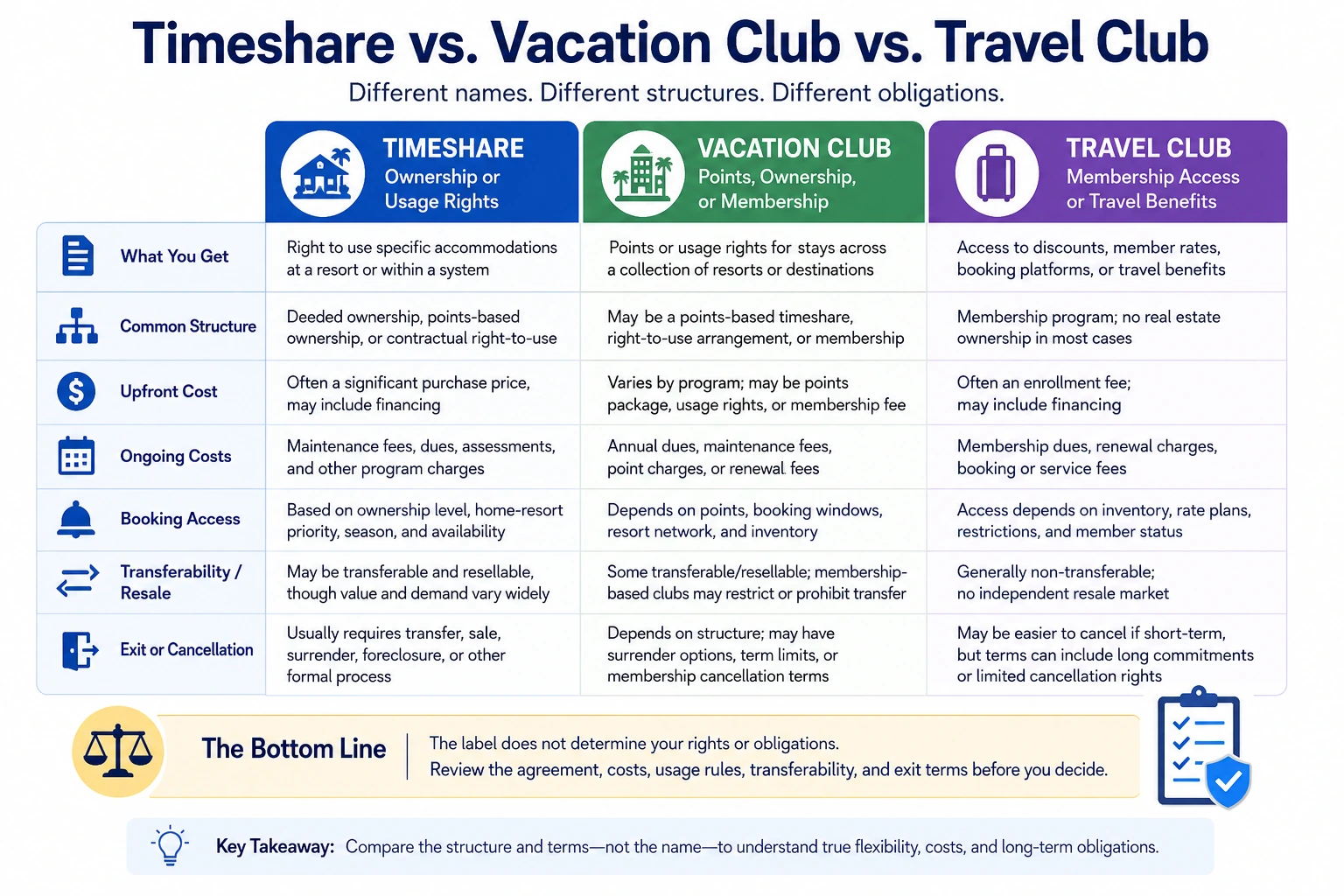
A timeshare may provide deeded or contractual vacation ownership. A vacation club may use points, memberships, or a timeshare-based system. A travel club may primarily provide access to travel rates or benefits without transferring an ownership interest. This guide helps you look beyond the sales label and identify what you would actually receive, pay for, and remain responsible for over time.
About this guidance: Timeshare Travel Club Authority’s guidance draws on experience with deeded timeshares, right-to-use agreements, points-based vacation clubs, travel-club memberships, exchange programs, hybrid products, booking benefits, annual fees, transfers, and exit limitations. Product names are not always used consistently, and terms can vary by provider, contract, ownership structure, membership level, and sales channel, so consumers should review the specific agreement to determine what they are purchasing and which obligations continue after enrollment.
The Labels Overlap More Than Most Buyers Expect
Before comparing these products side by side, it helps to understand that the categories are not always cleanly separated.
For a broader explanation of deeded ownership, contractual usage rights, weeks, points, booking rules, recurring costs, and exchange, start with What Is a Timeshare?
A traditional timeshare may provide a deeded week, a points-based ownership interest, or contractual usage rights. Some vacation clubs use those same structures but emphasize flexibility, destination choice, or a branded resort network rather than the word “timeshare.”
Travel clubs are more often membership-based. They may provide access to negotiated rates, booking platforms, vacation inventory, or other travel benefits. But even a membership product may involve an upfront purchase price, financing, annual dues, usage restrictions, or limited cancellation rights.
That is why two programs with different names can create similar costs or limitations—and two products using the same label can work very differently.
Important Distinction
A Vacation Club Is Not Automatically Different From a Timeshare
Some vacation clubs are points-based timeshare programs presented under a broader or more flexible-sounding name. Others are right-to-use arrangements or membership products without deeded ownership. The words “vacation club” do not establish which structure applies.
To understand what you are buying—or what you already have—review the agreement, ownership or membership duration, financing documents, recurring charges, booking rules, transferability, and written cancellation or exit provisions.
Timeshare, Vacation Club, and Travel Club Compared
The distinctions become clearer when the products are compared by what the consumer receives rather than by the name used in the sales presentation.
Ownership or Usage Rights
Timeshare
A timeshare may provide deeded ownership, points-based ownership, or contractual rights to use accommodations within a resort or vacation network.
Common considerations: purchase financing, maintenance fees, booking priority, resale value, transfer rules, and long-term ownership obligations.
Structure Varies by Program
Vacation Club
A vacation club may be a points-based timeshare, a right-to-use program, or a membership that provides access to a collection of resorts or travel benefits.
Common considerations: point values, booking windows, resort networks, annual dues, ownership duration, and whether the interest can be transferred.
Membership or Access
Travel Club
A travel club more commonly provides access to member rates, booking platforms, travel inventory, discounts, or other benefits without traditional real-estate ownership.
Common considerations: membership term, enrollment cost, financing, renewal charges, inventory availability, benefit restrictions, and cancellation rules.
How Timeshare Rights Are Usually Structured
A timeshare generally provides some form of recurring vacation-use right. The consumer may own an interest in a specific property, receive points connected to a vacation ownership system, or hold a contractual right to use accommodations for a defined period.
With a deeded interest, ownership may continue until the interest is transferred, surrendered, foreclosed upon, or otherwise legally terminated. A right-to-use agreement may last for a stated number of years rather than indefinitely. Points-based systems can add flexibility, but the points may still be connected to a long-term ownership contract.
Timeshare owners commonly face an initial purchase price, possible loan payments, annual maintenance fees, and additional assessments or program charges. Reservation access may depend on home-resort priority, ownership tier, season, available points, and how early the owner books.
The presence of points or multiple destinations does not necessarily turn a timeshare into a fundamentally different product. In many programs, those features change how the ownership is used—not whether an ongoing obligation exists.
How Vacation Clubs Can Fit More Than One Model
“Vacation club” is one of the least precise labels in the industry.
Some vacation clubs are clearly timeshare systems. Members purchase a deeded or contractual interest, receive an annual allocation of points, and pay recurring maintenance or club fees. The program may offer access to multiple resorts, but the underlying arrangement still involves vacation ownership. For a fuller explanation of the different structures, points systems, fees, and reservation rules, see What Is a Vacation Club?
Other vacation clubs provide a term-limited right to use accommodations without conveying a deeded interest. Some operate as memberships that give consumers access to resort inventory or travel benefits for as long as the membership remains active.
This variation is why the phrase “vacation club” cannot answer basic questions about ownership, duration, cost, flexibility, or exit. Two vacation clubs may use similar marketing language while giving members substantially different rights and obligations.
Owner takeaway: When a program is described as a vacation club, confirm whether you are purchasing an ownership interest, a long-term right to use accommodations, or a membership that can expire or be canceled. The answer affects costs, booking rights, transferability, and the available path when you no longer want the product.
How Travel Club Memberships Usually Work
Travel clubs more commonly sell membership access rather than an ownership interest in a resort or vacation property.
The membership may provide access to discounted hotel rates, vacation rentals, cruises, tours, resort inventory, concierge services, or a private booking platform. Some memberships are short-term or renewable, while others require a substantial upfront purchase and continue for many years.
These products do not always use the same reservation model. The guide to timeshare booking windows explains how timeshare-style priority periods differ from travel-club access that may depend primarily on supplier inventory, membership eligibility, and applicable usage fees.
A travel club may appear simpler because there is no deed to sell or transfer. But consumers still need to examine the financial and contractual structure. An upfront membership purchase may be financed, annual charges may continue, and advertised inventory or savings may be subject to availability, blackout dates, booking fees, or other restrictions.
The absence of real-estate ownership does not automatically create an unrestricted cancellation right. The agreement may control when the membership can be terminated, whether payments continue after use stops, whether benefits can be transferred, and whether any portion of the purchase price is refundable.
How Upfront and Ongoing Costs Differ
All three models may involve more than the price emphasized during the sales presentation.
A timeshare commonly includes a purchase price, possible financing, and annual maintenance fees. Depending on the program, owners may also pay club dues, reservation charges, exchange fees, assessments, or transaction fees.
A vacation club can involve many of the same costs when it operates as a points-based or right-to-use timeshare. A membership-style vacation club may use a different fee structure, but an enrollment price, financing, annual dues, booking charges, or renewal costs may still apply.
Travel clubs may charge an upfront membership fee, recurring dues, renewal charges, or booking-related fees. Some advertise discounted travel without making it immediately clear that the membership itself has a substantial cost.
The better comparison is the total cost of receiving and continuing the benefits, not simply the initial price or annual fee.
How Booking Access and Flexibility Differ
Flexibility is often measured by the number of destinations shown in a sales presentation. But a large resort directory or travel catalog does not necessarily mean the consumer can reserve the dates, accommodations, or destinations they actually want.
Timeshare access may depend on ownership tier, home-resort priority, available points, season, unit size, reservation windows, and remaining inventory. Owners with the same brand may therefore have different booking rights.
Vacation clubs may offer access across a broader network, but availability can still depend on point values, release dates, ownership level, program rules, and whether the requested resort participates in the same booking system.
Travel clubs may display a wide selection of hotels, resorts, rentals, cruises, or packages, but the membership may not control that inventory. Member pricing and availability can change, and some advertised benefits may apply only to selected dates, properties, room categories, or rate plans.
The useful comparison is not simply how many destinations appear available. It is whether the program provides dependable access to the vacations the member is likely to use at a total cost that remains competitive.
Decision Insight
More Destinations Do Not Necessarily Mean More Usable Access
A program may advertise hundreds or thousands of destinations while still limiting the dates, room types, booking priority, rates, or inventory available to a particular owner or member.
Flexibility should be measured by the reservations the consumer can realistically confirm—not by the total number of properties displayed in marketing materials or an online directory.
Which Is Easier to Sell or Transfer?
A traditional timeshare may have a formal transfer process and an established resale market. That does not mean a buyer will be easy to find or that the ownership will retain meaningful resale value.
Transferability may depend on whether the loan is paid off, the account is current, the developer has a right of first refusal, the buyer satisfies program requirements, and the ownership is eligible for transfer. Resale buyers may also receive fewer benefits than direct purchasers.
A vacation club may be transferable when it represents a timeshare or contractual usage interest. A membership-based club may prohibit assignment or allow transfer only with company approval.
Travel club memberships are frequently non-transferable. In those cases, the absence of a deed may simplify the paperwork, but it also means there may be no resale market or independent way to pass the membership to someone else.
It is important to separate three different questions:
- Can the product be transferred under the agreement?
- Is there a realistic buyer or recipient?
- Would a completed transfer release the current owner or member from future responsibility?
A product can be technically transferable and still be difficult to sell. Another may have no resale value but provide a written cancellation or expiration process. Transferability, resale value, and exit flexibility are related—but they are not the same.
Risk Point
Flexible Marketing Can Hide a Long-Term Obligation
Words such as “club,” “membership,” “points,” and “access” may sound less restrictive than traditional ownership. But the agreement may still include financing, recurring charges, a lengthy term, limited cancellation rights, or provider-controlled transfer rules.
Consumers should not assume a product is low-risk simply because it is not described as a deeded timeshare. The financial commitment and written termination terms matter more than the label.
Which Is Easier to Cancel or Exit?
A travel club may be easier to leave when it is a short-term membership with a clear expiration or written cancellation process. A timeshare may involve additional steps because the ownership or usage interest generally must be transferred, surrendered, sold, foreclosed upon, or otherwise formally terminated.
That does not mean every travel club is easy to cancel. A financed membership, long contract term, automatic renewal provision, or limited cancellation language can create substantial exit friction even when no deeded ownership exists.
Vacation clubs can fall anywhere between those models. A points-based vacation club tied to long-term ownership may be subject to transfer and surrender rules similar to other timeshares. A term-based membership may have a simpler ending process, but the member still needs to verify whether financing, dues, or other balances remain.
The most important questions are:
- Does the agreement expire, renew, or continue indefinitely?
- Is there a loan or other unpaid balance?
- Can the product be canceled, transferred, surrendered, or sold?
- What written confirmation proves the obligation has ended?
Owners researching the broader pathways for leaving an ownership can review the Timeshare Exit Guide: How to Get Out of a Timeshare.
What to Review Before Buying—or Trying to Leave
A reliable comparison should begin with the documents, not the sales label.
The agreement should explain whether the consumer receives ownership, usage rights, membership access, points, or booking benefits. It should also identify how long the arrangement lasts, which charges continue, how reservations work, and what must happen to end or transfer the obligation.
Action Step
Verify the Structure Before Comparing the Label
Before buying, transferring, canceling, or trying to exit a timeshare, vacation club, or travel club, confirm how the agreement actually works and which obligations continue.
Identify what the agreement provides, such as deeded ownership, points, right-to-use access, membership benefits, or discounted travel services.
Confirm the duration and renewal terms, including whether the agreement expires, renews automatically, or continues indefinitely.
Calculate the complete financial obligation, including the purchase price, financing, annual fees, dues, assessments, and booking charges.
Review how booking access works, including reservation windows, points requirements, inventory limits, blackout dates, and ownership priority.
Check the transfer and resale provisions, including approval requirements, fees, benefit restrictions, and whether the product is assignable.
Locate the written cancellation or termination process and identify what document would confirm that future responsibility has ended.
Quick Win
Start with the definitions, duration, payment, transfer, and termination sections. Those provisions usually reveal more about the product than the name printed on the sales brochure.
Why Two Programs With the Same Label May Work Differently
Two companies may both describe their products as vacation clubs while selling very different arrangements.
One program might convey a deeded or points-based ownership interest with annual maintenance fees. Another might provide a ten-year right to use selected accommodations. A third might sell access to a travel-booking platform with renewable membership dues.
The same variation can exist within a single company. Older contracts, newer points programs, converted ownerships, resale purchases, and upgraded membership levels may each carry different benefits and obligations.
That is why a general brand description cannot replace a review of the specific agreement. The consumer needs to know not only what the company usually sells, but which version of the product was actually purchased.
❓ Frequently Asked Questions
These questions address the most common points of confusion when consumers compare timeshares, vacation clubs, and travel clubs.
Is a vacation club the same as a timeshare?
Sometimes. Many vacation clubs are points-based timeshare or right-to-use programs presented under a club name. Others are memberships without deeded ownership. The agreement determines which structure applies.
Is a travel club considered a timeshare?
Not necessarily. A travel club more commonly provides membership access, booking benefits, or discounted rates rather than ownership in vacation property. However, the membership may still involve financing, dues, restrictions, and long-term contractual obligations.
Which is more expensive: a timeshare or a travel club?
There is no universal answer. Timeshares may involve a larger purchase price and recurring maintenance fees, while some travel clubs charge substantial enrollment prices, financing costs, dues, and booking fees. Compare the complete cost over the expected duration.
Are vacation clubs more flexible than traditional timeshares?
They may provide more destination or points flexibility, but access can still depend on booking windows, ownership tier, available inventory, points requirements, and program restrictions. More destinations do not always mean better usable availability.
Which is easier to cancel: a timeshare or a travel club?
A simple term-based travel club membership may be easier to end than a long-term ownership interest. However, financed memberships, automatic renewals, restrictive cancellation terms, and unpaid balances can make a travel club difficult to resolve as well.
Do timeshares, vacation clubs, and travel clubs have resale value?
Some timeshare and vacation club interests can be resold or transferred, although market value may be limited. Many travel club memberships are non-transferable and have no independent resale market. Transferability and resale value should be confirmed separately.
Bottom Line
Timeshares, vacation clubs, and travel clubs can provide different forms of ownership, usage rights, membership access, and travel benefits. But the labels frequently overlap.
The useful comparison is what the agreement provides, what it costs, how realistically it can be used, whether it can be transferred, and what must happen when the consumer wants out.
The Product Label Does Not Tell You What the Agreement Will Cost—or Require.
Whether you are reviewing a timeshare, vacation club, or travel club, the real decision depends on the structure, financing, recurring costs, booking rules, transfer restrictions, account status, and written exit terms. The Timeshare Decision Intelligence Report™ helps organize those details so you can understand what you have and which questions still need answers before you act.
Get the Timeshare Decision Intelligence Report™ Customized ownership review • Decision-support report • No exit-company sales pitchIndependent decision support. This is not legal advice, contract cancellation, an exit service, a resale service, lender negotiation, or a promise that your timeshare can be exited.
Related Guides
These guides can help you evaluate the cost, usability, resale limitations, and exit considerations that may sit behind a timeshare or club membership.
Ownership Costs and Value
- Total Cost of Timeshare Ownership: What You Actually Pay Over Time
Review how purchase price, financing, maintenance fees, assessments, and usage costs affect the long-term financial picture. - Are Timeshare Benefits Worth It?
Compare booking access, exchange options, owner perks, and travel benefits against the costs required to keep the ownership.
Resale and Transferability
- Why Are Timeshares So Hard to Sell?
Understand how buyer demand, annual fees, competing listings, and transfer restrictions affect the resale market. - Why Can’t I Sell My Timeshare? What May Be Blocking a Sale
Review the specific loan, fee, pricing, transfer, and buyer-benefit issues that may delay or prevent a sale.
Exit Decisions
- Timeshare Exit Guide: How to Get Out of a Timeshare
Review the primary exit pathways and the factors that may determine which options are realistic.