
Timeshare Maintenance-Fee Guide
Why Do Timeshare Maintenance Fees Keep Increasing?
The purchase price may be fixed, but the annual cost of operating, repairing, insuring, and funding the resort usually is not.
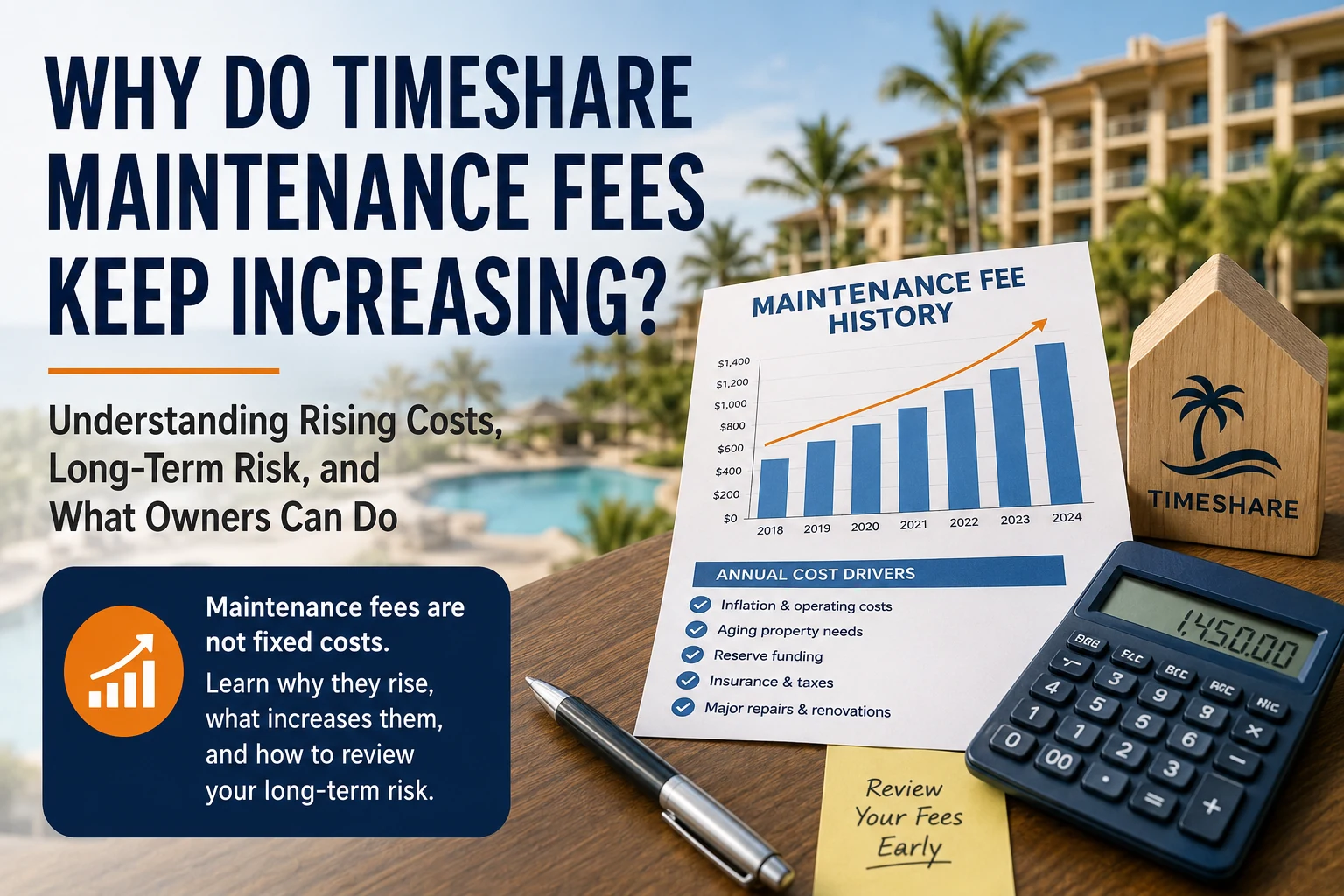
Labor, utilities, insurance, taxes, vendor contracts, aging property, renovations, and reserve needs can all place pressure on the annual budget. But one higher bill does not tell the entire story. This guide helps you determine whether the latest increase reflects normal cost growth, a temporary adjustment, or a longer-term pattern that may be changing the value of keeping the ownership.
About this guidance: Timeshare Travel Club Authority’s guidance draws on experience with maintenance-fee budgets, labor and utility costs, insurance, taxes, management expenses, repairs, renovations, reserve funding, special assessments, owner delinquencies, and long-term ownership costs. Fee increases can vary by resort, ownership structure, location, property age, operating budget, reserve position, insurance exposure, and management practices, so owners should review several years of statements and the supporting budget information rather than evaluating only the latest bill.
Important Distinction
Maintenance Fees Are Tied to Ownership, Not Usage
Maintenance fees generally support the ongoing operation and upkeep of the property or vacation program. The resort still incurs staffing, insurance, utility, repair, management, and reserve costs even when an individual owner does not travel.
That means an owner may still owe the full fee—and face future increases—during years when the timeshare goes unused. Skipping a vacation does not usually pause the shared-cost obligation.
Before Rising Fees Force the Decision
Understand How the Fee Trend Affects the Real Cost of Your Ownership
Rising maintenance fees may affect affordability, usage value, resale difficulty, account standing, and the timing of future ownership decisions. The Timeshare Decision Intelligence Report™ helps organize your fee history, ownership structure, loan status, documents, limitations, and realistic decision pathways before you make another costly move.
Need a clearer view of the ownership before costs become harder to manage?
Review the Report Option Independent decision support • No exit-company sales pitchWhat Do Timeshare Maintenance Fees Typically Pay For?
Timeshare maintenance fees support the recurring costs of operating and maintaining the resort, club, trust, or ownership program. They are not limited to cleaning the unit an owner occupies.
The budget may include property staffing, housekeeping, utilities, landscaping, security, insurance, taxes, management, owner services, routine repairs, and contributions toward future capital expenses. In a points-based or multi-resort system, part of the fee may also support reservation technology, centralized administration, and shared program operations.
The exact allocation varies by ownership structure. The most useful source is usually the annual budget or fee statement, which may show how the current amount is divided and where the largest year-over-year changes occurred.
What Causes Maintenance Fees to Increase?
Most increases begin with a change in the property’s operating costs, repair needs, or reserve requirements.
Labor and Staffing
Wages, benefits, housekeeping, maintenance teams, security, front-desk operations, and contracted services may rise over time.
Utilities and Supplies
Electricity, water, waste service, internet, cleaning supplies, and other operating inputs can increase with inflation and usage.
Insurance and Taxes
Property insurance, deductibles, coverage changes, local taxes, and regulatory costs may place additional pressure on the annual budget.
Repairs and Aging Property
Roofs, plumbing, elevators, pools, rooms, furniture, and common areas require more attention as a property ages.
Reserve Funding
Resorts may increase contributions to prepare for future replacements or rebuild reserves that are no longer sufficient.
Management and Program Costs
Management contracts, administration, billing, reservation systems, owner services, and shared club operations may also affect the fee.
Why Do Some Resorts Increase Fees Faster Than Others?
Two properties can begin with similar maintenance fees and follow very different cost paths.
A recently renovated resort with healthy reserves may be able to absorb normal repairs more predictably. An older property with deferred maintenance, insurance pressure, or underfunded reserves may need sharper increases to catch up with expenses that were postponed or underestimated.
Location also matters. Coastal and storm-exposed properties may face different insurance and repair costs than inland resorts. High-cost destinations may have greater labor, utility, tax, and vendor expenses. Heavy occupancy can produce more wear, while a shrinking or delinquent owner base may leave fewer paying owners supporting shared costs.
The fee history therefore reflects more than inflation. It can also reveal how the property has been maintained, funded, insured, and managed.
More Predictable Growth vs. Greater Increase Exposure
Better-Funded or Recently Updated Properties
Fee increases may be steadier when major costs are anticipated and the property has the financial capacity to address them.
Healthy reserve funding
Recent renovations or replacements
Clear long-term capital planning
More consistent operating budgets
Aging Properties or Financial Catch-Up
Sharper increases may appear when existing funding is not keeping pace with repairs, insurance, operations, or future obligations.
Underfunded reserves
Deferred maintenance or renovation cycles
Insurance or storm-related pressure
Owner delinquencies or budget shortfalls
Decision Insight
The Fee Trend Matters More Than One Annual Increase
One larger bill may result from a temporary insurance adjustment, reserve contribution, renovation cycle, or operating-cost change. It does not automatically establish that every future increase will follow the same pattern.
The more useful review looks at several years of statements. A sustained upward trend can show how quickly the ownership cost is changing and whether the annual fee is moving farther away from the vacation value the owner actually receives.
Risk Point
Compounding Fees Can Change the Value of Keeping the Ownership
The concern is not simply that the next annual bill is higher. Repeated increases can raise the cost of every future use year while the owner’s travel habits, booking access, resale value, and exit flexibility may be moving in the opposite direction.
When fees become difficult to manage, allowing the account to become delinquent may add late charges, restrictions, collections, or other consequences. It may also complicate options that require the ownership to remain current.
What to Review Before Maintenance Fees Become Harder to Manage
Start with the fee history rather than the latest statement alone. Comparing several years can show whether increases have been gradual, whether one year was unusually high, or whether the ownership is following a sustained upward cost pattern.
Next, review what changed in the resort budget. Higher insurance, reserve contributions, renovations, labor costs, utilities, or owner delinquencies may explain the increase. A sharp rise without a clear explanation is a reason to request the budget notice, annual statement, reserve information, or other supporting documents.
The final question is practical: Does the annual cost still make sense for the vacations you actually receive? That comparison should include how often the ownership is used, what comparable travel would cost independently, and whether future fee exposure appears manageable.
Action Step
Measure the Fee Trend Before It Becomes a Payment Problem
Review several years of statements and compare the rising cost with the actual vacation value you continue to receive.
Collect at least three to five years of fee statements so you can see the pattern rather than one isolated increase.
Calculate the average annual increase and note any years with unusually large jumps.
Review the budget explanation for changes in insurance, reserves, repairs, labor, utilities, or management costs.
Check for special assessments or major projects that could add costs beyond the regular annual fee.
Compare the annual cost with actual usage and the price of booking similar travel independently.
Review ownership options while the account is current rather than waiting until the fees are already past due.
Quick Win
Divide your latest maintenance fee by the number of nights you actually used. That simple calculation can reveal whether the ownership still produces practical vacation value.
Are Timeshare Maintenance Fees Capped?
Many timeshare agreements do not create a strict ceiling on future maintenance-fee increases. The documents may explain how the budget is prepared, how fees are allocated, or who approves the annual amount without guaranteeing that the charge will remain below a fixed percentage.
Some ownership structures include association votes, board review, budget notices, or other approval procedures. Those controls may govern the process, but they do not necessarily prevent increases when operating costs or reserve needs rise.
The contract explains what is permitted. The historical statements show how that authority has actually been used. Owners should review both.
Do Timeshare Maintenance Fees Increase Every Year?
Not necessarily. A fee may remain stable for a year when operating costs are controlled, reserves are adequately funded, or no major changes are needed.
Over a longer ownership period, however, upward movement is common because labor, utilities, insurance, repairs, taxes, management, and replacement costs rarely remain unchanged indefinitely.
One flat year does not make the fee fixed, just as one larger increase does not prove every future year will rise at the same rate. The more useful measure is the multi-year trend.
Owner takeaway: Maintenance fees should be evaluated as a long-term ownership cost, not a fixed annual price. The most useful comparison is the multi-year fee trend against actual usage, comparable travel costs, and the value the ownership still provides.
❓ Frequently Asked Questions
These questions address the most common concerns owners have about rising timeshare maintenance fees.
Why do timeshare maintenance fees keep increasing?
Fees commonly rise as the cost of labor, utilities, insurance, taxes, repairs, management, and reserve funding increases. Aging property needs and underfunded reserves can also lead to larger adjustments.
Do I owe maintenance fees if I do not use the timeshare?
Usually, yes. Maintenance fees are generally tied to ownership rather than usage. The obligation may continue even during years when the owner does not make a reservation or take a vacation.
Are timeshare maintenance fees capped?
Many agreements do not provide a strict cap. The documents may describe how fees are calculated or approved, but the amount may still rise with the property’s actual operating and reserve needs.
Do timeshare maintenance fees increase every year?
Not always. Some years may remain stable, while others may bring larger increases. The longer-term trend is generally more useful than one year when evaluating future cost exposure.
Can maintenance fees increase because other owners do not pay?
Owner delinquencies can place pressure on a resort or association budget when shared expenses must still be paid. The effect depends on the ownership structure, reserve position, collection practices, and allocation rules.
What should I do when maintenance fees become unaffordable?
Review the fee history, loan status, account standing, usage value, and available transfer, resale, surrender, or deed-back pathways before payments are missed. Waiting until the account is delinquent may create additional costs and reduce available options.
Bottom Line
Timeshare maintenance fees rise because the cost of operating, repairing, insuring, and funding the property changes over time.
The most useful question is not whether one bill increased, but whether the multi-year trend still makes sense compared with how often the ownership is used and the vacation value it provides.
Review the fee history before rising costs become a payment or account-standing problem.
Before Rising Fees Force the Decision
Understand Whether the Ownership Still Makes Financial Sense
The Timeshare Decision Intelligence Report™ helps organize your fee history, ownership documents, loan status, usage limitations, account standing, transfer restrictions, material findings, and realistic decision pathways before you make another costly ownership decision.
Customized ownership review • Decision-support report • No exit-company sales pitch
Independent decision support. This is not legal advice, fee negotiation, debt settlement, contract cancellation, an exit service, a resale service, or a promise that your timeshare can be exited.
Related Guides
These guides provide more detail on ownership costs, unexpected charges, payment risks, and the broader decision to keep or leave a timeshare.
Ownership Costs
- Total Cost of Timeshare Ownership: What You Actually Pay Over Time
Review how financing, annual fees, assessments, club charges, exchanges, and travel expenses shape the real long-term cost. - Timeshare Special Assessment Fees: Why They Happen and What Owners Should Do
Learn how special assessments differ from regular maintenance fees and what to verify after receiving an unexpected charge. - Why Do Timeshares Lose Value?
Understand how recurring fees, limited buyer demand, financing, and transfer restrictions affect resale value.
Payment and Ownership Decisions
- Should You Stop Paying Your Timeshare?
Understand why stopping payment is different from ending the ownership and what risks may follow. - Timeshare Maintenance Fees in Collections: What Happens Next?
Review how unpaid balances may escalate and why account standing can affect future options. - Is Your Timeshare Worth Keeping? How to Decide
Compare usage, annual costs, benefits, booking access, and long-term obligations. - Why Is It So Hard to Book a Timeshare?
See how limited availability can reduce the practical value of continuing to pay rising annual fees.