
Why Can’t I Sell My Timeshare? What May Be Blocking a Sale
Listing a timeshare does not always lead to serious inquiries, even when the asking price is reduced.
The problem is often not simply the advertisement or where it was posted. A buyer is evaluating the entire obligation attached to the ownership, including annual fees, booking rules, transfer requirements, financing, and future cost exposure.
That is why some timeshares remain difficult to sell even when they are listed for very little—or offered at no upfront cost.
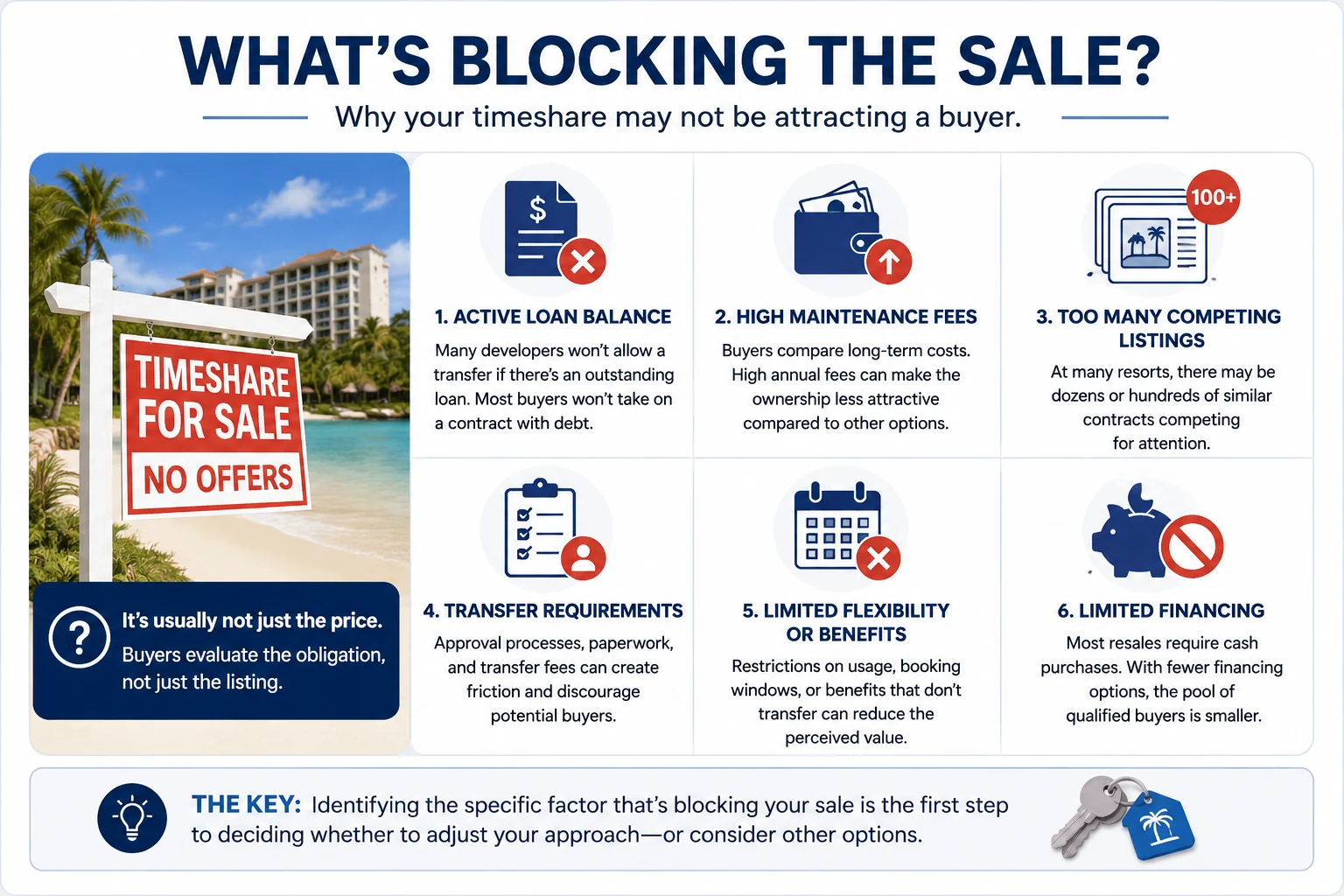
An active loan may prevent the transfer from moving forward. High maintenance fees may make the ownership unattractive. Similar listings may already be competing for a limited number of buyers. Resale purchasers may also receive fewer benefits than someone buying directly from the developer.
The more useful question is not only:
“Why isn’t anyone responding to my listing?”
It is:
“Is the sale merely taking longer than expected, or is something about the ownership blocking a buyer from accepting it?”
This guide explains the most common resale barriers, why another price reduction may not solve them, and what to verify before relisting, paying another resale company, or shifting to a different exit path.
Quick Answer
Why Can’t I Sell My Timeshare?
A timeshare may not sell because buyers are evaluating more than the listing price. Common barriers include an active loan, high maintenance fees, weak buyer demand, too many competing listings, transfer restrictions, limited resale-buyer benefits, and account requirements that must be resolved before ownership can change.
Before lowering the price again or paying another company to advertise the ownership, identify whether the problem is buyer interest, transfer eligibility, financial exposure, or the long-term obligation a buyer would have to accept.
Start by Separating a Slow Sale From a Blocked Sale
Not every timeshare that takes time to sell is impossible to transfer.
A slow sale may reflect limited exposure, unrealistic pricing, poor listing details, seasonal buyer interest, or competition from similar ownerships. Those issues may improve with better positioning or more realistic expectations.
A blocked sale is different. It means something about the ownership may prevent or discourage the transaction even when a buyer is interested.
An active loan may need to be paid before transfer. The account may need to be current. The developer may require approval, charge transfer fees, or restrict certain benefits for resale purchasers. High annual fees may also outweigh the value a buyer expects to receive.
Before changing the listing again, determine whether the sale needs more time—or whether the ownership itself contains a barrier the listing cannot fix.
Important Distinction
A Low Asking Price Does Not Remove the Ownership Obligation
Buyers are not only deciding whether the upfront price is reasonable. They are deciding whether they want the annual maintenance fees, possible assessments, booking restrictions, transfer process, and long-term responsibility attached to the timeshare.
That is why some ownerships remain difficult to sell even when they are listed cheaply or offered for free. Reducing the price does not remove the future costs or restrictions the buyer would inherit.
Before You Pay for Another Resale Attempt
Identify What Is Actually Preventing the Timeshare From Selling
The Timeshare Decision Intelligence Report™ helps organize your loan status, annual costs, ownership documents, account standing, transfer restrictions, resale limitations, and unresolved questions before you lower the price again, pay another listing company, or move toward a different exit path.
Need a clearer view of what may be blocking the sale?
Review the Report Option Independent decision support • No resale or exit-company sales pitchCommon Timeshare Sale Blockers
A sale may be limited by one major issue or by several smaller barriers working together.
Sale Blockers
What May Be Preventing Your Timeshare From Selling?
These financial, contractual, and market factors can reduce buyer interest or prevent a transfer even when the asking price appears low.
Financing Barrier
Active Loan Balance
The lender or developer may require payoff before transfer, and the remaining balance may be higher than the likely resale proceeds.
Annual Cost
High Maintenance Fees
Buyers may decide that the annual obligation costs more than comparable vacations without a long-term ownership commitment.
Market Supply
Too Many Similar Listings
When comparable ownerships are available cheaply, another price reduction may not make one listing meaningfully more attractive.
Transfer Friction
Developer Rules and Fees
Approval requirements, transfer charges, account-status rules, and processing delays can discourage buyers or prevent closing.
Reduced Appeal
Limited Resale-Buyer Benefits
A resale purchaser may lose status, booking privileges, exchange benefits, discounts, or other features offered to direct buyers.
Buyer Pool
Limited Resale Financing
Many resale buyers must pay cash, which can reduce the number of people able or willing to complete the purchase.
Why Lowering the Price Does Not Always Work
A lower asking price can help when the listing is simply overpriced. It does not solve every resale problem.
Buyers may place more weight on the future obligation than on the amount paid upfront. A timeshare offered for one dollar may still include thousands of dollars in annual maintenance fees, possible assessments, booking restrictions, transfer expenses, and a long-term responsibility the buyer does not want.
Price reductions also become less effective when many similar ownerships are already available for very little. If the competing listings offer the same resort, season, points, or usage rights, lowering the price may not create a meaningful advantage.
When an active loan or transfer restriction is involved, the sale may be blocked regardless of the listing price. In those situations, the issue is not what the buyer will pay. It is whether the ownership can legally and financially be transferred.
How an Active Loan Can Prevent the Sale
A financed timeshare creates a separate obligation that usually must be addressed before ownership can change.
The buyer may be willing to accept the timeshare but unable to assume the seller’s existing loan. The lender may require full payoff, and the developer may refuse to process the transfer until the financing is cleared and the account is current.
The problem becomes more difficult when the payoff amount is higher than the likely resale value. The owner may need to contribute the difference before the lender releases the account.
That is why an active loan should be investigated before spending more money on advertising. The important figures are the current payoff amount, realistic resale proceeds, transfer costs, and any unpaid account balances.
Why Maintenance Fees Can Matter More Than the Asking Price
Buyers often evaluate a timeshare by comparing its annual cost with the vacation value they expect to receive.
A low purchase price may attract attention, but high maintenance fees can quickly reduce that interest. Buyers may also consider how often the fees have increased, whether special assessments are possible, and whether similar accommodations can be booked without accepting a continuing obligation.
This can be especially important for ownerships with limited reservation availability or restrictive usage rules. If the buyer expects difficulty using the timeshare, even a moderate annual fee may feel too high.
For that reason, a listing should explain the usage received in exchange for the annual cost. Hiding or minimizing the fees may generate inquiries, but it is unlikely to produce a completed transfer once the buyer reviews the actual obligation.
How Transfer Rules Can Block an Interested Buyer
Finding someone willing to take the timeshare does not guarantee that the ownership can be transferred.
The developer, association, or management company may require the account to be current, specific transfer forms, processing fees, buyer information, and formal approval before changing the owner of record.
Some contracts also include a right of first refusal or other restrictions that allow the developer to review the proposed transaction before it closes.
These requirements may not make resale impossible, but they can delay the transaction, increase closing costs, or cause an interested buyer to walk away.
Before accepting an offer, obtain the current transfer instructions directly from the organization responsible for maintaining the ownership records.
Decision Insight
Buyer Interest and Transfer Eligibility Are Different Questions
A timeshare may attract an interested buyer and still fail to close because of an active loan, unpaid fees, developer approval requirements, benefit restrictions, or incomplete transfer documents.
Before spending more money on advertising, confirm that the ownership is actually eligible to transfer under its current financial and account conditions.
Why Resale-Buyer Benefits Can Reduce Demand
The benefits available to a resale purchaser may differ from those provided to someone buying directly from the developer.
Depending on the program, the buyer may receive the underlying week, points, or usage rights but lose access to certain status levels, reservation priorities, internal exchanges, discounts, upgrade opportunities, or travel benefits.
Those differences can make the resale ownership less attractive even when the resort itself remains desirable.
Before advertising the timeshare, confirm which benefits transfer and which do not. A listing that promises privileges the buyer will not receive can cause disputes and prevent the sale from closing.
The more useful comparison is between the rights the resale buyer will actually receive and the annual costs and restrictions they will be expected to accept.
What to Check Before Relisting or Paying a Resale Service
Before paying for another listing or reducing the price again, determine whether the ownership is financially and contractually ready to transfer.
Confirm the loan status, account standing, maintenance fees, transfer charges, buyer-benefit limitations, approval requirements, and documents needed to complete the transaction.
If you already have a buyer and the remaining issue is completing the ownership change, review what a timeshare transfer company does before paying for transfer assistance.
Then compare the ownership with similar active listings. Use the same resort, season, unit type, points allocation, annual fees, and transferable benefits rather than relying on the amount originally paid.
Also review what the resale company is actually offering. Advertising may help a marketable ownership reach buyers, but it cannot remove a loan, reduce maintenance fees, change transfer rules, or restore benefits that do not pass to resale purchasers.
The goal is to determine whether the listing needs better positioning—or whether another resale attempt would repeat the same unresolved problem.
When Waiting for a Buyer Becomes Its Own Risk
A slow sale does not pause the ownership.
As long as the timeshare remains in your name, maintenance fees, loan payments, assessments, taxes, and other account obligations may continue. The account may also need to remain current for a future transfer, surrender request, or developer-assistance program.
Waiting may still make sense when the ownership is transferable, competitively positioned, and receiving credible buyer interest.
It becomes more concerning when every potential sale encounters the same unresolved problem—such as an active loan, high annual costs, weak demand, restricted buyer benefits, or developer requirements that cannot currently be satisfied.
In that situation, more advertising time may increase the cost of waiting without improving the likelihood of a completed transfer.
Risk Point
Waiting for a Sale Can Extend the Cost Problem
If the timeshare does not sell, the financial obligations usually continue. Another year of loan payments, maintenance fees, assessments, and listing costs may accumulate while the same resale barrier remains unresolved.
Before deciding to wait longer, determine whether the sale is merely slow or whether financing, transfer restrictions, high annual costs, or weak demand make the current resale strategy unlikely to succeed.
Before You Decide What to Do Next
A timeshare that has not sold does not automatically require an exit company, default, or immediate surrender attempt.
First determine whether the sale can realistically be improved.
A listing problem may be corrected by using accurate ownership details, setting a market-based price, clearly disclosing annual fees, identifying transferable benefits, and reaching buyers who understand the specific resort or program.
A structural problem requires a different response. If the loan cannot be cleared, the account is ineligible for transfer, resale buyers lose important benefits, or comparable ownerships have little demand, changing the advertisement may not address the real obstacle.
The next step should be based on the blocker—not simply on how long the listing has been active.
Action Step
Check These Details Before Paying for Another Resale Attempt
Confirm whether the ownership is marketable and ready to transfer before spending more money on listings, advertising, or resale assistance.
Confirm the loan status and whether payoff is required before transfer.
Review annual ownership costs from the perspective of a potential buyer.
Request current transfer instructions directly from the developer or management company.
Identify which benefits transfer and which privileges a resale buyer may lose.
Compare similar active listings using the same resort, season, points, and fee structure.
Decide whether the sale is delayed or blocked before repeating the same listing strategy.
Quick Win
Call the developer or management company before relisting. Ask exactly what must be satisfied for the transfer to be approved, including loan payoff, account standing, fees, forms, and buyer eligibility.
What If Resale Still Looks Unlikely?
If the sale remains unrealistic after reviewing financing, annual costs, market demand, transfer rules, and buyer benefits, the next step may not be another listing.
That does not automatically mean the owner should stop paying or hire the first company promising an exit.
It means the decision should shift from “How do I improve the listing?” to “Which ownership-resolution paths may be realistic under the current conditions?”
Depending on the account, that may involve checking developer surrender or deed-back eligibility, reviewing whether a permitted transfer is possible, continuing to use the ownership while financial conditions change, or comparing broader exit options.
The key is not to keep repeating the primary barrier is something the listing itself cannot change.
Owner takeaway: If your timeshare is not selling, identify whether the problem is pricing and exposure or a deeper barrier involving financing, fees, transfer eligibility, buyer benefits, or weak demand before paying for another resale attempt.
❓ Frequently Asked Questions
These answers address the most common questions owners ask when a timeshare listing receives little interest or repeatedly fails to close.
Why can’t I sell my timeshare?
Common barriers include weak buyer demand, an active loan, high maintenance fees, competing listings, transfer restrictions, account-status requirements, and benefits that do not pass to resale buyers.
Why won’t my timeshare sell even at a low price?
A low asking price does not remove the annual fees, future assessments, booking restrictions, transfer costs, or long-term obligation. Buyers may reject the ownership because of those ongoing responsibilities rather than the upfront price.
Can an active loan stop a timeshare sale?
Yes. The lender or developer may require the loan to be paid before transfer, and the buyer generally cannot assume the original owner’s financing. The payoff balance may also exceed the likely resale proceeds.
How long does it take to sell a timeshare?
There is no standard timeline. Some ownerships attract interest, while others remain listed for months or longer. Timing depends on the brand, location, season, fees, transferable benefits, pricing, transfer rules, and buyer demand.
Do resale buyers receive the same benefits as direct buyers?
Not always. Some programs limit status, reservation privileges, exchange access, discounts, upgrade opportunities, or other benefits for resale purchasers. Those restrictions can reduce buyer interest and resale value.
Should I pay another company to list my timeshare?
First confirm whether the ownership is transferable and realistically marketable. Advertising cannot remove a loan, lower annual fees, change developer rules, or create buyer benefits that do not transfer.
What should I do if my timeshare still will not sell?
Identify the main blocker before repeating the same listing strategy. Depending on the ownership, the next step may involve revising expectations, resolving financing or account issues, checking developer surrender options, or comparing broader exit paths.
How do I know whether the sale is delayed or blocked?
A delayed sale may still be transferable and receive credible buyer interest. A blocked sale repeatedly fails because of financing, unpaid balances, transfer restrictions, limited resale benefits, high fees, or weak demand that another advertisement is unlikely to change.
Bottom Line
A timeshare may fail to sell because of more than its listing price.
Buyers are evaluating the entire ownership obligation, including financing, mai requirements, available benefits, booking flexibility, and future costs.
Before relisting or paying another resale company, determine whether the sale needs better positioning or whether the ownership contains a financial, contractual, or market barrier that the listing cannot solve.
Before You Pay for Another Resale Attempt
Understand What Is Blocking the Sale Before You Choose Another Path
The Timeshare Decision Intelligence Report™ helps organize your loan status, annual fees, ownership documents, account standing, transfer restrictions, resale-buyer limitations, market barriers, verification gaps, and possible decision pathways before you relist, stop paying, or hire a resale or exit company.
Customized ownership review • Decision-support report • No resale or exit-company sales pitch
Independent decision support. This is not legal advice, contract cancellation, an exit service, a resale service, lender negotiation, or a promise that the ownership can be sold, surrendered, transferred, or otherwise resolved.
Related Guides
These guides provide more detail about resale value, financing barriers, market demand, developer programs, and broader ownership-resolution paths.
Resale Value and Market Barriers
- Why Are Timeshares So Hard to Sell?
Understand the wider market forces behind low resale demand, oversupply, and weak pricing. - Can You Sell a Timeshare If You Still Owe Money?
Learn how an active loan, payoff requirements, and a possible payoff gap can prevent a sale from closing.
Developer and Exit Options
- Can You Sell a Timeshare Back to the Developer?
Understand the difference between a true developer repurchase, a surrender request, and a deed-back option. - What Is a Timeshare Deed-Back Program?
Review how developer take-back programs may work and which eligibility requirements may apply. - How to Get Out of a Timeshare: The Complete Exit Guide
Compare resale, surrender, transfer, developer programs, and other possible ownership-resolution paths.