
Timeshare Ownership Documents
Timeshare Ownership Documents Explained: What Each Record Tells You
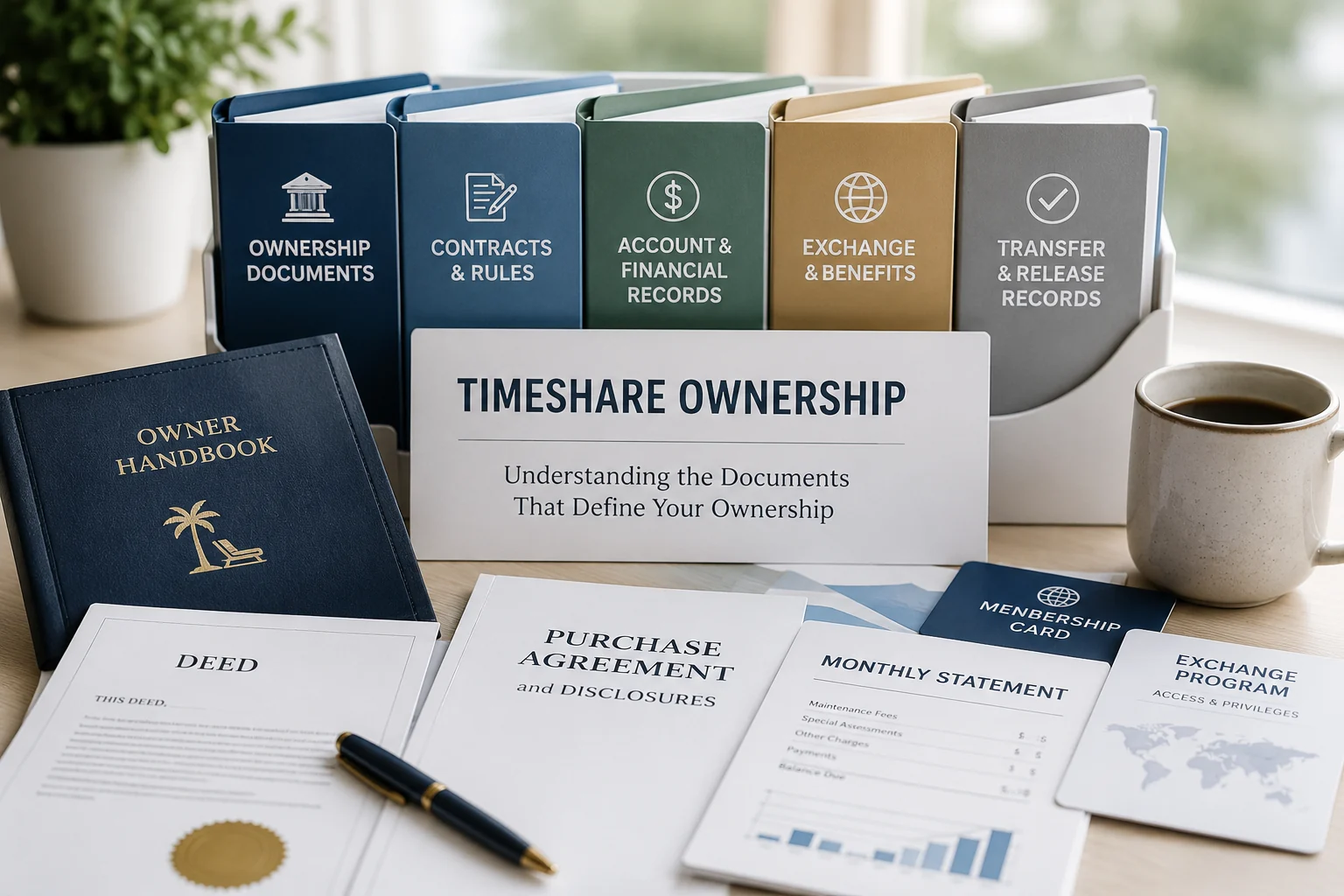
Your deed, purchase contract, club rules, points statement, fee bill, loan records, and exchange documents may each explain a different part of your timeshare.
This guide shows which records can help identify what you own, how you can use it, what you still owe, which benefits may apply, and whether a transfer or release has actually been completed.
About this guidance: Timeshare Travel Club Authority’s guidance draws on experience with timeshare ownership structures, developer programs, purchase agreements, deeds, points systems, maintenance fees, financing, exchange records, booking rules, transfers, surrender processes, and the documents owners rely on when evaluating what they own. Because document names, legal structures, benefits, obligations, and transfer procedures can vary by contract, developer, ownership type, account status, and applicable law, owners should verify the records and rules that apply to their specific situation before acting.
How It Works
Build the Ownership Picture in Four Stages
Your paperwork should be reviewed as a connected record. One document may identify the ownership, while other records explain how it can be used, what remains due, and whether a later change was completed.
Identify
Find the deed, contract, trust interest, membership agreement, or assignment that shows what was acquired and who is named.
Match
Compare the ownership record with current points, booking, usage, benefit, and exchange rules.
Confirm
Review loan balances, maintenance fees, assessments, account standing, and any unresolved financial obligations.
Verify
Look for recorded transfers, written approvals, releases, payoff letters, and account updates proving that a later change took effect.
TTCA Framework Insight: The goal is not simply to collect paperwork. It is to determine whether the ownership record, current program rules, financial account, and any later transfer or release documents tell a consistent story.
Timeshare Document Map
Start With the Question You Are Trying to Answer
You do not need to understand every page of your paperwork before you begin. Choose the situation closest to yours to see which documents may answer the question and what you should look for.
1 You are not sure what you actually own
Start with the document that created or recorded your ownership. Depending on the product, this may be a deed, purchase agreement, membership contract, trust interest, assignment, or right-to-use agreement.
Look for the owner names, resort or club, contract number, week, unit, season, points allocation, ownership term, and whether the interest is deeded or contractual.
Documents to check: Your deed, purchase agreement, membership contract, trust documents, assignment, or right-to-use agreement.
Example: Your deed may identify a specific week at one resort, while a separate club agreement explains that you now use that ownership through a points-based reservation system.
2 You cannot tell how booking is supposed to work
Your deed or original sales contract may not explain your current reservation rights. Booking windows, home-resort priority, points expiration, borrowing, banking, cancellation rules, and availability procedures are often found in current club rules or owner materials.
Compare the current written rules with what you believe you purchased, especially if the program has changed or desired reservations have become difficult to secure.
Documents to check: Reservation rules, owner handbook, points chart, use-year statement, club terms, booking policies, and current program notices.
Example: You may receive a 13-month booking window at your home resort but only a 10-month window for other locations. That difference can materially affect which reservations you can realistically obtain.
3 You need to know what you still owe
Your annual maintenance-fee bill may show only one part of the financial obligation. You may also have a purchase loan, club dues, special assessment, exchange membership fee, late charges, or an account that has already entered collections.
Separate the loan balance from recurring ownership expenses. This helps you determine whether the greatest financial pressure comes from the original purchase financing, the annual cost of ownership, or both.
Documents to check: Loan agreement, current payoff statement, maintenance-fee invoice, special-assessment notice, account ledger, and collection correspondence.
Example: You may have paid off the original purchase price but still owe annual maintenance fees, club dues, and a newly approved special assessment.
4 You are unsure which benefits you still have
Not every benefit is part of the underlying ownership. Exchange access, travel discounts, loyalty status, bonus points, reservation privileges, and developer-direct benefits may be controlled by separate membership terms.
Confirm whether each benefit is automatic, optional, temporary, separately billed, conditional on account standing, or available only to people who purchased directly from the developer.
Documents to check: Membership agreement, benefits guide, exchange enrollment, affiliation records, owner-portal statements, and current benefit notices.
Example: A resale buyer may receive the underlying ownership and home-resort rights but not the original purchaser’s elite status, bonus program, or developer travel benefits.
5 You are considering a sale, transfer, or surrender
Before paying a transfer service or signing documents, confirm what the resort, club, association, trustee, or developer currently requires. The process being used today may not be fully explained in your original contract.
Look for account-status requirements, loan restrictions, transfer fees, approval steps, right-of-first-refusal provisions, required closing documents, and benefits that may not pass to the next owner.
Documents to check: Ownership documents, current transfer policy, governing rules, resale restrictions, surrender forms, and written correspondence from the responsible organization.
Example: A developer may require the loan to be completely paid off and all maintenance fees to be current before it will review a surrender or approve a transfer.
6 You believe the ownership ended, but bills continue
Signing a deed, divorce agreement, surrender form, or transfer document does not necessarily update every connected record. The recorded ownership, resort account, loan, membership profile, and billing system may each require separate action or confirmation.
Do not assume the process is complete until you have written evidence showing which obligations ended, which records changed, and whether you remain responsible for any future balance or fee.
Documents to check: Recorded deed or assignment, lender release, payoff letter, surrender approval, account-closure notice, and updated owner records.
Example: A quitclaim deed may remove your name from a property record without removing you from the purchase loan or the resort’s internal billing account.
Important distinction: A document can be genuine and still answer only one part of your question. The deed may show ownership, the club rules may control use, the account ledger may show what is due, and a separate written release may be needed to prove that your responsibility ended.
What a Timeshare Document Can—and Cannot—Prove
Different records answer different ownership questions. A deed may identify the property interest and named owners. A purchase agreement may show the original transaction. Current club rules may control booking and benefits. Loan and fee statements may show what remains due. A recorded transfer or written release may be needed to confirm that responsibility ended.
The most useful document therefore depends on what you are trying to establish. An older document is not necessarily invalid, but it may no longer describe current reservation procedures, benefit rules, fees, or administrative requirements. Likewise, an owner-portal balance or verbal explanation may be helpful without replacing the governing documents or written confirmation.
When two records appear inconsistent, compare their purpose and effective dates before deciding that one must be wrong. Determine which organization controls the issue, check for later amendments or notices, and request clarification in writing when ownership, financing, transfer status, or future responsibility remains uncertain.
Free Ownership Review Preview
Are Missing or Unclear Documents Increasing Your Ownership Risk?
Uncertainty about your deed, contract, loan balance, account standing, transfer restrictions, or current program rules can make it harder to judge which next step is realistic.
- Identify which ownership details may require closer verification.
- See whether financing, fees, transfer limits, or account status may create additional pressure.
- Get a preliminary view of the factors that may affect your next ownership decision.
Get a clearer preview of the ownership factors that may deserve your attention first.
Try the Free Ownership Risk Profile™ Free preview • No exit-company sales pitch • Educational decision supportRisk Point
Relying on One Document Can Lead to the Wrong Ownership Decision
A deed may confirm that your name appears on the ownership, but it may not show your current loan balance, booking rules, transfer restrictions, account standing, or whether a developer surrender program is available. Likewise, a zero balance in an owner portal may not prove that every financial or legal obligation has ended.
This becomes especially risky when you are considering stopping payments, paying an exit company, transferring the ownership, removing a name, or assuming that a surrender has been completed. Before acting, compare the records that control ownership, financing, billing, program use, and release from future responsibility.
Action Step
Create One Ownership File Before You Make the Next Decision
Bring the records that describe your ownership, usage, finances, and current account status into one place. You do not need every historical document before you begin, but you should be able to identify what is confirmed, what is missing, and what still needs written verification.
Start with the ownership document. Save the deed, purchase agreement, membership contract, trust record, or other document showing what was acquired and who is named.
Add the current usage rules. Include the owner handbook, reservation policies, points chart, use-year statement, and any recent program changes.
Separate the financial records. Gather the loan statement, payoff amount, maintenance-fee bill, assessment notices, account ledger, and collection correspondence.
Document your benefits and affiliations. Save exchange enrollment, club membership terms, benefit guides, and records showing which programs remain active.
Add every later change. Keep transfer documents, name-removal requests, surrender forms, payoff letters, approvals, recorded documents, and release notices together.
Write down what is still unclear. List missing records, conflicting information, unexplained balances, and questions that require confirmation from the resort, club, lender, or association.
Quick Win
Create a one-page ownership summary listing the owner names, ownership type, resort or club, contract number, points or week, annual fees, loan balance, exchange affiliation, and current objective. This makes gaps and contradictions much easier to identify.
Frequently Asked Questions
For a deeded timeshare, begin with the public recording office for the county or jurisdiction where the timeshare property is located—not necessarily where you live. The resort, developer, owners’ association, title company, or closing company may also have a copy.
How can I get a copy of my timeshare deed?
For a deeded timeshare, you may be able to request a copy from the public office where the deed was recorded. The resort, developer, owners’ association, title company, or closing company may also have a copy in its records.
Search using the legal owner names, resort name, recording location, approximate purchase date, or recording information shown on other ownership documents. A non-deeded membership may not have a recorded deed, so you may instead need the membership agreement, assignment, or account ownership record.
What should I do if I cannot find my original purchase agreement?
Ask the developer, resort, club, association, or account administrator for the ownership documents currently maintained in your file. Request the purchase agreement, membership contract, ownership summary, financing records, and any amendments or program documents connected to the account.
You can still begin organizing the ownership using available records, but note the missing agreement as an unresolved item. Current account records may explain how the ownership operates today, while the original agreement may contain important purchase, financing, disclosure, or cancellation terms.
Which document controls if two timeshare records appear to conflict?
There is no universal answer because the documents may govern different parts of the ownership. A deed may establish a property interest, a membership agreement may control club participation, and later rules may govern current reservations or benefits.
Identify what question you are trying to resolve, compare the effective dates, and request written clarification from the organization responsible for that part of the ownership. A qualified attorney may be appropriate when the conflict affects legal ownership, liability, financing, or enforceable contract rights.
Can my owner portal replace the official ownership documents?
No. An owner portal can be useful for viewing points, reservations, fees, balances, and account activity, but it may not establish legal ownership or show every contract, loan, transfer restriction, or historical account change.
Save useful portal records as part of your ownership file, but compare them with the deed or contract, current program rules, financial statements, and written confirmations.
Should I give original timeshare documents to an exit or transfer company?
Keep your original documents unless a legitimate closing, recording, legal, or administrative process specifically requires otherwise. Provide copies when possible, retain a complete duplicate file, and confirm who will receive the records and how they will be used.
Before sharing sensitive documents, verify the company, understand the proposed service, remove unnecessary personal or financial information, and obtain written terms explaining the process, cost, and expected proof of completion.
Bottom Line
Your timeshare is rarely explained by one document. The deed or contract may show what you acquired, but current booking rules, financial statements, benefit terms, transfer policies, and later account records may determine how the ownership works today.
Before you stop paying, transfer the ownership, pursue surrender, hire outside help, or assume that your responsibility has ended, compare the records that address ownership, usage, financing, fees, and release. The most important next step is often identifying what is confirmed, what is missing, and which question still requires a written answer.

Personalized Decision Support
Organizing the Documents Is the First Step. The Report Helps Organize the Decision.
Your deed, contract, loan records, fee statements, booking rules, and transfer documents may reveal important parts of the ownership. The Timeshare Decision Intelligence Report™ helps bring the facts you provide together into a personalized review of your ownership, financial exposure, unresolved questions, and practical decision paths.
If you are uncertain whether to keep using the ownership, request surrender, pursue a transfer, address unpaid balances, or seek outside assistance, a structured review can help identify what deserves verification before you act.
View the Timeshare Decision Intelligence Report™What Your Report Is Designed to Provide
- ✓ Organize the ownership documents, account information, and financial commitments you provide.
- ✓ Identify missing information, inconsistencies, and verification priorities.
- ✓ Compare practical decision paths and the conditions that may affect each one.
- ✓ Provide a personalized framework for evaluating your next step.
Related Guides
Continue with the guide that best matches the ownership question you are trying to resolve.
Understand What You Own
- What Is a Timeshare? Ownership Types, Points, Fees, Booking, and Exchange Explained
See how ownership, points, fees, booking, and exchange fit together. - Timeshare vs. Vacation Club vs. Travel Club: Key Differences
Compare deeded ownership, vacation clubs, and travel-club memberships.
Change Ownership or Account Records
- How to Transfer a Timeshare to Someone Else
Review transfer requirements, fees, approvals, and proof of completion. - How to Remove Someone From a Timeshare Deed or Ownership
Understand why the deed, loan, billing account, and membership may require separate updates.
Verify a Surrender or Exit
- Timeshare Deed-Back Program: What Owners Should Know
Learn how loan status, unpaid fees, and developer rules affect eligibility. - How to Verify a Timeshare Exit Is Legally Complete
Identify the records that may confirm ownership and future obligations have ended.