
Ownership Portfolio Review
Multiple Timeshare Contracts: How to Identify Every Ownership and Obligation
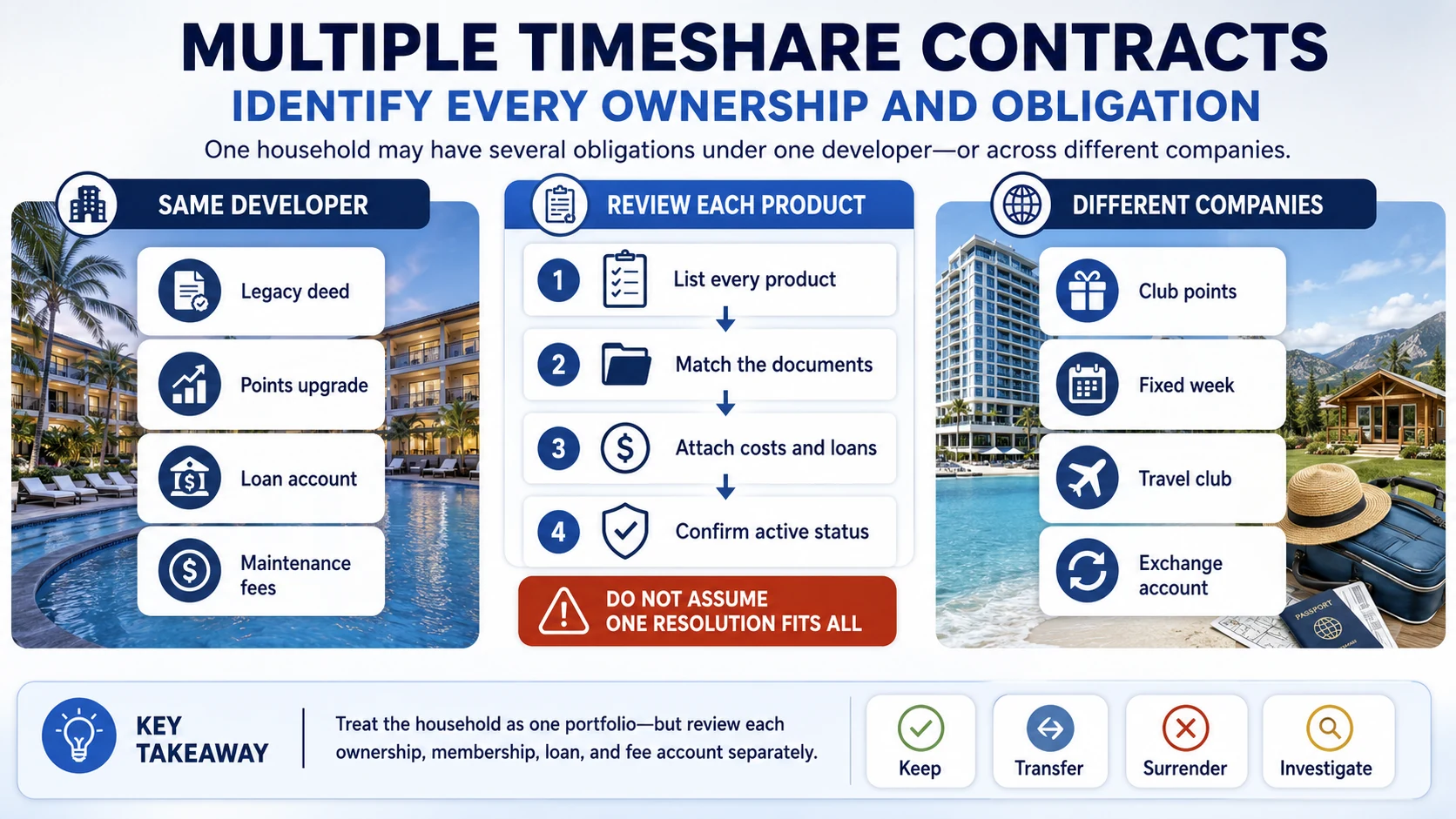
A household may have several obligations under one company—or a mix of unrelated timeshare, vacation-club, and travel-club products.
You might hold points with one vacation club, a fixed or floating week through another resort, and a separate travel-club membership governed by completely different terms. You may also have several deeds, contracts, loans, or legacy products associated with the same developer. Before deciding what to keep, transfer, sell, surrender, cancel, or investigate, determine what each product is, what it costs, and which obligations remain active.
Map the Full Portfolio
Separate Every Product Before Choosing a Path
Organize the household’s complete portfolio by company, product, contract, cost, rights, and current status.
- Every deeded week, points interest, trust, right-to-use product, or resort ownership
- Every vacation-club or travel-club membership, including products that are not deeded
- Every associated loan, maintenance-fee account, club due, usage charge, or exchange membership
- Whether each product is active, replaced, transferred, surrendered, cancelled, or still uncertain
Products connected to the same developer may still be separate obligations, while products from different companies will usually require their own review and resolution path.
About this guidance: Timeshare Travel Club Authority specializes in evaluating timeshare, vacation-club, and travel-club ownership structures across different companies, including deeds, contracts, memberships, loans, fees, and legacy products. This guidance helps households identify every active obligation and understand why each product should be reviewed separately before deciding what to keep, transfer, sell, surrender, cancel, or investigate.
Two Ownership Patterns
Multiple Contracts May Be Connected—or Completely Unrelated
The household’s portfolio may include layered products from one company, separate products from several companies, or a combination of both. Each product should be identified before its costs, rights, and possible next steps are evaluated.
Same Company
Several Products May Exist Under One Developer
A later purchase, conversion, enrollment, or upgrade may add another contract, deed, points interest, loan, or membership without necessarily replacing the earlier ownership.
A shared portal or consolidated statement can make separate obligations appear to be one product. Confirm which documents, balances, fees, and usage rights remain active.
Example: A legacy deed may remain active alongside a later points purchase, trust interest, club enrollment, or separate financing agreement.
Different Companies
Unrelated Products May Carry Completely Different Obligations
A household may own products from several operators that do not share contracts, inventory, billing, transfer procedures, or cancellation rules.
Each company may use a different ownership structure, booking system, fee schedule, financing arrangement, and resolution process.
Example: A household might hold Club Wyndham points, a legacy fixed week associated with Marriott, and a separate Prestige travel-club membership.
Before You Choose a Resolution Path
Confirm Whether You Have One Ownership Problem—or Several
A sale, transfer, surrender, cancellation, or exit process may address only the specific product named in that transaction. Other deeds, memberships, loans, annual fees, or products held with different companies may remain active. The Timeshare Decision Intelligence Report™ helps organize the ownership information, documents, costs, account status, and unresolved questions you provide before you decide what should happen to each product.
Need a clearer view of several ownerships, memberships, or obligations?
Review the Report Option Or continue building your ownership portfolio below
How It Works
How to Build a Complete Ownership Map
Begin with the entire household portfolio, then separate every product and connect it to the documents, costs, rights, and account status that belong to it.
List Every Company and Product
Record each developer, resort, vacation club, travel club, points program, deeded week, trust interest, right-to-use product, or other membership held by the household.
Match the Documents
Connect every purchase agreement, deed, certificate, membership document, upgrade, conversion, transfer, or cancellation record to the product it appears to govern. When you are unsure what each record establishes—or which documents may still be missing—review Timeshare Ownership Documents Explained .
Attach Every Cost and Obligation
Identify the loan, lender, payoff balance, maintenance fee, club due, usage charge, assessment, exchange membership, or other recurring expense connected to each product.
Confirm the Current Status
Determine whether the product is active, paid off, financed, delinquent, transferred, surrendered, cancelled, replaced, or still uncertain—and obtain written confirmation when the records conflict.
TTCA Framework Insight: The purpose of the ownership map is not merely to count contracts. It is to determine which rights, costs, loans, and responsibilities belong to each product so one unresolved obligation is not mistaken for another—or overlooked entirely.
Product-by-Product Review
Build One Simple Record for Each Product
You do not need to understand every contract immediately. Start by capturing these eight basic details for each ownership or membership.
What Is the Product?
Name the developer, resort, club, program, or membership.
How Is It Structured?
Note whether it is a deeded week, points product, trust, right-to-use interest, vacation club, or travel club.
Which Numbers Identify It?
Record the contract, deed, membership, loan, and billing numbers you can locate.
Who Is Named on It?
List the people or entities shown on the deed, contract, membership, loan, or fee account.
What Can You Use?
Note the week, season, points, home resort, booking rights, or travel benefits provided.
Is Money Still Owed?
Record the lender, monthly payment, payoff balance, and whether the loan is current.
What Does It Cost Each Year?
Include maintenance fees, club dues, assessments, exchange fees, and other recurring charges.
What Is Its Current Status?
Mark it active, transferred, surrendered, cancelled, disputed, or uncertain—and note what you hope to do with it.
Important distinction: Create a record for each product, not merely each company. The same developer may appear more than once when separate ownerships, memberships, loans, or fee obligations remain active.
Why One Transaction May Not Resolve Everything
Multiple obligations often build gradually. A household may purchase products from different companies, add points or memberships over time, or complete an upgrade that appears to replace an earlier ownership.
A later transaction may fully replace the original product, modify only part of it, or add another contract alongside it. The same uncertainty can arise when an ownership is transferred, surrendered, cancelled, sold, or paid off. The transaction generally applies only to the product, loan, or account specifically identified in the documents.
For example:
- A points upgrade may leave an earlier deed or fee account active.
- Paying off a loan does not end the underlying ownership.
- Cancelling a travel-club membership does not eliminate a deeded timeshare.
- Transferring one fixed week does not affect points held through another company.
- Closing an exchange account does not remove the ownership that supplied the week or points.
One portal may contain several obligations, while several account numbers may sometimes relate to one broader product. Neither the number of logins nor the number of statements proves what remains active.
Practical rule: Keep each product on the ownership map until its status has been confirmed in writing.
Evaluate Each Product Separately
Once the ownership map is complete, avoid making one blanket decision about the entire portfolio. One product may still provide useful travel value while another has become expensive, difficult to use, or burdensome to manage.
For each product, consider:
- Whether the benefits still match how the household travels
- Whether it is realistically usable when and where it is needed
- Its financing, annual fees, and related costs
- Whether someone is willing and able to manage it
- Which keep, transfer, sale, surrender, or cancellation options actually apply
The outcomes may differ. A household might keep a useful points program, investigate surrender options for an older fixed week, and cancel a separate travel-club membership.
The goal is to make a deliberate decision for each product—not force the entire portfolio into one outcome.
Risk Point
Resolving One Contract Can Create a False Sense That Everything Is Closed
A transfer, surrender, cancellation, payoff, or membership termination may apply only to the specific product named in the documents. Other ownerships, loans, fee accounts, or memberships may remain active, even when they share the same household, developer, or online account.
Action Step
Confirm the Status of Every Product Before Closing the File
Review the portfolio one product at a time and collect written proof showing what remains active, what has been resolved, and which obligations still require attention.
Contact each company separately and ask which ownerships, memberships, loans, and fee accounts remain open.
Match each response to a specific product rather than relying on a general statement that the account is closed.
Request written confirmation showing whether the ownership, financing, billing, and named-party responsibility ended.
Keep unresolved items on the ownership map until the documents and current account records agree.
Quick Win
Use one direct question for every product: “Can you confirm in writing whether this specific ownership, membership, loan, and fee account is still active?”
Owner Takeaway
Treat the Household as One Portfolio—but Each Product as a Separate Decision
Treat the household as one portfolio, but each ownership or membership as a separate decision. Identify each product, confirm its current status, and do not assume that resolving one obligation ends the others.
Frequently Asked Questions
These answers address common complications involving upgrades, missing documents, surrender requests, exit services, and products held under different ownership structures.
How can I verify whether an upgrade replaced my earlier ownership?
Look for documents that specifically identify the earlier product and state whether it was surrendered, transferred, cancelled, or replaced. A new purchase agreement, conversion document, or higher points balance alone does not prove that the previous obligation ended.
Can several contracts with the same developer be surrendered together?
Possibly, but only when the developer, resort, association, or other accepting party agrees to take back each product. The written approval should identify every deed, contract, membership, loan, and fee account included. Anything not specifically addressed may remain active.
Can one exit company resolve products held with several developers?
An exit company may offer to work on several products, but each ownership will still have its own documents, account status, rules, and possible resolution path. Obtain a separate written scope, strategy, fee, and completion standard for every product before paying.
What should I do if I cannot find every contract or deed?
Begin with current billing statements, loan records, tax documents, owner portals, reservation records, and correspondence. Then ask each developer, resort, association, club, or lender for written confirmation of every product and account connected to the household.
Is a travel-club membership handled the same way as a deeded timeshare?
No. A travel club may be a contractual membership rather than a real-property ownership. Its cancellation, renewal, transfer, and fee rules may differ substantially from those governing a deeded week or points-based timeshare.
Bottom Line
A household may hold several timeshare, vacation-club, and travel-club products under one company, across unrelated companies, or both. Each product can carry separate documents, costs, financing, usage rights, and resolution requirements.
Build the complete household portfolio, verify the status of every product, and obtain written confirmation when an obligation is closed. One purchase, transfer, surrender, cancellation, or payoff should never be assumed to resolve everything else.
Personalized Decision Support
Several Ownerships Create Several Decisions. The Report Helps Organize Them.
A household may have multiple timeshares, vacation-club products, travel memberships, loans, and fee accounts governed by different companies and documents. The Timeshare Decision Intelligence Report™ helps organize the ownership information, financial commitments, account status, uncertainties, and decision considerations you provide into a personalized written report.
A structured review can help you separate the products that may still provide value from those that may require transfer, surrender, cancellation, sale, or further verification—before one unresolved obligation is mistaken for another.
View the Timeshare Decision Intelligence Report™What Your Report Is Designed to Provide
- Organize the ownerships, memberships, financing, and recurring costs you provide.
- Identify conflicting records, missing information, and uncertain account status.
- Separate the practical decision paths that may apply to each product.
- Establish verification priorities before you spend money or take action.
Related Guides
These guides can help you evaluate individual products, confirm what remains active, and compare possible resolution paths for each ownership or membership.
Evaluate What You Own
- Is Your Timeshare Worth Keeping?
Evaluate whether an individual ownership still delivers enough practical travel value to justify its costs and responsibilities. - Timeshare vs. Vacation Club vs. Travel Club
Understand how these product structures differ and why their ownership rights, fees, and cancellation or transfer rules may not be the same.
Transfer or Surrender an Ownership
- Can You Transfer a Timeshare to Someone Else?
Learn what must be verified before assuming a transfer will release every named owner, loan, and fee obligation. - Timeshare Deed-Back Programs
See how voluntary surrender programs work and why each separate ownership may require its own approval. - Timeshare Name Removal
Review the differences between removing a name from a deed, purchase contract, loan, membership, or billing account.
Compare Broader Resolution Options
- Timeshare Exit Guide
Compare legitimate options when one or more ownerships no longer fit the household’s finances, travel habits, or long-term plans.