
Timeshare Cruise Benefit Guide
Are Timeshare Cruise Benefits Worth It? Discounts, Booking Fees, and the Real Cost
A cruise certificate, credit, or member discount can sound valuable—but the advertised benefit does not always equal the amount you actually save.
The real value depends on the final cruise price after booking fees, redemption charges, restrictions, taxes, required add-ons, and any difference between the member offer and a comparable public rate. The benefit matters only if it produces meaningful savings on a cruise you would realistically book.
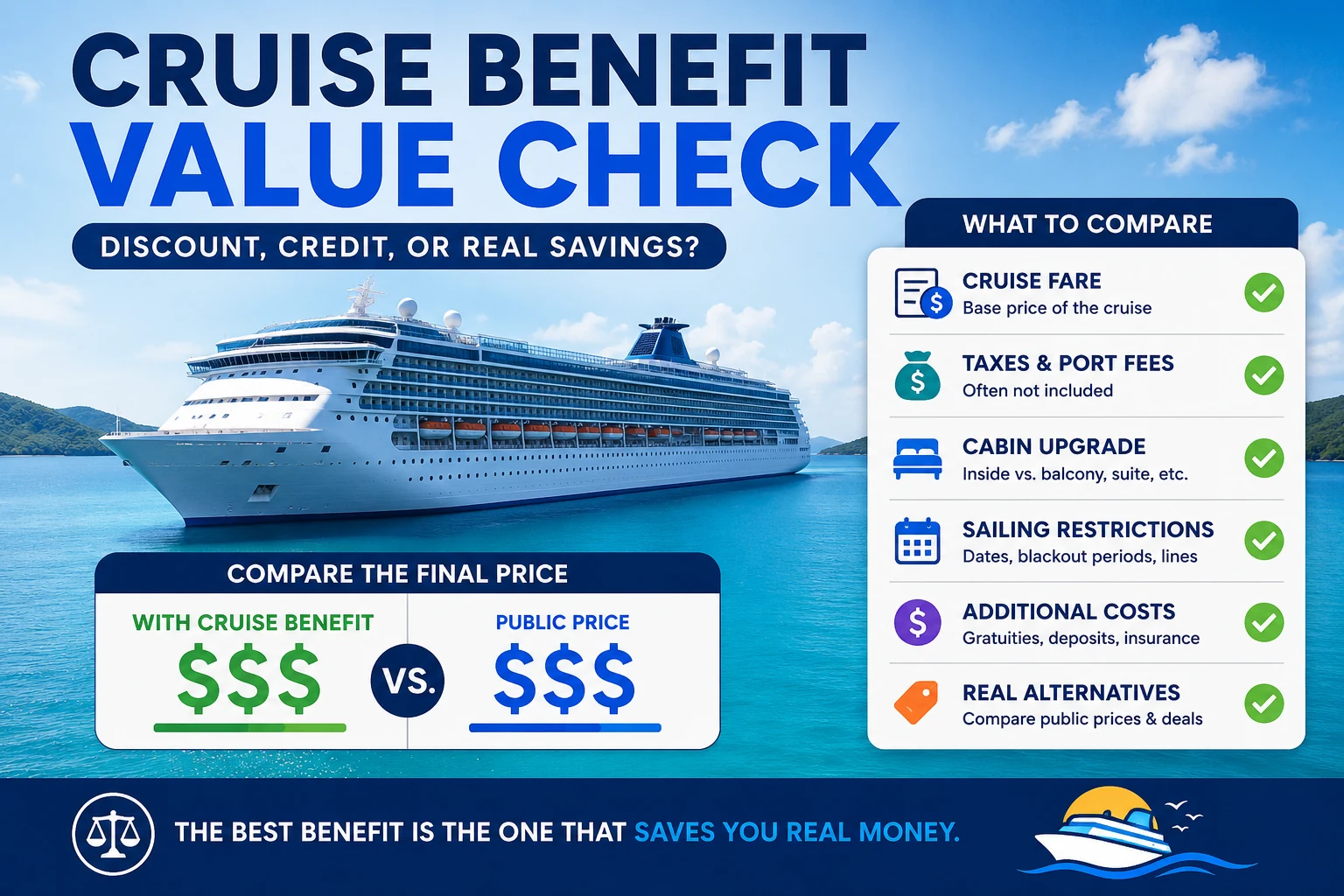
About This Guidance: TTCA evaluates timeshare cruise benefits by comparing the marketed value of a certificate, credit, discount, or booking privilege with the practical cost of using it. This guidance focuses on cruise fares, booking and redemption fees, taxes and required charges, cabin and itinerary restrictions, public-rate comparisons, and how much usable savings the benefit actually provides before an owner relies on it when buying, upgrading, or evaluating a membership.
Important Distinction
A Cruise Benefit May Be Access to a Booking Service—not a Separate Cruise Entitlement
Some timeshare and vacation-club cruise benefits provide access to a travel department, exchange-company program, affiliated cruise agency, or third-party booking platform. The service may operate under the club’s branding even when an outside provider supplies the inventory, pricing, and reservations.
The owner may still need to pay a booking, activation, exchange, or redemption fee before receiving a discount from a published cruise rate. That discount may provide value, but it should not be treated as savings until the final price is compared with the best equivalent cruise available elsewhere.
Before You Upgrade for More Travel Benefits
Determine Whether the Cruise Benefit Adds Real Value to the Ownership
A cruise discount may appear valuable without offsetting the purchase price, financing, annual fees, club dues, exchange costs, or other obligations tied to the ownership. The Timeshare Decision Intelligence Report™ can help organize the costs, benefits, restrictions, and verification gaps before you buy more points, upgrade, renew, or make another costly ownership decision.
Need a clearer view of what your ownership benefits are really providing?
Review the Report Option Independent decision support • No exit-company sales pitchSystem Insight
The Advertised Discount May Not Reflect the Best Available Cruise Price
- Published rates may be higher than the prices travelers commonly pay after cruise-line promotions, travel-advisor offers, package discounts, or onboard credits.
- A separate booking or redemption fee can reduce the apparent savings before taxes, port charges, gratuities, insurance, and upgrades are added.
- Member pricing is not automatically exclusive pricing. A club-branded portal may use the same third-party inventory available through other travel sellers.
- The benefit should be measured by net savings, not by the percentage discount displayed inside the member portal or sales presentation.
What Determines Whether a Timeshare Cruise Benefit Is Worth Using?
A cruise benefit may provide genuine value when it applies to a sailing the owner already wants, offers a suitable cabin, and produces a lower final price after every required fee is included.
Its value becomes less clear when the owner must pay to activate or redeem the benefit, accept restricted sailings or cabin categories, or compare the offer against an inflated published rate rather than the best price available elsewhere.
The most reliable test is to price the same cruise independently. Compare the cruise line, ship, itinerary, sailing date, cabin category, cancellation terms, included credits, and full out-of-pocket cost. A benefit that saves money under that comparison may be useful. A benefit that merely creates another way to book the cruise may have limited practical value.
Cruise Value Check
Compare the Real Booking Cost—not Just the Advertised Discount
Price the same sailing through the timeshare-related benefit and through independent booking options. Small differences in cabin type, included credits, cancellation terms, and required fees can make two apparently similar offers very different.
| Cost or Term | Timeshare-Related Offer | Independent Booking Comparison |
|---|---|---|
| Starting cruise price | Confirm whether the quoted savings are measured against a published, brochure, or promotional rate. | Compare the best available price for the same ship, itinerary, sailing date, and cabin category. |
| Benefit-use or booking fee | Add any activation, exchange, redemption, transaction, membership, or booking charge required to access the offer. | Confirm whether a cruise line, travel advisor, or public travel platform charges a comparable fee. |
| Cabin category | Verify whether the offer applies to an inside cabin, oceanview, balcony, suite, or another restricted category. | Compare the same cabin type and location rather than a lower-priced room that you would not choose. |
| Taxes and port charges | Determine whether these charges are included, discounted, or added after the advertised benefit is applied. | Compare the final checkout price with all required government taxes and port charges included. |
| Promotions and onboard credits | Check whether the benefit includes or excludes drink packages, gratuities, onboard credit, Wi-Fi, specialty dining, or other promotions. | Include cruise-line promotions, travel-advisor incentives, loyalty benefits, and available onboard credits. |
| Cancellation and change terms | Review deposits, final-payment deadlines, change penalties, cancellation rules, and whether the booking is refundable. | Compare the flexibility and financial risk of the independently available rate. |
| Ownership-related cost | Consider whether annual dues, exchange membership, club fees, or other ownership costs are required to maintain access to the benefit. | Public cruise pricing generally does not require the traveler to maintain a separate long-term ownership obligation. |
Important: A lower cruise fare does not automatically mean the timeshare benefit is the better value. Compare the complete trip, including required access fees, cabin quality, promotions, flexibility, and the ongoing cost of maintaining eligibility for the benefit.
Risk Point
A Cruise Discount Can Make the Ownership Feel More Valuable Than It Is
A cruise benefit may provide genuine savings, but it can also be used during a purchase, upgrade, renewal, or owner presentation to make the overall ownership package appear more valuable. That impression may be overstated when the owner must pay to access the booking channel or when the advertised discount is measured against a published cruise rate that travelers rarely pay.
The larger risk is using uncertain cruise savings to justify a purchase price, financing obligation, maintenance fee, club due, exchange membership, or upgrade cost. Even a useful cruise discount may not offset the full cost of maintaining the ownership that provides access to it.
Owner takeaway: Treat the cruise benefit as a separate travel transaction—not as an automatic dollar value attached to the timeshare. It is only a meaningful benefit when the final comparable cruise price is genuinely lower after every required fee and restriction is considered.
Action Step
Price the Cruise Before Counting the Benefit as Savings
Before redeeming a cruise benefit—or allowing it to influence an ownership decision—compare the complete offer against the same cruise available outside the timeshare or club program.
Identify who is actually providing the cruise offer, including the developer, exchange company, travel department, certificate issuer, or third-party booking service.
Request the complete member price in writing, including activation, exchange, redemption, booking, transaction, or benefit-use fees.
Match the exact sailing and cabin category, including the ship, itinerary, travel dates, cabin location, occupancy, and included benefits.
Add every required cruise cost, including taxes, port charges, deposits, gratuities, insurance, upgrades, transportation, and other mandatory charges.
Check independent booking alternatives, including direct cruise-line offers, travel advisors, public promotions, loyalty benefits, and available onboard credits.
Separate the cruise savings from the ownership cost, especially if annual dues, exchange membership, financing, or an upgrade is required to maintain access.
Quick Win
Ask for the final checkout price—not the percentage discount. Then compare that amount with at least two independent offers for the same sailing and cabin before deciding whether the benefit provides meaningful value.
Should You Buy, Upgrade, or Keep a Timeshare Because of Cruise Benefits?
Cruise access should rarely be the deciding reason to buy, upgrade, renew, or keep a timeshare.
The benefit may add value when the ownership already fits the owner’s budget and travel habits—and when the cruise offer produces genuine savings on a sailing the owner intended to book anyway. But a possible discount should not be used to justify a larger purchase price, new financing, higher annual dues, or an ownership that is otherwise difficult to use.
Owners should evaluate the cruise transaction separately from the ownership itself:
- Is the cruise offer actually competitive after all fees?
- Would the owner have taken the cruise without the promotion?
- Does the ownership still make sense without assigning value to the cruise benefit?
A useful cruise offer can improve an ownership package, but it cannot correct high annual costs, weak booking access, limited resale demand, or an ownership that no longer matches how the owner travels.
Decision Insight
Cruise Benefits Work Best as an Added Perk—not the Reason to Own
A cruise benefit may be useful when the underlying ownership already makes sense and the final cruise price is genuinely better than comparable public offers.
But cruise discounts, credits, certificates, and member booking access do not offset an unsuitable purchase, unaffordable annual costs, limited usage, weak resale value, or an ownership that no longer fits the owner’s travel plans.
❓ Frequently Asked Questions
These questions address how timeshare cruise benefits, exchange-company cruise offers, certificates, and member travel services may work—and how owners can determine whether the pricing provides real value.
Are timeshare cruise benefits actually free?
Owners should not assume that a cruise benefit is free. A certificate, credit, discounted rate, or promotional cruise may still require an activation, booking, exchange, redemption, or transaction fee. Taxes, port charges, deposits, gratuities, insurance, transportation, cabin upgrades, and other cruise expenses may also apply.
Why do I have to pay a fee to use a cruise benefit?
Some programs provide access to a cruise-booking channel rather than a prepaid cruise. The fee may cover activation, redemption, exchange processing, travel-agency services, or use of an affiliated booking platform. Paying the fee does not automatically mean the offer is a poor value, but it should be included when calculating the final savings.
Are exchange-company cruise options the same as exchanging for a resort?
Not necessarily. An exchange company may offer cruises through a travel department, affiliated cruise provider, vacation promotion, member discount program, or exchange-style redemption. The cruise may be a separate travel product rather than inventory obtained through the same process used for a resort exchange.
Are member-only cruise discounts better than public cruise rates?
They may be, but member access does not guarantee the lowest available price. Compare the final amount against direct cruise-line pricing, travel-advisor offers, loyalty promotions, public travel platforms, and available onboard credits for the same sailing and cabin category.
What is a white-labeled cruise booking service?
A white-labeled service is operated by an outside travel company but presented through the vacation club’s branding, website, or member portal. The club may promote the benefit, while the third party supplies the cruise inventory, pricing, booking support, and reservation terms.
How can I tell whether a cruise benefit is a good deal?
Compare the exact ship, itinerary, sailing date, occupancy, cabin category, included benefits, cancellation terms, and final checkout price. Include every required fee and compare at least two independent offers rather than relying only on the discount percentage displayed by the member program.
Should I buy, upgrade, or keep a timeshare because of cruise benefits?
Cruise benefits should generally be treated as an added perk rather than the primary reason to accept a purchase price, loan, upgrade cost, or ongoing annual obligation. The ownership should still make sense based on its core resort usage, total costs, booking access, travel fit, and long-term restrictions without depending on uncertain cruise savings.
Bottom Line
Timeshare cruise benefits are not automatically worthless, but they are often less straightforward than the sales description suggests.
The owner may be paying for access to a discount channel, exchange-company travel service, certificate program, or third-party cruise-booking platform. The resulting price may be lower than a published cruise rate without being lower than the best offer actually available to the public.
A cruise benefit provides meaningful value when it gives the owner a suitable sailing and cabin at a genuinely better final price after booking fees, redemption charges, taxes, port costs, upgrades, and other required expenses are included.
It provides much less value when the discount disappears after those costs are added—or when the same cruise can be booked independently for a similar price with better promotions, credits, flexibility, or cancellation terms.
The benefit should therefore be evaluated as a separate travel transaction. It may enhance an ownership that already works, but it should not be used to make an unsuitable or overly expensive timeshare appear financially worthwhile.
Understand Whether the Benefits Actually Support the Cost of Your Ownership
Cruise discounts, exchange access, bonus weeks, travel credits, and member-only offers may add value—but they should be reviewed alongside your purchase price, financing, annual fees, booking access, usage history, restrictions, and long-term obligations. The Timeshare Decision Intelligence Report™ helps organize those details, identify material findings, and clarify what still needs to be verified before you buy, upgrade, continue paying, or choose another ownership path.
Get the Timeshare Decision Intelligence Report™ Customized ownership review • Decision-support report • No exit-company sales pitchIndependent educational decision support. This is not legal advice, contract cancellation, an exit service, a resale service, lender negotiation, travel booking, or a promise that a particular benefit, discount, transfer, or ownership option will be available.
Related Guides
These published guides can help you compare cruise access with other ownership benefits, exchange programs, annual costs, and the broader value of keeping the timeshare.
Compare Other Timeshare Benefits
- Are Timeshare Benefits Worth It? How to Evaluate the Perks You Actually Use
Compare resort usage, exchange access, bonus weeks, cruise programs, discounts, and promotional benefits against what you actually pay and use. - Timeshare Bonus Weeks and Bonus Time: Are They Worth It?
Review booking fees, availability, restrictions, and travel costs before treating an extra week as free vacation value. - How Timeshare Exchange Programs Work
Understand how exchange inventory, trading power, deposits, timing, membership fees, and transaction charges affect practical value.
Evaluate Exchange and Ownership Value
- Is RCI Worth It?
Evaluate whether RCI exchanges, Extra Vacations, Last Call offers, rentals, and related fees provide enough value for your travel habits. - Is Interval International Worth It?
Review Interval International exchanges, Getaways, membership costs, transaction fees, availability, and owner flexibility. - Total Cost of Timeshare Ownership: What You Actually Pay Over Time
Compare purchase price, financing, maintenance fees, club dues, exchange charges, assessments, and other long-term ownership expenses.