Independent Exchange Program Review
Is RCI Worth It? Reviews, Fees & Exchange Value
RCI can expand how a timeshare owner travels, but a large resort directory does not necessarily mean all of the vacations you see are available as exchanges.
The decision: Do the exchanges you can actually confirm—and the other travel benefits you genuinely use—justify the cost of the timeshare, RCI fees, and any additional cash required for the vacations you want?
TTCA reviewed RCI’s current U.S. Weeks and Points fee schedules, exchange guidance, Trading Power information, rental products, and recently updated explanation of exchange, rental, resort, and total charges. Fees and program rules can change, and individual resort charges vary. Always confirm the terms shown in your own RCI account before booking.
On This Page

Quick Answer
Is RCI Worth It?
RCI can be worth it when you regularly confirm vacations you actually want at a total cost that compares favorably with booking similar accommodations independently.
Its value tends to be stronger for owners who are flexible with dates, destinations, resorts, and unit sizes. It can become harder to justify when Trading Power restricts the realistic exchange options, desired inventory is difficult to confirm, or repeated fees are required to preserve or use deposited value.
One of the most important distinctions is that not everything displayed through RCI is necessarily available as a traditional exchange. Extra Vacations, Last Call vacations, and other rental inventory can require a separate cash payment.
When is RCI actually worth paying for?
RCI is most useful when the vacations you actually confirm justify the combined cost of maintaining the underlying ownership and using the exchange program.
The size of the resort directory matters less than whether your ownership, Trading Power, travel flexibility, available inventory, transaction costs, and additional resort charges produce vacations that work for you.
Important Distinction
RCI Is an Exchange Company—not Your Timeshare
RCI generally provides exchange and travel access connected to an affiliated timeshare, vacation club, or membership program. The underlying ownership remains the resort, club, deeded interest, points interest, or other vacation right associated with the account.
That distinction matters because RCI may improve how useful the ownership feels without changing what the timeshare itself costs or what it may be worth on the resale market.
A strong RCI experience can add personal travel value. It does not automatically make the underlying timeshare a strong financial investment or increase buyer demand.
Exchange Mechanics
How RCI Trading Power Affects What You Can Exchange Into
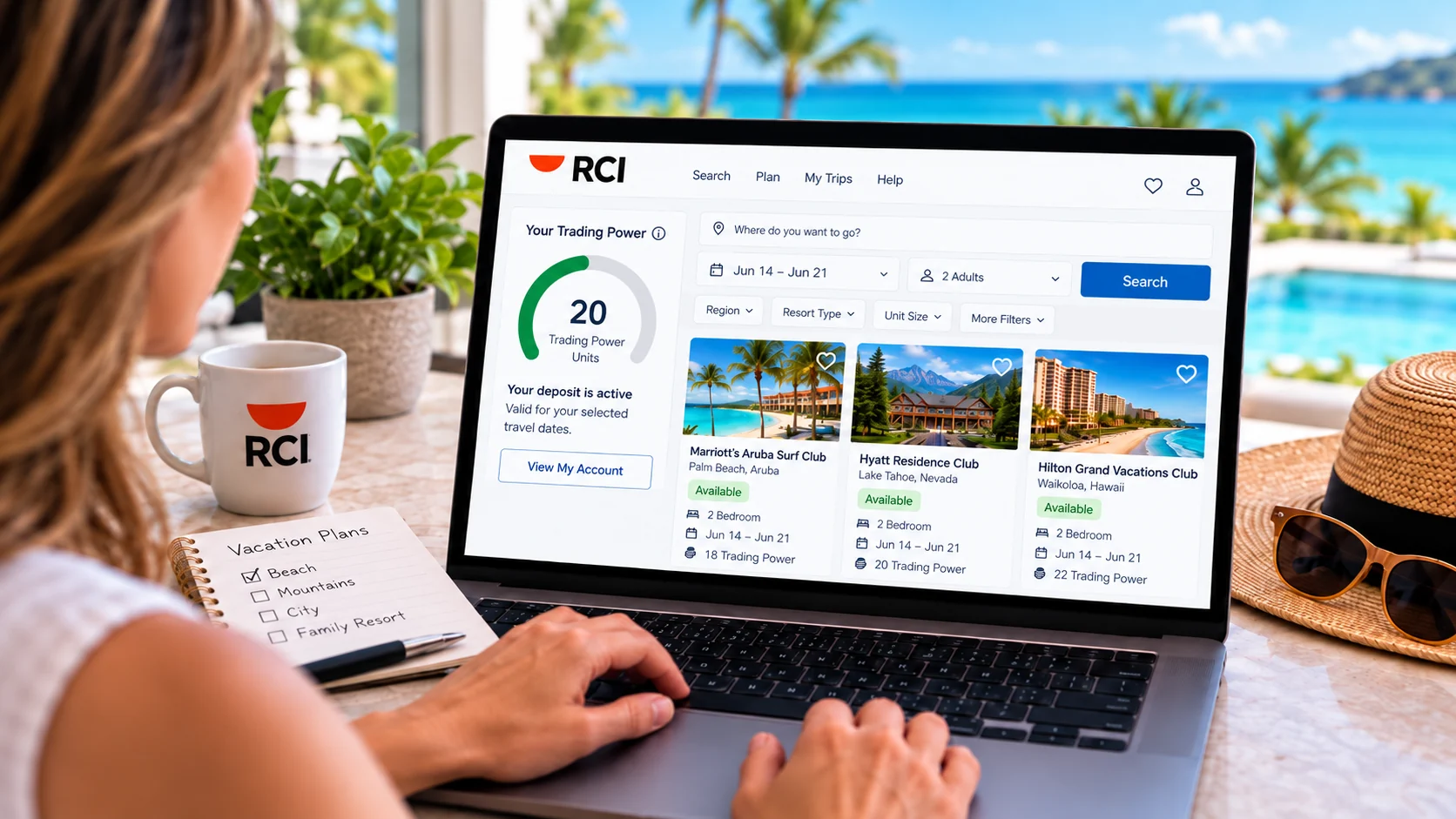
In RCI Weeks, a deposited week receives Deposit Trading Power. That value helps determine which available exchanges the deposit can access.
Trading Power is influenced by factors such as supply and demand, the resort, unit type, season or week, resort designation, and when the week is deposited.
This means two RCI members searching the same destination may not have the same realistic exchange choices.
Availability
Trading Power and Availability Are Two Different Things
A deposit can have enough Trading Power for a resort and still fail to produce the vacation you want if no matching inventory is available.
Availability depends on what enters the exchange system, when you search, demand for the destination, season, accommodation size, and the flexibility of your request.
Specific requests are harder
An owner who needs one exact beachfront resort during spring break in a two-bedroom unit has a much narrower search than someone who can consider several destinations, weeks, and resorts.
A large network is not the same as bookable inventory
RCI can display a broad resort network, but the meaningful question is what your account can actually confirm when you want to travel.
For a deeper explanation of inventory matching, see How Timeshare Exchange Programs Work .
Current Cost
What Does RCI Really Cost?
The exchange fee is only one potential cost. An RCI member may also be carrying the underlying timeshare’s purchase or financing cost, maintenance fees or club dues, an RCI subscription, deposit-management charges, and resort-level expenses.
Current published U.S. RCI Weeks fees
| Fee | Current Published Amount |
|---|---|
| 1-year RCI Weeks subscription | $109 |
| Standard RCI Weeks exchange fee | $299 |
| Deposit extension — 1 month | $49 |
| Deposit extension — 12 months | $159 |
| Combine Deposits — 12-month expiration | $169 |
| Combine Deposits — 24-month expiration | $249 |
| Guest Certificate | $109 |
| Trading Power Protection | $89 or $129 |
| Last Call — hotel/studio | $309 |
| Last Call — 1 bedroom | $339 |
| Last Call — 2 bedroom | $379 |
RCI states that fees are subject to change. RCI Points uses a different fee schedule. The current U.S. Points one-year subscription is $134, and Points reservation charges vary by reservation type and length of stay.
You can review the current RCI Weeks fee schedule directly through RCI.
Exchange vs. Rental Inventory
How Much of What You See in RCI Is Actually an Exchange?
This is one of the most important questions to ask when evaluating RCI. Not every attractive vacation displayed in the platform is necessarily something your deposited week or Trading Power can obtain as a traditional exchange.
Exchange vacations
These use eligible deposited vacation value or RCI Points and generally require an applicable exchange or reservation fee.
Extra Vacations and Last Call
These are cash-priced rental products. They may offer attractive travel deals, but the member pays separately for the vacation.
Resort-level charges
A reservation may also carry resort, destination, housekeeping, amenity, tax, parking, or mandatory all-inclusive charges.
The ownership cost still exists
Maintenance fees, club dues, financing, and other ownership costs may continue whether you complete an exchange or purchase a rental vacation.
RCI now shows more of the total trip cost before booking
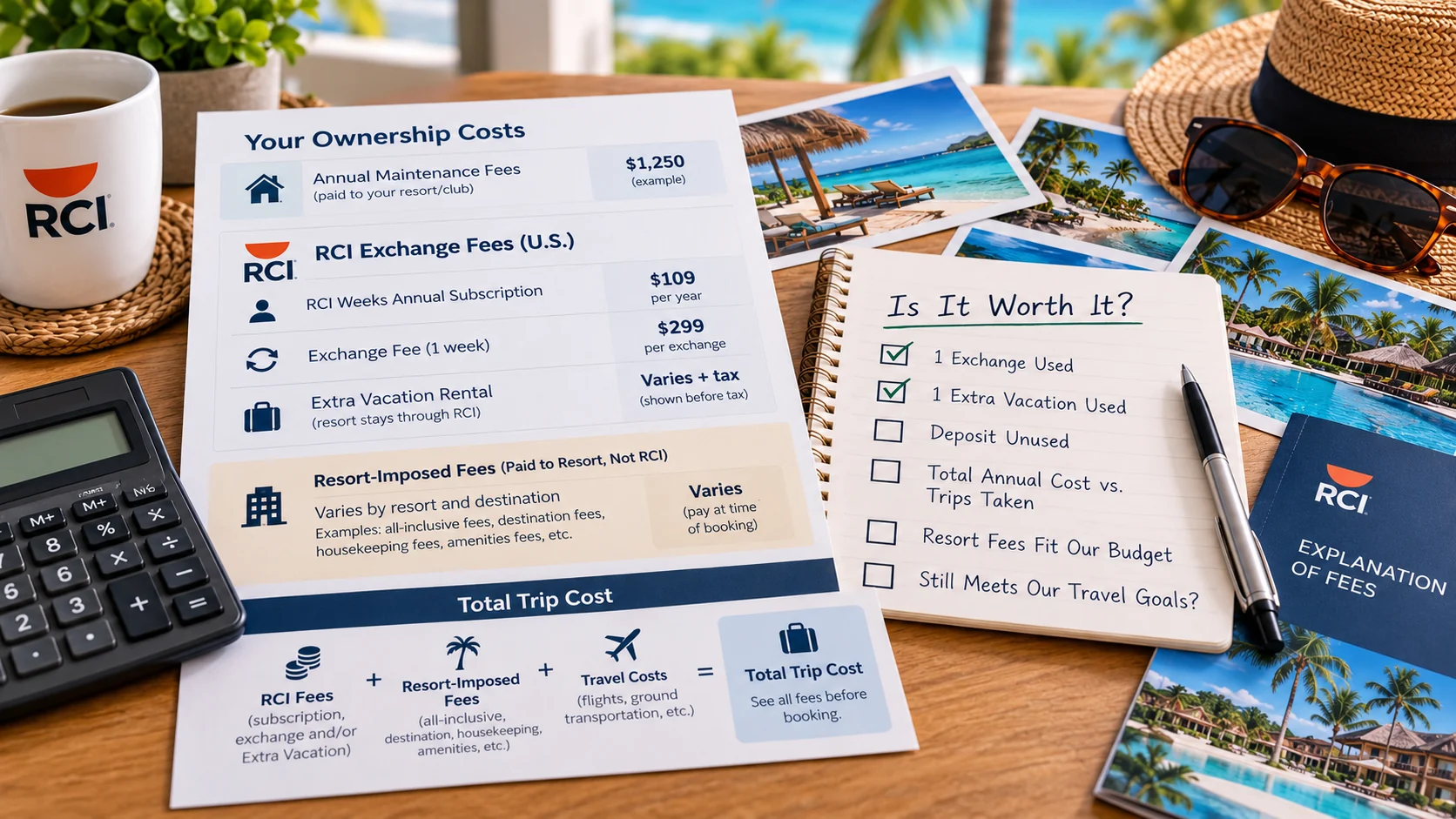
RCI’s updated fee explanation separates exchange fees, rental fees, resort fees, and Total Charges. RCI notes that resort-level charges can vary based on the resort, stay length, number of guests, amenities, or all-inclusive requirements.
That is useful because the amount paid directly to RCI is not necessarily the complete cost of the vacation.
For the full framework, see How Much Does a Timeshare Exchange Really Cost? .
My Take
I Would Not Judge RCI by How Much Inventory Appears on the Screen
I would separate the vacations my ownership and exchange value can actually obtain from the vacations RCI is asking me to purchase separately.
Extra Vacations and Last Call can absolutely be useful if the price is good. But a good rental price is not the same thing as receiving strong exchange value from the timeshare you already paid to buy and continue paying to maintain.
If I am paying maintenance fees, RCI fees, and then additional cash for many of the vacations I actually want, I would compare that complete travel cost with what I could book independently without owning the timeshare at all.

TTCA Ownership PathFinder™
Keep, rent, sell or exit?
If exchange access was one of the reasons you kept the ownership, declining RCI value may change the broader ownership decision.
PathFinder organizes the main ownership paths around your usage, costs, financing, and what you want to accomplish next.
Complimentary for TTCA visitors • About 2 minutes
You decide what happens next. We help you understand the paths.
Value Check
When RCI Can Be Worth It—and When the Value Starts to Break Down
Stronger fit: You use it regularly
Confirmed vacations provide more value than exchange access that remains unused year after year.
Stronger fit: You can travel flexibly
Multiple dates, destinations, resorts, seasons, and unit sizes can substantially expand the practical options.
Stronger fit: Total trip cost compares well
RCI is easier to justify when the full trip delivers better value, space, resort quality, or accommodations than independent booking.
Weaker fit: The best options require more cash
Rental inventory may still be useful, but repeated additional purchases can change the economics of maintaining the ownership.
Weaker fit: Fees keep accumulating
Membership, exchange, combine, extension, protection, resort, and ownership expenses can become substantial when viewed together.
Weaker fit: You need one exact high-demand trip
RCI is harder to rely on when the value depends on one specific resort, premium week, destination, or large accommodation.
If Exchange Value No Longer Supports the Ownership
Is There a Realistic Resale Path?
If RCI access was one of the reasons you kept your timeshare and the exchange value no longer offsets the annual cost, you may want to explore whether the underlying ownership has a realistic secondary-market path.
Explore My Resale OptionsAffiliate disclosure: TTCA may earn a commission if you use this link, at no additional cost to you.
Owner Experience
Why Are RCI Reviews So Polarized?
Some owners describe RCI as a valuable way to access more destinations, larger accommodations, and vacation choices they would otherwise pay more to book.
Others describe difficulty finding exchanges, frustration with Trading Power, high fees, or disappointment that attractive inventory requires an additional cash payment.
Both experiences can be genuine because owners are not necessarily using the same ownership, depositing the same value, searching for the same vacations, or paying the same total trip cost.
Before relying on an RCI review, ask what the owner was actually trying to book
- Were their dates flexible?
- Were they looking for one difficult peak-season vacation?
- What Trading Power or points did they have?
- Did they need a larger unit?
- Was the reservation an exchange or a cash rental?
- Were mandatory resort or all-inclusive charges involved?
- Were they evaluating RCI or dissatisfaction with the underlying timeshare?
Those details often explain why two members can reach completely different conclusions about the same exchange company.
Ownership Value
Does RCI Make Your Timeshare More Valuable?
RCI can make an ownership more useful to the current owner by providing additional destinations and travel options.
That personal-use value should not be confused with resale value. Secondary-market demand is influenced more directly by the underlying resort or club, annual fees, booking rights, ownership structure, transfer rules, season, unit or points allocation, and current buyer demand.
For more on that distinction, see Why Are Timeshares So Hard to Sell? .
If You Want to Test the Resale Market
See Whether Your Ownership Has a Practical Buyer Path
If you have concluded that RCI provides personal travel value but does not justify keeping the ownership, Timeshare Specialists’ Owner’s Advantage Plan is one option for exploring whether the underlying timeshare can be marketed on the secondary market.
Explore My Resale OptionsAffiliate disclosure: TTCA may earn a commission if you use this link, at no additional cost to you.
Before You Pay Again
Before You Renew, Combine, Extend, or Pay Another RCI Fee
Review what RCI has actually produced for you during the last two years.
- Count the vacations you actually completed. Separate traditional exchanges from Extra Vacations, Last Call, and other cash purchases.
- Add the RCI transaction costs. Include exchange, combine, extension, protection, guest certificate, and other applicable charges.
- Add mandatory resort charges. Include all-inclusive requirements, resort or destination fees, housekeeping, parking, taxes, or similar charges where applicable.
- Do not ignore the ownership carrying cost. Maintenance fees, club dues, financing, and assessments exist even when the vacation itself is booked through RCI.
- Compare with independent booking. Look at similar dates, destination, accommodation size, resort quality, and total price.
- Ask whether the trip matched what you actually wanted. A vacation taken mainly to avoid losing a deposit is not necessarily evidence of strong exchange value.
Frequently Asked Questions
RCI FAQs
Is RCI a timeshare company?
RCI is primarily a vacation exchange and travel-services company. The timeshare or vacation-club interest connected to the account is the underlying ownership.
How much does an RCI exchange cost?
RCI’s current published U.S. Weeks exchange fee is $299. That does not include the cost of maintaining the timeshare or any additional resort-level charges that may apply.
Is everything shown in RCI available as an exchange?
No. RCI also displays cash-priced vacation products such as Extra Vacations and Last Call. Those can still provide value, but they should be evaluated as separate travel purchases rather than as traditional exchanges using deposited vacation value.
What additional fees can an RCI resort charge?
Depending on the resort, additional charges may include mandatory all-inclusive packages, resort or destination fees, housekeeping, parking, taxes, amenities, or other stay-specific costs.
Are RCI Extra Vacations worth it?
They can be if the cash price compares favorably with similar public hotel, resort, package, or vacation-rental pricing. Their value should be judged separately from the exchange value produced by the underlying timeshare.
Why are RCI reviews so different?
Experiences vary because owners have different Trading Power, points, travel flexibility, destination preferences, unit-size needs, ownership costs, expectations, and booking histories.
Does RCI increase the resale value of a timeshare?
Not necessarily. RCI may add personal travel value, but resale value depends more directly on the underlying ownership, annual fees, transfer rules, booking rights, resort or brand, and buyer demand.
Should I keep my timeshare just because it includes RCI?
RCI can be a useful benefit, but the underlying timeshare should still make sense based on its own cost, usage, booking rights, annual fees, and long-term fit.
TTCA Decision
Judge RCI by the Vacations You Actually Receive—not the Inventory You Can See
RCI can provide meaningful value when the ownership produces useful exchange value, the member remains flexible, and the vacations actually confirmed compare favorably with independent booking.
The value is weaker when desired exchanges remain difficult to obtain, repeated fees are required to preserve deposited value, or many of the trips the owner wants ultimately require additional cash purchases.
The most useful calculation is therefore not simply the RCI exchange fee. It is the complete cost of maintaining the ownership, using RCI, paying applicable resort charges, and obtaining the vacations you genuinely want.
Continue From Here
Go Deeper on Exchange Value
-
RCI vs. Interval International
Compare the two major exchange networks by availability, exchange mechanics, fees, travel options, and owner fit.
-
How Much Does a Timeshare Exchange Really Cost?
Combine ownership, exchange, transaction, resort, and travel costs into one more realistic vacation-value calculation.
-
How Timeshare Exchange Programs Work
Understand deposits, inventory matching, trading value, booking windows, and why exchange availability varies.

Free Timeshare Self-Review
Take a clearer look at how your vacation ownership is working for you.
The Timeshare Self-Review helps you evaluate the ownership itself—not just the exchange benefit attached to it.
- How often you use it
- Your annual ownership costs
- Your booking experience
- The benefits you actually use
- Fit with your travel habits
- Ownership factors worth reviewing
Private • Self-guided • Instant result. By subscribing, you’ll also receive practical TTCA timeshare guidance and updates.