
Timeshare Exchange Systems Explained
How Timeshare Exchange Programs Work: Deposits, Trading Power, Fees, and Availability
Timeshare exchange is often presented as the freedom to trade one vacation for another. In practice, the result depends on what you deposit, when you deposit it, what inventory becomes available, and what you are willing to pay.
Depositing a week or using points generally gives you access to an exchange system—not a guaranteed replacement vacation of equal size, season, location, or quality. Trading power, request timing, destination demand, membership rules, and transaction charges can all affect the outcome. This guide explains how those pieces work together before you deposit, search, or pay an exchange fee.
Understand the Exchange Equation
Four factors shape what you may receive
Exchange success depends on more than simply placing your ownership into the system.
- The timing, season, resort, and unit you deposit
- The trading power or points assigned to your ownership
- The inventory deposited by other owners and participating resorts
- The fees, restrictions, and deadlines attached to the exchange
An exchange membership expands your search options, but it does not turn limited owner inventory into hotel-style availability.
About this guidance: Timeshare Travel Club Authority’s guidance draws on experience with timeshare exchange memberships, week and points deposits, trading power, request-first searches, exchange fees, inventory availability, unit-size upgrades, guest certificates, extensions, and resort-level charges. Exchange results can vary by ownership, affiliated network, resort, season, deposit timing, points or trading value, destination demand, and search flexibility, so owners should review the rules and fees attached to their specific membership before depositing or confirming an exchange.
The Important Distinction
Exchange Access, Exchange Availability, and Exchange Value Are Not the Same Thing
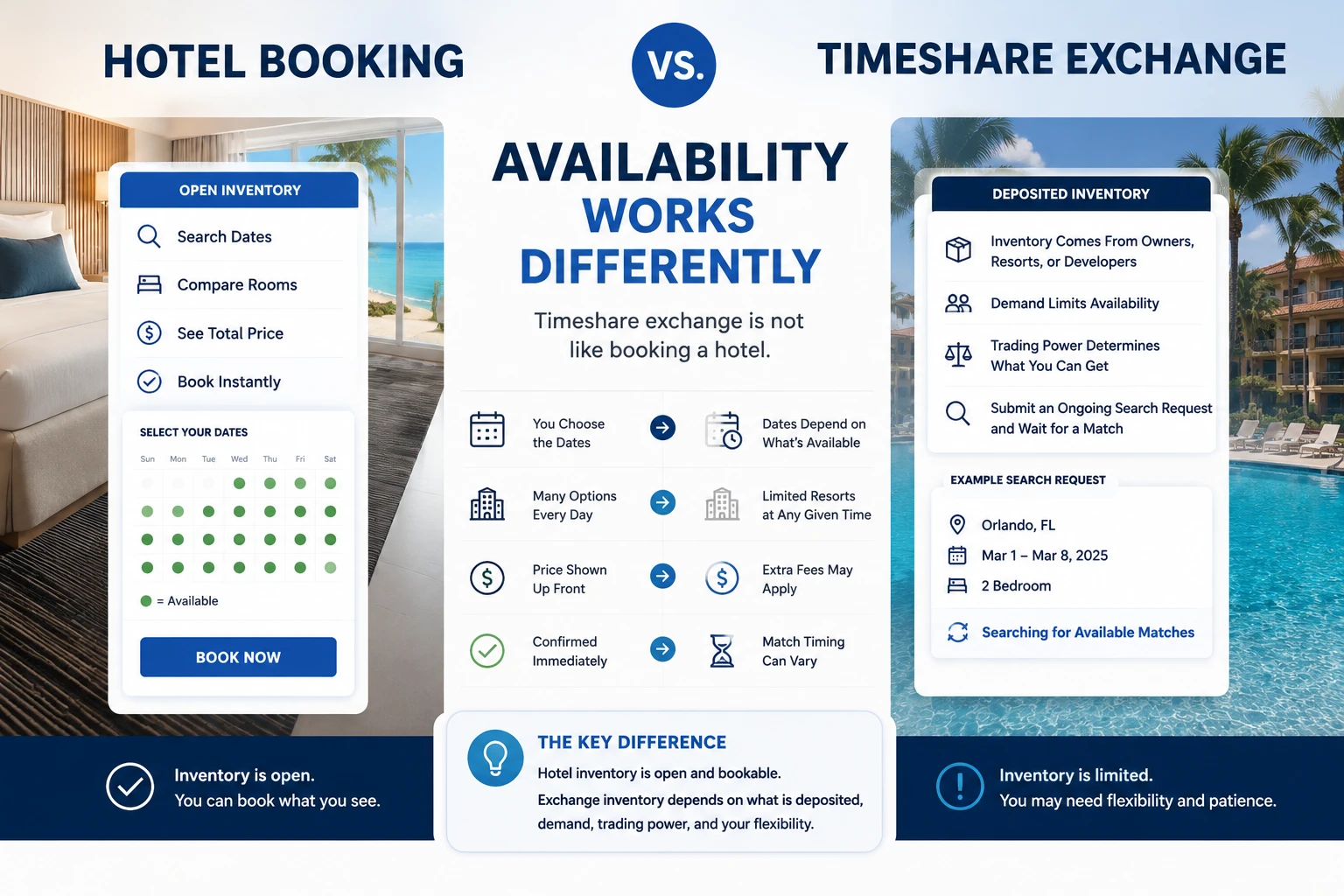
Many owners assume they can call an exchange company and ask what rooms are open in the same way they would call a hotel. But an exchange representative is not searching the resort’s complete commercial room inventory.
The representative can generally search only the weeks, points-based inventory, or units that owners, clubs, resorts, or developers have deposited or released into that exchange system. A resort may therefore have rooms available for paying hotel guests while showing no availability through the exchange program.
Exchange Access
You have the ability to use an exchange company or internal club exchange system.
Exchange Availability
Matching inventory must actually be deposited or released into the system when you search or when an ongoing request is processed.
Exchange Value
Your deposited week, points, or ownership may or may not have enough exchange strength to obtain the inventory you want.
A resort appearing in the directory confirms access to the network—not open hotel-style availability. Understanding the difference between access, deposited inventory, and exchange value is the first step toward setting realistic expectations.
Before You Rely on Exchange
Exchange Access Only Adds Value When It Fits How You Actually Travel.
A large resort directory can look flexible, but the ownership still needs enough exchange value, realistic inventory, workable booking timing, and acceptable total costs. The Timeshare Decision Intelligence Report™ helps organize your ownership, usage pattern, exchange limitations, annual costs, and available next steps before you continue paying based primarily on exchange promises.
Unsure whether exchange access still justifies your ownership?
Review the Report Option Or continue with the step-by-step exchange processInternal Exchange vs External Exchange
Timeshare owners may have more than one way to use their ownership outside a home resort. The first step is identifying which exchange system applies.
Internal Exchange
An internal exchange takes place within the developer’s or vacation club’s own network.
Instead of transferring usage to a separate exchange company, the owner uses points, club currency, or eligible ownership rights to reserve another participating resort within the same system. Examples may include booking across a developer’s affiliated resorts or using a broader internal access program.
Internal exchange may offer:
- Earlier access to affiliated resorts
- Fewer steps than depositing into an outside network
- Booking rules tied directly to the owner’s club membership
- Better recognition of the owner’s points or status
But access still depends on the specific ownership. A resort may belong to the broader company without being available through every membership level or resale ownership.
External Exchange
An external exchange uses a separate company—most commonly RCI or Interval International—to match an owner’s eligible usage with inventory deposited or supplied by other participating resorts and owners.
The owner may need to:
- Deposit a week or points
- Receive trading value or exchange credit
- Search available inventory
- Submit an ongoing request
- Pay a separate exchange fee
External exchange expands the possible destination list, but it also adds another layer of rules, fees, availability, and cancellation terms.
Independent Exchange
Some owners may also qualify to use an independent exchange company outside the developer’s preferred network. Eligibility depends on the resort, ownership documents, and whether the owner can deposit or assign the usage independently.
Independent exchange can add options, but owners should confirm that depositing through another company will not interfere with their home-resort rights or internal club usage.
7Across is one example of an independent exchange pathway, but it has its own ownership-verification requirements, deposit options, fees, inventory, and cancellation rules. Our 7Across review examines when that program may provide practical value.
How a Timeshare Exchange Works Step by Step
The exact process varies, but most exchanges follow the same basic sequence.
Exchange Process
What Happens From Deposit to Confirmation?
The exchange is not complete simply because an owner belongs to a network. The ownership must first be eligible, assigned a value, and matched with suitable inventory.
Confirm Exchange Eligibility
Verify which internal or external exchange programs the ownership can use and whether enrollment, membership, or account activation is required.
Select the Usage to Exchange
The owner may need to choose a specific reserved week, unreserved week, annual points allocation, or another eligible usage credit.
Deposit or Assign the Usage
Depending on the program, the owner may permanently deposit the usage, assign points, or begin a request before giving up the original reservation.
Receive Trading Value
The system evaluates the deposited usage based on factors such as resort demand, season, unit size, location, and how early the deposit was made.
Search or Submit a Request
Available inventory may be confirmed immediately. Harder destinations may require an ongoing request across several resorts or travel dates.
Pay the Exchange Costs
The owner may owe a transaction fee along with membership, resort, tax, guest, upgrade, or mandatory all-inclusive charges.
Receive the Confirmation
Once matched, the exchange reservation follows its own occupancy, check-in, cancellation, guest, and resort rules.
How the Ownership Format Changes the Exchange
The owner should know whether the exchange is based on a specific interval or on a quantity of points before giving up any usage.
Weeks-Based Exchange
A Specific Week Creates the Trading Value
A weeks-based owner may deposit a fixed week, floating week, or reserved interval. The resort, season, unit size, demand, and deposit timing can affect how strongly that week trades.
- The owner may need to reserve a week before depositing it.
- Prime seasons and larger units may receive stronger exchange value.
- Depositing early may improve the usable value or matching period.
- The original week may no longer be available once it is deposited.
Points-Based Exchange
A Quantity of Points Is Applied to the New Stay
A points-based owner may assign or deposit a certain number of points. The destination, travel dates, unit size, and length of stay determine how many points the exchange requires.
- The owner may be able to exchange only part of an annual points allocation.
- High-demand resorts or larger units may require more points.
- Deposited points may have separate expiration or extension rules.
- External exchange points may not function the same way as the owner’s internal club points.
A weeks-based owner is primarily exchanging the value of a particular interval. A points-based owner is primarily exchanging a currency whose usefulness depends on how many points are available and what the requested stay requires.
That distinction is missing from the current version, which discusses exchange factors extensively without showing owners how the ownership moves through the system.
Deposit First, Search First, and Ongoing Requests
Exchange programs do not all require the owner to give up the original usage at the same point.
Deposit First
Under a deposit-first process, the owner places an eligible week, reservation, or points allocation into the exchange system before confirming a replacement vacation.
Once accepted, the deposited usage generally becomes exchange credit or trading value. The owner may no longer be able to reclaim or use the original week, even if the desired exchange never becomes available.
Deposit first may make sense when:
- The owner is certain the original usage will not be used
- Depositing earlier may preserve stronger exchange value
- The owner is flexible about dates and destinations
- The exchange credit has a useful redemption period
Before depositing, confirm the expiration date, extension options, cancellation rules, and whether the original usage can ever be restored.
Search First
Some programs allow an owner to search or request an exchange while retaining the original week until a match is confirmed.
This can reduce the risk of giving up a desirable home-resort reservation without receiving a suitable replacement. However, search-first options may not be available for every ownership, exchange product, or request type.
The owner should confirm:
- Whether the original reservation remains protected
- What happens when a match is found
- How quickly the owner must accept the match
- Whether the search can be changed or canceled
- When the exchange fee becomes nonrefundable
Ongoing Requests
An ongoing request tells the exchange company to continue searching when matching inventory is not currently available.
This is especially useful for destinations or travel periods where desirable inventory may be deposited later. The request is more likely to succeed when it includes several acceptable resorts, arrival dates, destinations, or unit sizes.
An ongoing request is not a waiting list for one guaranteed reservation. It is a standing search that can only match inventory meeting the request criteria and the owner’s available exchange value.
Where Timeshare Exchange Inventory Comes From
Exchange companies cannot generally provide every unit at every affiliated resort. Inventory must first enter the exchange system.
Common sources include:
- Owner deposits: An owner gives up an eligible week or usage period in exchange for trading value.
- Club allocations: A vacation club assigns certain inventory to an external exchange partner.
- Developer deposits: A developer may place unsold or controlled inventory into the exchange system.
- Resort-controlled inventory: A resort or association may make specific weeks available under its exchange agreement.
- Returned or canceled reservations: Some inventory may reappear after another member changes or cancels a reservation.
The source can affect when the inventory appears, how long it remains available, and which members are allowed to confirm it.
A resort directory only shows that the property participates in the network. It does not show how much inventory the resort contributes, which seasons are deposited, or how frequently desirable units become available.
That is why a resort may appear prominently in exchange marketing while rarely showing the exact dates or room type an owner wants.
System Insight
A Resort’s Presence in the Directory Does Not Measure Its Real Availability
- Affiliation means the resort participates in the exchange network.
- Inventory supply depends on which weeks, dates, and units are actually deposited.
- Confirmation still depends on the owner’s exchange value and request criteria.
- High-demand inventory may be confirmed quickly or routed through priority rules before appearing in a general search.
How Trading Power Is Determined
Trading power is the exchange strength assigned to a deposited week, points allocation, or usage credit.
The exact formula may not be fully visible to the owner, but exchange value commonly reflects several factors:
Resort demand
A week at a resort with strong demand may receive more exchange value than similar accommodations in a market with heavy supply.
Travel season
Holiday weeks, school-break periods, ski season, and prime beach dates may trade more strongly than lower-demand periods.
Unit size and occupancy
A two-bedroom unit may receive more value than a studio, although demand and destination can matter more than size alone.
Deposit timing
Depositing well before the check-in date may preserve more value than depositing shortly before the week begins.
Location and resort quality
A high-demand destination or highly rated resort may strengthen the deposit, but neither factor guarantees access to equally desirable inventory.
Supply within the exchange network
Even an attractive ownership may trade less strongly when the system already has many similar deposits.
Trading power does not guarantee a like-for-like replacement. A two-bedroom deposit may still match only a one-bedroom unit in a destination with much stronger demand. Conversely, a strong deposit used in a high-supply destination may produce a larger unit or more travel options.
For a more practical strategy, see our guide to timeshare exchange tips, including how deposit value, ongoing searches, timing, destination supply, and flexibility affect the likelihood of a match.
Why Some Destinations Are Harder to Confirm
Exchange difficulty is driven by the relationship between available supply and member demand.
A destination with many participating resorts may produce frequent exchange inventory. A destination with few timeshare properties—or where owners usually keep their prime weeks—may produce very little.
High-Supply Destinations
Large resort markets can be easier because more units regularly enter the exchange system. Owners may see multiple resort choices, larger units, or shorter-notice availability.
That does not mean every property or travel period will be easy. Holiday weeks and premium resorts can still disappear quickly, even in markets with substantial overall supply.
Limited-Supply Destinations
Urban locations, small island markets, national-park gateways, and destinations with few timeshare resorts may be harder to confirm because the exchange network has less inventory to match.
A directory may show several participating properties while producing only occasional deposits.
Prime Travel Periods
Demand usually increases around:
- Major holidays
- School breaks
- Peak ski periods
- Popular beach seasons
- Festivals and special events
- Warm-weather destinations during winter
Owners seeking one exact arrival date at one resort may wait without receiving a match, even when the deposited ownership has strong trading power.
Unit Size Can Narrow the Search
Larger accommodations are often more limited than studios or one-bedroom units. An owner requesting a two- or three-bedroom unit during a high-demand week may face much lower odds than someone willing to accept a smaller unit or alternate dates.
The strongest request is usually not the most specific one. Owners often improve their chances by including several resorts, multiple arrival dates, acceptable unit sizes, and one or two backup destinations.
How Much Does a Timeshare Exchange Really Cost?
The exchange transaction fee is only one part of the total cost.
For a dedicated trip-level calculation, see How Much Does a Timeshare Exchange Really Cost?, which explains how to combine the ownership value used, exchange-program charges, and destination fees before comparing the stay with other booking options.
A useful comparison is:
Annual ownership cost allocated to the exchanged usage + exchange-related fees + destination charges = total exchange cost
That total can then be compared with the cost of independently booking a similar resort, room type, and travel period.
An exchange may still provide strong value when it delivers a larger unit, high-demand destination, or longer stay for less than an equivalent cash booking. But the directory price or exchange fee alone does not prove that the trip is a bargain.
Worked Example: From Home Week to Exchange Confirmation
Worked Exchange Example
A Strong Deposit Still Requires a Realistic Request
Assume an owner has a two-bedroom beach week in a moderately desirable season but wants to exchange into a ski destination during winter.
The owner deposits early
The beach week is deposited nine months before check-in, preserving more exchange value than a last-minute deposit might receive.
No suitable ski week appears immediately
The owner sees several participating resorts in the directory, but none has the requested two-bedroom unit for the preferred week.
The request is broadened
Instead of requesting one resort and one arrival date, the owner selects four resorts, three arrival weeks, and accepts either a one- or two-bedroom unit.
A future deposit creates a match
Several weeks later, a one-bedroom unit enters the exchange system and matches the owner’s ongoing request.
The owner reviews the full cost
Before accepting, the owner adds the exchange fee, destination resort fee, taxes, and the maintenance-fee cost tied to the deposited week.
The exchange succeeded because the owner deposited early, used an ongoing request, and expanded the acceptable dates and resorts. The final unit was smaller than the deposited accommodation, showing that exchange value does not always produce a like-for-like trade.
Ownership Risk
Buying or Keeping a Timeshare Primarily for Exchange Can Create the Wrong Expectation
Exchange access can expand travel options, but it does not guarantee a particular resort, date, unit size, or level of savings. The owner is still responsible for the underlying maintenance fees and other ownership obligations even when the desired exchange does not become available.
The risk is highest when exchange is the main reason for owning. If the home resort or core club has little value to the owner without exchange, one failed request can reveal that the ownership depends too heavily on inventory and rules outside the owner’s control.
Action Step
Test the Exchange Before Treating It as a Reliable Ownership Benefit
Use a realistic trip—not a general resort directory—to evaluate whether the exchange system fits your travel habits.
Choose an actual trip with the destination, travel period, unit size, and length of stay you would normally request.
Confirm the exchange method, including whether you must deposit first, can search first, or may submit an ongoing request.
Review your trading value and whether the deposited week or points can realistically obtain the requested stay.
Broaden the request to include alternate dates, resorts, destinations, or unit sizes when the first search produces no match.
Add every cost, including the allocated maintenance fee, membership, exchange fee, resort charges, taxes, and mandatory add-ons.
Compare the cash alternative before assuming the exchange delivers better value than booking independently.
Quick Win
Search for the same realistic trip through both the exchange program and public travel sites. Compare availability, room type, cancellation terms, and total cost—not just the exchange fee.
When Exchange Adds Real Ownership Value
Exchange can strengthen a timeshare when it expands the owner’s travel options without creating excessive cost, uncertainty, or planning pressure.
It is most likely to add value when the owner:
- Uses the underlying home resort or club even without exchange
- Plans far enough ahead to work within deposit and request deadlines
- Remains flexible on destinations, resorts, unit sizes, or travel dates
- Understands how the deposited week or points receive exchange value
- Consistently obtains trips that would cost more to book independently
- Accepts that some high-demand requests may never match
Exchange becomes less valuable when the owner keeps paying mainly because the resort directory looks impressive, repeatedly fails to confirm useful trips, or pays several layers of fees for vacations that could be booked independently at a similar cost.
The right question is not whether the exchange program includes thousands of resorts. It is whether the ownership consistently produces vacations the owner actually wants at a total cost and planning burden that still make sense.
❓ Frequently Asked Questions
These questions address the exchange process, deposits, trading power, inventory, fees, and what owners should confirm before giving up their original usage.
How do timeshare exchange programs work?
An owner generally assigns or deposits an eligible week, points allocation, or usage credit into an internal or external exchange system. The program gives that usage an exchange value, which may then be matched against available resort inventory. The owner may confirm an available stay immediately or submit an ongoing request.
Do I have to deposit my week before searching?
Not always. Some programs require a deposit before the owner can complete an exchange. Others may allow certain searches or requests while the original week remains available. Owners should confirm whether the week is permanently relinquished once deposited and what happens if no suitable match is found.
What happens to my original week after I deposit it?
The deposited week usually becomes exchange credit or trading value within the exchange program. The owner may lose the ability to use or reclaim the original reservation. Deposit expiration, extension, cancellation, and restoration rules vary by program and should be reviewed before the deposit is completed.
What is trading power?
Trading power is the exchange strength assigned to the deposited ownership. It may reflect resort demand, season, unit size, location, supply, and how early the usage was deposited. Stronger trading power may provide access to more inventory, but it does not guarantee a specific resort or date.
Why is a resort listed in the directory but never available?
Directory participation only means the resort is affiliated with the exchange network. A matching week or unit must still be deposited or otherwise released into the system. Some resorts contribute limited inventory, and high-demand dates may be confirmed quickly or subject to priority rules.
What is an ongoing exchange request?
An ongoing request instructs the exchange company to continue searching for inventory that matches the owner’s criteria. It can improve the chances of securing a future deposit, especially when the request includes several resorts or arrival dates. It does not guarantee that a suitable match will appear.
Can I exchange a timeshare week for a larger unit?
Possibly, but it depends on trading value, available inventory, destination demand, and the exchange program’s rules. A strong deposit used in a high-supply destination may obtain a larger unit, while a high-demand destination may require the owner to accept a smaller accommodation.
Are timeshare exchange programs worth the fees?
They can be when the confirmed stay provides more practical value than the total cost. Owners should include maintenance fees, exchange membership, transaction charges, resort fees, taxes, upgrades, and mandatory add-ons before comparing the exchange with an independent cash booking.
Should I buy a timeshare mainly for exchange access?
Exchange is generally safer to treat as an additional benefit rather than the primary reason to buy. The owner should still be comfortable using the home resort or core club because exchange inventory, trading value, fees, and availability can change and are not guaranteed.
Bottom Line
Timeshare exchange programs can expand where owners travel, but the process is not the same as booking a hotel from open commercial inventory.
The owner may need to deposit or assign eligible usage, receive trading value, search available inventory, submit an ongoing request, pay exchange-related fees, and accept separate cancellation and resort rules. A resort appearing in the exchange directory does not guarantee that the desired date, unit size, or season will become available.
Exchange works best for owners who plan early, understand the value of what they are depositing, remain flexible, and compare the full exchange cost with independent booking options.
It should be treated as an additional way to use ownership—not guaranteed access to every resort in the network and not the sole reason to purchase or continue carrying a timeshare.
Is the Exchange Program Actually Supporting the Value of Your Ownership?
Exchange access may look flexible on paper while producing limited availability, repeated fees, or trips that do not fit how you travel. The Timeshare Decision Intelligence Report™ helps organize your ownership costs, usage pattern, exchange limitations, account position, and realistic next-step pathways before you decide whether the ownership still works for you.
Get the Timeshare Decision Intelligence Report™ Customized ownership review • Decision-support report • No exit-company sales pitchIndependent decision support. This is not legal advice, contract cancellation, an exit service, a resale service, lender negotiation, or a promise that your timeshare can be exited.
Related Guides
If exchange access is an important part of your ownership, these guides can help you compare programs, evaluate costs, and determine whether the benefit still fits how you travel.
Exchange Programs and Benefits
- RCI vs Interval International: Key Differences for Timeshare Owners
Compare the two major exchange networks by inventory, trading power, fees, booking rules, and owner flexibility. - Is RCI Worth It?
Review when RCI exchanges, Extra Vacations, Last Call stays, fees, and availability may or may not justify the added cost. - Is Interval International Worth It?
Evaluate Interval exchange access, Getaways, membership costs, exchange fees, and the flexibility needed to obtain practical value. - Are Timeshare Bonus Weeks Worth It?
Understand how bonus-week availability, booking restrictions, fees, and travel flexibility affect whether the benefit is useful.
Booking, Cost, and Ownership Fit
- Why Is It So Hard to Book a Timeshare?
Learn how booking windows, demand, owner priority, points rules, and limited inventory can affect regular timeshare reservations. - Total Cost of Timeshare Ownership
Add up financing, maintenance fees, club dues, assessments, exchange charges, and other costs paid over time. - Are Timeshare Benefits Worth the Cost of Ownership?
Compare exchange access, booking privileges, discounts, bonus stays, and other benefits with the costs required to keep them. - Is Your Timeshare Worth Keeping?
Review whether usage, availability, fees, ownership benefits, and future obligations still support keeping the timeshare.