
How to Exit a Timeshare Without Making It Worse
Exiting a timeshare can feel urgent.
Maybe the fees are too high. Maybe you still have a loan. Maybe you are not using it. Maybe the developer will not give you a clear answer. Maybe an exit company is promising help. Or maybe you are thinking about simply stopping payments.
That urgency is understandable.
But the first move matters.
Many owners make the situation harder before they understand what they own, what they owe, and which exit paths are actually available.
The better question is not only “How do I exit my timeshare?”
It is “How do I avoid making the situation worse while I figure out the right path?”
This guide explains the most common exit mistakes, what to check before taking action, and how to approach a timeshare, vacation club, or travel club exit with more structure and less risk.
Quick Answer
How Do You Exit a Timeshare Without Making It Worse?
To exit a timeshare without making the situation worse, avoid making irreversible moves too early. Start by identifying what you own, what you owe, whether your account is current, and which written exit, surrender, transfer, or resale options may actually apply.
The safest first step is to preserve options. Review your contract structure, loan balance, maintenance fees, account status, transfer rules, and developer policies before choosing resale, surrender, outside help, legal review, or nonpayment.
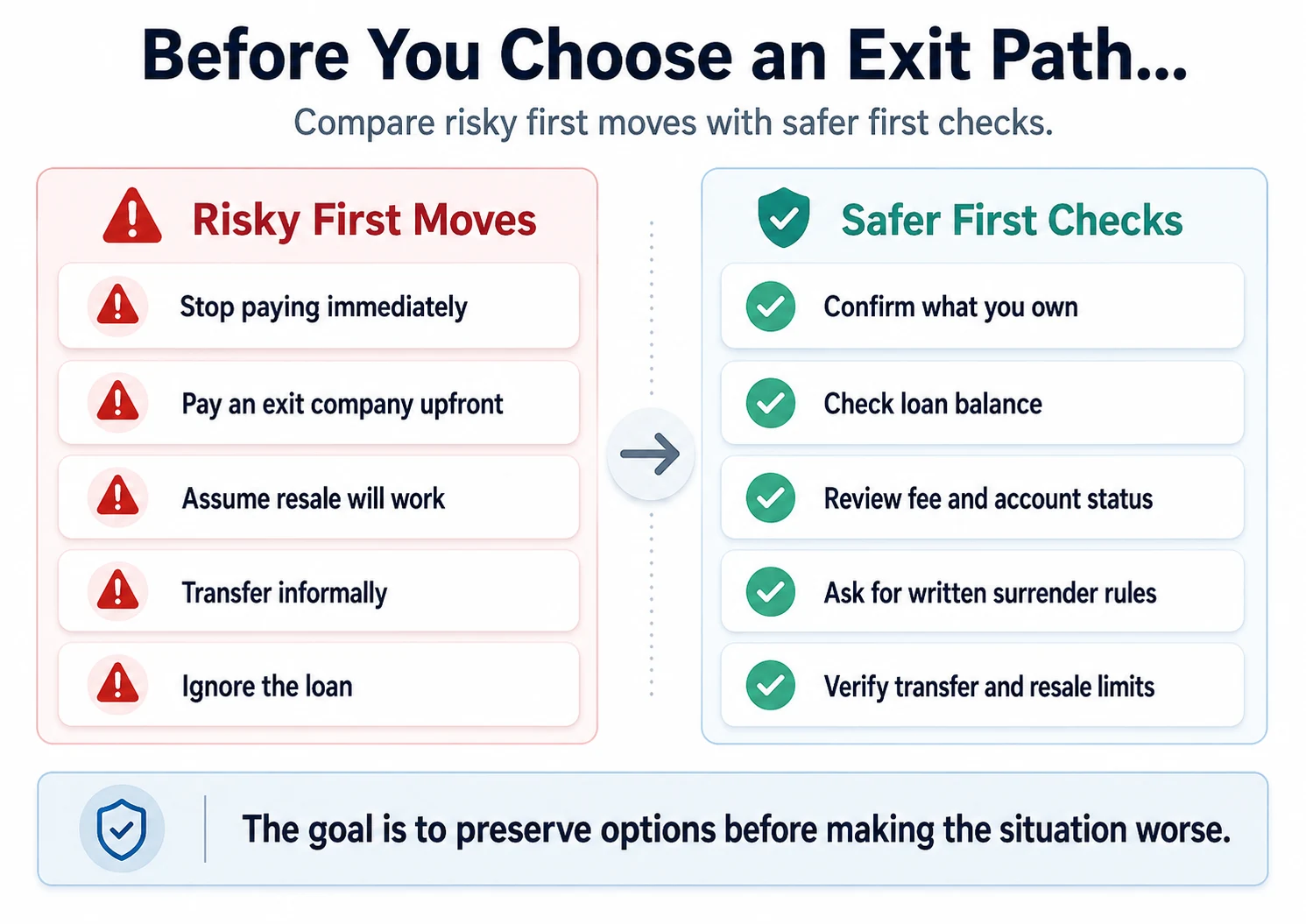
A good exit decision starts with knowing which moves may create risk. Some actions feel like progress in the moment, but can make the situation harder if they come before reviewing the contract, account status, and realistic exit paths.
Important Distinction
Exiting Faster and Exiting Safely Are Not the Same Thing
When a timeshare feels unaffordable, unusable, or impossible to sell, speed can feel like the priority. But the fastest-sounding option is not always the safest option.
A quick decision can create new problems if it ignores loan balances, maintenance fees, account standing, transfer restrictions, developer rules, or collection risk. The goal is not to delay action forever. The goal is to avoid choosing a path that reduces your options before you understand them.
Before You Make the Problem Worse
The Wrong Exit Move Can Create New Costs, Delays, or Credit Risk.
A timeshare exit can become harder if you stop paying too soon, sign the wrong exit-company agreement, rely on a resale promise, attempt a transfer that fails, ignore notices, or overlook developer surrender rules. Before you choose a path, the Timeshare Decision Intelligence Report™ helps organize your ownership details, account status, documents, cost exposure, transfer limits, surrender options, and realistic next-step pathways.
Want a clearer read before choosing an exit path?
Review the Report Option Or continue reading belowCommon Timeshare Exit Mistakes That Can Make Things Worse
Most exit mistakes happen before the owner fully understands the agreement. The problem is not always that the owner chose an impossible path. It is often that they chose a path too early.
Common Exit Mistakes
The First Move Can Create the Biggest Risk
These mistakes are common because they feel logical when an owner is frustrated. But each one can create added cost, delay, or exposure if it happens before the contract and account status are reviewed.
Payment Risk
Stopping Payments Too Early
Nonpayment can trigger late fees, collections, credit reporting, foreclosure, or other consequences depending on the contract and ownership type.
Outside Help
Hiring an Exit Company First
Paying for outside help before checking direct developer, surrender, resale, or transfer options can increase cost without improving the outcome.
Resale Assumption
Assuming Resale Will Solve It
Some timeshares have little resale demand, and transfer may be limited by loan balances, approval rules, fees, or buyer restrictions.
Transfer Risk
Trying an Informal Transfer
A timeshare usually is not transferred safely until the developer, association, or closing process recognizes the change in writing.
Loan Issue
Ignoring the Loan Balance
Active financing can limit resale, transfer, surrender, and negotiation options. The loan may need separate review from the ownership itself.
Bad Comparison
The label matters, but the structure matters more.
Another owner’s success or failure may not apply if your contract type, account standing, developer, or loan status is different.
What Are You Actually Trying to Exit?
Before choosing an exit path, identify what type of agreement you have.
A traditional timeshare may involve deeded ownership, points, a fixed or floating week, a right-to-use agreement, or some form of vacation ownership interest. These arrangements often include long-term obligations, annual maintenance fees, and transfer rules.
A vacation club may operate through points, club membership, trust interests, or resort-network access. It may feel more flexible than a traditional week, but it can still involve long-term financial obligations, annual dues, booking rules, and exit restrictions.
A travel club is often more membership-based. Instead of owning a deeded interest or timeshare week, members may pay for access, discounts, VIP benefits, or preferred rates. These programs may not have traditional maintenance fees, but they can still include upfront costs, renewal fees, usage rules, cancellation limits, or contract terms that affect exit.
The label matters less than the structure.
The question is not just whether it is called a timeshare, vacation club, or travel club. The question is what the agreement actually requires — and what happens if you try to leave.
System Insight
The Structure Controls the Risk, Not the Label
Two owners may both say they want to “exit a timeshare,” but one may have deeded ownership, another may have points, another may have a travel club membership, and another may still owe on a loan. The available exit paths depend on the agreement’s structure, not just the name used in marketing.
What to Do Instead
A safer exit starts with preserving options.
That does not mean doing nothing. It means taking the next step in a way that does not create unnecessary cost, missed deadlines, or new exposure.
Start by identifying the agreement type. Is it deeded ownership, points-based ownership, right-to-use, a fixed or floating week, a vacation club membership, or a travel club contract?
Then confirm the financial position. Is there a loan? Are maintenance fees current? Are there unpaid dues, assessments, taxes, late fees, or collection notices?
Next, check for direct options. Ask the developer, resort, association, or program administrator whether any written surrender, deedback, hardship, transfer, or internal exit process exists. Ask for the requirements in writing.
After that, evaluate resale or transfer carefully. Do not assume someone can take over the ownership unless the agreement allows it and the transfer is recognized properly.
If outside help is being considered, review the contract, fee structure, refund language, timeline, and who is actually performing the work. Be cautious with broad promises, large upfront fees, or guarantees that do not clearly match the facts of your ownership.
The goal is to choose an exit path based on the agreement — not panic, pressure, or promises.
Owner Risk
When the First Move Creates Bigger Problems
Stopping payments, paying for outside help, accepting a resale promise, or transferring ownership without written confirmation can create consequences that are harder to reverse. The risk is highest when the action happens before you understand the loan balance, account status, developer rules, transfer requirements, and consequences of default.
Before choosing an exit path, slow the decision down enough to check the facts. A structured review does not eliminate every risk, but it can help you avoid the most common mistakes that make the situation worse.
Action Step
Check These Details Before Your First Exit Move
Before you stop paying, hire outside help, attempt resale, request surrender, or transfer ownership, gather the facts that determine which exit paths may still be realistic.
Identify whether the agreement is deeded, points-based, right-to-use, fixed week, floating week, vacation club, or travel club membership.
Confirm whether there is an active loan balance and whether the loan must be paid before transfer or surrender.
Review current maintenance fees, dues, assessments, taxes, late fees, and account standing.
Ask for written developer surrender, deedback, hardship, or internal exit requirements.
Review resale and transfer restrictions before assuming another buyer or recipient can take over.
Understand what could happen if payments stop, including collections, credit reporting, foreclosure, or added fees.
Free Ownership Review Preview
Not Sure What Matters Most in Your Timeshare Situation?
Timeshare decisions can depend on several factors at once, including ownership type, loan status, annual fees, usage fit, transfer rules, surrender options, resale difficulty, and account standing. The free Ownership Risk Profile™ Preview can help you identify which issues may deserve closer attention before you choose a next step.
Want a quick read on your ownership factors?
Try the Free Preview Free preview • Educational decision support • No exit-company sales pitchDecision Insight
A Safer Exit Starts With Preserving Options
The best exit strategy is not always the most aggressive one. In many cases, the safer approach is the one that preserves account standing, avoids unnecessary fees, verifies direct options first, and prevents avoidable escalation.
That does not mean every owner should keep paying indefinitely or avoid outside help. It means the next move should match the facts of the ownership instead of the pressure of the moment.
❓Frequently Asked Questions
Timeshare exit mistakes often happen because owners act before they know what their agreement allows. These answers explain what to check before stopping payments, hiring help, attempting resale, or assuming surrender is available.
What is the safest first step if I want to exit a timeshare?
The safest first step is to review what you own, what you owe, and whether your account is current. Confirm whether there is a loan, what fees are due, whether transfer or resale is allowed, and whether the developer offers a written surrender or deedback option before choosing a strategy.
What should I avoid doing first when trying to exit a timeshare?
Avoid stopping payments, paying a company upfront, transferring ownership informally, or relying on resale before reviewing your contract and account status. These actions may still be considered later, but they can create added risk if they happen before you understand the loan balance, fees, transfer rules, and written exit options.
Can stopping payments make a timeshare exit harder?
Yes. Stopping payments may lead to late fees, collections, credit reporting, foreclosure, or other enforcement steps depending on the contract. It may also affect eligibility for surrender, transfer, or negotiated options. Nonpayment should not be treated as a clean exit without understanding the consequences.
Should I hire a timeshare exit company before contacting the developer?
Usually, it is better to check direct options first. Ask the developer, resort, association, or program administrator whether a written surrender, deedback, hardship, or transfer process exists. If you consider outside help later, review fees, guarantees, refund language, timelines, and who performs the work.
Can I transfer my timeshare to someone else to get out?
Possibly, but only if the transfer is allowed and properly completed. Many ownerships require developer approval, payment of transfer fees, loan payoff, closing documents, or written recognition of the new owner. Informal transfers can leave the original owner responsible if the process is not completed correctly.
Is a travel club easier to exit than a timeshare?
Sometimes, but not always. A travel club may not involve deeded ownership or traditional maintenance fees, but the contract may still include cancellation limits, renewal terms, usage fees, or other obligations. The exit difficulty depends on the agreement, not just the label.
How do I avoid making my timeshare exit worse?
Avoid making irreversible decisions before reviewing the contract. Do not stop payments, pay outside help, accept a resale promise, or transfer ownership casually without first confirming loan status, fees, account standing, developer rules, and written exit or transfer requirements.
Bottom Line
Exiting a timeshare is not only about finding a way out. It is also about avoiding decisions that make the situation harder.
The first move can shape what happens next. Stopping payments, hiring outside help, assuming resale will work, or attempting an informal transfer can create problems if those steps happen before you understand the contract, loan balance, account status, and developer rules.
A safer exit starts with clarity.
Identify what you own. Confirm what you owe. Check whether the account is current. Ask for written surrender or transfer rules. Understand the consequences of nonpayment. Then choose the path that matches your situation.
The Wrong Timeshare Exit Move Can Cost More Than the Problem You’re Trying to Solve.
Stopping payments, hiring an exit company, chasing resale promises, requesting a surrender, or transferring ownership can all lead to very different outcomes depending on your contract, loan status, fees, account standing, documents, and developer rules. The Timeshare Decision Intelligence Report™ helps organize those details so you can see which paths appear realistic before you commit to the wrong move.
Get the Timeshare Decision Intelligence Report™ Customized ownership review • Decision-support report • No exit-company sales pitchIndependent decision support. This is not legal advice, contract cancellation, an exit service, a resale service, lender negotiation, or a promise that your timeshare can be exited.
Related Guides
These guides can help you go deeper into the decisions that most often affect a timeshare exit.
Timeshare Exit Guide
Start with the right exit path based on your situation before choosing resale, surrender, exit companies, legal review, or nonpayment.
Read the exit guide →
How Timeshare Exit Companies Work
Before paying outside help, review how the exit-company process usually works and what questions to ask about fees, timelines, authorization, and account handling.
Read the process guide →
What Happens If I Stop Paying My Timeshare?
Understand collections, credit risk, foreclosure exposure, loan issues, and why nonpayment is not the same as a clean exit.
Read the stop-payment guide →
Can’t Afford Your Timeshare Anymore?
Review what to check before stopping payments, including loan balance, maintenance fees, account status, surrender options, resale limits, collections risk, and possible next steps.
Read the affordability guide →
Timeshare Exit Companies
Learn how exit companies position their services, what they may charge, and what owners should review before hiring outside help.
Read the exit company guide →
Are Timeshare Exit Companies Legit or a Scam?
Check whether an exit company’s claims, fees, strategy, and payment advice could create new risk before you sign or pay.
Read the legitimacy guide →
Timeshare vs Travel Club: Which Is Harder to Exit?
Compare how timeshare, vacation club, and travel club structures can affect exit difficulty.
Read the comparison guide →
How Much Does It Cost to Get Out of a Timeshare?
Review the costs that may apply across resale, surrender, legal review, exit companies, transfer, and nonpayment scenarios.
Read the cost guide →
Timeshare Exit Guide
Review the main exit starting points before choosing a strategy that could affect your contract, payments, resale options, or account standing.
Read the exit guide →