
Club Wyndham vs Marriott Vacation Club: Costs, Resale, and Exit Options
Club Wyndham and Marriott Vacation Club are two of the largest and most recognizable vacation ownership systems.
Both offer points-based travel options, access to multiple resorts and destinations, and connections to familiar hospitality brands. On the surface, the comparison can look like a choice between resort networks, destination variety, and brand preference.
But the more important differences may appear in how the ownership works over time.
Club Wyndham and Marriott Vacation Club can differ in their points structures, booking systems, annual fees, financing, resale treatment, transfer requirements, and possible exit pathways.
The more useful comparison is whether the specific ownership is:
- affordable over time
- practical to use for the trips you actually want
- transferable under the applicable program rules
- realistic to resell
- manageable if your travel habits or finances change
- eligible for any surrender, deed-back, or other exit review
This guide compares Club Wyndham and Marriott Vacation Club across costs, points and booking access, resort networks, maintenance fees, financing, resale restrictions, transfer rules, and possible exit options.
Quick Answer
Are Wyndham and Marriott the Same Company?
No. Wyndham is not part of Marriott, and Marriott is not part of Wyndham. Club Wyndham and Marriott Vacation Club are separate vacation ownership systems operated by different companies. Club Wyndham is part of the Travel + Leisure Co. portfolio, while Marriott Vacation Club is operated by Marriott Vacations Worldwide.
The familiar Wyndham and Marriott names can make the programs seem connected, but their ownership structures, booking systems, fees, resale rules, transfer requirements, and exit pathways are separate. Neither program is automatically better; the stronger fit depends on the specific contract and how the ownership works over time.
Important Distinction
Comparing the Brands Is Different From Comparing the Ownership Contracts
Club Wyndham and Marriott Vacation Club may both offer recognizable brands, points-based travel, established resorts, and access to multiple destinations. Those similarities can help buyers compare the vacation experience, but they do not show how a specific ownership will work financially or contractually.
The more important differences may involve the exact ownership structure, booking priority, annual fees, financing, resale benefits, transfer restrictions, and whether a surrender, deed-back, or other exit pathway may be available later. A stronger brand preference does not automatically create the stronger long-term ownership.
Before You Compare Wyndham and Marriott
The Better Program Depends on How the Specific Ownership Works for You.
Club Wyndham and Marriott Vacation Club can differ in points structure, booking access, annual costs, financing, resale benefits, transfer restrictions, and possible exit pathways. The Timeshare Decision Intelligence Report™ helps organize your ownership documents, cost exposure, usage fit, account status, and unanswered questions before you buy, upgrade, sell, transfer, or pursue an exit.
Want a clearer read before making an ownership decision?
Review the Report Option Or continue reading belowClub Wyndham vs Marriott Vacation Club at a Glance
Club Wyndham and Marriott Vacation Club may look similar because both offer points-based travel, access to multiple destinations, and connections to familiar hospitality brands. But the practical differences appear in how each ownership handles booking access, annual costs, resale rights, transfer rules, and possible exit options.
The comparison image below provides a high-level view of the two systems. The detailed table that follows explains what those differences may mean for an owner over time.
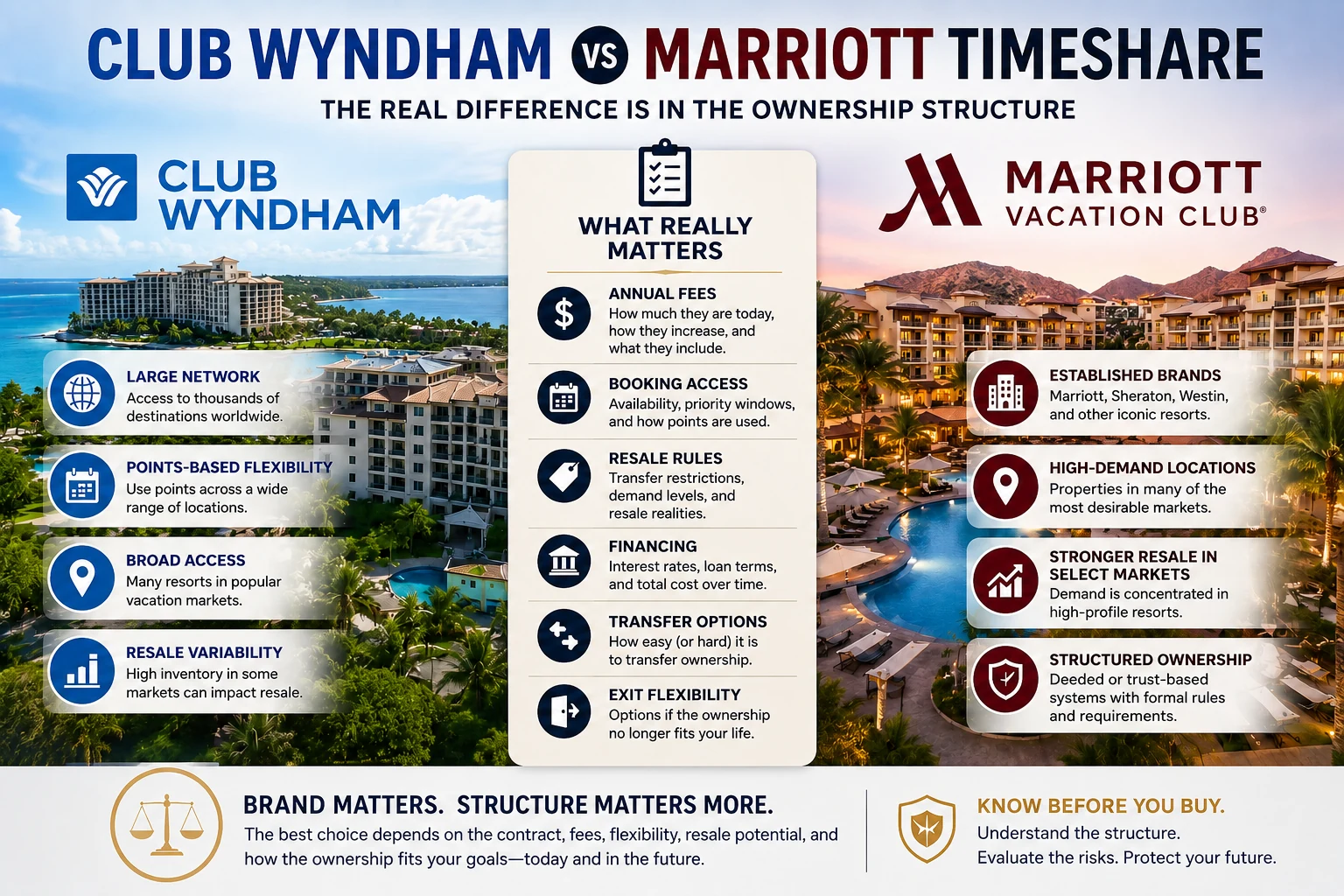
What the Differences May Mean for Owners
A brand-level comparison is useful, but owners should also consider how each system may affect real-world usage, long-term cost, resale, and exit flexibility.
The table below compares the questions an owner should verify before buying, upgrading, reselling, transferring, or trying to leave either program.
Which Vacation Club May Fit Which Type of Owner?
Club Wyndham and Marriott Vacation Club may appeal to different travel styles, but neither system should be judged by brand preference alone. The stronger fit depends on how the owner plans, books, pays, and expects the ownership to work if circumstances change.
May Favor Club Wyndham
Owners Who Value a Broad Points-Based Network
Club Wyndham may appeal to owners who want destination variety and are comfortable planning within a large points-based system. The practical value depends on booking windows, point requirements, resort demand, home-resort priority, and whether the owner has enough flexibility to use the network effectively.
May Favor Marriott Vacation Club
Owners Who Value Established Resort Markets and Brand Positioning
Marriott Vacation Club may appeal to owners who prefer Marriott-affiliated vacation ownership resorts, established destinations, and premium positioning. The fit still depends on the specific product, annual dues, booking rights, resale treatment, and the availability of the trips the owner actually wants.
May Favor More Caution
Owners Focused on Low Cost or Easy Exit Flexibility
Neither program removes financing, rising annual fees, resale uncertainty, transfer restrictions, or surrender limitations. Buyers who need low ongoing costs, highly flexible booking, or a predictable exit should review the exact contract carefully before assuming either brand will provide those outcomes.

Club Wyndham Overview
Club Wyndham is a points-based vacation ownership program within the broader Travel + Leisure Co. vacation ownership portfolio.
Its main appeal is access to a large network of resorts and destinations. Owners may use points for different locations, unit sizes, and travel periods, subject to booking windows, availability, point requirements, home-resort priority, and the rules attached to the specific ownership.
That flexibility can be useful for owners who plan ahead and are comfortable navigating a points system. But the size of the network does not guarantee that every resort or travel date will be easy to book.
The practical value of a Club Wyndham ownership may depend on:
- the number and type of points owned
- the home resort, trust, or association structure
- booking priority and reservation windows
- annual maintenance fees and club charges
- financing and interest
- benefits that may change after resale
- transfer requirements and exit eligibility
It is also important to distinguish Club Wyndham from other Wyndham-affiliated vacation ownership programs. WorldMark by Wyndham, for example, operates under its own ownership structure, rules, booking system, and fee model.
For a deeper review of the program, see Club Wyndham: What Owners Should Know.
Marriott Vacation Club Overview
Marriott Vacation Club is a vacation ownership program operated within Marriott Vacations Worldwide.
Its appeal often comes from established resort destinations, Marriott-affiliated branding, and access to a broad vacation ownership network. Depending on the product, owners may hold destination points, a legacy week, a deeded interest, a trust-based interest, or resale ownership subject to different rules and benefits.
That variety means Marriott Vacation Club ownership does not work the same way for every owner.
The practical value may depend on:
- the specific ownership product
- resort or trust structure
- booking windows and reservation priority
- annual dues and club charges
- financing and interest
- exchange or conversion privileges
- resale benefits and restrictions
- transfer requirements and exit eligibility
Brand familiarity may make the program feel more predictable, but owners still need to review the actual contract, fee structure, usage rights, and long-term obligations.
For a deeper review of the program, see Marriott Vacation Club Ownership: Costs, Resale Restrictions, and Exit Options.
Owner takeaway: Club Wyndham may offer broader points-based variety, while Marriott Vacation Club may appeal through established resort markets and premium positioning. But the better ownership depends on the specific contract, booking access, annual costs, resale rights, transfer rules, and realistic exit options—not the brand name alone.
Key Differences Between Club Wyndham and Marriott Vacation Club
The strongest comparison is not simply which program has more resorts or the more recognizable brand. The practical differences appear in how each ownership performs when the owner tries to book, manage annual costs, resell, transfer, or exit later.
1. Resort Network and Destination Access
Club Wyndham is often associated with a broad points-based network and a large range of destinations. That may appeal to owners who value variety and want to use points across different resorts rather than returning to the same location each year.
Marriott Vacation Club may appeal to owners who prefer established resort markets, Marriott-affiliated vacation ownership properties, and destinations associated with premium resort positioning.
Neither advantage guarantees easier travel.
The practical value of either network depends on:
- whether the desired resorts participate in the owner’s specific program
- booking windows and reservation priority
- seasonal demand
- unit size and point requirements
- the owner’s flexibility with dates and destinations
- whether sufficient points are available for the preferred trip
A larger network may provide more theoretical options, while a premium resort portfolio may offer stronger appeal in particular markets. But the better system is the one that gives the owner realistic access to the vacations they are most likely to book.
Owner takeaway: Compare the trips you are most likely to book, not just the size or reputation of the resort network. Availability, point requirements, booking windows, and travel timing can matter more than the brand list.
2. Points, Booking Windows, and Flexibility
Points play a major role in both Club Wyndham and Marriott Vacation Club, although not every ownership is structured the same way.
Club Wyndham is generally built around points-based usage. The owner’s practical access may depend on the points package, home resort or trust structure, booking window, reservation priority, resort demand, unit size, and travel season.
Marriott Vacation Club may involve destination points, legacy weeks, trust interests, deeded interests, or other ownership structures. Booking access may depend on the specific product, reservation window, season, point requirements, availability, and any exchange or enrollment rights attached to the ownership.
That is why the number of resorts or destinations does not tell the full story. An owner may technically have access to a large network but still need to:
- reserve far in advance
- use more points during popular periods
- accept different dates, resorts, or unit sizes
- compete for limited high-demand inventory
- pay additional transaction or exchange charges
- understand whether resale ownership changes certain benefits
The stronger system is not necessarily the one advertising the most destinations. It is the one whose booking rules, point requirements, and availability fit the owner’s actual travel habits.
System Insight
Points Flexibility Is Controlled by the Rules Behind the Points
- Booking windows and reservation priority can matter as much as the number of points owned when popular resorts or dates have limited availability.
- Season, unit size, and destination demand can change the number of points required for the same length of stay.
- The ownership product and purchase source may affect practical access, including benefits, enrollment rights, or options available after resale.
- The most useful comparison is based on realistic trips, not the total number of destinations advertised by either program.
3. Exchange Networks and External Travel Options
Both Club Wyndham and Marriott Vacation Club may provide ways to travel beyond a single home resort, but exchange access should be evaluated separately from the underlying ownership.
Depending on the specific product, owners may have access to:
- internal resort networks
- affiliated vacation ownership programs
- external exchange services
- hotel or travel-related conversion options
- additional reservation or exchange benefits
Those options can expand where an owner travels, but they may also involve separate rules, fees, enrollment requirements, account-standing conditions, and inventory limitations.
For Club Wyndham, exchange and external travel access may depend on the ownership type, points package, program eligibility, and benefits attached to the account.
For Marriott Vacation Club, access may depend on whether the owner holds destination points, a legacy week, an enrolled product, a trust interest, or resale ownership with different exchange or conversion rights.
Before comparing the programs, owners should verify:
- which exchange options are actually included
- whether participation requires additional dues or transaction fees
- how far in advance exchanges can be requested
- whether desired resorts and dates are realistically available
- whether resale ownership changes exchange or conversion privileges
- whether unused points or weeks can be carried forward, converted, or lost
Exchange access can add travel flexibility, but it does not reduce the underlying loan, annual dues, maintenance fees, transfer restrictions, or exit obligations. It may help an owner use the ownership differently, but it should not be treated as a solution when the ownership is no longer affordable or practical.
Owner takeaway: Exchange access can add travel options, but it should not be confused with exit flexibility. If the ownership becomes too expensive or difficult to use, exchange programs usually do not solve the underlying contract obligation.
4. Hotel Loyalty Programs and Brand Connections
Club Wyndham and Marriott Vacation Club may offer connections to broader hotel, travel, or loyalty ecosystems, but those benefits should be reviewed separately from the timeshare ownership itself.
Loyalty-program access can make an ownership feel more flexible or familiar. Depending on the product and account, owners may be able to convert points, access affiliated travel benefits, or use certain hotel-related options.
But those benefits may depend on:
- whether the ownership was purchased directly or through resale
- the specific membership or ownership level
- enrollment requirements
- conversion ratios and transaction fees
- annual account standing
- program rules that may change over time
- whether benefits transfer to a future buyer
A hotel loyalty membership is generally optional and can often be used without owning a timeshare. A vacation ownership contract is different because it may include financing, annual fees, booking rules, transfer restrictions, and long-term obligations.
Before giving extra value to either brand connection, owners should compare what the benefit provides in practice. A conversion or hotel-related option may sound appealing, but it may offer less value than using the ownership directly once point requirements, fees, and conversion limitations are considered.
The most useful question is not whether Club Wyndham or Marriott Vacation Club has the more familiar loyalty ecosystem. It is whether the specific benefits materially improve how the owner travels—and whether those benefits remain available after resale, transfer, or a change in account status.
5. Resale Value and Transfer Restrictions
Resale is one of the most important differences to evaluate before choosing between Club Wyndham and Marriott Vacation Club.
Neither brand guarantees that an ownership will retain its original purchase value or be easy to sell later. Resale outcomes depend on the specific product, annual costs, buyer demand, transfer rules, and which benefits remain available after the ownership changes hands.
For Club Wyndham, resale value may be affected by:
- the number and type of points
- annual maintenance fees and club charges
- the home resort, trust, or association structure
- the supply of comparable resale listings
- transfer requirements and administrative costs
- benefits or privileges that may not transfer to a resale buyer
For Marriott Vacation Club, resale value may be affected by:
- whether the ownership involves a legacy week, points, trust interest, or another product
- the resort, season, points package, or destination demand
- annual dues and other recurring charges
- Marriott’s transfer or review requirements
- benefits, enrollment rights, or exchange options that may change after resale
- any right-of-first-refusal process that applies to the ownership
The original purchase price is not a reliable measure of resale value. A future buyer is usually evaluating the ongoing obligation, including annual fees, booking access, usage rights, transfer costs, and any limitations attached to resale ownership.
Financing can create an additional barrier. A sale or transfer may not be possible until the loan balance is resolved, and the resale price may be far below the amount still owed.
Before relying on resale as a future exit strategy, owners should confirm:
- whether the ownership can be transferred
- whether a loan or delinquent balance must be paid first
- which benefits remain with the resale buyer
- whether developer approval or review is required
- what closing, recording, or transfer fees may apply
- what comparable ownerships have actually sold for—not only their asking prices
A recognizable brand may help create buyer interest, but the resale market ultimately depends on whether another person sees enough usable value to accept the ongoing costs and restrictions.
Owner takeaway: Resale value depends on the specific ownership, not just the brand. Before assuming Club Wyndham or Marriott will be easy to sell, compare transfer rules, annual fees, loan status, resale buyer benefits, and realistic market demand.
6. Maintenance Fees, Financing, and Long-Term Cost
The long-term cost of Club Wyndham or Marriott Vacation Club ownership may be more important than the initial purchase price.
Both programs can involve recurring expenses such as:
- annual maintenance fees or dues
- club or program charges
- reservation or transaction fees
- exchange costs
- assessments
- financing payments and interest
Those costs may continue whether or not the owner uses the ownership in a particular year.
For Club Wyndham, long-term cost may depend on the number of points owned, the home resort or trust structure, association expenses, annual program charges, and the number of points required for the trips the owner wants.
For Marriott Vacation Club, cost may depend on the ownership product, resort or trust structure, annual dues, club participation, exchange use, and whether additional points or benefits are needed to book preferred travel.
Financing can significantly change the comparison. An owner carrying both a loan and annual fees may face a much higher total cost than the purchase price alone suggests. Interest can also increase the gap between what is owed and what the ownership may be worth on the resale market.
Before comparing affordability, owners should separate:
- the original purchase price
- the remaining loan balance
- total interest over the financing term
- annual maintenance fees or dues
- club, exchange, and transaction charges
- assessments or other variable expenses
- the actual number of nights or trips used each year
The better-value program is not necessarily the one with the lower annual fee. A lower-cost ownership may still provide poor value if points go unused or desired reservations are difficult to secure. A higher-cost ownership may be worthwhile for some owners if it consistently supports trips they would otherwise purchase at a comparable or greater cost.
The more useful question is whether the total cost remains reasonable compared with the travel value the owner actually receives—and whether those obligations would still be manageable if usage declines or circumstances change.
Risk Point
Brand Strength Does Not Remove Long-Term Cost or Resale Risk
Club Wyndham and Marriott Vacation Club may both offer recognizable vacation ownership systems, but neither brand eliminates financing, rising annual fees, booking limitations, resale restrictions, or transfer requirements.
The risk becomes greater when the ownership is financed, points are not used consistently, annual costs increase faster than the owner’s travel value, or resale and surrender options are assumed rather than verified. A familiar brand may make the purchase feel more secure, but it does not make the underlying contract easier to afford, sell, transfer, or exit.
7. Exit Flexibility and Surrender Options
Exit flexibility is one of the most important differences to review before choosing between Club Wyndham and Marriott Vacation Club.
Neither program gives every owner an automatic right to cancel, return, or walk away from the ownership after the rescission period ends. The available path may depend on the specific product, loan status, account standing, transfer rules, resale demand, and whether a current surrender, deed-back, or voluntary-return process applies.
For Club Wyndham, possible pathways may include:
- resale or transfer to another person
- review through a current developer or owner-assistance program
- surrender, deed-back, or voluntary-return consideration
- resolving financing or delinquent balances before another option can proceed
For Marriott Vacation Club, possible pathways may include:
- resale, subject to the product and transfer requirements
- developer review of eligible surrender or deed-back requests
- right-of-first-refusal procedures where applicable
- resolving financing, annual dues, or account issues before transfer or relinquishment
In either system, the owner should verify:
- whether the loan must be paid off
- whether annual fees and dues must be current
- whether the ownership is eligible for transfer
- whether resale benefits differ from direct-purchase benefits
- whether the developer is currently accepting surrender or deed-back requests
- whether fees, closing costs, or administrative charges apply
- what written document will confirm that the ownership and future obligations have ended
A strong resort network or recognizable brand does not guarantee an easy exit. The better comparison is whether the specific ownership has a realistic pathway to be sold, transferred, surrendered, or otherwise resolved if the owner’s circumstances change.
Action Step
Compare the Specific Ownerships, Not Just Club Wyndham and Marriott Vacation Club
Before buying, upgrading, reselling, transferring, or trying to exit either program, collect the details that determine how the ownership will actually perform over time.
Identify the exact ownership product, including points, legacy week, trust interest, deeded interest, home resort, association, or resale status.
Compare realistic booking access, including reservation windows, point requirements, priority rules, high-demand dates, and preferred unit sizes.
Calculate the full annual and long-term cost, including financing, interest, maintenance fees, club dues, transaction charges, and assessments.
Verify resale and transfer restrictions, including which benefits remain available to a resale buyer and whether developer review applies.
Ask about current surrender or deed-back requirements, including loan payoff, account-standing rules, fees, documents, and eligibility limits.
Confirm how completion would be documented if the ownership is later sold, transferred, surrendered, or otherwise resolved.
Quick Win
Compare one realistic vacation in each system. Use the dates, destination, unit size, points required, annual costs, and booking window you would actually need. That comparison is more useful than relying on resort counts or brand reputation alone.
Which Is Riskier: Club Wyndham or Marriott Vacation Club?
Neither Club Wyndham nor Marriott Vacation Club is automatically the riskier ownership system.
The risk depends more on the specific contract and account than on the brand name. A financed Club Wyndham ownership with rising fees, limited booking value, and weak resale demand may create more pressure than a paid-off Marriott ownership that is used consistently. The reverse may also be true.
The most important risk factors include:
- whether the ownership is financed
- the remaining loan balance and interest cost
- current maintenance fees, dues, and assessments
- whether the points or usage rights support realistic travel
- booking-window and availability limitations
- resale demand and buyer-benefit restrictions
- transfer requirements
- account standing
- surrender or deed-back eligibility
- the availability of a realistic exit path
Club Wyndham may be a stronger fit for owners who value a broad points-based network and can plan within its reservation system.
Marriott Vacation Club may be a stronger fit for owners who value established resort destinations, Marriott-affiliated positioning, and the rights attached to a particular Marriott ownership product.
But neither is necessarily the better choice for someone who needs low annual costs, highly predictable reservations, strong resale value, or a guaranteed ability to give the ownership back later.
The lower-risk ownership is generally the one that remains affordable, usable, transferable, and realistic to exit if the owner’s finances, travel habits, or family circumstances change.
Free Ownership Review Preview
Which Ownership Factors Deserve a Closer Look?
Comparing Club Wyndham and Marriott Vacation Club can clarify broad differences, but the risk in a specific ownership may depend on its financing, annual costs, booking rights, resale treatment, transfer restrictions, account standing, and possible exit pathways.
- Identify financial or usage factors that may reduce the ownership’s long-term value.
- Review resale, transfer, surrender, and documentation issues that may require verification.
- See which unanswered questions deserve attention before buying, upgrading, selling, or exiting.
Get a quick read on the factors that may affect your ownership decision.
Try the Free Ownership Risk Profile™ Free preview • Educational decision support • No exit-company sales pitchDecision Insight
Choose the Ownership That Fits the Long-Term Reality
A useful Club Wyndham versus Marriott Vacation Club comparison should look beyond the next vacation. The ownership also needs to make sense if annual costs rise, booking needs change, points become harder to use, resale demand is weaker than expected, or family members do not want to continue the obligation.
The better choice is not automatically the larger network or more familiar brand. It is the specific ownership whose costs, booking rights, resale treatment, transfer rules, and possible exit pathways remain manageable under realistic—not ideal—conditions.
❓ Frequently Asked Questions
These questions commonly arise when buyers and owners compare Club Wyndham and Marriott Vacation Club across company relationships, booking access, annual costs, resale restrictions, and possible exit options.
Are Wyndham and Marriott the same company?
No. Wyndham is not part of Marriott, and Marriott is not part of Wyndham. Club Wyndham and Marriott Vacation Club are separate vacation ownership systems operated through different companies.
Club Wyndham is part of the Travel + Leisure Co. brand portfolio, while Marriott Vacation Club operates within Marriott Vacations Worldwide. Their contracts, points systems, fees, reservation rules, and exit processes are separate.
Is Club Wyndham better than Marriott Vacation Club?
Neither program is automatically better. Club Wyndham may appeal to owners who value a broad points-based network and destination variety. Marriott Vacation Club may appeal to owners who prefer established resort markets and Marriott-affiliated vacation ownership properties.
The stronger fit depends on the specific ownership product, booking access, annual costs, financing, resale restrictions, transfer rules, and possible exit pathways.
Which has better resale value: Club Wyndham or Marriott Vacation Club?
Resale value depends on the specific ownership rather than the brand alone. Some Marriott products or resort locations may attract stronger demand, while Club Wyndham outcomes may vary based on the points package, annual fees, home resort or trust structure, and comparable resale supply.
Buyers may also receive different benefits after resale. Owners should compare completed sales, transfer rules, recurring costs, and which booking or exchange rights remain available to a resale buyer.
Are Club Wyndham and Marriott Vacation Club easy to sell?
Not necessarily. Brand recognition may create interest, but a completed sale still depends on realistic buyer demand, annual fees, financing, transfer requirements, account standing, and the benefits that transfer with the ownership.
Listing an ownership does not complete an exit. The loan may need to be resolved, a buyer must accept the ongoing obligation, and the required transfer process must be completed.
Which has lower maintenance fees: Club Wyndham or Marriott Vacation Club?
There is no single brand-wide answer. Club Wyndham fees may vary by points package, home resort, trust, association, and program structure. Marriott Vacation Club dues may vary by product, resort, trust interest, points allocation, or legacy-week ownership.
A useful comparison should include annual dues, club charges, reservation or transaction fees, assessments, financing, and the travel value received—not only the headline maintenance-fee amount.
Can you give back a Club Wyndham or Marriott Vacation Club timeshare?
Possibly, but neither company must automatically accept every ownership. A surrender, deed-back, voluntary-return, or internal review may depend on the product, loan status, account standing, fee balance, documents, and current program requirements.
Owners should request the eligibility terms in writing and confirm what document would show that ownership and responsibility for future fees have officially ended.
Which is easier to exit: Club Wyndham or Marriott Vacation Club?
Neither program is universally easier to exit. The realistic options may depend on whether the ownership is paid off and current, whether resale demand exists, whether transfer restrictions apply, and whether the specific product qualifies for a current surrender or deed-back review.
A paid-off, current, transferable ownership may offer more flexibility than one with financing or delinquent fees, regardless of whether it is Club Wyndham or Marriott Vacation Club.
Is WorldMark by Wyndham the same as Club Wyndham?
No. Club Wyndham and WorldMark are separate vacation club brands within the broader Travel + Leisure Co. portfolio. They may have different ownership structures, points or credits, booking systems, annual charges, transfer rules, and exit considerations.
Owners should rely on the exact program named in their contract rather than treating every Wyndham-affiliated vacation ownership as interchangeable.
Bottom Line
Club Wyndham and Marriott Vacation Club are both major vacation ownership systems, but neither is automatically the better choice.
Club Wyndham may appeal to owners who value a broad points-based network and destination variety. Marriott Vacation Club may appeal to owners who prefer established resort markets, Marriott-affiliated vacation ownership properties, and premium positioning.
The stronger ownership is the one that remains workable across the factors that matter most:
- realistic booking access
- annual maintenance fees and club charges
- financing and total interest
- benefits that remain after resale
- transfer requirements
- buyer demand
- surrender or deed-back eligibility
- long-term affordability
- a realistic path out if circumstances change
A large resort network does not guarantee easier reservations. A premium brand does not guarantee strong resale value. Neither program guarantees that the developer will accept the ownership back later.
Before buying, upgrading, reselling, transferring, or trying to exit either system, review the exact ownership product and governing documents—not only the Wyndham or Marriott name.
The better long-term choice is generally the ownership that remains affordable, usable, transferable, and realistic to exit under ordinary conditions, not just when everything goes according to plan.
A Brand Comparison Cannot Tell You What Your Specific Ownership Really Allows.
Club Wyndham and Marriott Vacation Club can differ in points, booking rights, annual costs, resale treatment, transfer restrictions, and possible exit pathways. The Timeshare Decision Intelligence Report™ helps organize your actual ownership documents, financing, fee exposure, account status, benefit restrictions, verification gaps, and realistic next-step options before you make another costly decision.
Get the Timeshare Decision Intelligence Report™ Customized ownership review • Decision-support report • No exit-company sales pitchIndependent decision support. This is not legal advice, contract cancellation, an exit service, a resale service, lender negotiation, or a promise that your timeshare can be exited.
Related Guides
Use these guides to compare other ownership systems and explore the cost, resale, and exit issues that may affect either program.
Compare Vacation Ownership Programs
- Marriott Vacation Club vs Hilton Grand Vacations
Compare two hotel-affiliated ownership systems across points, fees, booking access, resale, and exit flexibility. - Timeshare Companies Compared
See how major operators differ in ownership structure, resort access, recurring costs, resale restrictions, and exit pathways.
Understand Costs and Resale
- How Much Does a Timeshare Cost? Total Ownership Costs and Calculator
Calculate purchase price, financing, annual fees, assessments, usage expenses, and long-term ownership exposure. - Why Are Timeshares Hard to Sell?
Understand how buyer demand, annual fees, financing, transfer rules, and lost benefits can affect resale.
Review Exit Options
- Timeshare Exit Options: What Owners Should Know
Compare resale, transfer, surrender, deed-back, outside assistance, and nonpayment before choosing a strategy. - Can You Give Back a Timeshare?
Learn when surrender, deed-back, relinquishment, or voluntary return may be available and what to verify first.