
Timeshare vs Travel Club Exit: Which Is Harder to Get Out
Timeshares and travel clubs are often sold as different kinds of vacation products.
One may be described as ownership. The other may be described as membership, access, savings, or flexibility.
But when someone wants out, the question changes.
The real issue is not just “Is this a timeshare or a travel club?”
It is “What does the agreement actually require if I stop using it, stop paying for it, try to transfer it, or ask to cancel?”
In many cases, timeshares can be harder to exit because they may involve deeded ownership, long-term points contracts, ongoing maintenance fees, financing, and stronger enforcement mechanisms. Travel clubs may sometimes be easier to end because they are often membership-based, but that is not guaranteed.
Some travel clubs include financing, restrictive cancellation terms, non-transferable memberships, or dues that create their own exit friction.
This guide compares timeshare and travel club exit difficulty, explains why the underlying structure matters more than the label, and shows what to review before assuming one option is automatically easier to get out of.
Quick Answer
Which Is Harder to Get Out Of: a Timeshare or a Travel Club?
Timeshares are often harder to exit than travel clubs because they may involve deeded ownership, long-term points contracts, ongoing maintenance fees, financing, transfer restrictions, and stronger enforcement mechanisms. Travel clubs are often membership-based, which may create more flexibility, but that does not automatically make them easy to cancel.
The real answer depends on the agreement. A paid-off timeshare with a transfer or surrender option may be easier to resolve than a financed travel club with strict cancellation terms. Exit difficulty is usually determined by structure, financing, fees, transfer rules, and enforcement terms — not by the label used in the sales presentation.
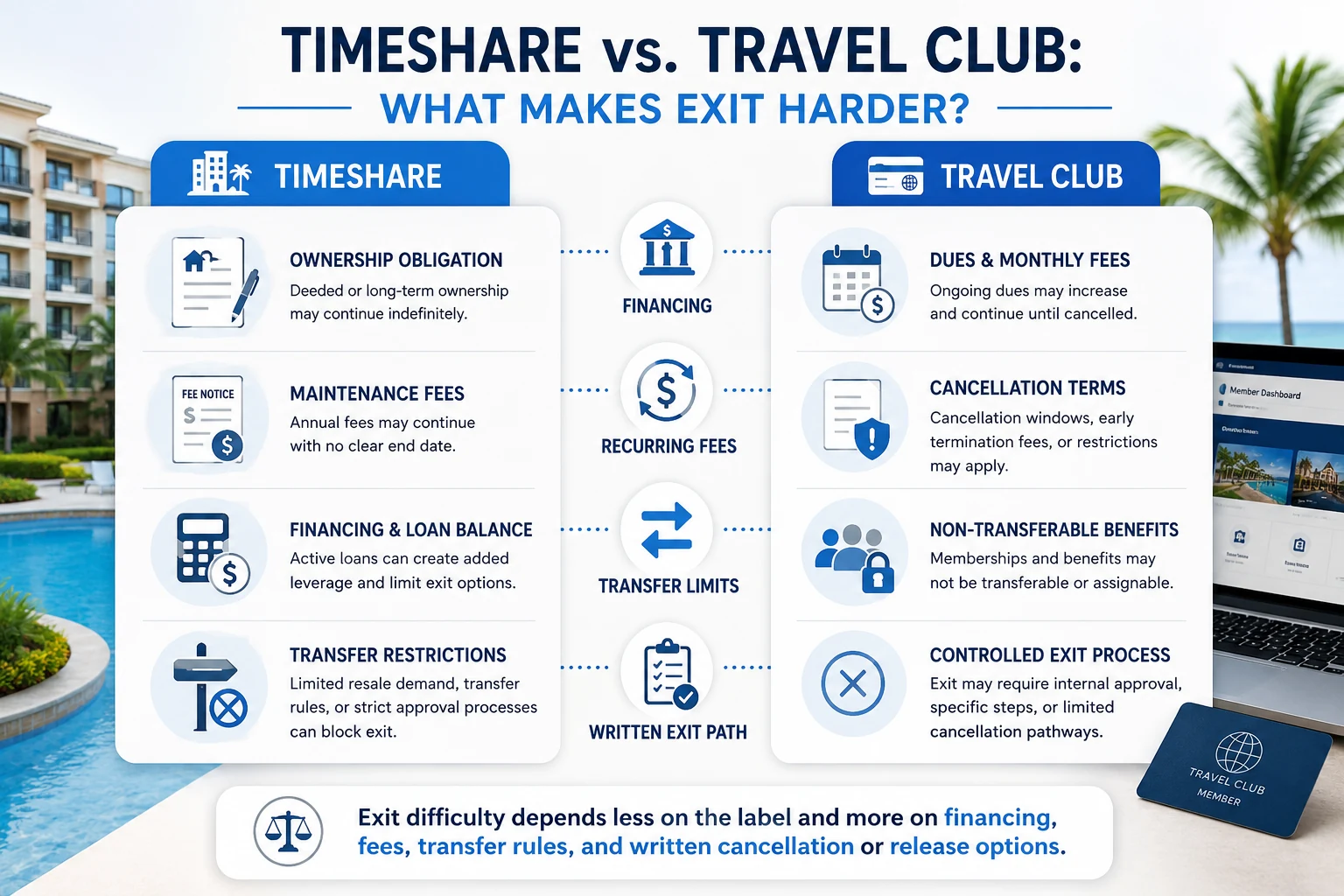
Before comparing timeshares and travel clubs side by side, it helps to separate the marketing label from the obligation underneath it.
A product may be called a timeshare, travel club, vacation club, membership, points program, or ownership plan. But when you want out, the name matters less than the structure behind it.
That structure determines whether you are dealing with a transferable ownership interest, a financed contract, recurring fees, a renewable membership, or a cancellation process controlled by the provider.
Once that distinction is clear, the comparison becomes easier to understand.
Important Distinction
The Name of the Product Does Not Determine Exit Difficulty
A timeshare is not automatically impossible to exit, and a travel club is not automatically easy to cancel. The real issue is how the agreement is structured: whether there is ownership, financing, recurring fees, transfer limits, cancellation restrictions, or provider-controlled exit rules.
That is why two products that sound very different during the sales process can create similar exit friction later. The label may shape expectations, but the contract structure usually determines what happens when someone wants out.
Timeshare vs. Travel Club Exit Difficulty
The easiest way to compare exit difficulty is to look at what the agreement gives the provider — and what it leaves the owner or member with.
A timeshare may involve deeded ownership, points-based ownership, recurring maintenance fees, financing, and transfer restrictions. A travel club may involve membership dues, cancellation rules, financed purchase agreements, non-transferable benefits, or access that ends only under certain conditions.
Neither label tells the full story.
Often Harder to Exit
Timeshares
Timeshares can be harder to exit when they involve deeded ownership, long-term points obligations, annual maintenance fees, active financing, limited resale demand, or developer-controlled surrender options.
Sometimes Easier, Sometimes Not
Travel Clubs
Travel clubs may be easier to end when they are simple memberships, but exit can become harder if the contract includes financing, restrictive cancellation terms, non-transferable benefits, dues, or limited refund rights.
What Actually Determines Exit Difficulty
Exit difficulty usually comes down to the contract terms that control payment, transfer, cancellation, and release.
The biggest factor is financing. If there is an active loan, the provider or lender may have more leverage, and exit options may be limited until the balance is addressed.
Next is duration. A perpetual or long-term ownership obligation can be harder to unwind than a shorter membership term.
Then review transferability. If the agreement cannot be sold, transferred, assigned, surrendered, or canceled without approval, the owner or member may have fewer practical options.
Finally, look at recurring fees and enforcement. Maintenance fees, dues, assessments, collections, credit reporting, arbitration provisions, or account penalties can all affect what happens when someone tries to stop.
That is why two contracts with similar sales presentations can produce very different exit outcomes.
When a Timeshare May Be Harder to Exit
A timeshare may be harder to exit when it includes ownership or long-term obligations that do not automatically end when the owner stops traveling.
This is especially true when the agreement includes:
- Deeded or perpetual ownership
- Annual maintenance fees with no clear end date
- Active financing
- Limited resale demand
- Transfer restrictions
- Strict surrender or deed-back eligibility rules
In these situations, the owner may need to resolve more than one issue at the same time: the ownership, the loan, the annual fees, and the transfer or release process.
A timeshare is not automatically impossible to exit, but the structure can create more friction than many buyers expected when they signed.
When a Travel Club May Be Harder to Exit
A travel club may sound more flexible because it is often described as a membership rather than ownership.
But that does not always mean it is easy to cancel.
A travel club can become difficult to exit when the membership was financed, the cancellation window has passed, the benefits are non-transferable, or the contract limits how and when a member can end the agreement.
Some travel clubs also rely on controlled internal processes. That means the member may not have a realistic resale path or outside transfer option, even if the product was marketed as flexible.
The key question is whether the agreement provides a clear written path to end the membership, stop future charges, and confirm that no balance remains.
Where Vacation Clubs Fit
Vacation clubs can fall on either side of the comparison.
Some vacation clubs function much like points-based timeshares, with long-term obligations, recurring fees, and limited exit flexibility. Others operate more like membership-based travel clubs, where the agreement may be term-based or tied to access rather than ownership.
Because “vacation club” is often a marketing label, it should not be used as the deciding factor.
The better question is whether the vacation club agreement behaves more like a timeshare ownership, a financed membership, or a renewable access product.
Owner takeaway: Do not assume a travel club, vacation club, or membership is easier to exit just because it does not sound like a traditional timeshare. The practical question is what the agreement requires, what is still owed, and whether there is a written path to end or transfer the obligation.
Common Misconceptions About Exit Difficulty
Some buyers assume travel clubs are easy to cancel because they sound more flexible than timeshares. That can be true in some cases, but not when the contract includes financing, dues, cancellation restrictions, or non-transferable benefits.
Others assume timeshares are impossible to exit. That is also too broad. Some timeshares may have resale, surrender, deed-back, or transfer options, especially when they are paid off and current.
The mistake is assuming the label answers the question.
Exit difficulty comes from the structure: what is owed, what can be transferred, what can be canceled, and what happens if payments stop.
Owner Risk
Assuming One Model Is Always Easier to Exit
The biggest risk is relying on the name of the product instead of the structure of the agreement. A travel club with financing and strict cancellation terms may create more exit friction than expected, while a paid-off timeshare with a written surrender or transfer option may be more manageable.
Exit Difficulty Check
Not Sure Which Structure Creates More Exit Pressure?
Timeshares and travel clubs can create different exit challenges depending on ownership type, membership rules, financing, annual dues, maintenance fees, transfer limits, cancellation terms, and written release options. The structure matters more than the label.
Check the structure before choosing a path.
The free Risk Score tool can help you organize the contract and account factors that may affect how difficult your agreement is to unwind.
Check My Timeshare Risk Score Free tool. No exit company pitch. No cancellation promise.How to Evaluate Your Own Agreement
Before deciding whether a timeshare or travel club is harder to exit, review the agreement itself.
Start with the basics: is it deeded ownership, points-based ownership, a right-to-use contract, a membership agreement, or a financed purchase? Then check whether the obligation is paid off, whether fees or dues continue, and whether the contract allows transfer, surrender, cancellation, or resale.
A useful review should answer four questions:
- What do I own or belong to?
- What do I still owe?
- What can be transferred, canceled, or surrendered?
- What happens if payments stop?
Those answers matter more than the sales label.
Action Step
Evaluate the Structure Before Assuming Which Is Harder to Exit
Before comparing a timeshare and a travel club, review the contract details that actually affect exit difficulty.
Quick win: If you are comparing exit difficulty, start with the unpaid balance, recurring fees, and written exit rules. Those usually matter more than whether the product is called a timeshare or a travel club.
Why Reviewing the Specific Agreement Matters
General comparisons can only go so far.
Even within the same brand or program, exit difficulty may vary based on when the agreement was signed, whether it was financed, whether it has been modified, and whether the account is current.
That is why the best answer is usually not “timeshare” or “travel club.”
The better answer is: review the agreement, then compare the exit path.
A paid-off ownership with a clear written surrender process may be easier to resolve than a financed membership with no transfer option. A travel club with a short term may be easier than a timeshare with perpetual fees. But a travel club with strict financing and cancellation terms may create real friction too.
The structure decides the difficulty.
Decision Insight
Exit Advice Should Match the Structure, Not the Label
Timeshare and travel club exit advice often sounds simple: sell it, give it back, cancel it, or stop paying. But those options do not apply equally to every agreement.
The safer path is to match the exit strategy to the facts of the contract: what is owed, what continues, what can be transferred, and what written release or cancellation process actually exists.
❓Frequently Asked Questions
These questions help clarify why exit difficulty depends more on contract structure than on whether the product is called a timeshare, travel club, or vacation club.
Is it always harder to get out of a timeshare than a travel club?
No. Timeshares are often harder to exit because they may involve ownership, maintenance fees, and financing, but some travel clubs can also be difficult to cancel if they include financing, restrictive terms, or non-transferable memberships.
Why are timeshares often harder to exit?
Timeshares may involve deeded ownership, long-term points contracts, recurring maintenance fees, limited resale demand, active loans, and developer-controlled surrender options. Those factors can make exit more complex.
Are travel clubs easier to cancel?
Sometimes, but not always. A simple membership may be easier to end, while a financed travel club with strict cancellation rules or non-transferable benefits may be harder to unwind.
Does financing make either one harder to exit?
Yes. Financing can increase exit difficulty for both timeshares and travel clubs because the unpaid balance may need to be addressed before transfer, surrender, cancellation, or release is available.
Can a vacation club be harder to exit than a timeshare?
It can be. Some vacation clubs function like points-based timeshares, while others operate more like travel memberships. Exit difficulty depends on the contract, financing, dues, transfer rules, and cancellation terms.
Bottom Line
Timeshares are often harder to get out of than travel clubs, but that is not a universal rule.
A timeshare may create more exit friction when it includes long-term ownership, maintenance fees, financing, transfer restrictions, or limited surrender options. A travel club may be easier to end when it is a simple membership, but it can still be difficult if the agreement includes financing, dues, cancellation limits, or non-transferable benefits.
The name of the product does not decide the exit difficulty.
The structure does.
The Wrong Timeshare Exit Move Can Cost More Than the Problem You’re Trying to Solve.
Stopping payments, hiring an exit company, chasing resale promises, requesting a surrender, or transferring ownership can all lead to very different outcomes depending on your contract, loan status, fees, account standing, documents, and developer rules. The Timeshare Decision Intelligence Report™ helps organize those details so you can see which paths appear realistic before you commit to the wrong move.
Get the Timeshare Decision Intelligence Report™ Customized ownership review • Decision-support report • No exit-company sales pitchIndependent decision support. This is not legal advice, contract cancellation, an exit service, a resale service, lender negotiation, or a promise that your timeshare can be exited.
Related Guides
Timeshare Exit Options: What Owners Should Know
Compare common exit paths and understand why structure, account standing, financing, and written release terms matter.
How to Get Out of a Timeshare
Review the main ways owners may try to exit a timeshare, including resale, surrender, deed-back, and other options.
How Much Does It Cost to Get Out of a Timeshare?
Understand why exit costs can vary depending on financing, maintenance fees, third-party help, and the path used.
How to Get Out of a Timeshare Without Ruining Your Credit
Learn why payment decisions, collections, and financing can affect exit strategy and credit exposure.
What Happens If You Stop Paying Your Timeshare?
Understand how payment decisions can affect fees, collections, credit exposure, and exit flexibility before assuming nonpayment is the easiest path.