
Timeshare Guest Use Guide
Can Someone Else Use My Timeshare? Guest Rules, Certificates & Check-In
In many timeshare programs, another person can use your reservation even when you are not traveling—but the guest may need to be added in advance or receive a guest certificate, confirmation, or other authorization.
The key question: Who controls the reservation, and what authorization does that provider require before someone else can check in without you?
TTCA evaluates guest use by separating the reservation from the underlying ownership. This guidance focuses on who may use a stay, how guest authorization works, what an exchange company may require, and how guest use differs from rental or a permanent ownership transfer.
On This Page
- Can someone else use my timeshare without me?
- Guest use vs. rental vs. ownership transfer
- How to authorize another traveler
- Do you need a guest certificate?
- Can family or friends use it?
- Can someone use a reservation booked with points?
- Can someone use an exchange reservation?
- What should the guest bring to check-in?
- Can you charge someone for the stay?
- Keep, Rent, Sell, or Exit
- My Take
- Frequently asked questions
- TTCA Decision

Another traveler can often use a timeshare reservation without the owner present, but the guest may need to be properly named or authorized before arrival.
Quick Answer
Can Someone Else Use Your Timeshare If You Are Not There?
Usually, yes—but the guest may need to be added to the reservation or receive a guest certificate, guest confirmation, or other authorization before arrival.
The exact process depends on the timeshare program, resort, reservation source, and whether an exchange company is involved. The traveler may also need to satisfy normal check-in requirements such as minimum age, photo identification, occupancy rules, or a payment card for incidentals.
What is timeshare guest use?
Timeshare guest use is when another traveler uses a reservation while the original owner or member remains responsible for the underlying ownership.
Guest authorization changes who may use a particular stay. It does not by itself transfer the timeshare, remove the owner’s financial obligations, or automatically permit commercial rental.
Important Distinction
Guest Use, Rental, and Ownership Transfer Are Three Different Things
Guest use: someone else takes the vacation
A family member, friend, or other traveler uses a reservation while you remain the owner or member. The guest may need to be added to the reservation or receive a guest certificate or confirmation before arrival.
Rental: someone pays to use the stay
Once money is exchanged, the arrangement may be treated differently. A program may permit ordinary guest use while restricting public advertising, repeated commercial rentals, or the rental of certain reservation types.
Ownership transfer: someone else becomes the owner
A transfer changes who legally or contractually holds the timeshare interest. That can involve deeds, assignments, developer or association requirements, fees, account changes, and different rights for the new owner.
How It Works
How to Let Someone Else Use Your Timeshare
1. Identify who controls the reservation
Determine whether the stay was booked directly through your timeshare, through a vacation club, or through an exchange company. The guest procedure may differ depending on who issued or controls the reservation.
2. Verify the guest-use rules
Confirm whether the owner must be present, whether another traveler may check in alone, and whether the program limits guest use for certain reservation types, benefits, or promotions.
3. Add or authorize the guest
Add the traveler’s name and obtain any required guest certificate, guest confirmation, or written authorization before arrival. Fees or advance deadlines may apply.
4. Confirm the resort’s check-in requirements
Verify the expected reservation name, identification requirements, minimum age, incidentals or deposit rules, occupancy limits, and any property-specific arrival instructions.

TTCA Ownership PathFinder™
Keep, rent, sell or exit?
Letting someone else use a reservation may solve a short-term usage problem, but it does not change the underlying ownership or long-term obligation.
If guest use is part of a broader question about whether the ownership still fits, PathFinder can help organize the four main ownership paths.
Complimentary for TTCA visitors • About 2 minutes
You decide what happens next. We help you understand the paths.
Guest Authorization
Do You Need a Guest Certificate?
It depends on the program and the reservation source. Some direct reservations may require only that the guest be added to the booking. Other clubs or exchange companies may require a formal guest certificate, guest confirmation, or similar authorization.
The company that controls the reservation generally determines the process. If an exchange company issued the reservation, authorizing the traveler only with the resort may not satisfy the exchange provider’s rules.
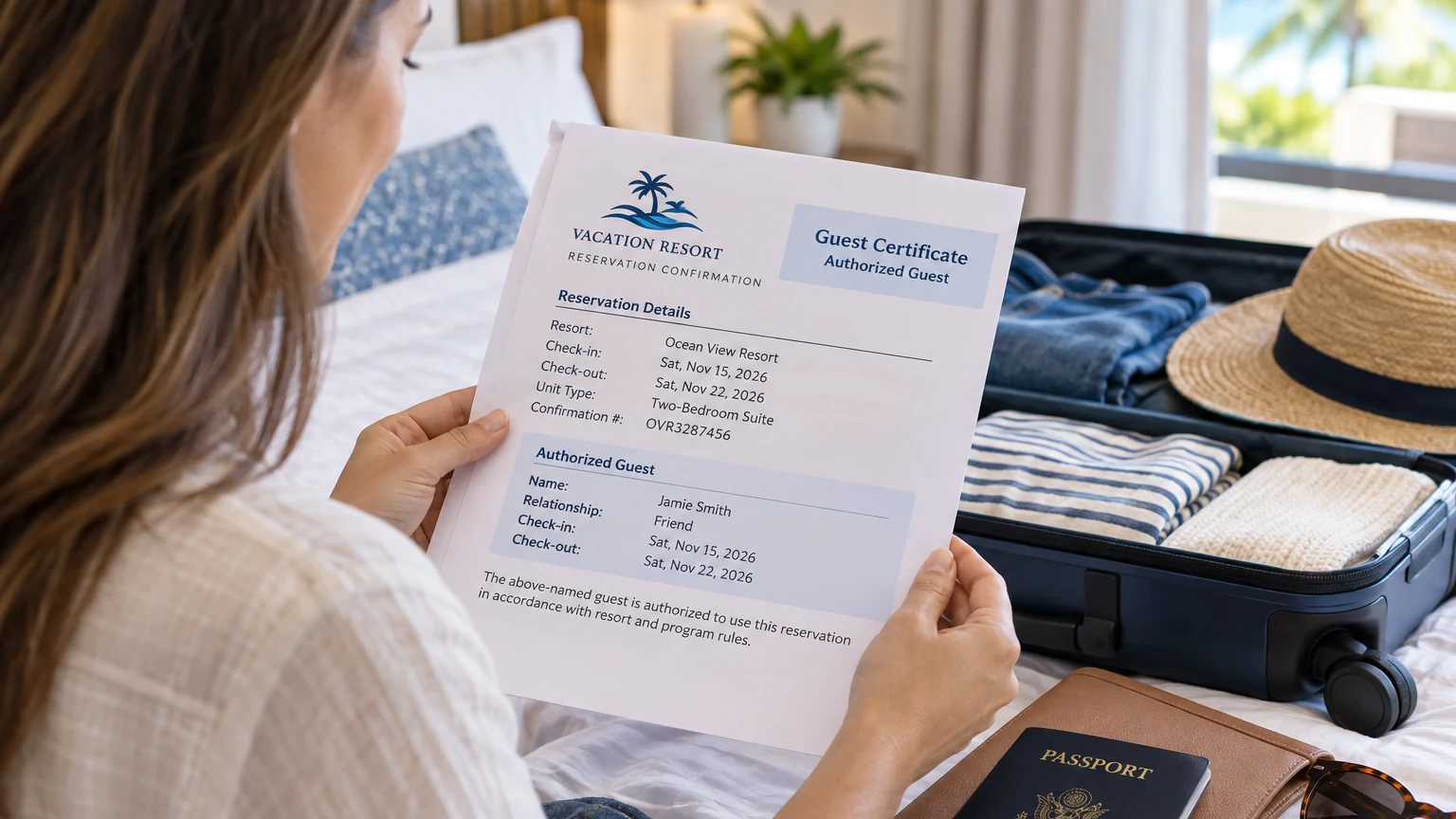
A guest certificate or confirmation can help show that another traveler is authorized to use the reservation when the owner is not present.
Family & Friends
Can Family Members or Friends Use Your Timeshare?
Often, yes. A spouse, adult child, relative, friend, or other traveler may be able to use your confirmed reservation even if they are not listed as an owner.
Being related to the owner does not necessarily create automatic check-in rights. Another traveler may still need to be formally named on the reservation and satisfy identification, minimum-age, deposit, and occupancy requirements.
Allowing the same person to use the timeshare repeatedly also does not by itself make that person an owner or shift responsibility for financing, maintenance fees, assessments, or other ownership obligations.
Points Reservations
Can Someone Else Use a Reservation Booked With Your Timeshare Points?
Often, yes. You may be able to use points from your account to make a reservation for another traveler and then authorize that person as the guest.
That is different from transferring the points themselves. Some programs may permit point transfers, household sharing, or other account-level use, while others keep the points in the member’s account and simply allow another person to use a reservation booked with them.
Before booking for someone else, verify whether a guest fee applies, whether a guest certificate is required, and whether benefits tied specifically to your membership status still apply when you are not traveling.
Exchange Reservations
Can Someone Else Use Your Timeshare Exchange Reservation?
Often, yes—but an exchange reservation may have its own guest-use requirements. When the exchange company controls the reservation, simply adding a name directly with the resort may not be enough.
The exchange provider may require its own guest certificate, confirmation, fee, or advance authorization. The resort generally receives the reservation subject to the terms established by that provider.
Before Arrival
What Should Your Guest Have at Timeshare Check-In?
A valid reservation does not necessarily mean every arrival requirement has been satisfied. Before the guest leaves home, confirm both the reservation authorization and the property’s check-in requirements.
- Correct reservation name: the guest should be listed exactly as the reservation provider expects.
- Guest certificate or confirmation: bring or retain any authorization issued by the club or exchange provider.
- Photo identification: the traveler’s ID should match the authorized guest name.
- Payment card: a credit or debit card may be required for deposits, incidentals, or resort charges.
- Minimum check-in age: verify any age requirement before assigning the reservation to a younger traveler.
- Occupancy requirements: confirm the number of guests permitted in the reserved accommodation.
- Property instructions: keep any front-desk, arrival, form, or special check-in instructions with the reservation details.

Guest use can allow family members or friends to enjoy a timeshare reservation even when the owner is not traveling with them.
Guest Use vs. Rental
Can You Charge Someone to Use Your Timeshare?
Possibly—but accepting payment can move the arrangement from ordinary guest use into rental, and different rules may apply.
A reservation provider may allow a guest to check in while still restricting commercial use, public advertising, repeated rental activity, or paid use of certain reservation types. A guest certificate should not be treated as automatic permission to rent.
If payment is involved, continue with Can You Rent Out Your Timeshare? before advertising the stay or accepting money.
Where does guest use fit among the four broader ownership paths?
- Keep
- Guest use may help preserve value when you cannot personally travel but still want to keep the ownership and use its vacation benefits.
- Rent
- Paid use may be possible where the contract, resort, club, and reservation source permit it. Guest authorization alone should not be treated as rental permission.
- Sell
- Resale may deserve consideration when the ownership no longer fits and realistic buyer demand exists after financing, transfer rules, and transaction costs are considered.
- Exit
- Surrender, transfer, or another legitimate ownership-resolution path may deserve review when guest use no longer solves the underlying ownership problem and the ongoing obligation no longer fits.
Make better timeshare decisions.
Get practical, independent TTCA guidance on ownership value, booking, guest use, rental, transfer, resale, and exit decisions.
My Take
I Would Treat Guest Authorization as a Reservation Rule, Not an Ownership Change
The biggest mistake is assuming that because someone else can use the vacation, that person now has rights to the ownership—or that the stay can automatically be rented. Those are separate questions.
I would first identify who issued the reservation, follow that provider’s guest-use process, and then confirm what the resort expects at arrival. If the real goal is to accept payment, give the timeshare away permanently, or change ownership, move to the rules for that specific transaction rather than treating guest use as a shortcut.
Frequently Asked Questions
Timeshare Guest Use FAQ
Does the timeshare owner have to be present at check-in?
Not always. Many programs allow another authorized traveler to check in without the owner present. The guest may need to be named on the reservation or have a guest certificate, confirmation, or other authorization before arrival.
Can my child or another family member use my timeshare?
Often, yes. An adult child, spouse, relative, or other family member may be able to use the reservation without becoming an owner. They still need to follow the guest and check-in rules that apply to that reservation.
Can a friend use my timeshare without me?
Often, yes, provided the program permits guest use and your friend is properly authorized before check-in. A copy of the reservation alone may not be sufficient if the provider requires the traveler to be formally added.
Do I need a guest certificate for someone else to use my timeshare?
It depends on the program and reservation source. Some direct reservations may only require the guest’s name to be added, while certain clubs or exchange reservations may require a formal guest certificate or guest confirmation.
Can someone else use a timeshare reservation booked with my points?
Often, yes. You may be able to use points from your account to make a reservation for another traveler. That does not necessarily mean you can transfer the points themselves or give the guest access to your membership account.
Can someone else use my timeshare exchange reservation?
Often, but the exchange company may require its own guest authorization. If the exchange provider issued the reservation, verify its guest rules before assuming that adding the traveler directly with the resort is enough.
Does letting someone use my timeshare give them ownership rights?
No. Allowing another person to use a reservation does not normally transfer the deed, membership, points ownership, financing responsibility, maintenance fees, or other obligations associated with the timeshare.
TTCA Decision
Guest Use Usually Changes Who Takes the Trip—Not Who Owns the Timeshare
Another person can often use a timeshare reservation without the owner present, but the traveler must follow the guest-use rules attached to that specific reservation.
Direct reservations, club reservations, points bookings, and exchange stays may not use the same authorization process. The guest should also satisfy the resort’s normal arrival requirements.
Guest authorization does not transfer ownership and should not be treated as automatic permission to rent. Identify who controls the reservation, complete that provider’s guest process, and confirm the resort’s check-in rules before the trip.
Continue From Here
Choose the Next Guide Based on What You Want to Do

Can You Rent Out Your Timeshare?
Understand when guest use becomes paid rental, what rules may restrict commercial activity, and what to verify before advertising a stay or accepting payment.
How Timeshare Exchange Programs Work
Learn how exchange reservations are created and why the exchange provider may impose separate guest, booking, inventory, and fee rules.
How to Transfer a Timeshare to Someone Else
Review the steps and restrictions that apply when the goal is to permanently change who owns or holds the timeshare rather than simply authorize a guest.

Free Timeshare Self-Review
Does the Ownership Still Fit How You Actually Use It?
Use TTCA’s free Timeshare Self-Review to consider actual usage, annual costs, booking and guest-use flexibility, resale or transfer fit, and what deserves closer attention before your next ownership decision.
- Review how the ownership is being used
- Consider current annual costs
- Look at resale and transfer fit
- Identify what deserves a closer look
Private • Self-guided • Instant result. By subscribing, you’ll also receive practical TTCA timeshare guidance and updates.