
How to Cancel a Timeshare Contract: What Owners Should Know
You want the timeshare contract to end.
Maybe you signed recently and need to know whether you can still cancel.
Or maybe you have owned the timeshare for months or years and are using the word “cancel” because you no longer want the ongoing fees, loan payments, or ownership obligations.
That distinction matters.
In timeshare contracts, true cancellation is usually tied to a short rescission period after signing. If you are still inside that window, you may have a legal right to cancel — but the deadline is short, the instructions are specific, and the request usually must be made in writing exactly the way the contract requires.
After that deadline passes, the situation changes.
Many owners still say they want to “cancel” the contract, but they are usually dealing with an exit problem instead. That may involve developer surrender, deed-back, resale, transfer, negotiation, contract review, or another path depending on the ownership structure.
The more useful question is not just “Can I cancel my timeshare contract?”
It is “Am I still inside the legal cancellation window, or do I need to evaluate a post-rescission exit path?”
This guide explains what cancellation means, why timing matters, what changes after the rescission period, and what owners should verify before relying on a cancellation promise or paying outside help.
Quick Answer
Can You Cancel a Timeshare Contract?
You may be able to cancel a timeshare contract if you are still within the short rescission period after signing. That is the clearest form of cancellation, and it usually requires written notice delivered exactly as the contract requires.
If the rescission period has already passed, cancellation is usually no longer a simple legal right. Owners may still have options, but those options are typically exit paths — such as developer surrender, deed-back, resale, transfer, negotiation, or contract review — rather than a basic contract cancellation.
Before You Try to Cancel the Contract
Timeshare Cancellation Depends on Timing, Documents, and the Path You Choose.
Cancelling a timeshare contract is very different inside the rescission period than it is after the deadline has passed. Once that window closes, the next step may depend on your contract terms, loan status, account standing, sales documents, developer policies, surrender options, transfer limits, resale reality, and whether an exit-company claim is actually realistic. Before you send a cancellation letter, stop paying, or hire someone to cancel the contract, the Timeshare Decision Intelligence Report™ helps organize your ownership details and realistic next-step pathways.
Want a clearer read before trying to cancel your timeshare contract?
Review the Report Option Or continue reading belowCancellation and Exit Are Not the Same Thing
The word “cancel” gets used loosely in timeshare situations.
A recent buyer may mean, “Can I undo the contract before the deadline?”
A long-time owner may mean, “Can I get out of this ownership, stop the fees, and end the obligation?”
Those are not the same problem.
True cancellation usually refers to the rescission period shortly after signing. After that period closes, the owner may still have options, but those options are usually forms of exit rather than simple cancellation.
That distinction matters because the wrong word can lead to the wrong expectation.
Important Distinction
Cancellation Is Usually a Deadline-Based Right. Exit Is a Structure-Based Problem.
During the rescission period, cancellation may be available if the owner follows the contract’s instructions on time. After that window closes, the question usually shifts to exit options such as surrender, deed-back, resale, transfer, negotiation, or contract review. Those paths depend on the ownership structure, loan status, fees, account standing, and developer policies.
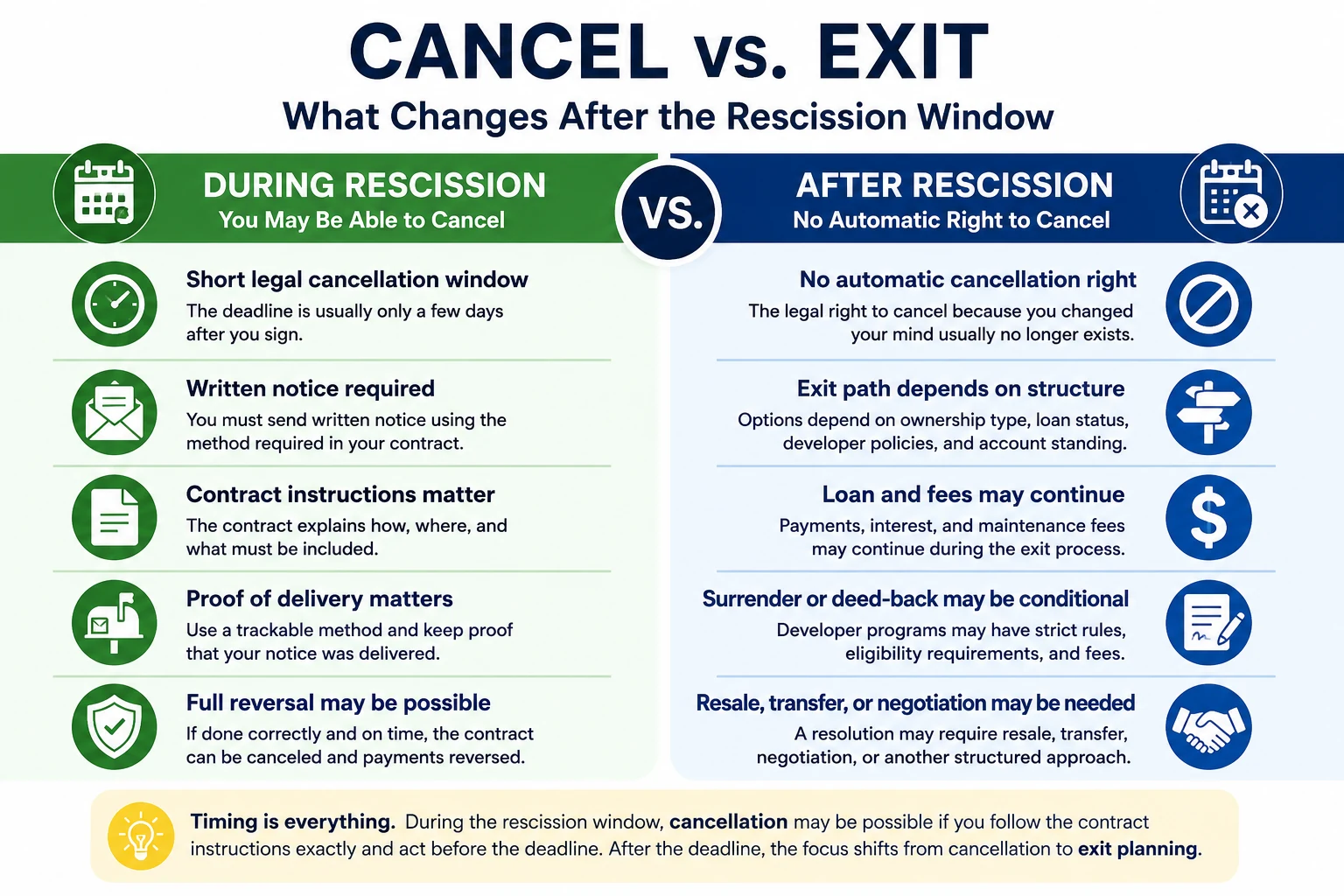
During the Rescission Period vs. After the Rescission Period
Not every owner who says “I want to cancel” is in the same position.
The first question is whether the legal rescission window is still open. If it is, the owner may be dealing with a true cancellation right. If it has passed, the owner is usually dealing with a broader exit problem.
Recent Purchase
During the Rescission Period
This is usually the clearest form of timeshare cancellation. The owner may have a legal right to cancel if the written notice is sent before the deadline and follows the contract instructions exactly.
- Short deadline after signing
- Written notice usually required
- Contract instructions matter
- Refund rights may apply
- Proof of delivery is important
Ongoing Ownership
After the Rescission Period
Once the cancellation window closes, the owner is usually no longer dealing with simple cancellation. The next step is to evaluate exit paths based on the contract, loan, fees, ownership type, and developer policies.
- No automatic right to cancel
- Loan and fee obligations may continue
- Surrender or deed-back may be conditional
- Resale or transfer may require approval
- Stopping payments can create risk
The practical difference is simple: rescission is about canceling on time. Post-rescission exit is about finding a path that actually resolves the ownership and future obligations.
What It Means to Cancel a Timeshare Contract
Canceling a timeshare contract usually means reversing the purchase during the legal rescission period.
During that short window, the owner may be able to cancel without penalty by following the contract’s instructions. That often means sending written notice to the correct address, using the required delivery method, and doing it before the deadline expires.
This is different from simply telling a salesperson, resort representative, or customer service agent that you changed your mind.
A valid cancellation usually depends on documentation. The owner should keep a copy of the cancellation letter, proof of delivery, and any confirmation from the developer or resort.
After the rescission period ends, the word “cancel” becomes less precise. The owner may still want the contract to end, but the process is usually no longer a simple cancellation. It may involve surrender, deed-back, resale, transfer, negotiation, legal review, or another exit path.
That is why the first step is always to identify where you are in the timeline.
Why Cancellation Outcomes Vary
Timeshare cancellation outcomes vary because not every owner is dealing with the same type of obligation.
Timing is the biggest factor. An owner still within the rescission period may have a clear cancellation right. An owner outside that window may have to evaluate other paths.
Loan status can also change the outcome. If the purchase was financed, canceling or exiting the ownership does not always automatically resolve the loan unless the cancellation, rescission, surrender, or settlement terms clearly address it.
Account standing can matter too. Some developer surrender or deed-back programs may require the loan to be paid off, maintenance fees to be current, and the account to be in good standing before the request is reviewed.
Ownership structure can also affect the path. A deeded week, points-based ownership, right-to-use membership, or travel club agreement may have different transfer rules, surrender options, and limitations.
This is why two owners who both say they want to “cancel” may have very different next steps. One may need to send a rescission letter immediately. Another may need to compare exit paths because the cancellation window closed long ago.
Owner Risk
Missing the Rescission Window Changes the Rules
Once the rescission period expires, canceling a timeshare contract is usually no longer a guaranteed right. The owner may remain responsible for loan payments, maintenance fees, dues, assessments, and other contract obligations until a valid exit path is completed. Stopping payments or relying on a cancellation promise without written confirmation can create collections, credit, foreclosure, or legal risk.
Free Ownership Review Preview
Not Sure What Matters Most in Your Timeshare Situation?
Timeshare decisions can depend on several factors at once, including ownership type, loan status, annual fees, usage fit, transfer rules, surrender options, resale difficulty, and account standing. The free Ownership Risk Profile™ Preview can help you identify which issues may deserve closer attention before you choose a next step.
Want a quick read on your ownership factors?
Try the Free Preview Free preview • Educational decision support • No exit-company sales pitchWhat to Confirm Before You Try to Cancel
Before you send a cancellation request, pay an outside company, or stop making payments, confirm where you are in the timeline.
If you are still inside the rescission period, the priority is speed and accuracy. Follow the contract’s cancellation instructions exactly, use the required delivery method, and keep proof that the notice was sent on time.
If the rescission period has passed, the priority shifts. You need to understand what options are still available and what obligations remain active.
That means reviewing the contract, loan status, maintenance fee balance, account standing, transfer rules, surrender or deed-back availability, and whether any written release would actually end the ownership.
Action Step
Match Your Next Step to Your Cancellation Timeline
Before taking action, determine whether you are still inside the rescission period or already past it. The right next step depends on timing, contract instructions, loan status, account standing, and whether a true cancellation right still exists.
Find the rescission deadline in the contract immediately.
Follow the written cancellation instructions exactly if the deadline is still open.
Keep copies of the cancellation letter, delivery proof, and all responses.
If the deadline has passed, confirm whether loan payments, fees, or account balances remain active.
Ask whether surrender, deed-back, resale, transfer, or negotiated resolution is available.
Do not rely on a cancellation, surrender, or exit promise unless the terms are confirmed in writing.
Quick win: If you recently signed, treat the rescission deadline as urgent. If the deadline has passed, stop asking only “Can I cancel?” and start asking which exit path could actually resolve the ownership.
What If the Cancellation Window Has Passed?
If the rescission period has already passed, the timeshare contract usually remains active.
That does not mean there are no options. It means the problem has changed.
Instead of a simple cancellation right, the owner may need to evaluate exit paths based on the contract, loan balance, maintenance fees, developer policies, transfer rules, and account status.
Possible paths may include developer surrender, deed-back, resale, transfer, negotiated resolution, or legal review if there are contract or sales-practice concerns. But those paths are not the same as rescission. They may involve requirements, delays, fees, losses, or approval steps.
This is also where owners need to be careful with third-party cancellation promises.
A company may use the word “cancel,” but the real question is what process they are using and whether it actually resolves the ownership, loan, fees, and future obligations. A promise to cancel is not the same as a written release, approved transfer, completed surrender, recorded deed-back, or confirmed rescission.
If the deadline has passed, the safest next step is to identify what obligations remain and which exit paths are realistically available before stopping payments or paying outside help.
Owner takeaway: If you are still inside the rescission period, cancellation is about speed, accuracy, and proof. If the deadline has passed, the issue is no longer simple cancellation — it is choosing an exit path that actually resolves the ownership and future obligations.
❓Frequently Asked Questions
These questions come up often when owners are trying to understand whether they can cancel a timeshare contract, whether the rescission period still applies, and what options may remain after the deadline passes.
Bottom Line
Canceling a timeshare contract depends first on timing.
If you are still within the rescission period, cancellation may be possible if you follow the contract instructions exactly and act before the deadline. That is the clearest form of timeshare cancellation.
If the rescission period has passed, the problem usually changes from cancellation to exit planning.
At that stage, the owner may need to evaluate developer surrender, deed-back, resale, transfer, negotiation, contract review, or another path based on ownership structure, loan status, maintenance fees, account standing, and developer policies.
Before relying on a cancellation promise, stopping payments, or paying outside help, confirm whether you are still inside the legal cancellation window — and if not, what exit path could actually resolve the ownership and future obligations.
The Wrong Timeshare Exit Move Can Cost More Than the Problem You’re Trying to Solve.
Stopping payments, hiring an exit company, chasing resale promises, requesting a surrender, or transferring ownership can all lead to very different outcomes depending on your contract, loan status, fees, account standing, documents, and developer rules. The Timeshare Decision Intelligence Report™ helps organize those details so you can see which paths appear realistic before you commit to the wrong move.
Get the Timeshare Decision Intelligence Report™ Customized ownership review • Decision-support report • No exit-company sales pitchIndependent decision support. This is not legal advice, contract cancellation, an exit service, a resale service, lender negotiation, or a promise that your timeshare can be exited.
Related Guides
If you are trying to understand whether a timeshare contract can still be canceled, these guides can help you compare the deadline-based cancellation path with broader exit options.
Timeshare Rescission Period: Can You Cancel a Timeshare After Signing?
Start here if you recently signed and need to understand whether you are still inside the short legal cancellation window.
Can You Cancel a Timeshare After the Rescission Period?
Review what may still be possible after the legal cancellation window has passed and why the issue usually shifts from cancellation to exit planning.
How to Get Out of a Timeshare: Legal and Practical Options
Compare broader exit paths, including rescission, resale, transfer, deed-back, surrender, negotiated resolution, and structured review.
What Is a Timeshare Deed-Back Program?
Learn how developer surrender and deed-back programs may work, who may qualify, and why they are different from canceling a contract.
Can You Exit a Timeshare Without Ruining Your Credit?
Understand how different exit paths may affect credit risk, especially if payments stop, fees go unpaid, or the account moves into collections.