
Timeshare Ownership-Change Guide
How to Remove Someone From a Timeshare Deed or Ownership
Removing someone’s name from a timeshare is rarely a simple account edit. It may require transferring or releasing that person’s ownership interest—and updating several records that create responsibility.
A deed, vacation-club membership, resort account, maintenance-fee record, and financing agreement may all be handled separately. Divorce papers, a quitclaim deed, or an internal transfer form may begin the change without completing every required step. This guide helps you identify which records must change before someone can reasonably be treated as removed from the ownership and its future obligations.
Verify Every Record
Four questions shape a complete name removal
The correct process depends on how the ownership and financial obligations are structured.
- Is the timeshare deeded, points-based, trust-based, or membership-based?
- Whose names appear on the ownership, loan, and maintenance-fee records?
- Which signatures, approvals, payments, recording, or transfer steps are required?
- What written proof will confirm who was removed and when responsibility ended?
Changing one document does not automatically update every obligation. Confirm the ownership, account, fee, and financing records separately.
About this guidance: Timeshare Travel Club Authority’s guidance draws on experience with deeded and non-deeded ownership changes, co-owner transfers, divorce and estate documents, resort and developer approvals, lender requirements, maintenance-fee accounts, notarization, recording, and written releases. Requirements can vary by ownership structure, contract, developer, resort, jurisdiction, loan status, account standing, reason for the change, and required owner consent, so owners should verify every record and obligation that must be updated before treating a name removal as complete.
Before You Start the Ownership Change
Removing a Name May Affect More Than the Deed
Divorce documents, transfer forms, recorded deeds, resort accounts, financing, maintenance-fee records, and membership rules may all affect whether someone is truly released. The Timeshare Decision Intelligence Report™ helps organize the ownership documents, account status, transfer restrictions, financial exposure, and verification questions that may need to be resolved before paperwork is signed.
Need a clearer view of which records and obligations may be involved?
Review the Report Option Or continue with the ownership-change steps belowImportant Distinction
Removing a Co-Owner Is Often a Partial Ownership Transfer
A person usually cannot be removed simply by deleting a name from the account. Their ownership interest may need to be transferred, released, assigned, or retitled to the remaining owner through the process required for that ownership structure.
This differs from transferring the entire timeshare to a new owner . The ownership may remain active, but the deed, membership, account, loan, and fee records must clearly show who continues to hold the rights and responsibilities.
Start by Identifying the Ownership Structure
Before preparing a quitclaim deed, transfer form, divorce document, or account-change request, confirm how the timeshare ownership is legally structured.
Some timeshares involve a recorded real estate interest. Others are built around points, trust interests, right-to-use agreements, or vacation-club memberships that are managed through internal company records.
Review the deed, purchase agreement, membership documents, and most recent account statement for terms such as:
- Deeded ownership
- Fee-simple interest
- Undivided interest
- Points ownership
- Trust-based ownership
- Right-to-use agreement
- Vacation-club membership
The ownership structure determines which party has authority to approve the change and which documents must be updated.
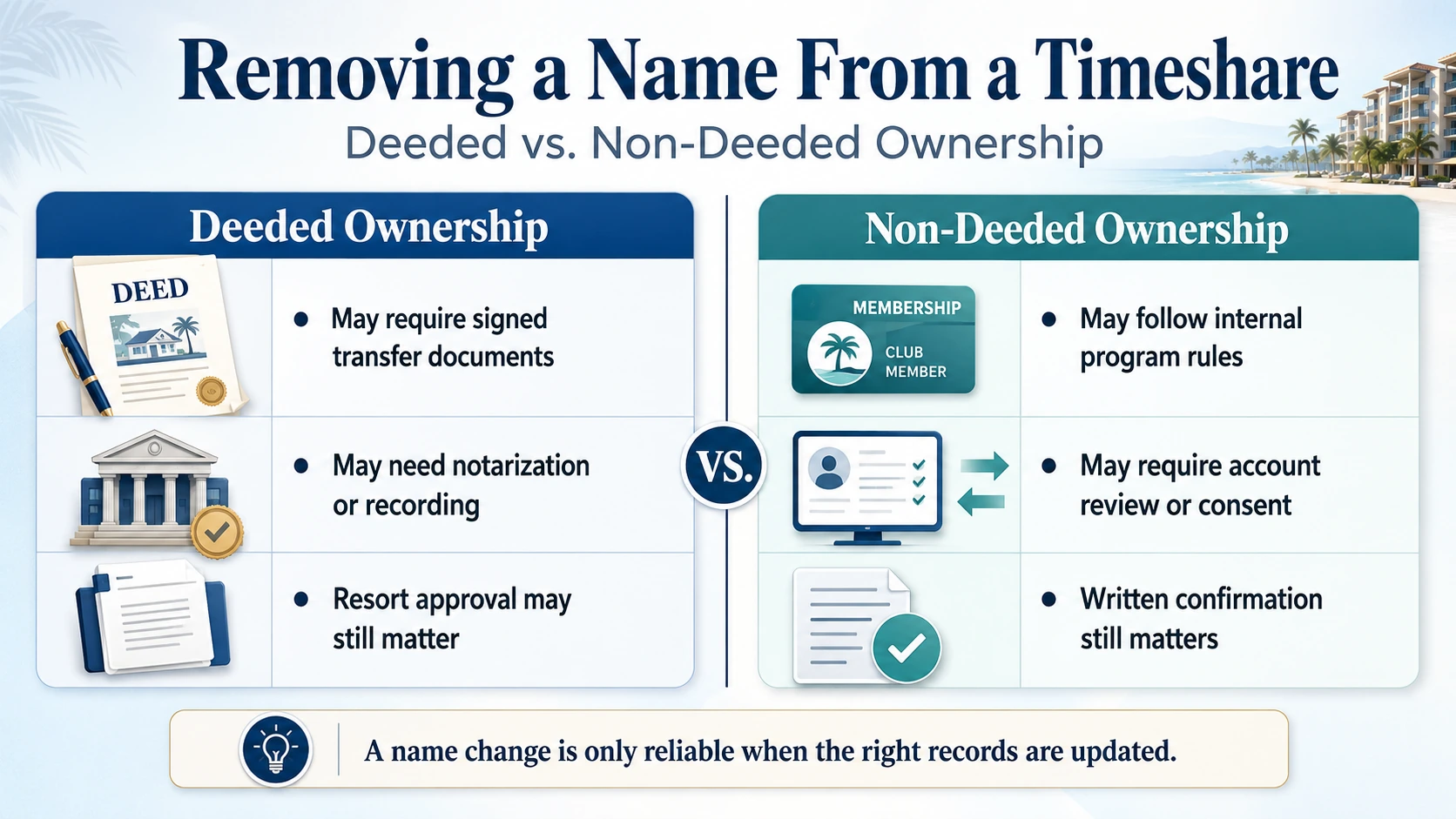
A deeded ownership may involve a title company, county recorder, resort transfer department, and lender. A non-deeded ownership may be handled through the developer, trustee, club administrator, or membership-services department.
Do not assume that the existence of points means there is no deed. Some points programs are still supported by an underlying deeded interest, while others are entirely contract- or trust-based. The ownership documents—not the way reservations are booked—should determine which process applies.
For help identifying what each deed, agreement, statement, and account record may establish, see Timeshare Ownership Documents Explained: What Each Record Tells You.
If the household holds more than one ownership or membership, first identify every timeshare contract and obligation so the deed, membership, loan, and fee records are matched to the correct product before beginning the name-removal process.
Ownership Structure
Deeded vs. Non-Deeded Timeshare Name Changes
The same request—removing one person’s name—can involve very different steps depending on whether the ownership is tied to recorded real estate title or controlled through internal club, trust, or membership records.
If the Timeshare Is Deeded
Removing one co-owner may require a formal transfer or release of that person’s ownership interest before the title record can be changed.
- May involve a quitclaim deed, warranty deed, gift deed, or another transfer document.
- Usually requires the signature of the person transferring their interest.
- May require notarization and county recording where the property is located.
- May still require resort, association, or developer review and transfer fees.
- Does not automatically remove a borrower from a separate financing agreement.
If the Timeshare Is Not Deeded
There may be no county deed to update, but the company may still control whether a listed owner can be removed from the membership or account.
- May involve points, right-to-use rights, trust interests, or club membership records.
- Usually follows the program’s internal transfer, assignment, or ownership-change rules.
- May require signed consent from all listed owners.
- May require account review, transfer fees, and current dues or maintenance fees.
- Should end with written confirmation showing who remains listed and responsible.
Practical point: Deeded ownership generally raises title and recording questions. Non-deeded ownership generally raises internal membership and account-control questions. In either case, do not rely on verbal confirmation that the change was completed.
Common Situations Where Owners Try to Remove a Name
The required process often depends on why the ownership is changing and whether everyone involved agrees.
A cooperative transfer between co-owners may be handled through routine ownership-change paperwork. Divorce, death, inheritance, or a co-owner dispute may require additional documents before the resort, lender, trustee, or title records can be updated.
Cooperative Change
When the Other Owner Agrees
This is usually the most straightforward situation, but consent alone may not complete the change. The resort, developer, trustee, lender, or transfer department may still require signed forms, identity verification, transfer fees, account review, and confirmation that maintenance fees or dues are current.
Co-Owner Dispute
When the Other Owner Does Not Agree
A person with an ownership interest generally cannot be removed simply because another owner requests it. The company may require that person’s signature or documentation establishing authority to make the change, such as a court, divorce, probate, or settlement document.
Former Spouses
After Divorce or Separation
A divorce agreement may assign the timeshare to one former spouse, but the deed, membership, account, and loan may remain unchanged until separate transfer requirements are completed. The resort and lender may each require different paperwork before removing a name.
Family and Estate Changes
Death, Inheritance, or Family Transfer
Removing or changing a listed owner after a death or family transfer may require estate documents, a death certificate, probate records, affidavits, signatures from heirs, or program-specific transfer forms. Informal family agreement may not be enough to update the official ownership records.
The reason for the change does not replace the required process. Until the appropriate deed, membership, account, and financing records are updated, a person may remain connected to the ownership even when everyone believes they have already been removed.
What If There Is Still a Timeshare Loan?
A name removal does not automatically change the financing agreement.
The deed, membership record, resort account, and loan may be maintained separately. Even when one co-owner transfers their ownership interest, the lender may continue treating both borrowers as responsible until it formally approves a release, assumption, refinance, or payoff.
Before relying on the ownership change, confirm:
- Whose names appear on the loan or financing agreement
- Whether the lender must approve the ownership transfer
- Whether the remaining owner must qualify to assume or refinance the balance
- Whether the loan must be paid in full before a name can be removed
- Whether any late payments, fees, or collection activity already exist
- What written confirmation the lender will provide after the change
A divorce decree or agreement between co-owners may determine responsibility between those individuals, but it does not necessarily change the lender’s records.
Until the lender confirms otherwise in writing, a person whose name remains on the financing agreement may still be responsible for payments—even if the deed or membership account has already been updated.
Owner takeaway: Removing someone from the deed or membership record and releasing them from a loan are separate steps. Before treating the change as complete, confirm in writing that both the ownership record and any financing agreement reflect the intended result.
What If Maintenance Fees, Dues, or Assessments Are Unpaid?
Past-due balances can delay or prevent a timeshare ownership change, even when every listed owner agrees.
A resort, association, developer, trustee, or vacation-club administrator may require the account to be current before it will process a deed transfer, membership change, assignment, or removal request.
Balances that may need to be resolved include:
- Annual maintenance fees
- Club dues
- Special assessments
- Late charges
- Collection expenses
- Transfer or administrative fees
- Closing or recording costs
Ask the company to confirm whether the account must be paid in full, whether an existing payment plan is acceptable, and whether the ownership change can proceed while the balance is disputed or in collections.
Also confirm who remains responsible for charges that arose before the effective date of the change. Removing a person from future ownership records may not erase amounts already billed while that person was listed as an owner or member.
Before submitting paperwork, request a current account statement and written confirmation of any financial conditions that must be satisfied.
System Insight
Removing a Name From One Record Does Not Update Every Obligation
- The deed, membership account, resort profile, loan, and maintenance-fee records may be maintained separately.
- Changing the ownership record does not automatically release someone from financing or previously billed amounts.
- The resort, lender, trustee, association, or membership administrator may each have separate approval requirements.
- The effective date may differ between the signed paperwork, recorded deed, internal account update, and lender release.
- Written confirmation should identify which records were changed, who remains responsible, and when each change became effective.
Can Removing Someone Stop Future Maintenance Fee Responsibility?
It may, but only after the ownership change is accepted and the account records are updated.
Signing a deed, transfer form, assignment, or divorce agreement does not necessarily end billing immediately. The resort, association, developer, trustee, or membership administrator may continue treating the person as responsible until every required approval and processing step is complete.
Before relying on the change, obtain written confirmation showing:
- Who was removed from the ownership or membership
- Who remains responsible for future fees
- How prior balances will be handled
- The effective date of the change
- Whether any loan remains separate
Keep copies of the recorded deed, transfer approval, updated account statement, and any lender or resort release. Until those records reflect the change, responsibility may continue.
Risk Point
Signed Paperwork Does Not Prove the Name Removal Was Completed
Signing a deed, transfer form, divorce agreement, or release may begin the ownership change without completing it. Recording, resort approval, lender action, trustee review, or an internal account update may still be required before the change becomes effective.
Until the relevant records show otherwise, the removed person may remain connected to future fees, loan payments, collection activity, credit exposure, or ownership disputes. Keep written proof identifying which records were updated, who remains responsible, and the effective date of each change.
When a Deed-Back or Surrender May Make More Sense
Sometimes the real problem is not that one co-owner wants their name removed. It is that no one wants to keep the timeshare.
Removing one person while leaving the ownership active may simply transfer the full responsibility to the remaining owner. That person could still be responsible for:
- Maintenance fees and club dues
- Special assessments
- Loan payments
- Reservation and usage obligations
- Future transfer or exit costs
- Any unresolved account balance
When both owners want to end the ownership, ask whether the resort, developer, association, trustee, or program administrator offers a formal deed-back, surrender, hardship, or owner-assistance process.
Eligibility may depend on factors such as:
- Whether the loan has been paid off
- Whether maintenance fees and assessments are current
- Whether the ownership is deeded or membership-based
- Whether the program is currently accepting returns
- Whether transfer, processing, or closing fees apply
- Whether every listed owner agrees and signs
A surrender is not guaranteed, and the resort may refuse the request or impose conditions. But when neither person wants to remain responsible, exploring a full ownership return may be more practical than spending time and money removing only one name while leaving the timeshare active.
What to Review Before Signing Name-Removal Paperwork
Before signing a deed, assignment, release, or ownership-change form, confirm what the document actually changes.
The paperwork should clearly identify:
- The person transferring or releasing an interest
- The person who will remain as owner or member
- The specific deed, membership, trust interest, or account affected
- Whether additional approval, recording, or processing is required
- When the change becomes effective
- Which obligations are specifically excluded from the release
Pay close attention to language stating that the document does not affect financing, previously billed fees, assessments, or other contractual obligations.
A signed document may begin the process without completing it. The Action Step below identifies the additional records and confirmations that should be verified before treating the name removal as final.
Then continue directly into the standard Action Step block.longer listed as an owner, member, borrower, or responsible party.
Action Step
Confirm Every Record That Must Change Before Removing a Name
Before signing a deed, transfer form, assignment, release, or ownership-change agreement, collect the information needed to confirm that the person can be removed from every record that may create ownership or financial responsibility.
Confirm how the ownership is structured, including whether it is deeded, points-based, right-to-use, trust-based, or membership-based.
Request the current ownership-change requirements in writing from the resort, developer, trustee, association, lender, or membership administrator.
Verify whose signatures and approvals are required, including consent from co-owners, lender approval, internal review, notarization, or county recording.
Review the financial status separately, including the loan balance, maintenance fees, assessments, late charges, transfer costs, and any collection activity.
Ask when the change becomes effective and whether signing, recording, resort approval, account processing, or lender release must occur first.
Keep written proof from every relevant party, including recorded deeds, transfer approvals, updated account statements, lender releases, and ownership confirmations.
Quick Win
Ask one direct question before signing: “Which written documents will confirm that this person is no longer listed as an owner, member, borrower, or responsible party?” If the answer covers only one record, additional steps may still be required.
Should You Use a Closing Company, Attorney, or Resort Transfer Department?
The right help depends on the ownership structure, the reason for the change, and which party has authority to update the controlling record.
For a deeded timeshare, a title company, closing company, deed-preparation service, or real estate attorney may help prepare and record transfer documents. Legal guidance may be especially useful when the change involves divorce, probate, inheritance, disputed ownership, or a co-owner who will not cooperate.
For a non-deeded ownership, the resort, developer, trustee, vacation club, or membership administrator may control the entire process. An outside company may be able to help with paperwork, but it cannot override the program’s transfer rules or force the account to be changed.
Before hiring anyone, confirm:
- Which party must approve the change
- Whether county recording is required
- Whether the provider will coordinate directly with the resort or lender
- Which documents and services are included in the quoted fee
- Whether the provider verifies completion or only prepares paperwork
- Who remains responsible if the transfer is rejected or incomplete
Be cautious of any service that promises a quick name removal without first reviewing the deed or membership documents, loan status, unpaid fees, transfer restrictions, and required approvals.
The key question is not simply who can prepare the paperwork. It is who has the authority to update the record that creates ownership and financial responsibility.
Can You Remove Yourself From a Timeshare?
Usually, you cannot remove your own name simply by asking the resort or signing an informal agreement with another owner.
If you are listed as an owner, member, borrower, or responsible party, your name generally remains connected to the timeshare until the ownership is formally transferred, surrendered, released, retitled, or otherwise changed through the required process.
The steps may depend on whether:
- Another person is willing and eligible to accept your interest
- The resort, developer, trustee, or association approves the change
- The ownership is deeded or handled through internal membership records
- A loan must be paid off, assumed, or refinanced
- Maintenance fees, assessments, and other balances are current
- Transfer restrictions or program rules limit who can take over
- Recorded documents or written account updates are still required
Allowing someone else to use the timeshare or agreeing that they will make the payments does not necessarily remove your legal or financial responsibility.
When no one wants to accept the ownership, the better question may be whether a deed-back, surrender, hardship, transfer, resale, or broader exit pathway is available—not simply how to delete your name from the account.
❓ Frequently Asked Questions
These questions address consent, deed changes, divorce, loans, non-deeded memberships, and whether removing a name actually ends responsibility.
Can I remove someone from a timeshare deed without their permission?
Usually not. A person with an ownership interest generally must agree to transfer or release that interest. When they do not agree, the resort, title company, county recorder, trustee, or membership administrator may require a court order, divorce document, probate record, settlement agreement, or other documentation establishing authority to make the change.
Is removing someone from a timeshare deed considered a transfer?
Often, yes. Removing one co-owner usually means that person is transferring, releasing, or assigning their ownership interest to the remaining owner. The timeshare stays active, but the resort or developer may still treat the change as a transfer for approval, documentation, and fee purposes.
What if the timeshare is points-based and there is no deed?
The change may be handled through internal club, trust, developer, or membership records instead of county recording. The program may still require signed consent, identity verification, account review, transfer fees, current dues, and written approval before removing someone from the ownership.
Do not assume that all points ownerships are non-deeded. Review the purchase and ownership documents to confirm how the interest is structured.
Does a divorce decree automatically remove an ex-spouse from the timeshare?
Not necessarily. A divorce decree may assign the timeshare to one former spouse, but the deed, resort account, membership record, maintenance-fee account, and loan may remain unchanged until the required transfer and account-update steps are completed.
Will a quitclaim deed remove someone from the timeshare loan?
Not by itself. A quitclaim deed may transfer an ownership interest, but it does not automatically change a separate loan agreement. The lender must confirm in writing whether the person was released, the balance was paid off, or the remaining owner assumed or refinanced the debt.
Can unpaid maintenance fees prevent a name removal?
Yes. A resort, association, developer, trustee, or club administrator may refuse or delay an ownership change until maintenance fees, dues, assessments, late charges, transfer fees, or other account balances are resolved.
Can I remove my own name from a timeshare?
Usually, you cannot simply remove yourself from the account. The ownership may need to be transferred, surrendered, released, retitled, or otherwise changed through the required process. Another person may need to accept the interest, and the resort, lender, trustee, or administrator may need to approve the change.
How do I know the name removal is complete?
Obtain written proof showing which records were updated and when the change became effective. Depending on the ownership, that may include a recorded deed, resort transfer approval, updated membership record, revised account statement, lender release, and confirmation showing who remains responsible for future fees.
Bottom Line
Removing someone from a timeshare deed or ownership usually requires more than deleting a name from the account.
Removing someone from a timeshare deed or ownership is usually a partial transfer—not a simple account edit.
A deeded ownership may require signed transfer documents, notarization, recording, resort approval, and separate lender action. A non-deeded ownership may depend on internal club, trust, or membership rules instead.
Do not treat the change as complete until written records confirm who was removed, who remains responsible, how financing and existing balances were handled, and when the change became effective.
Removing a Name From One Document May Not End Every Ownership Obligation.
Deeds, membership records, loans, maintenance-fee accounts, transfer rules, divorce documents, and resort approvals may all affect whether someone is truly released. The Timeshare Decision Intelligence Report™ helps organize those details, identify material risks and verification gaps, and clarify which records may need to be updated before the ownership change is treated as complete.
Get the Timeshare Decision Intelligence Report™ Customized ownership review • Decision-support report • No exit-company sales pitchIndependent decision support. This is not legal advice, deed preparation, title work, contract cancellation, an exit service, a transfer service, lender negotiation, or a promise that a person can be removed from the ownership.
Related Guides
These guides can help with transfer, inheritance, surrender, resale, and broader exit questions.
Ownership Transfers
- What Happens If You Inherit a Timeshare?
Review estate, fee, transfer, and heir-responsibility issues.
Surrender and Exit Options
- Timeshare Deed-Back Programs: What Owners Should Know
Learn how eligibility, loans, fees, and account status affect deed-back requests. - How to Exit a Timeshare or Travel Club
Explore surrender, transfer, resale, developer programs, and other exit pathways. - Timeshare vs. Travel Club: Which Is Easier to Exit?
Compare how ownership structure, contracts, financing, and transfer rules affect exit difficulty.
Resale Considerations
- Why Are Timeshares So Hard to Sell?
Understand how weak demand, fees, restrictions, and lost benefits affect resale.